POSSIBLE BOOKS: Carl Gustav Jung: The Collective Dream, Part 3
Neurotic and Psychotic Analogs
The particular expressions of a vision, Jung tells us, can never exhaust the possibilities of that vision: “What is essential in a work of art is that it should rise far above the realm of personal life and speak from the spirit and heart of the poet as man to the spirit and heart of mankind. When a form of ‘art’ is primarily personal, it deserves to be treated as if it were a neurosis.” Dante’s presentiments are clothed in images that run the gamut of Heaven and Hell; Goethe brings in the Blocksberg and the infernal regions of Greek antiquity; Blake invents for himself indescribable eternal figures. In Gerard de Nerval’s posthumously published prose poem Aurelia, the manuscript of which was found on the poet’s body after his suicide, Jung unfolds a classic account of vision and psychosis proceeding in tandem. Nerval relates the history of his anima, and at the same time his psychosis, in a sequence of fantasy experiences that are largely descriptions of archetypal figures. The natural process of coming to terms with the unconscious which Nerval transfigures into poetry is the same process that occurs in the initial stages of certain forms of schizophrenia. Jung named it the “transcendent function” because it represents a function based on real and “imaginary” data. The transcendent process itself is a work that involves both action and suffering.

In James Joyce’s Ulysses, too, Jung saw a suspicious resemblance to schizophrenic mentality, but, again, not the stereotyped and repetitious expressions that are characteristic marks of the compositions of the insane:

Joyce’s inexpressibly rich and myriad-faceted language unfolds itself in passages that creep along tapeworm fashion, terribly boring and monotonous, but the very boredom and monotony of it attain a grandeur that makes the book a Mahabharata of the world’s futility and squalor.

In his amusing and confessional preface to the book, Jung calls it “a piece of technical virtuosity . . . a brilliant and hellish monster-birth” in which “every sentence rouses an expectation that is not fulfilled.” He also calls it “cubistic”—the product of a modern artist who is following a current of collective life that arises from the collective unconscious of the psyche of modern man, “who is in the process of shaking off a world that has become obsolete” (emphasis is my own).

From Jung’s two volumes of professional responses to the fantasies of his patient and analysand, Miss Miller, a young American literature student whose tour of Europe touched off a bout of schizophrenia, we have received several of Jung’s most detailed commentaries. There are forty pages on Longfellow’s “Hiawatha” and two pages on the famous refrain of Poe’s “The Raven,” a poem whose atmosphere anticipates the fate that befell Miss Miller: spiritual benightedness. Reference to the neurotic woman’s desire to stand aside from the dangerous struggle for existence drew from Jung seven pages on the symbology of the mortals, the angels, and the passion in Lord Byron’s unfinished poem “Heaven and Hell.” Beside Byron’s poem appears the sonnet “Mon reve familier” from Paul Verlaine’s Poemes saturniens (1806), a beautiful expression of desire for a mother’s embrace, with a few lines of commentary.

Jung did more than cite the literary analogues of neurosis and psychosis and interpret their contents. He also theorized on their form. The real value of Jung’s two works on psychological types and poetry (“Schiller’s Ideas on the Type Problem,” “The Type Problem in Poetry”) is the exposition of his formal theory, although this is not readily apparent. These two articles on their face present poets and their works categorically to exemplify a psychological theory; concerned neither with the fundamental purpose of poetry nor with the basic aesthetic instinct, they investigate “style” or “expression” more than they do symbols and archetypes. The rather extensive commentary on Schiller emphasizes Jung’s debt to that poet’s concept of the sentimental and the naive, which anticipates and approximates his own concept of introverted and extraverted types. In Jung’s view, Schiller’s poems, and most of his plays, give us a good idea of the introverted attitude: they are material mastered by the poet’s conscious intention. In these discussions, Homer is always tied to Schiller, who considered Homer a perfect example of the “naive” poet. Of types and literary criticism, Jung has this to say:

We must bear in mind these two entirely different modes of creation [the introverted and the extraverted, the psychological and the visionary] . . . for much that is of the greatest importance in judging a work of art depends upon this distinction.

Many of the critiques of the representative authors arranged in this collection are drawn from The Spirit in Man, Art, and Literature, The Symbolic Life, Symbols of Transformation, and Psychological Types (CW, Vols. 15, 18, 5, and 6, respectively) in complete, or nearly complete, form. Among these critiques are the handful of introductions that Jung wrote for literary works, including Linda Fierz-David’s interpretive study of Francesco Colonna’s Dream of Poliphilo. The Holderlin commentary is typical of Jung’s critiques on major authors and their works. Jung’s twenty-page commentary on Holderlin, which composes the first half of “The Sacrifice” (CW, Vol. 5, Chap. VIII, pp. 397–414), analyzes the pathological ecstasy and apocalyptic vision of nearly a dozen of Holderlin’s poems. English translations of the poems by Hamburger and Leishman appear in the text. To the main article are joined brief commentaries from Jung’s other volumes; these are included as endnotes. The articles on Schiller and Longfellow’s “Hiawatha” are also of this kind.

Other critical articles are formed of brief excerpts, some almost little anthologies in themselves. Such, for instance, is the one on Dante and the Divine Comedy: More than twenty brief notes on the medieval Italian visionary, originally scattered through ten volumes written by Jung over forty years, have been synthesized into a single composite article. The inclusion of Jung’s full lecture on Gerard de Nerval’s Aurelia no doubt would have enriched this volume; unfortunately, the lecture exists only as an uncorrected twenty-four page typescript of a stenogram in the Jung archives and has never been translated into English; the one-page abstract by Jung that does appear in this volume discloses the lecture’s argument.


< PART 4 >


POSSIBLE BOOKS: Carl Gustav Jung: The Collective Dream, Part 2

Modes of Creation

The creative process of the poet, so far as Jung was able to follow it, consists in the unconscious activation of an archetypal image and its elaboration into a finished work. By giving it shape, the poet translates it into the language of the present and so makes it possible for us to find our way back to the deepest wellsprings of life. Primordial images, numerous in themselves, appear in works of art or in the dreams of individuals only when they are called into being by the waywardness of the general outlook; they are activated, one might say, “instinctively”; they come to light to restore the psychic equilibrium of the epoch. In dreams we can see this process quite clearly: The dream picture is “symbolic”; it states the situation indirectly “by means of a metaphor.” The metaphor is not a deliberate disguise but, quite simply, a formation of emotionally charged language that reflects the deficiencies in our understanding. The similarity of the personal dream to the collective dream is made clear enough by Jung in a single sentence: “A great work of art is like a dream; for all its apparent obviousness it does not explain itself and is never unequivocal.”

The creative impulse, according to Jung’s theory, arises in the poet from the unconsciousness—strong, capricious, and willful. The process of creation is a living thing implanted in the human psyche. In the language of analytical psychology, this living thing is an autonomous complex, a split-off piece of the psyche that leads a life of its own outside the hierarchy of consciousness. The nascent work of art is a psychic formation that remains unborn or subliminal until its “energy-charge” is sufficient to carry it over the threshold into consciousness. The energy needed for such a transformation is naturally drawn from the consciousness of the poet, unless the bearer of that consciousness happens to identify with the complex and loses himself. Once born, the work of art can be neither inhibited nor voluntarily reproduced; it can only be perceived: therein lies its autonomy.

Representative Authors
Psychological Authors, Significant Authors, and Visionary Authors
“The Work of Art” (1930), excerpted from Psychology and Literature, is the essay which opens this collection. It is Jung’s unofficial prologue. In it Jung distinguishes the two modes of literary creation, the psychological and the visionary. These two modes of creation are treated again more thoughtfully in the second essay, “On the Relation of Analytical Psychology to Poetry” (1922). Straight off, Jung distinguishes from the “psychological” those works of literature in which the author does not give a psychological interpretation of his characters. To this class of significant authors belong E. T. A. Hoffman’s tales, with their scurrilous but magnificent imagery, the fantastic romances of Pierre Benoit, English fiction in the manner of Rider Haggard, including that vein that Conan Doyle exploited to yield the detective story, H. G. Wells’s novels of inner transformation and mythical compensation, and Melville’s Moby Dick.

Countless literary works belong, on the other hand, to the class of psychological creations: novels of love, environment, family, crime, and society; didactic poetry; the larger number of song lyrics; and drama, both tragic and comic. No obscurity surrounds their themes: the themes repeat themselves millions of times in daily life and are responsible for the monotony of their manifestations in social creations like the police court and the penal code. Jung calls their mode of creation “psychological” because nowhere do these works transcend the bounds of psychological intelligibility. The author of the so-called psychological novel, to whom the layman often goes for “psychology,” attempts to reshape his material consciously in order to raise it from the level of crude contingency to that of psychological exposition and illumination.

The procedure of conscious tampering with the messages of the unconscious is not restricted to the novel. Jung points to this procedure again when he compares the first and second parts of Goethe’s Faust drama:

The two parts of Faust demonstrate by way of extremes the profound distinction between the two modes of literary creation. . . . The love-tragedy of Gretchen explains itself; in the second part, the richness of the imaginative material so overtaxes the poet’s formative powers that nothing is self-explanatory. It is a strange something from the hinterland of man’s mind that suggests the abyss of time or evokes a super-human world of contrasting light and darkness.

This visionary mode of artistic creation exemplified in the second part of Faust, he says, “astonishes us, confuses us, puts us on our guard, even disgusts us. . . and we demand explanations and commentaries.”

Jung finds such vision also in The Shepherd of Hermas, in Dante, in Nietzsche’s Dionysian exuberance, in Spitteler’s Olympian Spring, in the paintings and poems of William Blake, and in Jacob Boehme’s philosophic and poetic stammerings. In the chapter on Dante, Jung shows us how the poet has smoothed out the approach to the vision by cloaking it in historical facts. Other writers, and Jung enumerates them, use the story as the primary means of giving expression to significant material. This much Jung makes clear: While we, in our everyday lives, strive to construct a safe and manageable world in which natural law holds the same place that statute law holds in a republic, the poets in our midst now and then glimpse spirits, demons, and gods and have presentiments of incomprehensible happenings in the pleroma. They, and Jung, see something of the psychic world that once struck terror in the primitive of antiquity and still strikes terror in a part of ourselves.

Visions of Love
The reverberations of the initial love-experience, expressed in The Shepherd of Hermas, in the Divine Comedy, and in the Faust drama is shown by Jung to be completed and fulfilled by a vision. The author of Hermas, Dante, and Goethe can be taken as three steps in a sequence that stretches across nearly two thousand years of human development; in each we find the personal love-episode to be not only connected with the weightier visionary experience but frankly subordinated to it. It seems as if the love-episode served as a release, as if the personal experience were nothing but the prelude to the all-important “divine comedy.” This is the point: to reduce artistic creation to merely personal factors takes us away from the psychological study of the work of art and confronts us with the psychic disposition of the poet himself. The work of art is something in its own right, and the actual task is to interpret the work of art psychologically. For such an undertaking, it is essential to give serious consideration to the basic experience that underlies it—namely, to the vision.


< PART 3 >


POSSIBLE BOOKS: Carl Gustav Jung: The Collective Dream, Part 1

From POSSIBLE BOOKS


Carl Gustav Jung: The Collective Dream: The Literary Criticism of C.G. Jung, 1912–1961.

EDITOR’S PREFACE

Out of the work of a lifetime has grown a complete anthology of literary criticism and, flowering at its center, an enchanting theory of literature. To introduce it to the reading public, and to justify it, is the purpose of this preface. The grandness of the task prevents me from heeding the otherwise good advice of Quevedo to keep a preface brief. My purpose requires that I employ instead the French mode, in which a book of one thousand pages is introduced by a preface of one hundred, without, I hope, the tiresome characteristics of that genre: structureless critique and self-centered analysis.

Until now this book has been largely unrecognized, embedded in the mountain of Carl Jung’s Collected Works. (See Supplement 1) A petal of it was discovered by me through serendipity, the entire flower through many hours of reading and research. The author himself was probably not entirely aware of its existence. Ultimately, it is immaterial whether Jung recognized it himself or not. A corollary of his literary theory is that what an author has to say about his own work is often far from being the most illuminating word on the subject: a work is an author’s fate, which is best left to the judgment of others. Jung, like the visionary poets and the significant novelists he examined, was essentially the instrument for his work and subordinate to it.

It is a principle of Jung’s psychology that the human psyche is the womb of all human arts and sciences. It is a principle in the psychological study of art that a product of the psyche is something in and for itself. Jung recognized both principles as valid, and he explored the perspectives of both. Yet all of Jung’s literary commentaries were the results of clinical encounters and were written for professional purposes. This collection has one other limiting factor. The basically earthy nature of Jung the Swiss has shown a marked predilection for literature written in languages and composed by human natures close to his own. Never in the twenty volumes of his collected works do we find mention of Franz Kafka’s atrocious fantasies of behavior and feeling; never the negative themes of Stephane Mallarme or the dark splendors of Charles Baudelaire and Thomas de Quincey, who dramatized their unhappiness in famous volumes; neither the admirable plots of Henry James nor the mortal chaos of the Russian novel; neither the joyous, semidivine hero of Leaves of Grass created by the man of letters Walt Whitman nor the resigned and insipid days remembered by Marcel Proust.

The commentaries Jung made on works of dubious aesthetic merit, which often held great interest for him as a clinical psychologist, are also excluded from this anthology by design. This collection of essays represents solely Jung’s attention to familiar works of world literature, primarily those of the West, and primarily those in verse. Noticeably absent from this anthology as well are many of Jung’s voluminous commentaries on Goethe and his beloved Faust. To include all of his personal feelings and insights here would have thoroughly changed the character of the present volume and trebled its length. These have been retained for publication in a separate companion volume, Goethe According to Faust. Jung’s important theoretical works on mythic archetypes written in collaboration with Karl Kerenyi are also absent. The scope of these monumental works disqualifies them, or even parts of them, from entry into this volume: folktales, cultural myths, and epic song cycles represent the expressions and spiritual excursions of collective authors; that is, whole cultures, not individual authors.

The commentaries that appear here on the vast literatures of alchemy, philosophy, and science are exceptional. Those that are included are short forewords written by Jung for books of other psychologists that happen to approach literary themes directly. In one, Jung absolves fantasy, and, by extension, fantasy literature, of its reputation as an unnatural and morbid activity (see the foreword to Wickes, The Inner World of Childhood). In another, he vindicates the function of poetry and recounts the archetypal and redemptive process represented in drama (see the foreword to Jung, Configurations of the Unconscious). In a third, he praises Cornelia Brunner’s discussion of Rider Haggard, the Victorian spinner of yarns who developed the motif of the anima in the purest and most naive, if not the most aesthetic, form in his novel She (see the foreword to Brunner, The Anima as a Problem in Man’s Fate).

The individual chapters of this book do not require extraneous elucidation; the method of their arrangement, however, does. A careful disorderliness, the method suggested by the narrator of Moby Dick, is the blameless order of this volume. The world proposed by this book of literary criticism is not systematic, and neither is Jung’s manner of studying it. The chapters of Part I are sequestered in three major sections. The first section is theoretical and defines his views on the relation of analytical psychology to poetry. The second section examines the works of particular authors for evidence of the psychic events that transpired in their creation; this section, titled “Critiques,” is by far the longest section of the book and almost a critical anthology in itself; in it individual authors are arranged not alphabetically nor chronologically but according to the mode of creation they employ or the pathological process their works resemble. The third section exposes the central archetype of Jung’s literary theory. The sequence of chapters listed in the table of contents may not appear inspired, but it is certainly not arbitrary: it constitutes an outline of Jung’s thought on modern Western literature. The format of Jung’s book portrays his aversions and recognitions. It also suitably obscures the boundaries of verse and prose. The lack of distinction made between genres adds a special texture to the collection and at the same time supports more essential distinctions. The intimate network of relations between Jung’s theories and his application of them to specific works will become fully apparent to anyone who pursues a single topic of special interest through the extensive listings in the topical index of Jung’s Collected Works. Finally, it should be mentioned that the editor has attempted to introduce each chapter and section of this book with the kind of care and understanding that Robert Bly has imparted to his charming anthologies.

Just as the first section of theoretical essays in Part I engenders the second section of critiques, those two sections together beget Part II, a statement of the essential theory behind them both: the equation of literature and dream. The necessary root of this equation, the poet who functions as dreamer, is clearly assumed. The authors who are examined individually in Part I are identified in Part II as the natural and active agents of a collective dream, a kind of congress of local representatives who speak with our voices. The poet, Jung says, has moods and a will and personal aims as a human being; but as a poet he is a “collective man,” one who carries and shapes the unconscious psychic life of mankind:

An epoch, like an individual, has its own limitations of conscious outlook, and therefore requires a compensatory adjustment. This is effected by the collective unconscious in that a poet allows himself to be guided by the unexpressed desire of his times and shows the way, by word or deed, to the attainment of that which everyone blindly craves and expects —whether this attainment results in good or evil, the healing of an epoch or its destruction. (See Supplement 2)

In this statement lies the social significance of poetry: It is constantly at work educating the spirit of the age, conjuring up the forms in which the age is most lacking.


< PART 2 >


Annual Martin Luther King, Jr. Memorial Events Planned in Reno

Reno, NV (January 2013) The Northern Nevada Martin Luther King Jr. Holiday Committee and the Nevada Clergy Association announce the 27th annual Interfaith Community Memorial Service on Sunday January 20, 2013, at 3 p.m. at the Second Baptist Church, 1265 Montello Street in Reno.This year’s program’s theme is “Moving Forward with the Dream.” The keynote speaker will be the Reverend Michael L. Randle, pastor of Second Baptist Church and president of the African-American Clergy Council of Northern Nevada.

The Reverend Onie Cooper Humanitarian Award will be presented to Elder William “Bill” Moon who serves on the Executive Committee for the Reno-Sparks chapter of the NAACP. The award will also be presented to Volunteers of America (VOA), the nonprofit organization that runs the family homeless shelters in downtown Reno. Rachelle Pellissier, regional vice-president of VOA in northern Nevada, will accept the award.

The chairman of the Martin Luther King Jr. Holiday Commission and president of the Nevada Clergy Association, Bishop Gene Savoy Jr., said, “We congratulate the recipients of the Onie Cooper Humanitarian Award for their service and dedication to helping others as we celebrate the life and legacy of a great American, especially in the context of the issues that face us today.”

On Monday, January 21, 2013, the 15th annual Community Memorial Caravan will depart Second Baptist Church at 10:30 a.m. Participants will drive a portion of the Martin Luther King Jr. Highway (I-580) to honor King. The caravan will leave the church and drive north to Stead Blvd. It will proceed south to Neil Road and then back to the church, where a reception will be held.

Events are free and open to the public. For information, call Gene Savoy Jr., President, Nevada Clergy Association and Chairman, Northern Nevada Martin Luther King, Jr. Holiday Committee at (775) 786-1800 or e-mail gsavoyjr@communityofchrist.org.


Click here to download a PDF of the event flyer.


Services for the Week of January 5, 2013


Saturday, January 5, 2013
7:09 AM NEW DIVINE SERVICE
Church of New Epiphany
Leave: 6:00
Gate: 6:50
Sunrise: 7:24
RR Gene Savoy, Jr
Concelebrant: RR Sean Savoy
Assistants:
RC Roger Weld
Rev. Ted Staver
RM Carol Ann Crabb
Organist:
RC Gary Buchanan

11:00 AM COMMUNION
Chapel of The Holy Child
RR Gene Savoy, Jr
Lector: RC Gary Buchanan
Cantor: Rev. Dorothy Kubiak
Reader: Dea. Robert Anderson
Organist: Jonathan Kanzelmeyer

6:00 PM EPIPHANY EVE BANQUET & PANNUCHES MEAL
Rectory-Abbey
RR Gene Savoy Jr.

 Sunday, January 6, 2013
7:09 AM NEW DIVINE SERVICE
Church of New Epiphany
Leave: 6:00
Gate: 6:50
Sunrise: 7:23
RR Gene Savoy, Jr
Concelebrant: RR Sean Savoy
Assistants:
RC Roger Weld
Rev. Robert Petrovich
Rev. Barbara Whitney
Organist: RC Gary Buchanan

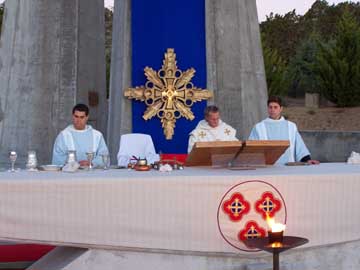
 OPEN-AIR COMMUNION
Church of Universal Theocracy                    Rev. Shinobu Uwataki
Church of the Americas                   Dea. Stephan Fuelling

Wednesday, January 9, 2013
12 N COMMUNION
Chapel of the Holy Child
Rev. Francine Petrovich
Organist: RC Gary Buchanan

Friday, January 11, 2013
9:00 AM PRAYER & FELLOWSHIP
Chapel of the Roses
Rev. Barbara Whitney


Services for December 29, 2012


Saturday, December 29, 2012
SUNRISE SERVICE SUSPENDED DUE TO INCLEMENT WEATHER
7:09 AM NEW DIVINE SERVICE

Church of New Epiphany
Leave: 6:00
Gate: 6:50
Sunrise: 7:24
RR Gene Savoy, Jr
Concelebrant: RR Sean Savoy
Assistants:
RC Roger Weld
RC Robert Petrovich
Rev. Barbara Whitney
Organist: RC Gary Buchanan

10:00 AM COMMUNION
Chapel of The Holy Child
RR Gene Savoy, Jr
Lector: RC Robert Petrovich
Cantor: Rev. Vickie Hewlett
Reader: Rev. Mike Tamburello
Organist: RC Gary Buchananan

3:00 PM CHILDREN’S TEA & BLESSING
Rectory-Abbey
Officiant: RC Elizabeth Reece
Assisting Acolyte: Sonya Savoy


Sunday, December 30, 2012
SUNRISE SERVICE SUSPENDED DUE TO INCLEMENT WEATHER
7:08 AM NEW DIVINE SERVICE
Church of New Epiphany
Leave: 6:00
Gate: 6:50
Sunrise: 7:23
RR Gene Savoy, Jr
Concelebrant: RR Sean Savoy
Assistants:
RC Roger Weld
Rev. Ted Staver
RM Carol Ann Crabb
Organist: RC Gary Buchanan


OPEN-AIR COMMUNION
Church of New Philadelphia                    Rev. Shinobu Uwataki
Church of New Qumran                    Dr. Tom Lee
Church of New Bethany                     Dea. Stephan Fuelling


Monday, December 31, 2012
7:08 AM NEW DIVINE SERVICE
Church of New Epiphany
Leave: 6:00
Gate: 6:50
Sunrise: 7:23
RR Gene Savoy, Jr
Concelebrant: RR Sean Savoy
Assistants:
RC Roger Weld
RC Robert Petrovich
Rev. Barbara Whitney
Organist: RC Gary Buchanan


Tuesday, January 1, 2013
7:08 AM NEW DIVINE SERVICE
Church of New Epiphany
Leave: 6:00
Gate: 6:50
Sunrise: 7:23
RR Gene Savoy, Jr
Concelebrant: RR Sean Savoy
Assistants:
RC Roger Weld
Rev. Ted Staver
RM Carol Ann Crabb
Organist: RC Gary Buchanan


Wednesday, January 2, 2013
7:08 AM NEW DIVINE SERVICE
Church of New Epiphany
Leave: 6:00
Gate: 6:50
Sunrise: 7:23
RR Gene Savoy, Jr
Concelebrant: RR Sean Savoy
Assistants:
RC Roger Weld
RC Robert Petrovich
Rev. Barbara Whitney
Organist: RC Gary Buchanan
 

 12 N COMMUNION
Chapel of the Holy Child
Rev. Amanda Buchanan
Organist: RC Gary Buchanan


Thursday, January 3, 2013
7:08 AM NEW DIVINE SERVICE
Church of New Epiphany
Leave: 6:00
Gate: 6:50
Sunrise: 7:23
RR Gene Savoy, Jr
Concelebrant: RR Sean Savoy
Assistants:
RC Roger Weld
Rev Ted Staver
RM Carol Ann Crabb
Organist: RC Gary Buchanan


Friday, January 4, 2013
7:08 AM NEW DIVINE SERVICE
Church of New Epiphany
Leave: 6:00
Gate: 6:50
Sunrise: 7:23
RR Gene Savoy, Jr
Concelebrant: RR Sean Savoy
Assistants:
RC Roger Weld
RC Robert Petrovich
Rev. Barbara Snyder
Organist: RC Gary Buchanan

9:30 AM PRAYER & FELLOWSHIP
Chapel of the Roses
RC Roger Weld


Joseph Asahi Roy Baptized into the Community


PHOTO: Rebecca Willis


Joseph Asahi Roy, the son of Noriko and Robert Roy, was baptized into the Community of Light in a public service held at the Chapel of the Holy Child on Saturday, December 22, 2012. The Right Reverend Gene Savoy Jr. officiated the service assisted by the Right Reverend Sean Savoy.

Godmother Elizabeth Reece and child PHOTO: Rebecca Willis

Godfather Ted Staver and child PHOTO: Rebecca Willis


During the service, the Reverend Elizabeth Reece accepted the role of Godmother and the Reverend Ted Staver accepted the role of Godfather of the child.

Noriko and Robert Roy holding their newly baptized son Joseph PHOTO: Rebecca Willis


“Religion as a Divine Communication & Healing Science”

PHOTO: Scribd.com

Dr. Gary Robert Buchanan has published a new essay on Cosolargy as a religion and communication science at Scribd.com. The eight-page essay is downloadable from the site.

Here’s how it begins:

“Etymologically, the word religion comes from the Latin religare, to reconnect. Naturally, the question must be asked, ‘To what are we reconnecting?’ Also implied linguistically is the idea that there must be a pre-existent something, a lost state of higher Consciousness, Being, Intellect, and/or Form, from which humankind has descended. In religion we refer to this something as a spiritual realm, i.e., ‘Heaven,’ or the ‘Worlds of Light,’ whence we originated or to which we aspire. If we accept this rather universally held concept, then in order to reconnect we must follow some kind of ‘system’ to re-establish that primordial connection, via a system of communication, or communion, in a logical and, yes, scientific manner.”

Read or download “Religion as a Divine Communication & Healing Science” online at Scribd.com.


Or read the PDF version here.


Heart Filled

PHOTO: Tom Fee

One whose heart

is filled with sorrows

of the past

will have less room

for the joys of the present.

Tom McFee 1960


Background Controversy on the Gospel of Judas Translation


PHOTO: Kenneth Garrett/NGS

In 2006 The National Geographic Society released the first English translation of the Gospel of Judas, a second-century text discovered in Egypt in the 1970s. The translation caused a sensation because it seemed to overturn the popular image of Judas the betrayer and instead presented a benevolent Judas who was a friend of Jesus.

In The Thirteenth Apostle, April DeConick offers a new translation of the Gospel of Judas that seriously challenges The National Geographic interpretation. Inspired by The National Geographic Society’s efforts to piece together this ancient manuscript, DeConick sought out the original Coptic text and began her own translation. She said: “I didn’t find the sublime Judas, at least not in Coptic. What I found were a series of English translation choices made by the National Geographic team, choices that permitted a different Judas to emerge in the English translation than in the Coptic original. Judas was not only not sublime, he was far more demonic than any Judas I know in any other piece of early Christian literature, Gnostic or otherwise.”

Read what April D. DeConick has to say about the original translation of the Gospel of Judas in  the New York Times Op-Ed page on December 1, 2007: “Gospel Truth”

Read what the translators of the Gospel of Judas have to say about the comments on their work made by April D. DeConick in the New York Times Op-Ed page on December 7, 2007: “The Gospel of Judas: A Word from the Translators.

Read what was written about the debate in  National Geographic News at nationalgeographic.com by Stefan Lovgren : “Judas was a Demon After All, New Gospel Reading Claims.”

Follow this link to the book The Thirteenth Gospel: What the Gospel of Judas Really Says by April D. DeConick  at Amazon.com and there *Look Inside* to read the “Preface to the Revised Edition.” You will get a good piece of the story of how the stressful translation schedule of the scholars hired by National Geographic led to important translation errors and a sensational and misguided view of what the original manuscript said.

Click here to see a PDF of the 2006 translation of the Gospel of Judas at nationalgeographic.com.

Click here to link to The Gospel of Judas, Critical Edition at Amazon.com.


links provided by Robert Petrovich