Sanctuary Water Project Progress: A Report
Since March 2011, the water project at the Red Rock Consecrated Sanctuary has made significant progress.
The importance of this five-year project cannot be overlooked. Once it is completed, development of our Sanctuary can begin in earnest and with much greater potential—putting 17 million gallons of water annually to beneficial use. Our Community has invested close to $200,000 in this project thus far and nearly 10,000 volunteer man-hours.
Phase 1
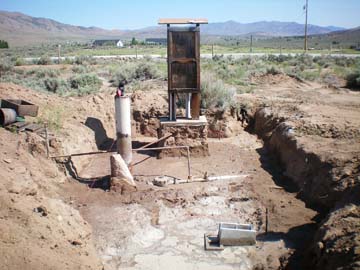
The existing well head. PHOTO: Ted Staver
Phase 1 of the water project entailed building a structure around the existing well head at the Argonaut site.
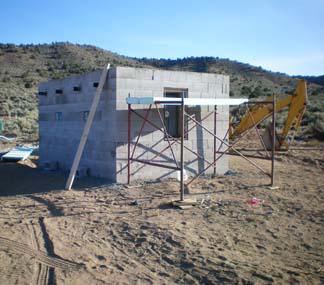
Main structure of Argonaut pump house under construction. PHOTO: Ted Staver
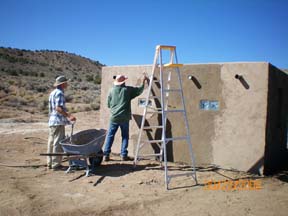
Argonaut pump house being finished with stucco. PHOTO: Ted Staver
With that completed, Church work crews were able to install the necessary electrical switches and conduit along with a high-voltage transformer for power distribution throughout the sanctuary. The Argonaut pump site was finalized with the installation of all remaining conduit, electrical wiring, service boxes, and signal wire for the control sensors. A high-voltage transformer for power distribution to a lift pump station and power distribution for future expansion was also installed.
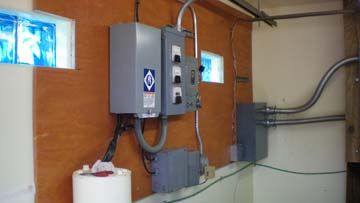
View of some of the inside electrical fittings in the Argonaut pump house. PHOTO: Ted Staver
The photos below show the trench leading to the first “pull box.” This is where wire connections are made for electrical distribution. Power cables from the Argonaut pump site to the Chapter House (a distance of almost one mile) were laid.
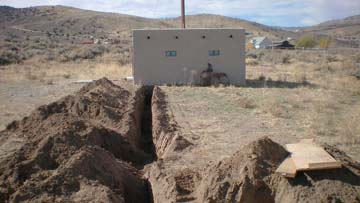
Pump house and trench to first pull box. PHOTO: Ted Staver
The pull boxes are rather large, and there is a total of 17 of these boxes stretching up to the Chapter House.
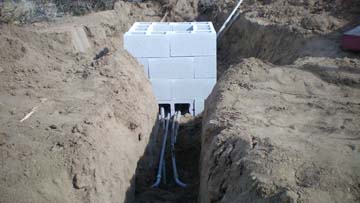
Last pull box. PHOTO: Ted Staver
The concrete pad for the lift station was poured and the housing unit put into place. Finally, the final 300 feet of trench were excavated and water pipes installed, completing the connection from the lower portion of the Sanctuary to the upper part. Two small transformers were installed in separate locations for use with smaller irrigation pumps for future expansion.
Phase 2
The second phase of the project involved the connection of the high-voltage power lines from the main pump house up to the lift pump station, and the planning and placement of the water lines from the tank site to the lift pump site. This work was performed primarily by the Reverends Ted Staver and Herman Aggenbach.
Once that was completed, a concrete pad for the lift pump housing was poured and the housing placed on it. From that point on, it was simply a matter of configuring the placement of all the electronic controls for controlling the lift pump and monitoring water levels in the tanks. The photos show that the crew managed to load a lot of things into the small housing.
The final step in this phase of the project was to acquire and install a second transformer for the lift pump station and a variable motor speed controller. A booster pump capable of producing 40 gallons per minute was also needed, as well as a 4,000-gallon water tank. (The holding capacity for the tank was raised from 2,500 gallons, as reported last year, to 4,000.) The cost of these items was between $12,000 and $15,000. Work continued once funds were raised.
Phase 2 was nearly complete at the time this article was posted. It is just a matter of weeks before the final connection of wire is made and the components are tested. The next step will be to acquire the water tank that will supply water for the lift pump and to make the final water pipe connections. The crew expects to be pumping water to the upper level of the Sanctuary by the end of August 2012.
This project has taken several years to reach this point. It represents not only the attainment of water rights for the church but also future growth for new residences because of the availability of water and power. In planning the system, the crew included means to connect wind and solar to the pumping system so as to make it an off-grid system in the hope that the Sanctuary can be totally self-reliant in the future.
It is hoped also that we will be fully utilizing the new water distribution system by mid-summer, putting to use our water resources and saving precious dollars as a result of energy savings. It also means that the indoor and outdoor vegetable gardens, which were expanded last year, can be more fully utilized.
Remodeling of another portion of the Chapter House has begun so that a fourth staff-minister can reside at the Chapter House and assist with additional landscaping and greenhouse gardening.
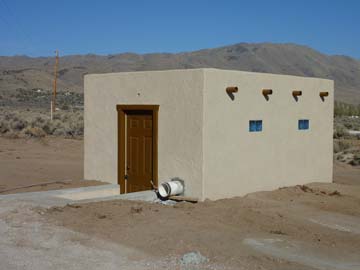
Completed pump house on Argonaut Way. PHOTO: Ted Staver