Sacred Oversee Meets on Sanctuary Water
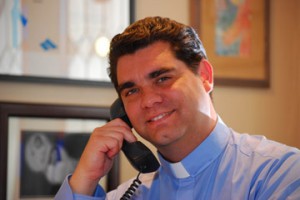
A special meeting of the Sacred Oversee of the International Community of Christ, Church of the Second Advent, was held on Wednesday, April 29, 2009, in the chambers of the Sacred Oversee, to discuss future development at the Red Rock Consecrated Sanctuary, especially as that development relates to availability of water and water rights.
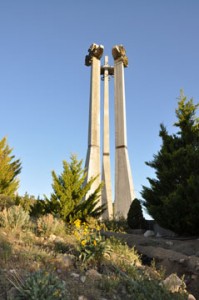
As the first matter of business, Bishop Savoy requested consensus on the next proposed project at Red Rock, the next stage of development at the Church of the Christian Churches. This project, he said, would put our water rights to use and would replace the old asymmetrical cross design with a new Second Advent Cross design. In this project, Revs. Staver and Foust would follow the new mathematical figures put down by Rev. Buchanan based on the correct gematria. It is possible to undertake this project now, Bishop Savoy said, because The Church had fulfilled the five-year federal requirements for development of the deer-feeding project and so The Church was now again free to take development of the Church of the Christian Churches to the next level.
While the federal requirements were no longer applicable to Sanctuary development, the state of Nevada has been getting stricter on water use, Bishop Savoy said, and the Christian Churches project would allow us to use our water rights within the guidelines already set. Bishop Savoy went on to explain the situation of The Church and the Sanctuary regarding its water rights and water availability. A summary follows:
Each parcel in the northland and the southland retains its own individual domestic water rights, which can be used either by drilling a well on each parcel or by having a single well on one of the parcels from which water is distributed to all the other parcels so long as it is from the same water basin.
In addition to domestic water rights, The Church has reserved to it 17.144 million gallons/year of additional water rights, which are presently distributed between two water basins: Antelope Valley, which serves the southland and half of the northland, and Biddel Flats, which serves the other half of the northland.
The primary point to this discussion of water rights is that The Church is at present not using enough water for beneficial use to keep its water rights without filing extensions, and if The Church cannot prove beneficial use for the additional water rights reserved to it, the state of Nevada has notified The Church that it will give those water rights to someone else. For the time being, undertaking the proposed Christian Churches project would allow The Church to prove beneficial use for its additional water rights; there was consensus among the members of the Sacred Oversee to undertake this project. However, questions arose regarding future water rights.
The present additional water rights of The Church are distributed over two water basins, Antelope Valley and Biddel Flats. The language of The Church’s water rights permit at present distributes those rights over these two water basins but does not indicate how much from each water basin. The state has asked The Church to determine how much of the 17.144 million gallons it wants to take from each basin so that the old combined permit can be put aside and two new permits issued in order to clarify use.
In addition, for The Church to maintain its water rights in the Biddel Flats water basin, The Church needs to drill a well in the northland that pulls water from the Biddel Flats basin. Initially, the state gave The Church until 12/27/09 to drill this well; later the state said it would give The Church until 2010 to drill the well since The Church would be unable to undertake the expense of a well while undertaking its other water projects in the southland. The decision The Church has to make is whether it wants to split use between the two water basins or put all its rights into the Antelope Valley water basin, since the state of Nevada is going to split the present permit in any case.
Following this summary of points delivered by Bishop Savoy, members of the Sacred Oversee raised questions and proposed courses of action regarding the matter of water rights. Ultimately, three basic courses of action were suggested: (1) to keep all the special use water rights in the Antelope Valley basin and give up all water rights in the Biddel Flats basin, (2) to keep nominal rights in the Biddel Flats basin and the vast majority in the Antelope Valley basin, or (3) to split the rights equally between the two basins. Suggestions (2) and (3) were made with the understanding that any claim to water rights from the Biddel Flats basin would require that The Church drill a well, meter the use, and pump water from it with proven beneficial use.
Two other questions were also raised: (1) If The Church gives up its rights to water from the Biddel Flats basin under the present permit, could The Church apply for a new water rights permit for the Biddel Flats basin? (The thought here was that by applying for a new permit, all the old extensions filed by The Church would be discounted and The Church would have the chance to tackle the problem of water rights in the northland anew.) (2) If The Church gives up its rights to water from the Biddel Flats basin, can it create a new point of diversion in the Antelope Valley basin by drilling a new well in the northland that draws from the Antelope Valley basin permit and distributes water over the entire northland?
Bishop Savoy said that he would speak to Mike Buschelman, water rights consultant, and Doug Cannon, water rights attorney, on these matters to get their opinions on all the questions and proposed courses of action brought up during the meeting before he would get back to the Sacred Oversee to make a final decision.