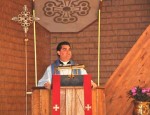
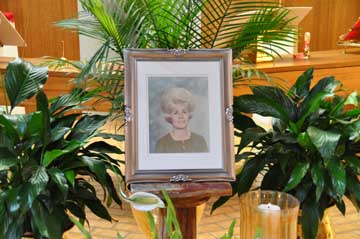
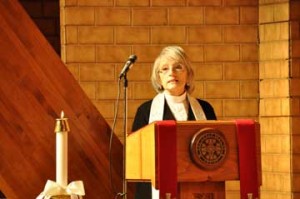
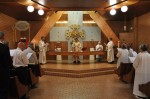
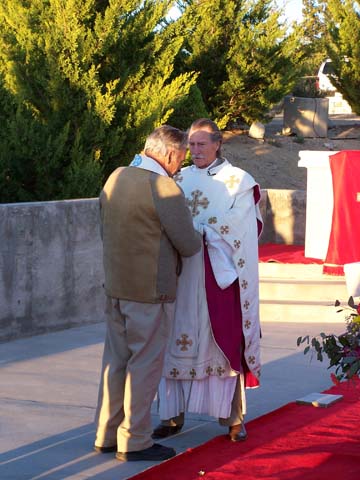
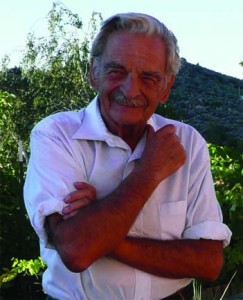
 A funeral service to honor the life of the Reverend Father Reano Castell (March 26, 1931 – March 9, 2010) was held Saturday March 20, 2010, in the Chapel of the Holy Child, Reno, Nevada. In recognition of Father Castell’s office in The Church, his casket was draped with The Church flag; in recognition of his citizenship and proud service in the Swiss army, the foot of his casket was draped with the flag of Switzerland. The order of service included scriptural readings, eulogy, benediction of commital, and final blessing. A special addition to the service was the reading of the Swiss national anthem, “Landeshymne,” in both German and English, the anthem often referred to as the “Swiss Psalm” because it reads like a sunrise prayer. Another special addition was the solo performance of the song “Edelweiss” from the movie The Sound of Music in recognition of Father Reano’s love for this national flower of Switzerland. (For the full order of service, see: Father_Reano.order_of_service
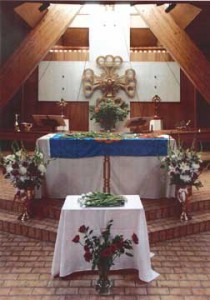
A banquet reception to celebrate the life of our departed Brother in Light was held at the Rectory-Abbey on Carmel following the service. The remains of Father Castell were anointed by the Head Bishop, the Right Reverend Gene Savoy, Jr., before the funeral in a private ceremony on Saturday March 13 and cremated following the funeral service.
The eulogy for Father Castell was composed and read at the funeral service by the Right Reverend Sean Savoy. The transcript follows:
The Reverend Father Reano Castell
March 26, 1931 – March 9, 2010
EULOGY
Delivered by Rt. Rev. Sean Savoy
Introduction
It is a distinct honor for me to have been chosen to speak today for a few brief minutes on behalf of all of us who knew Reano, our dear departed Brother in Light. And I’d like to thank each of you in attendance and those who couldn’t be here today who contributed information on Reano’s life.
I first remember meeting Reano when he moved to Reno from British Columbia, Canada. I was 10 years old, and we were engaged in building the East Wing of the Rectory. Ironically, perhaps, all these years later I reside in that parsonage, so, believe me, Reano (and the rest of the building crew) aren’t often far from my thoughts.
For twenty-seven years, Reano was part of life in The Community. And even though he was a fixture in the weekly lives of each of us for nearly three decades, I’m not sure many of us really understood the private Reano — the man beyond the old stories and jokes he was so prone to repeat — whether it be the story of being forced to eat his mother’s onion pie, the time he put ink in the holy water at school, when he tied his classmate’s pig tails together as a prank, or even when he had to kneel for hours on pebbles as punishment for his mischievous ways.
Those who did have the chance to know Reano on a more personal basis, I believe, found a good and loyal friend in him. I know that my father was one of them. In the early years — Reano began communicating with my father in the 1960s — correspondence between them was often by letter, but later on, Reano became more than an associate and student of Gene Savoy at a distance. By the time he moved to Reno in 1983, he had become an extension of our family and of the Rectory.
I remember it was Christmas 1983, and Reano was invited to a big Italian dinner. He walked into the Rectory kitchen and enthusiastically asked, “What can I do to help?” So my dad gave him a block of Parmesan cheese and a cheese grater. Reano had a great time grating the cheese while my mother and Ileana cooked the pasta and sauces. Needless to say, it became a tradition anytime Reano came for Italian, that he was in charge of the Parmesan.
There wasn’t a birthday or holiday to which Reano wasn’t invited, and I believe these joyous times together gave him a sense of belonging—something that seemed of utmost importance to him.
In one of his early applications to join the Sacred College, he wrote:
“I would spend more time and energy to find the real purpose of life here. My primary goals are to gain a better understanding of this life and spiritual life, to help and lead man to ultimate reality of God. But how can I help? For some reason I’m setting on the fence, and I ask myself: Does God really want me? I don’t know if I qualify for Ministerial training. I leave that to the Community and God.”
Despite this vulnerability and any flaws he may have shown, indeed, Reano put his trust in The Community, in his service to a New World, and in his devotion to God. Many of us here were witness to this dedication.
Background & Church Life
Reano was born March 26, 1931, to Enrico Castell and Martha Catharina Nagel in Olten, Switzerland. He was raised in a family of twelve children, five siblings and six orphaned cousins taken in by his parents. All the children were only a few years apart, but Reano was the oldest. His home and school were in the Swiss mountains. He skied to school in the winter months. When he was about 13, he was sent to live and study at a monastery in southern Switerzland. There, he had to learn Italian because no one there spoke German, his native tongue.
As a young man he trained as a Swiss Grenadier, completing his mandatory military service. The following story relates one of the dangerous episodes he lived through as part of his military training:
When Reano was eighteen, he was assigned to work in a tunnel in the Swiss mountains. His supervisor detected a gas leak in the tunnel, and it was up to Reano and his superior to warn all of the other soldiers and get them out of the tunnel safely. Everyone was out of the tunnel but Reano and his supervisor when the area exploded. They were thrown from the tunnel. Reano received severe injuries to his head and spine. He overheard the doctors telling his parents that he would likely never walk again, but he would not accept the prognosis. Six months after the accident, he walked for the first time, from his bedroom to the kitchen, where his mother was. Ironically, she told him to go back to bed because he was not well enough to be up yet. As a result of his injuries, he was prone to seizures for the rest of his life.
Reano also undertook religious studies. After one and a half years of ministerial training at St. Marie College, he continued his education in civil engineering, carpentry, and architectural drafting.
When he was twenty years old, he traveled by ship to Canada with only a quarter of American money in his pocket. Upon his arrival on Canadian shores, he bought two loaves of bread with his quarter. He kept one for himself and gave the other to a family with children. He walked and caught rides across the continent, working at various farms along the way. He sometimes worked for people who did not speak a language he knew. Eventually, he was taught English by the wife of one of his employers.
He saved his money and eventually married his wife, Betina. They settled in Victoria, British Columbia, where he owned and ran a contracting business, which employed several European master craftsmen specializing in the building of high-end custom homes. To complement his professional and spiritual interests, over the years he took courses in, and later taught, cosmobiology, astrology, and Kabbalistic philosophy.
He was in correspondence with the International Community of Christ Church since the mid-1960s after seeing an article in Fate magazine about Gene Savoy. He later joined The Academy in 1971. In his letters to the Center — whether in Lima, Mexico City, or Reno — he often praised The Community for the depth of information, for the quality of our publications, and, most important, for the education and knowledge he believed he was privileged to receive.
Reano was an early member of the Andean Explorers, such as it existed in the 1970s, and wrote with praise for the book Antisuyo and of his appreciation for our work in Peru and the Amazon, as well as his desire to maybe one day visit the jungle. Although he never made that trip, he did serve on the board of directors when the club was resurrected in the 1980s, and he was honored for his early design work on Feathered Serpent III.
Giving over his contractor’s business to his sons, Brandon and Rob, in 1983, he left Canada and his family to become a permanent resident of the Reno Community in order to complete his ministerial training in The Church and dedicate his life to the Sacred Teachings of Light within the Jamilian Order.
Frustrated that his wife was adamantly opposed to religion in general and was not supportive of his spiritual endeavors in this Church (or any other, for that matter), Reano — I don’t believe — ever really got over the loss of his family, who rejected him and his decision to be part of The Community. Yet, Reano was steadfast in his decision.
Following first-level ordination in 1983, he was immediately assigned to The Church’s Building Department and became a resident of the Chapter House at the Red Rock Consecrated Sanctuary attached to the Cathedral Abbey of Monte Viejo. Upon taking the vow of nonmaterialism, he assumed liturgical functions and administration of the sacraments as an assistant to the Pastor, and in 1986 received second-level ordination. He was assigned as part-time faculty of the Jamilian University and was given a Lector’s chair at the Chapel of the Roses at the Steamboat Priory.
In 1993, under new pastorship papers, he was given several administrative appointments under the designation of Canon, including a seat on the Sacred Oversee, the leadership of the Building Department, the priorship of Steamboat Hot Springs Priory-Mission, and the role of secretary-director for the International Community Guilds and the Steamboat Springs Water Works.
In 1998, he was made Rector of the Church of the New Covenant, and in the year 2000, he was appointed co-Chair of the American Association of Concerned Clergymen of the Advocates for Religious Rights & Freedoms. Reano remained active in some or all of these capacities until his passing, although his administrative duties became fewer and fewer in the last few years.
In 1991, he was among the first to enter the Order of Patriarchs, and it is this role that he cherished toward the end of his life, holding to his daily devotions and the rituals of life at the Sanctuary. As a “Father” of The Community, in his later years — despite the frustrations of old age — Reano assumed a more serene attitude, even though he never lost the feistiness that endeared him to — and often frustrated — his fellow companions.
Some may not realize that before he took his vows of poverty/nonmaterialism, Reano was a constant supporter of The Community with his financial donations. He supported many projects, including the Publishing Department, exploration and research projects and, of course, the Sanctuary. Even after taking his vows, he was generous with the small amount of funds he had available to him. He would often give small contributions to help out other projects of The Community not related to his areas. And just a few years ago, after saving up several thousand dollars unbeknownst to anyone, he was able to purchase and install a small greenhouse for the perpetuation of the Sanctuary.
Memories
Reano had many talents. He was a master builder, a contractor, a draftsman, a painter, and a craftsman. He was a competent astrologer and an avid reader. He might have been a meteorologist, as he could often predict the weather with a certain accuracy. He loved to garden. He loved to dance. Does anyone remember his now infamous “chicken dance,” which he would perform from time to time at gatherings? He loved to make fondue on his birthdays. And he loved his wine. Yes, how he loved his wine — a Valpolicella or a nice Chianti, please.
Always the ladies’ man, he enjoyed the company of all the devoted women of The Community, and did not hesitate to turn on the charm during one of our holiday parties or at a dinner of the Andean Explorers.
Reano enjoyed having the company of the men working on projects at the Sanctuary—especially recently, when he no longer had the weekly visits by my father or the Saturday lunches he used to enjoy at the Rectory to keep his spirits up.
In his last years, Reano continued to be active as best he could with work crews, if only to lend a helping hand and, more important, to offer moral support. And he never faltered from his duty to escort the Sunday groups on their trips to perform “second services” each week.
Certainly, each of us has our own memories of Reano. To summarize, I’d like to share a few memories of Reano as submitted by his friends and companions. These brief stories convey best the essence of the man, far better than I could attempt to do.
“I am very proud to have had Reano as a dear and loyal friend all of these years. I loved sitting at the table with Reano and Rev. Gene and listening to them discuss work projects and tell jokes. I also loved my many walks around the Sanctuary with my friend. I will miss his beloved presence very much.” (Barbara Whitney)
“Over the last two years there has not been one week where he would not tell me at least twice about how every Wednesday the late bishop would come out to the Sanctuary and bring with him a bottle of wine, a loaf of bread, cheese and olives, and the two of them would sit and talk about ‘certain things’ (he would say), and then they would go hiking around the Sanctuary. He never really recovered from the loss of his friend, and I believe that he is with him now.” (Ted Staver)
“Reano was one of the first people to greet me when I joined the Church. His warm laugh and great sense of humor always lifted my spirits and put a smile on my face. I learned that my birthday fell on the same day as his daughter’s, who had a very short life. This seemed to create a bond that stayed with us for many years.” (LaCynda Gibson)
“Reano always remained loyal to his beloved teacher. When his parents passed away about 1994, he turned down his inheritance and the title of [burgermeister] of the region he had been raised in. His surviving family continued to reject him. He hung on to The Church for the sake of his faith and his loyalty. He proudly accepted and took very seriously the title Rev. Gene gave him, “his Swiss Guard.” (Barbara Whitney)
“He loved to sit with a glass of wine and talk for hours about his days in the Swiss army. He was a grenadier (equivalent to our Green Berets). ‘You had to be one tough son of a gun to make it through that,’ he would often say. And he would talk about the refugees that came into the country during the war and how the Swiss would extend their hands in welcome and that ‘in those days we helped one another, not like today.’” (Ted Staver)
“One of the most endearing contributions I will always remember Reano for was his great and long-lasting role as our dear Santa Claus. We had more fun watching him and listening to him coming in with all of the reindeer. I think [they] had more fun than any of us.” (LaCynda Gibson)
“I remember the time the Bishop, Reano, and I were watching the men work on the Temple Mount. Some of this work involved dynamiting portions of the rocky terrain to make way for the fence. Reano had been pushing the ignite button to ignite the dynamite, and at one point he looked at me, smiled, and asked: ‘Here, you want to do it?’ Of course I did. (LaCynda Gibson)
“When I think of Reano, my mind races with episodes of adventures. I remember the time he was working out in the field at Red Rock and his thumb nail got caught on something and bent backward. (Ouch!) One of [the men] grabbed him, drove him to the Chapter House, and held his hand over the sink with running water, and flipped the thumbnail back into place. The yell from Reano echoed throughout the valley.” (LaCynda Gibson)
“I considered Reano a master storyteller. He had a way of telling a story over and over again and everyone would listen as if it were being told for the first time.” (Robert Roy)
“I was saddened to hear of the passing of Rev. Father Reano. He was a wonderful, precious man who was always very kind and helpful to me. I will miss his gentle presence.” (Bruce Bunch)
“Reano was a good man and a dear friend of your father’s who loved him very much. I am sorry to hear of his sudden passing.” (Sylvia Ontaneda-Bernales)
“The passing of Rev. Father Reano was a great shock to me. He has shown many kindnesses to me. May his soul rest in peaceful Light.” (Shinobu Uwataki)
“The first memory I ever had in my life was of Reano. I was around one year old, and I remember him tucking me into my crib at night.” (Matthew Madonna)
“Just a thought about Reano. For Mother’s Day he gave the women of The Church hand-drawn cards of the Madonna and Child – which he did twice that I can recall — a very kind thing for him to do.” (Mary Foust)
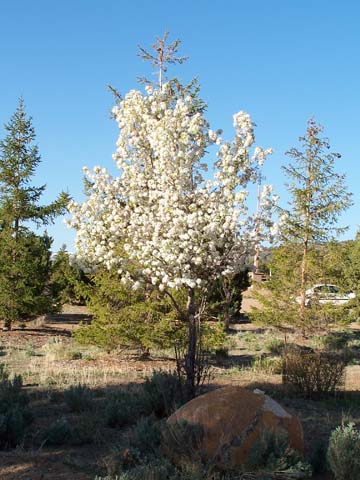
“I was talking about this with Reano two weeks ago: I remembered walking up to the Church of New Ephesus with Reano. It was spring and it had been a wet winter. The wildflowers were everywhere. I spotted a small white flower which I did not recognize. Reano looked down, and with a gasp in his breath, he said it was edelweiss, the national flower of Switzerland. He just stood there gazing at that flower. I knew he was thinking of home. When he looked up, there were tears in his eyes. He said the flower told him he was home at Red Rock, just like Switzerland.” (Amanda Buchanan)
And this final thought from a fellow Canadian:
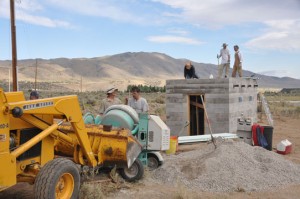
“Reano was a man for all seasons. From assistant hog farmer in central Manitoba, Canada, to independent building contractor in Victoria, B.C. From Swiss national guard trooper jumping out of low-flying light aircraft into Swiss mountain snow banks to sergeant in the PPCCL, a crack Canadian forces airborne regiment. From apprentice carpenter to master builder; and from school boy in monastic school to a Rt. Rev. Priest and venerated Patriarch in the International Community of Christ (not to mention a rather convincing Santa Claus). He played a very important role in the construction of the Community’s infrastructure, notably the Chapter House and Sanctuary buildings and the open-air churches; the East Wing of the Rectory; the Cathedral towers, platform, and communion table. These projects and many others that are well known to all of you. They stand better than any words of mine as tribute and memorial to his life and character. I enjoyed working with Reano. While working it was no nonsense, but when the work was done there was always time for a glass of wine and a story or two. He was a good friend, and I know that even as we celebrate his well-lived life and are glad he is in a better place; we feel a sadness at his passing. Rest in The Light, my friend!” (Patrick Newman)
As a child, I came to know and respect Reano — with all of his eccentricities, his charm, his intelligence, his good will, and, of course, his accent. I have many memories of him, but I believe enough has been expressed this afternoon in tribute to him. I will say, however, that although he could be hard line — “no-nonsense,” as Pat put it — on the job site, during Young Explorers outings at the Sanctuary, or on the sports field — where he made sure the guys, or the kids, including myself, followed direction, he was a proud, kind, and good man who strove for the proper outcome no matter what the project.
Most of all he was a spiritual person, who will be greatly missed. As a final tribute, the pasture area in front of the Chapter House where he lived for twenty-seven years, will be designated Castell Park and Memorial Gardens in his honor.
It became a popular tradition in the 1970s to take the melody of Edelweiss — one of Reano’s favorite songs and flowers — and to make it into a Benediction. I thought it would be appropriate to read these words as a conclusion to our thoughts on Reano’s life.
May the Lord, mighty God,
Bless and keep you forever.
Grant you peace, perfect peace,
Courage in every endeavor.
Lift your eyes and see His face,
And His grace forever.
May the Lord, mighty God,
Bless and keep you forever.
+
+ +
+
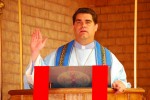 A summary of the message delivered from the pulpit by Bishop Gene Savoy Jr. on Saturday March 13, 2010, follows: