Project “X” Tours Japan Day by Day: DAY 3
11 MAY
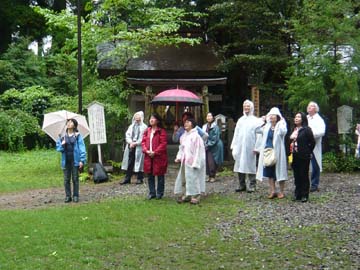
PHOTO: Sean Savoy
Communion Service and Third-Degree Ordination for Reverends Shoko Ohba and Eriko Ueno. Breakfast at hotel. Depart by bus for Seiwa Bunraku Puppet Theater to watch a full play. Bunraku companies, performers, and puppet makers have been designated Living National Treasures. Then, visit the Heitate Shrine, closed for centuries as the “Hidden Shrine.” Heitate is considered the navel of the world, where the legend of “High Heaven’s Plain” (Takamagahara) was born. Lunch. Continue by bus to Takachiho, site of one of the most well-known and important legends of Japanese mythology, that of the great sun-goddess Amaterasu. Tour Amano-iwato Shrine and Ama-no-yasugawara, the “Cave of the Sun Goddess” or “Heavenly Rock Cave.” Dance performance at nearby art center. Dinner and overnight at Hotel Shenzhou.
COMMUNION SERVICE
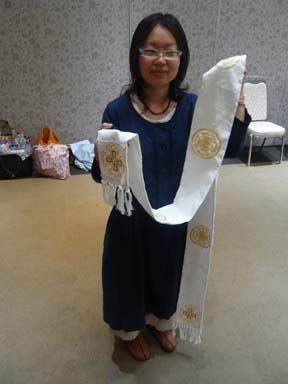
Noriko Soejima shows off her embroidery handiwork before the service. PHOTO: Sean Savoy
“Birthday of Gene Savoy, Sr. He is in our thoughts.
“We are up early (4:00 AM) to depart to a site on Mt. Aso for a sunrise service. Unfortunately, it is still overcast. Thus, we are unable to debark and set up for a service. We return to the hotel to put into action ‘Plan B.’
“After breakfast we hold a small Communion Service in a side room off the lobby … with rice cakes, followed by a 3rd-Degree Ordination service for Eriko and Shoko.
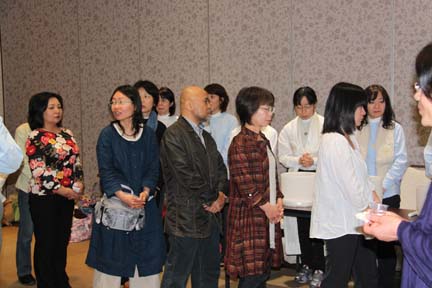
Congregation gathers for Communion of Fellowship Service PHOTO: Rob Roy
“Music is played by myself on a small keyboard … while some of our Japanese Consociates accompany with singing bowls in the correct keys. Quite effective, and there are many wet eyes in the room.”
—Journal entry by Gary Buchanan
ORDINATION CEREMONY
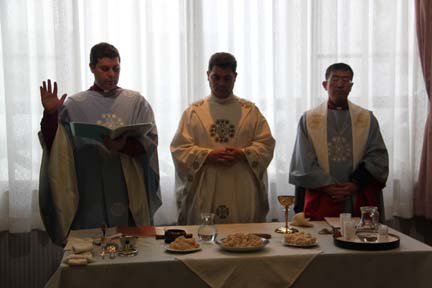
Bishops (from left to right) Sean Savoy, Gene Savoy Jr., and Yukinori Matsushita open Ordination Ceremony. PHOTO: Rob Roy Deaconesses Eriko Ueno and Shoko Ohba receive Third-Degree Ordination. PHOT Rob Roy(from left to right) Deaconesses Yaeno Sanada, Shinobu Uwataki, Miyuki Okayama, and Keiko Inoue of the Bell Choir play crystal bowls during Ordination Ceremony. PHOTO Sean Savoy
SEIWA BUNRAKU PUPPET THEATER
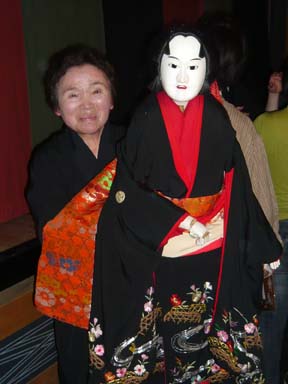
PHOTO Sean Savoy
In the Aso district the group visits Seiwa Bunraku Puppet Theater to watch a full play.
Founded in the seventeenth century, bunraku is a theatrical art form expressing the movements of human feeling and gesture. It is an author’s theater. The Joruri music that accompanies the play is a form of traditional music that emphasizes lyrics and narration over the music itself.
The puppets of bunraku range in size from two to four feet in height. The heads and hands are carved by specialists; the costumes are designed by a costume master; the preparation of the puppets’ hair is an art in itself. All but the most minor characters require three puppeteers.
Training a main puppeteer can take thirty years.
Bunraku companies, performers, and puppet makers have been designated Living National Treasures.
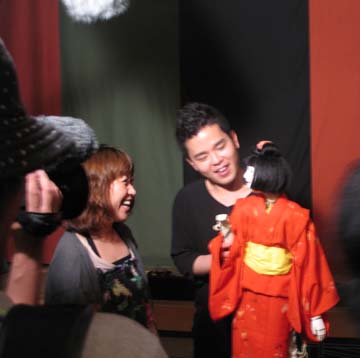
Bunraku puppeteer amuses the audience after the performance. PHOTO: Gary Buchanan
<Read about Bunraku on Wikipedia> [http://en.wikipedia.org/wiki/Bunraku].
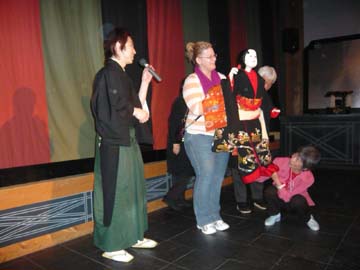
Tour member Jalayne Grady appears onstage with puppeteers and puppets. PHOTO: Sean Savoy
The theater at Seiwa is an award-winning design, a large-scale version of the conventional layered-wood structure with eaves thirty-feet high, designed to stage a form of bunraku that has been performed from the time of the Tokugawa Shogunate.
<Read about the architectural design of the Seiwa Bunraku Puppet Theater [http://www.pref.kumamoto.jp/uploaded/attachment/16270.htm] >.
“The play was being filmed for TV broadcast on May 21.
“The theater show is a 160-year-old art form — oral tradition — drama and music, Japanese “opera.” Members of our group were invited to try out the puppets — great fun!”
—Journal entry by Gary Buchanan
HEITATE SHRINE
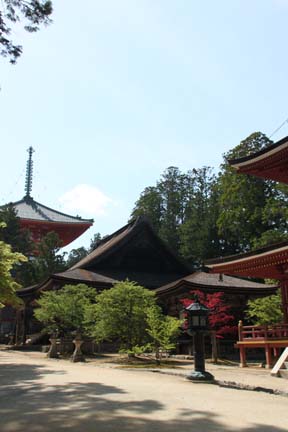
Heitate Jingu Shrine is considered one of the most outstanding power spots in Japan and the origin of the world. Every five years, a celebration is held at the shrine celebrating the origin of all peoples: the Five-Colored Grand Festival.
In the city of Aso the group visits Heitate Shrine, a famous “power spot” on the Japan Median Tectonic Line, on which are many other sacred places, including Ise Shrine. Heitate Shrine is considered the navel of the world, where the legend of “High Heaven’s Plain” (Takamagahara) was born.
Closed for centuries as the “Hidden Shrine” to preserve its extraordinary sanctity, Heitate Shrine is not big and not easy to access, but ambassadors and officials, spiritual leaders and people from around the world have come here to visit during the Five-Colored Grand Festival (Goshikitaisai), which is held every five years in August to celebrate the ancestors of humankind and to pray for peace.
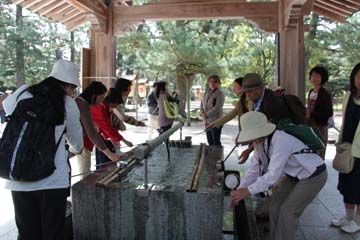
Spring at Heitate Shrine. PHOTO: Rob Roy
“At 11:30 AM we depart for Heitate Shrine — ‘Navel of the World’ — ‘High Heaven’s Plain.’
“It is a long climb up stone steps to the shrine at the top of the hill. For a long time a ‘hidden shrine,’ the original was simply trees and rocks (very old trees). Now there are several buildings and individual springs and smaller shrines…for drinking sacred waters and washing hands.
“We learn/observe the entry protocol of two bows, two claps, and final bow before entering.
“One could fee a great presence at this shrine…and after walking down a nearby pathway into the forest. There was also a unique smaller shrine with five small priests (appearing like children) looking heavenward.”
—Journal entry by Gary Buchanan
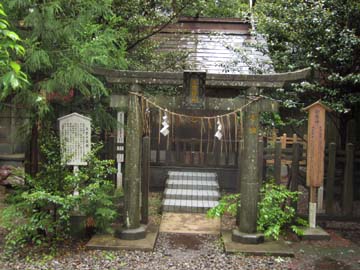
One of the smaller shrines within the Heitate Shrine. PHOTO: Ron Theriault
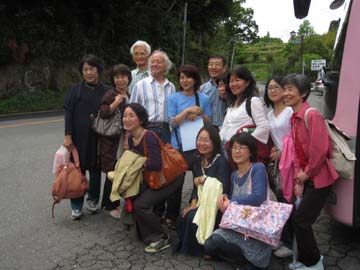
Members of the tour group on the way to Takachiho Shrine PHOTO: Ron Theriault
TAKACHIHO SHRINE
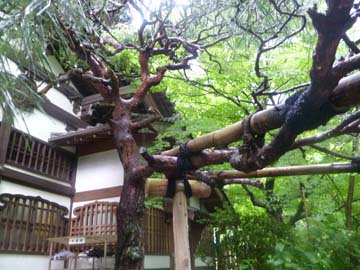
Ancient cedar tree at Takachiho Shrine. PHOTO: Sonya Savoy
Takachiho is the site of one of the most important and well-known legends of Japanese mythology. According to Japanese mythology, the land of Takachiho is where Ninigi, the bringer of celestial gifts and great-grandfather of the first emperor, descended from the heavens, sent by the Shinto sun goddess Amaterasu. According to the popular tradition, the three gifts he brought are the imperial sacred treasures: the sacred mirror, the sacred sword, and the sacred jewel. Today the mirror is enshrined at the main shrine of Ise Jingu, the sword at Atsuta Jingu in Nagoya City, and the jewel in the Imperial Palace.
Takachiho Shrine enshrines the three gods of the three generations (Joko Takachiho Sumegami) that appear in the Himuka imperial foundation myths. According to oral tradition, the shrine was founded early in the first century CE. In the precincts is an 800-year-old cedar tree planted in the twelfth century by the famous samurai Hatakeyama Shigetada, who visited the shrine on behalf of the Kamakura Shogunate.
AMA-NO-IWATO SHRINE
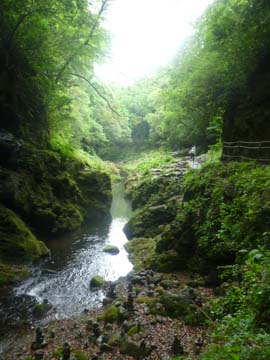
Landscape near Ama-no-iwato Shrine. PHOTO Sonya Savoy
Ama-no-iwato Shrine, according to the myth, is where the sun goddess Amaterasu hid in a cave, outraged by her brother’s cruelty, bringing darkness and cold to the world, until she was lured out by a wild dance led by Ame-no-Uzume, goddess of the dawn and revelry. The other gods placed a mirror at the opening of the cave, so that when she came out to see what was going on she would see her own image in the mirror. As she looked out, she was blinded by the light and, thinking they were celebrating the arrival of a greater goddess than herself, she came out of the cave. The world was bathed again in light and a holy seal was placed on the cave so that she could not hide there again. The Sacred Mirror, recognized as one of the three imperial gifts from heaven, is enshrined at Ise Grand Shrine.
The cave is enshrined in the West Hall of the shrine; the goddess Amaterasu herself is enshrined in the East Hall. A shortened form of the legend is reenacted for tourists every night of the year as night dances (yokagura) at the Takachiho shrine.
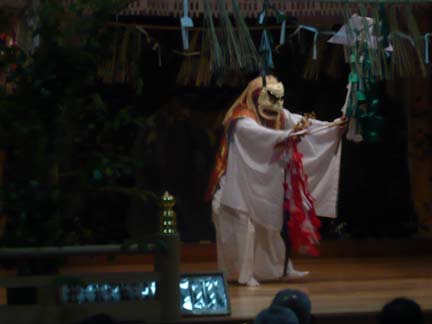
Kagura dancer. PHOTO: Sean Savoy
Read more about < kagura [http://en.wikipedia.org/wiki/Kagura]> in Wikipedia.
AMA-NO-YASUGAWARA
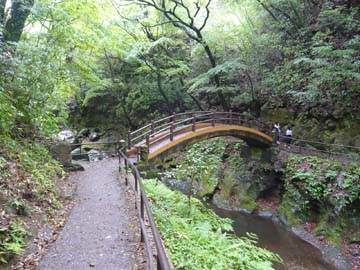
PHOTO Sean Savoy
South of town is Takachiho Gorge, formed by the lava that once flowed out of Mt. Aso. Designated as a special natural treasure and scenic spot, it is famous for the feel of its rocks and the mysterious beauty of their forms, such as the precipice Byobuiwa.
The “Cave of the Sun Goddess” or “Heavenly Rock Cave” grotto is filled with visitors and hundreds of small rock piles, devotionals built as offerings to the shrine over the centuries. This is the legendary cave where the sun goddess emerged after being kidnapped.
Manai waterfall in Takichiho Gorge is one of the most prominent falls in Japan. Approaching the falls by boat is a thrilling experience.
TRADITIONAL DANCE PERFORMANCE
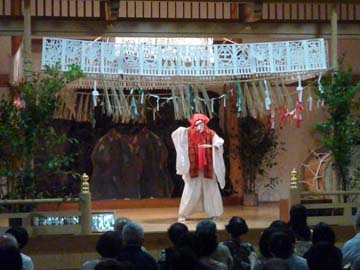
In the evening there is a dance performance at the nearby art center. PHOTO: Sean Savoy