“Man Proposes, God Disposes,” Part 2
* * *
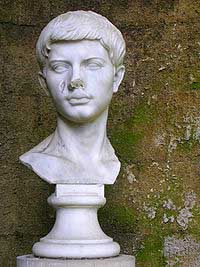
A bust of Virgil from his tomb at Naples, Italy. PHOTO: A. Hunter Wright
Both Virgil’s act of creation and the ambivalent act of destruction and recycling performed by the Egyptian populace were acts of remembrance; both were self-serving, and both were accidentally and unconsciously irreverent. Both had borrowed materials from a predecessor in order to apply them to a new purpose, and both had performed a service to people of the future and a disservice to God: They had profaned an image devoted to God and thus unknowingly salvaged it from oblivion. In time, this secret has been revealed.
In the mid-nineteenth century, on the east bank of the Nile, halfway between Memphis and Thebes, the ruins of an ancient and unidentified city, literally covered by the sands of time, were found by the army of Napoleon excellently preserved. Its outlines were mapped by the army’s engineers, and the reliefs on its tombs and temples and boundary steles were recorded by archaeologists. Later in that century, a poor woman of the house of Ishmael, who was digging on the ancient site for nitrogen-rich fuel for her hearth, accidentally uncovered a cache of three hundred letters written in cuneiform on clay tablets that identified the unknown city as Akhetaten and its builder as the then-unknown pharaoh Akhenaten. Today the sacred city of Akhetaten remains the only ancient Egyptian city whose internal plan is preserved in detail. During the twentieth century, three millennia after the mysterious and damaging enmity that arose between Egyptians and Israelites, more than one student of Egyptology has proposed that Akhenaten might be another child of the Hebrew scriptures, one whose name was also banned in Egypt and whose memory was buried in Israel by biblical redactors. Among the ancient adherents of this school are Lysimachus, Tacitus, Strabo, and Manetho; among the modern adherents are Sir Matthew Flinders Petrie, James Henry Breasted, Arthur Weigall, Alan Gardiner, E. Wallis Budge, Sigmund Freud, and Ahmed Osman. Breasted was the first modern scholar to recognize that the name Moses means “child” in the ancient Egyptian language (The Dawn of Conscience, 1934, page 350). Freud popularized this meaning to identify the Jewish figure Moses with the Egyptian Akhenaten or one of the heretic king’s followers (Moses and Monotheism, 1937). Osman went further and put this meaning into a theory with dramatic context (The Hebrew Pharaohs of Egypt, 1987; Moses and Akhenaten, 1990) by historical identification of biblical characters: All the kings who ruled from the sacred city of Akhetaten, the so-called Amarna kings—Akhenaten (Amenhotep IV), Semenkhkare, Tutankhaten (Tutankhamun), and Aye—are identified as descendants of the house of Jacob; that is to say, Israel, through Yuya, the vizier to Amenhotep III, who was, historically, the biblical patriarch Joseph. The usurper Horemheb is identified as the biblical oppressor king “who knew not Joseph” (Exodus 1:8); Akhenaten he identified as the biblical Moses. Osman proposes that after Akhenaten fell from power and fled into exile—when it became a crime to utter the name Akhenaten, the name that had been part of his royal and religious power while he sat on the throne—he was referred to unofficially as “the fallen one” or “the rebel of Akhetaten”; and his followers, faced with the accusation that their leader was not the real heir to the throne and being forbidden to speak his name, invented for him a nickname—Mos, meaning “the child” or “the son” or “the son and rightful heir”—to indicate that Akhenaten was the legitimate son of Amenhotep III and the rightful heir to his father’s throne. That nickname, claims Osman, has come down to us in its Greek transliteration, as Moses.
In 1907, after centuries of speculation, three British scholars published extensive findings and thorough research to prove that the prophetic Hebrew image of the Golden Age of the future had been grafted into Virgil’s Fourth Eclogue (Virgil’s Messianic Eclogue: Its Meaning, Occasion & Sources). A century of historical and literary clarifications followed. Our time offers a further point of clarification: The Divine Child who would fulfill the original intention of the oracle was born not around 40 BCE, as Virgil had hoped, nor nearly forty years later in Bethlehem, as medieval Christians believed, but in the year 1959 of our own age. The Child’s name was Jamil (See Jamil: Child of Light).*
_______________________
* My note “The Divine Child of Virgil” provides an account of how the image of the Divine Child came to enter Virgil’s Fourth Eclogue and a summary of these findings.
Robert Petrovich
July 2012
FURTHER READING:
Jamil: Child of Light, Gene Savoy (1973)
< For ebook, click HERE >
< For printed text, click HERE >