THE LUMINOUS TEACHING STONE OF CHINA: The Stone Itself, Part 2: Discovery
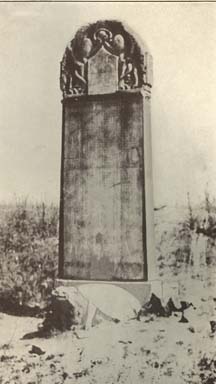
The Luminous Teaching Stone as it appeared on site at the Buddhist temple in the early 20th century
Documents contemporary to the uncovering of the stone leave doubts about where and when it was actually found. Three different stories of its recovery are reported, with two variations of its original location and disposal. The story here yields the most cooperative details and happens to be also the most sensible.
For many winters before the discovery of the monument, natives of one of the post towns between Hsi-an and Chou-chin, in the area of the four forts, had observed that snow would not lie on a certain small patch of ground beneath the foundation of a ruined wall there. Workmen digging irrigation trenches at the spot by order of the Ming government early in 1623, perhaps in the beginning of March, came upon a great slab of stone buried several feet beneath the surface of the earth. The men carefully raised it. When they cleaned it, they saw it was covered with a perfectly preserved inscription of beautiful workmanship.
The discovery did not fail to attract the attention of Liang Ko-shun, the district governor of Chou-chin who had ordered the excavation project. He hastened to the spot. There he found a tablet in the form of a gravestone, and on it an inscription following the line of biographies usual in Chinese cemeteries. The inscription claimed the stone to be 842 years old. True to his country’s tradition of reverence – for antiquity, for the dead, and for literature – the mandarin did obeisance to the ancient relic, making a profound and solemn bow.
That same spring, Governor Liang Ko-shun merited the attention of the emperor for his beneficent administration of the water supply and his vigorous measures in defense of his people from robbers and murderers. He was selected for promotion to the honorable post of censor as soon as his term of office in Chou-chin expired. In autumn, Liang came to reside in the capital city of Hsi-an. Two years later, as censor, he ordered the transportation of the stone by way of the Rivers Tsao-Ho and Wei-Ho to the outer yard of the Ch’ung-jen-ssu Buddhist temple. There, in the fields outside the western gate of the city, Liang mounted it on “a fair pedestal” (a clumsily worked stone tortoise) strangely near the site of the first Ta-ch’in monastery built in 638. There the monument remained in place until October 2, 1907.
Soon after the exhumed relic was transported to the capital, the first rubbing of the stone was made and sent thousands of miles, somewhere in the neighborhood of Hang-chou, for examination by Dr. Leon Li, a famous Chinese Christian of the time. In June 1625, one of the Jesuits in the city of Hang-chou published a Latin translation of the inscription. The French Jesuit father Nicholas Trigault visited the stone in October, accompanied by two Shensi Christians of high office. News of the find spread all over the empire and the world. All the men of letters in the capital district, experts in writings on metal and stone, came to study the monument and pronounced with certainty that it belonged to the T’ang era.
Opposition to the monument’s authenticity in Europe, more anti-Jesuit than intelligent, interfered with reception of the news. Early Protestant missionaries, and later the most celebrated intellectuals of enlightened Europe, made it out to be a Jesuit forgery. Voltaire made fun of it from France in the fourth of his Chinese and Indian letters. Bishop George Horne, the most eloquent English preacher of his time, contended that the monument was not genuine. So did many others. For nearly two hundred years, the intelligentsia of Europe refused even to acknowledge its existence. Then, at the end of the eighteenth century, Edward Gibbon again revealed the fact of the monument’s existence to the world in chapter 47 of his famous history, Decline and Fall of the Roman Empire. Yet the question of the authenticity of the monument continued to divide Western scholars for another hundred years. Professor Karl Neumann of Munich, an indefatigable student of oriental language, and the great Parisian sinologist Stanislas Julien, who had mastered the genius of the Chinese language by intuition in order to translate Hsuan-tsang’s Travels and the Tao Te Ching, published their doubts on the genuineness of the stone. In America, Professor E. E. Salisbury, in his published opinion, remarked that the monument was generally regarded as a forgery by the learned, and added the egocentric and tautological argument that since neither he nor any of his friends had ever met anyone who had seen the monument, he was not sure whether such a thing did actually exist. In time, however, several great sinologists provided translations of the inscription into French, German, andEnglish, thus making it impossible to ever doubt its genuineness again: A. Wylie (1854), J. Legge (1888), P.Y. Saeki (1916), and A.C. Moule (1930).)
In nearby Japan, where Christianity prohibition boards and their strict enforcements under shogunate law forbade knowledge of the religion, the existence of the monument was not known until the early nineteenth century. There a few Japanese scholars learned of the inscription in 1817 in spite of the prohibition, when a shipment of imported books arrived in Japan. The shipment included the 160-volume collection of ancient Chinese inscriptions on metal and stone compiled in 1805 by the famous Wang Ch’ang. The inscription occupied the larger part of the sixty-fifth volume. Even after shogunate authorities at Yedo had inspected the work and approved it, the discerning Kondo Seisai, inspector general of publications and imported books, found the inscription and concluded it was related to the forbidden “Religion of Jesus.” He declared the whole work of Wang Ch’ang proscribed in Japan. The Japanese nation did not hear of the monument again until some years after the Restoration, in 1872, when the new government removed the notorious prohibition boards. Even then, during the reign of the Meiji emperor (1867–1912), only three scholars paid much attention to the subject in their writings: Dr. Takakusu, Dr. Kuwabara, and Dr. Nakamura.
Not until later in the twentieth century did the devoted Japanese interpreter of the monument, P.Y. Saeki, point out that the ultimate origin of Japan’s “Protestant” Buddhism was this same East Asian Christian tradition. In the borrowed language of English, Professor Saeki extolled the significance of the monument and clearly traced the path that the Christian teaching had taken into the Far East as it spread throughout East Asian civilization, entangled itself in the course of Buddhism at its fall, and was finally forgotten. His first book, The Nestorian Monument in China (1916), provides a translation of the inscription in sympathy with Chinese thought, speech, and literature; the translation is accompanied by copious and erudite notes that contain all the leading thoughts on the monument expressed in Japan up to his time. His second book, The Nestorian Documents and Relics in China (1951), collects his translations of the Chinese historical records relating to the Church of the East and all Church manuscripts found in China and Chinese Turkestan. His work embodies the good will of many scholars and continues to provide a light to work by for religious researchers in the West.
Robert G. Petrovich
1989, 2010
Read THE LUMINOUS TEACHING STONE OF CHINA: The Stone Itself Part 3: Recovery