Approaching the I Ching, Part 7
D. READING THE HEXAGRAM

A young yin or young yang line does not change. An old yin or old yang line is a changing line and turns into its opposite. A hexagram with all young lines is static; only the text of the statement of the hexagram with all young lines applies to you and none of the line commentaries. The oracle then takes into account only the idea represented by the hexagram as a whole, as set down in the Judgment and the Commentary on the Decision, together with the Image.

If there are one or more changing lines in the hexagram cast, the words appended to the given line or lines are also to be considered. These words carry the superscription “Nine in the xth place” or “Six in the xth place.” Further, if there are changing lines, the change in the lines gives rise to a second hexagram, whose meaning also needs to be taken into account. Read the text for this second hexagram but none of its line commentaries.

The first hexagram presents your situation at the moment. The first hexagram is the starting situation of a development that leads, by way of the situation discussed in the changing lines and their appended counsel, to the second hexagram.

As with anything, experience and time are important to achieve success with the I Ching. Properly handled, the I Ching can assist you to make right decisions in important matters. Be wary of misinterpretations. Careful and meditative readings are essential to receive the proper answers.

Reading the First Hexagram: The Development of the Situation
Consult the texts in Book I. With careful thought and meditation, the answer will be found somewhere in the text. Following the reading in Book I, read the commentaries in Book III. Take into account the texts of the Judgment and of the Image and of the commentaries accompanying them, as well as the texts of changing lines that appeared in the hexagram you cast, but not the other line texts.

The texts describe energy fields potent with many meanings. The process of working with these meanings can open a new way of seeing things. The texts speak directly. Meaningful complexes of images open our awareness in the same way that images of a dream remembered activates our imagination, and meaning arrives.

Reading the changing lines
The texts of the changing lines (6 or 9) reveal the potencies of individual action within the situation described by the first hexagram as a whole and suggest what your situation can lead to and how you can get there. The texts of the changing lines advise on the direction of specific actions and the potential consequences.

Each hexagram is built from six lines. These lines are symbols of time and position. The hexagrams represent dynamic developments in time, the possible modes of change in the world. Each hexagram may be seen as a set of six empty places or positions through which energy moves and changes. Energy comes into the hexagram from below and leaves at the top. The places are numbered sequentially, and each of the lines in sequence from bottom to top generally represents a stage of progress in the situation.

The present situation is revealed by the name and structure of the hexagram together with the Decisions, the Commentary on the Decision, the Image, the Commentary on the Image, and the Commentary on the Lines. The interpretation of each changing line involves not only the initial moment of the present situation but also its association with the “approached hexagram” that indicates future potential or tendency. Changing lines describe the various aspects of the change from the first hexagram to the approached hexagram. When several changing lines are received, they should be read, from bottom to top, as sequential events in the change from one situation to the next. They may also describe the points of view that you may develop while in transition.

In the Changes, the position of each line within its hexagram is considered meaningful: the first and lowest line is early and peripheral to the situation, the fifth line is generally the climax of a situation, and the sixth line is late and outside the situation. It may be that a situation in itself favorable may reveal unfavorable aspects at various stages along the way; for example, at the beginning when the situation is still embryonic, or at the end when the influence of the situation is ebbing. In the Changes, that which is late in a cycle changes into its opposite and generates a new cycle. In this way, each hexagram represents a cycle.

Reading the Second Hexagram: The Final Situation in Potential
When the changing lines turn into their opposites, they generate a second hexagram, the “approached hexagram,” which is an image of the overall future potential of the situation. The approached hexagram indicates the direction in which your situation can evolve if you choose to act in the way described. The Image of the approached hexagram does not present an immutable future but indicates the potential contained in your present situation.

The Judgment and the Image of the first hexagram describe the situation in which you find yourself, and the line texts contain the specific advice the situation calls for. When all the changing lines are changed into their opposites, the initial hexagram is transformed, and in this way, the second hexagram emerges. The Judgment and the Image of the approached hexagram show the result that can be attained if this counsel is followed. The counsel in the line texts of the approached hexagram are ignored.

*

As you read through the texts, certain images will present themselves as the key images of your situation. Examine their meanings and let them suggest ways to understand your situation. The ultimate interpretation is cumulative. The commentary on the images of the I Ching by the third-century interpreter of the I Ching, Wang Bi, may help to clarify the process of understanding the images:

It is the images that give meaning, it is the words that make the image clear. To exhaust the meaning there is nothing better than the images; to exhaust the images there is nothing better than the words. The words ought to concentrate on the images, then the right words for contemplating the images are found. The images ought to concentrate on the meaning, then the right images for contemplating the meaning are found. The meaning is exhausted by means of the images. The images are exhausted by means of the words. Thus he who speaks in order to make the images clear obtains the images and becomes oblivious of the words; he who makes images that contain the meaning obtains the meaning and becomes oblivious of the images. It is like following a trail to catch a hare. Once one has the hare, one forgets the trail. Or it is like putting out wicker traps to catch fish. Once one has the fish, one forgets the traps. Now, the words are the trails of the images, and the images are the traps of the meaning. Therefore, whoever retains only the words does not grasp the images, and whoever retains only the images does not grasp the meaning. The images arise from the meaning, but if one retains only the images then what is retained are not the right images. The words arise from the images, but if one retains only the words then what is retained are not the right words. Thus only by forgetting the images can one grasp the meaning, and only by forgetting the words can one grasp the images. In fact, grasping the meaning consists in forgetting the images, and grasping the images consists in forgetting the words. Thus if images are established that exhaust the meaning completely, one may forget the images. And if the trigrams are superimposed on each other in order to exhaust the situation completely, then one may forget the exhaustion. If, then, one hits upon the types, one can make their images; if one is in harmony with the precepts, one can bear witness. . . . Only when one forgets the images and studies the meaning do the precepts emerge.
(Chou I Lueh-li, or General Remarks on the Changes of the Zhou, section 4, Hellmut Wilhelm, translator)





Approaching the I Ching, Part 6

B. CASTING THE WANDS TO FORM A HEXAGRAM

According to the ancient tradition we follow, King Wen used wands made of tortoise shell inlaid with ivory to meditate upon the Changes. Ancient Chinese adepts approached the source with great dignity. They made their invocations dressed in ceremonial robes, in the presence of the proper flowers and with incense and candles burning. There were six wands, one for each of the six places in a hexagram. They were exactly alike: one side blank, the other side inlaid. These wands were placed up the sleeves of their robes, three in each sleeve, before they were cast on the floor. The simple arrangement the adept cast gave an answer to the question asked.

Concentrate on your question, and concentrate on addressing your question directly to the Changes (I Ching). With the mind prepared, and while in a kneeling position, pick up the wands, three in each hand, and cast them before you in such a way that all six wands are scattered before you separate from each other.

To form the hexagram, select the wand nearest you and then the wand next nearest you, one at a time, putting them in sequence, from bottom to top, until the hexagram is complete. Place the wands before you in sequence with the side facing up that appeared when they fell. Do not worry if there are two so close that you cannot easily determine which is closer to you. Consider whichever one your hand reaches out for first to be the closest.

C. RECORDING THE LINES OF THE HEXAGRAM CAST

The hexagram that you cast is the one that links your question with the oracle texts that answer it.

Draw the hexagram that is formed from bottom to top.


When the result is ,

draw a broken line with an X in the middle , indicating an open line that is changing, the so-called old yin, and number it “6.”


When the result is [side inlay down figure] ,

draw a whole line with a circle in the middle , indicating a whole line that is changing, the so-called old yang, and number it “9.”


When the result is ,

draw a whole line , indicating a whole line that is at rest, the so-called young yang, and number it “7.”


When the result is ,

draw an open line , indicating an open line that is at rest, the so-called young yin, and number it “8.”


                 9      old yang changing

                 8      young yin at rest

                7      young yang at rest

                6      old yin changing


In this way a hexagram of six stages is built up.

If all the lines in the hexagram are either young yin or young yang lines—meaning lines that are at rest and do not change—simply record the hexagram that they form.

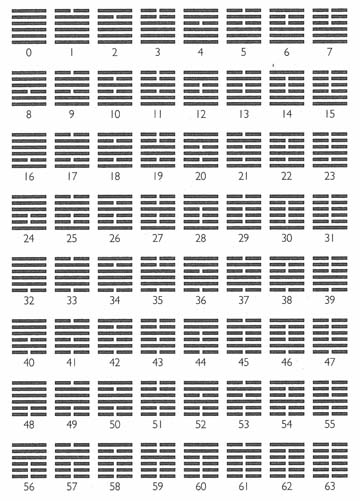
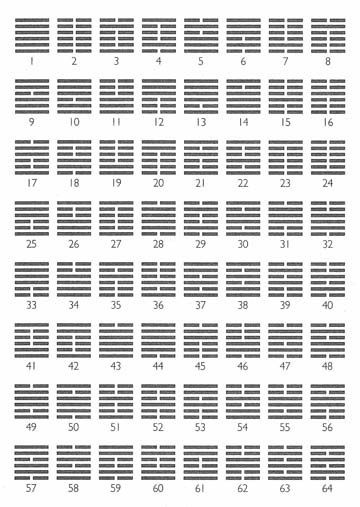
Find your hexagram in the Index and write down the name and number of the hexagram formed.

If the hexagram you cast contains lines that change—meaning old yang or old yin lines—then you need to derive a second hexagram by substituting the opposite line for each of the “old” changing lines. Draw the second hexagram beside your first one. Beginning from the bottom line, copy the lines of the first hexagram. Whenever you arrive at an old yang line, draw a young yin line in its place in your second hexagram. Whenever you arrive at an old yin line, draw a young yang line in its place in your second hexagram. Find the second hexagram in the Index and write down the name and number of this hexagram.

<PART 7>


Approaching the I Ching, Part 5

III. CONSULTING THE I CHING USING THE SIX-WAND METHOD

A. PREPARATION

To prepare yourself for your introduction to the I Ching, we recommend that you follow the suggestions made in Project “X” Symposium III: Solar Teachings of China. Obtain a copy of the Wilhelm/Baynes English translation of the I Ching and use that as your standard text for reference. (All references made to the I Ching in the Project “X” symposium and in this section are to the Wilhelm/Baynes text unless otherwise noted.) Make yourself familiar with the text by reading the Foreword by Carl Jung, the Translator’s Note by Cary F. Baynes, and the Preface and Introduction by Richard Wilhelm—in that order. Then turn to Book II, “The Material,” and read the Introduction, Part I, and Part II in their entirety. Put aside Book I, “The Text,” and Book III, “The Commentaries,” for later reference and study. You may find all this heavy reading, but do not be discouraged. It takes many years to understand the I Ching. The oracle book can be absorbed and understood only through careful reading, deep reflection , and continual use.

Preparing the Circumstances
The technique of consulting the I Ching is not complicated in itself. What is important is to make it work. When you are in possession of the wands and a copy of the I Ching, you are prepared to consult the oracle.

Approach the oracle with respect. When the book is not in use, it is traditional to wrap the book and the wands in silk or some other elegant cloth, and to place the wrapped book and wands on a shelf at about eye level. It is recommended to wash the hands before divination, then to unwrap the book and the wands and to spread out the wrappers before you as you would tablecloths.

The proper approach to the I Ching is as a ritual. All spiritual matters require us to take the first steps. Then there will be a response. The spiritual does not pursue us first. We must initiate the encounter. This is the purpose of ritual. This is the role that ritual has served since ancient times. Ritual is a symbolic language that has to be acted out to have meaning. Look upon ritual as an aid to the psychic processes that play an important role in consulting the oracle. The psyche functions via symbols and understands them. If you speak to the psyche in symbols, it will respond. By the use of symbols, the adept gains access to information that is not available to the average person. Some form of ritual is recommended, no matter how simple. The I Ching will work only if a proper state of mind has been attained. Ritual helps us to achieve this state.

In Chinese tradition, those in authority faced south when granting an audience. Thus during the consultation, you should sit near the center of the room and face north, prepared to receive the instructions of the oracle (the “authority” in this case).

Privacy is essential. Compose yourself in a clean and quiet room. Be absolutely alone. Let no one disturb you. Place the I Ching and the wands before you. It is helpful to have a vase of fresh flowers nearby with a candle and a stick of incense burning. Offer up a prayer or use a short form of meditation to attain a tranquil and reverent state of mind. During this time, formulate the question in your mind.

Preparing the Question
The I Ching should be used to receive answers to important questions. Do not use it indiscriminately. The I Ching helps you to see what forces are at work, how they can develop, and how you can relate to them.

The I Ching is a book of wisdom that can help you make the right decision in harmony with the natural laws of the universe. Therefore, the question you ask of the I Ching should relate to your life as an adept. The question is the point of contact that focuses the images and connects them to your situation. The question is your point of contact with the unknown. You are asking for a deeper understanding on which to base your decision and actions. The oracle’s response to the question you ask will come through the text of one of the 64 hexagrams. The decisions given are for the betterment of the individual and the world community.

It is vital that the question to be asked is clear in your mind. Have a clear concept of what it is you are asking. The question needs to be presented without any form of confusion. Make the question simple and clear. Avoid vague and either/or questions. The more specific your question, the more specific the answer will be. It is better not to ask for a prediction. The best inquiry is for advice. Phrase the question as an inquiry about your situation: “How can I—?” or “What will happen if—?” or “What should my attitude be toward—?” or “What will be the result of—?”

There is no answer until one inquires. You must first approach and inquire in order to receive. You must initiate the encounter. Make a clear and precise formulation of your question in words and write the question down together with the date in a notebook; in other words, a diary. Below the written question, you will record the hexagram once it is cast.

In a single session, ask only one question. The oracle should not be abused by repeating the same question or by asking irreverent or trivial questions. The Commentary warns: If you approach the I Ching a second time, you will not receive an answer.

< PART 6>


Approaching the I Ching, Part 4


CURRENT METHOD: SIX WANDS
It is said that King Wen used tortoise shell wands to meditate on the I Ching. The original wands were made of tortoise shells inlaid with ivory. There were six wands all exactly alike: one side blank and the other side inlaid. Each wand was the sign for a line, and six wands together made a hexagram when they were cast.

Why the Six-Wand Method Is Preferred
We prefer the six-wand method to consult the I Ching because it is the simplest and probably the oldest. With the six-wand method, the hexagram is cast at once in a single moment when the energy is concentrated and correct. There is no conscious mediation. The immediacy of the method cuts through all rational or subjective interference (the methods of counting yarrow stalks or throwing coins each take various lengths of time to determine each one of the six lines in sequence). When casting the wands, there is equal opportunity for any of the four states of a line to appear, unlike both the stalk and coin methods, each of which provide a greater possibility of obtaining lines at rest (7 or 8 ) than of obtaining changing lines (6 or 9).

Design of the Wands
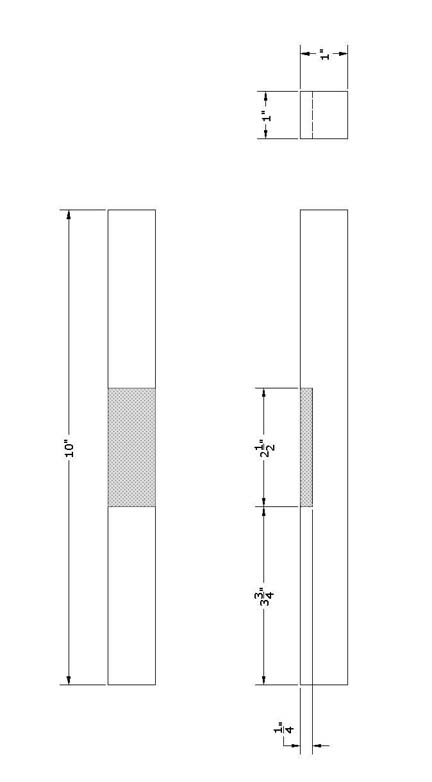
For the original materials of tortoise shell and ivory, we have substituted wood. These wands are ten inches long by one inch wide by one inch high (10″x1″x1″). Any natural wood will do. One side is blank; the other side is inlaid. The wand may be made of lighter-colored wood with a darker wood for the inlay, or a dark wood may be used for the wand and a lighter wood for the inlay. (See the diagram below for precise dimensions). Some care should be taken to use a wood for the inlay that is of the same weight or density as the wood used for the wand in order to avoid “loading,” or unbalancing the wand in a way that makes it more likely that one face appears than the others when the wand is cast. The wands can be finished or oiled for durability and longer life.


Graphic image: Jim Elliott


Though the wooden wands are more cumbersome than coins, they are most effective. We recommend that wands be used rather than sticks or coins. Smaller wands can be made of metal. These need measure only an inch and a half in length, with an inlay of proportions similar to those of the wooden wands. Silver and copper are excellent metals, and the smaller size makes them convenient for travel. Metal wands are preferred over coins.

The Four Movements Represented
When the six wands are cast, the movement is outward, away from you, the one seeking counsel. The direction is outward, into the unknown and toward the oracle for guidance. Keeping in mind the direction outward (upward on this page) and reading from bottom to top, it is easy to see how the images of the line in each wand represents the four changes:

          old yang  literally turns into young yin;

    young yang  literally turns into old yang;

              old yin  literally turns into young yang;

        young yin  literally turns into old yin.

< PART 5 >


Approaching the I Ching, Part 3

C. INSTRUMENTS USED TO FORM A HEXAGRAM

ANCIENT METHODS
The yarrow-stalk method and the coin method are the two methods most commonly used at present in the Western world.

Fifty Yarrow Sticks
The yarrow-stalk oracle became popular about three thousand years ago during the Chou dynasty . In early Chou times, yarrow stalks and tortoise shells were consulted equally by the soothsayers employed by the Chou state, who continued as a class descended from their Shang ancestors until the tortoise shell oracle finally disappeared. The elaborate present-day method of consulting the oracle by manipulation of yarrow stalks was apparently not in use in early Chou times. At first, the yarrow stalk method seems to have been a sort of drawing of lots, in which long stalks meant a positive answer and short stalks a negative. Then, at some period of time when the two fundamental forces were seen to be of equal rank, two short stalks were made to equal one long stalk and, in accord with the still more ancient concept that heaven is one and earth is two, the two stalks were used together to represent the yin force.

Yarrow (Achillea millefolium) stalks were easier to use than animal bones and tortoise shells. The stalk of the yarrow was firm and durable and remained unwithered for a long time. It was tall and straight and could be prepared for use with little manual labor. The ancients came to consider it a divine gift bestowed upon humanity so that men could communicate with heaven. It was natural that yarrow stalks were chosen to be used for oracular purpose in ancient times. At that time yarrow grew wild in the commons that were set apart for sacred rituals. From the time that the commons no longer served this sacred role, it became customary to gather yarrow stalks from some other hallowed place such as the grave of Confucius or Mencius.

According to Chou tradition, people of different social strata received yarrow stalks of different lengths to divine with. According to The Book of Rites of the Chou Dynasty, yarrow stalks of nine chi (one chi equaling approximately one foot) were relegated to the emperor, of seven chi to a duke or prince, of five chi to a high official, and of three chi to a scholar. (No length was relegated to the common people in The Book of Rites.) At that time, divination was a social event, a ritual for seeking harmony between heaven and humans. People gathered to watch the diviner and his attendants. Later, when divination became a personal affair, the yarrow stalks became shorter. Today it is not easy to find fifty yarrow stalks, and people tend to use substitutes they are comfortable with.

Fifty yarrow stalks make the set used for consulting the oracle. One stalk is set aside at the beginning of the procedure and plays no further part. (Exact instructions for consulting the oracle through the yarrow-stalk method are available in nearly every modern English edition of the I Ching. These modern instructions are based on the instructions given in the Great Treatise that is attributed to Confucius, chapter IX.3–6.) Manipulating the stalks three times produces one line. For the six lines of a hexagram, one needs to manipulate the fifty yarrow stalks eighteen times. To obtain a six-line hexagram takes at least half an hour. Most modern commentators suggest that the thirty minutes it takes to consult the oracle using the yarrow-stalk method should be used to meditate, and they consider that the repetitive process of separating, dividing, and counting the yarrow stalks introduces a deeper level of awareness.

According to the specific method of triple counting used in the yarrow-stalk method, the stalks are counted off to obtain the number values 6, 7, 8, or 9 for each of the six lines of a hexagram. It is in this way that the numbers assigned to the lines in a hexagram—6, 7, 8, or 9—were derived from the yarrow-stalk oracle. The assignment of these symbolic numbers was the contribution made to the Changes by a school of natural philosophers from the end of Chou times who were in line with the tendency of their age toward systemization. Yang was given 7 for a symbol and yin was given 8; a yin and yang together made fifteen; yang transforms 7 to 9 and yin transforms 8 to 6, and together the transformed numbers also made fifteen; thus the sum of the symbol and the sum of the transformed symbol were the same. These numbers continue in use today to represent the changes.

Using the yarrow-stalk method, the mathematical probabilities are asymmetrical. There is a greater possibility of obtaining a resting line (7 or 8 ) than there is of obtaining a changing line (6 or 9).

Yarrow Stalk Method Probability

Yarrow-stalk method probability

Yin / Yang

Number

Symbol

1/16

old yin

6


3/16

old yang

9

5/16

young yang

7

7/16

young yin

8

Three Coins
During the Tang dynasty (618–907 CE)—more than two thousand years after the I Ching was written—a simpler way to consult the oracle was devised, using three coins. The description of the process appears in the Tang-era book The Correct Significance of Rites. The coin method became popular during the Sung dynasty (1127–1279 CE) after it was promoted by Shao Yun, the most prominent I Ching scholar of this time. Traditionally, three of the old-type Chinese coins, with a hole in the middle and inscribed on one side and blank on the other, were used for this purpose. The procedure involves throwing three coins six times; each throw obtains a line. (Exact instructions for the coin method are found in nearly every modern English edition.) The entire procedure takes only a few minutes.

The coin oracle yields results more quickly than does the yarrow-stalk method; however, it too has a particular bias: the probability of obtaining changing yin and changing yang lines is equal, and the probability of obtaining a stable yin and a stable yang line are equal, but the probability of obtaining a stable line is greater than the probability of obtaining a changing line.

Three-coin Method Probability

Three-coin method probability

Yin / Yang

Number

Symbol

2/16

old yin

6

2/16

old yang

9

6/16

young yang

7

6/16

young yin

8

In addition to these methods, some modern commentators encourage even shorter methods that will result in only one changing line, so that the process and the interpretation are simplified (I would say over-simplified), so that the interpretation of the answer will not become too complex for modern Westerners who consult the I Ching.

The six-wand method dispenses with biased probability and returns to the changes of the I Ching equal dignity with stability.


Probabilities for Various Methods of Divination

Yarrow-stalk method probability

Three-coin method probability

Six-wand method probability

Yin / Yang

Number

Symbol

1/16

2/16

4/16

old yin

6

3/16

2/16

4/16

old yang

9

5/16

6/16

4/16

young yang

7

7/16

6/16

4/16

young yin

8


< PART 4 >


Approaching the I Ching, Part 2

II. METHODS USED TO RECEIVE AN ORACLE

A. ARCHAIC ORACLES: BONES AND TORTOISE SHELLS
The practice of divination in China long predates the I Ching. At the ancient site of Yin in Hunan Province, once the capital of the Shang dynasty (1766–1122 BCE), one hundred thousand pieces of inscribed bone were discovered at the turn of the twentieth century and later identified as the royal records of divination of the Shang Court. The Court of Shang divined with tortoise shells. The Chinese scholar Alfred Huang explains (Huang, p. 2): “In matters of grave import, such as seasonal sacrifice ceremonies, expeditions, royal enthronements, weddings, and hunts, and even weather, the augur would be asked to divine whether there would be good fortune or misfortune. The procedure of divining with tortoise shells was complicated. In most cases the belly surface of a shell was used. The shell would be prepared by drilling and chiseling with a tiny stylus; then the shell was heated until cracks appeared. By reading the patterns of the cracks, the augur interpreted the oracle.” The auguries contained in the Tuan (Judgments) texts of the I Ching—”good fortune,” “misfortune,” “remorse,” “humiliation,” and others—are reminiscent of the tortoise oracle.

B. THE ANCIENT AND MODERN ORACLE: THE 64 HEXAGRAMS
The conceptual basis of the I Ching begins with original limitlessness and the principle of the One. The One is represented by the line. This line, which in itself represents oneness, at the same time posits the opposites: the positions above and below, right and left, front and back.

The 2 Lines
The first movement out of limitlessness is the world of polar opposites. These opposites are represented as an unbroken line: , called yang, and an open line:  , called yin. Each of these two lines has two states of being, one of rest and one of movement. In the process of change, these lines transform into their opposites. The balance of these opposites is in constant flux. At some time in antiquity, these two sorts of lines were given the names “firm” and “yielding.” The firm line (yang) has unity as its quality; the yielding line (yin) is open to receive. The names firm and yielding describe one of the aspects of polarity. In the older strata of the I Ching, these are the names given most frequently to the two fundamental forces. The Great Commentary makes frequent use of these two names.

The polarity of these two forces is built into the I Ching. It does not indicate rigidity or a pole around which cyclic movement turns but rather a dynamic energy field, like the polarity of a magnetic field, that determines the process of change and evokes it.

The 4 pairings
The four (22) possible pairings of these two lines represent the initial interaction of the opposites, which are commonly called yin and yang.

The 8 trigrams
The four pairs of lines recombine with the primary yin and yang lines to express a further level of complexity (23). This set is called the eight trigrams.


The 64 hexagrams
The number of the eight trigrams squared (82) generate the sixty-four hexagrams. The sixty-four situations of the I Ching are each represented by a complex of six lines in which each line carries a polar tension and expresses this tension, and the sixfold combination of the polar forces defines the situation.

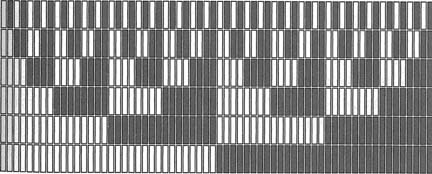
The Early Heaven hexagram arrangement, of unknown antiquity, follows a binary number sequence and is attributed to the legendary Fu Hsi (mid-29th century BCE).

Early Heaven Arrangement


This illustration, based on a drawing by the Sung philosopher Shao Yung (1011–1077 CE), depicts the binary scheme of the Early Heaven sequence generated from yang (white) and yin (black) lines. On the left are the six yang lines that generate Hexagram 1. On the right are the six yin lines that generate Hexagram 64 in the Early Heaven sequence.


The Early Heaven sequence was later revised. The revised sequence, known as the Later Heaven sequence, is attributed to a feudal prince of the Chou era (1046–256 BCE) posthumously known as King Wen.

Later Heaven Arrangement

The Later Heaven sequence remains in present use. In this sequence, the hexagrams are arranged in pairs of opposites. Overall, the Later Heaven sequence begins with the opposite pair of all yang lines (Hexagram 1) and all yin lines (Hexagram 2) and ends with perfect alteration of yin and yang lines (Hexagrams 63 and 64). The sixty-four hexagrams have names or titles. It is not known whether King Wen named them or whether he used preexisting names.

The hexagrams represent situations; the appended names characterize the situations; these names and the linear complexes to which they are appended frame the subject matter of the book. Each hexagram in the I Ching has three core texts:

1. The Statement or Judgment: The brief text at the beginning of each hexagram, often rhymed, called Tuan, sums up the situation. Tuanis translated into English tentatively as “Judgment” or “Decision.” This text is attributed to King Wen.

2. The Line Commentaries: A second text, Yao, adds words to each of the six lines of each hexagram. This text is attributed to King Wen’s fourth son, the Duke of Chou (mid-11th century BCE).

3. The Image: A third text, of more recent date, called Hsiang, “Image,” starts from the meaning of the linear complex and applies the meaning of this complex to a human, social, or cosmic situation in the form of advice addressed to a “noble one” or “superior man.” This text is attributed to Confucius (551–479 BCE).

< PART 3 >


Approaching the I Ching, Part 1


I. APPROACHING THE I CHING

A. WHEN TO APPROACH THE I CHING
The Book of Changes contains a fourfold tao of
the holy sages. In speaking, we should be guided by
its judgments; in action, we should be guided by its
changes; in making objects, we should be guided by
its images; in seeking an oracle, we should be guided
by its pronouncements.
Therefore the superior man, whenever he has to
make or do something, consults the Changes, and he
does so in words. It takes up his communications like
an echo; neither far nor near, neither dark nor deep
exist for it, and thus he learns of the things of the future.
—Great Treatise, chapter X.1–2

The I Ching is not a fortune-telling book. It is a book of oracles, so it should be used only for answers to important problems. It is a book of wisdom, and it can help you make the right decision in harmony with the natural laws of the cosmos. The questions you ask of the I Ching should relate to your life as a solar adept. The decisions given are for your betterment and the betterment of the world community. In this sense, it is a book of proper conduct, moral codes, and ethics. When you already know what you should do in a situation, you should not consult the I Ching. Consult the I Ching only for important questions and events and never for mean purposes or with selfish motives.

B. WHO SHOULD APPROACH THE I CHING
In the Book of Changes it is said: “He is blessed
by heaven. Good fortune. Nothing that does not further.”
The Master said: To bless means to help. Heaven
helps the man who is devoted; men help the man
who is true. He who walks in truth and is devoted in
his thinking, and furthermore reveres the worthy,
is blessed by heaven. He has good fortune, and there
is nothing that would not further.
—Great Treatise, chapter XII.1

The I Ching is a religious book, alive with a soul that puts man’s Consciousness in contact with forces outside the range of the rational mind, and it is only as reliable as the individual into whose hands it is placed. To cast a hexagram and read the commentary on that hexagram does not mean that you understand the I Ching or that it is working for you. The I Ching in the hands of an adept is one thing; the I Ching in the hands of a person who approaches it with no understanding is something else.

The I Ching teaches that a person’s first duty is to live in accordance with heavenly laws. Knowledge of these laws is always taught by a School of Light. A person who lives in accordance with heavenly law and wishes to know whether it is right or wrong to make a movement or to make a decision on an important matter may consult the I Ching. The I Ching is not to be used indiscriminately. If the I Ching is approached properly with ritual and ceremony, it will never fail you.

C. WHAT THE I CHING IS
The Master said: The Changes, what do they do?
The Changes disclose things, complete affairs, and
encompass all ways on earth—this and nothing else.
For this reason the holy sages used them to penetrate
all wills on earth and to determine all fields of action
on earth, and to settle all doubts on earth.
—Great Treatise, chapter XI.1

Nature and man can and do influence one another. The ancient Schools of China taught a System by which each student became adept at collaborating with nature and harmonizing with its forces and, above all, knowing when to act and when not to act. Fortunes, health, and accidents are all determined by timing; so knowing when to act and how to act is important. If you know how to act, you can to large degree dictate what happens to you. Learning how to pace yourself and live in accordance with natural law determines how happy you are going to be, what you are going to get out of life, and what you can give back to it. This is the secret of the I Ching.

In the proper hands, the I Ching is an oracle book and a book of wisdom that can assist an individual to project his or her Consciousness into the cosmos. Like dreams, the I Ching uses symbols. Its exact workings is a profound psychological study in itself. The I Ching goes beyond the range of the rational mind, ordinary consciousness, and awareness of the ego. The I Ching deals with cosmic Consciousness and the deep layers of the psyche. When one enters the world psyche or the world of cosmic Consciousness, one goes beyond the rational concepts of beginning, middle, and end, and one enters into a world where past, present, and future are one and the same.

All life is like the time continuum: it is an interrelated superstructure of psychophysical mind. The ancient Chinese used a cryptic symbology and allegory to signify these interrelations. The Chinese System organized heaven and earth, sun, moon, and stars into divisions of symbols and signs. The sages recognized that nature worked in a certain way; they knew how to act and when to act, and everything they did was done in accordance with the force they wanted to bring out. When the adepts wished to know whether it was right or wrong to make a movement or decision on an important matter, they would consult the I Ching.

If you do not have the key, you cannot understand the writings. Much of the ancient teachings was handed down orally, and much has been lost in the literal translation of the works. To cut through the coding used by the writers, one needs to insert the keys of The System of our own School of Light.

The rational mind works with the forms and images of the sensory world; it cannot fathom the language of the Unconscious. The trigrams and hexagrams of the I Ching represent archetypal symbols that are allied more with intuition than with rational awareness. These symbols are coded, and although they are deciphered by the psychic faculties, the rational mind is not always able to grasp their meaning—and it is actually not important that it does. So to prevent unnecessary conflict in the perpetual battle between the psyche and the rational mind, we recommend that you follow the suggestion made in The Project “X” Solar Teachings of China and do not be overly concerned initially with trying to understand the workings of the oracle book. The essentials for approaching the I Ching are presented in that Project “X” symposium. This supplement provides further background on the I Ching and detailed instructions for casting hexagrams with the six-wand method and reading the hexagram that is cast.

The I Ching, or Book of Changes, has been used for many thousands of years, and it is still being used today in both East and West. In the English-speaking West, the standard text most often used is the Wilhelm/Baynes edition. This is the translation referred to and quoted from in this supplement. It is recommended that you study this standard text and various other books that comment on the I Ching for a better understanding of how the System of the I Ching works.

< PART 2 >


Summer 1999

During the month of May, the Community remembered in Communion Prayer Estella Heavener, the mother of  the Reverend Carol Ann Crabb, who passed away on May 2, and Jo Ann Marie McIntyre, the mother of Deacon Michael McIntyre, who passed away on May 20.

*

On June 3, 1999, the second luncheon gathering of Reno-Sparks religious leaders was held, this one at Temple Sinai at the invitation of Rabbi Myra Soifer. This gathering represented primarily clerics, with about thirty in attendance, including the Reverend Robert Petrovich from the Second Advent Church, while the first such meeting included more attendees from service organizations and missions. Following lunch, table groups formed to discuss possible goals and purposes for the continuance of such interfaith gatherings.

While there was no formal general consensus, there was general agreement that similar gatherings should continue quarterly, hosted by the various religious groups involved, on a rotating basis, and that the host should take the opportunity to introduce those gathered to his or her ministry and religious customs. There was a strong consensus that no strict agenda or organization or guidelines be developed for the gatherings but rather that the gatherings be kept informal and open-ended tp encourage individuals to get to know each other by name and face, learn to trust each other, and discuss possible coprojects with the idea that there is a great value in encouraging trust, colleagueship, and fraternal and sororial feelings toward other leaders in the religious community.

This was decided because all present recognized that there were really very few places and circumstances that allowed religious professionals to discuss spiritual matters and religious concerns in a personable environment. There was also mutual agreement that anything that developed during these gatherings should develop naturally, that nothing be forced, and that developments be progressive and not be “decided by committee.” Both of these principles have continued to be held until the present.

While several of the founders of this interfaith gathering have retired or passed on, others have risen to take their places, and the Second Advent Church continues to be active and central to the organization.

*

On Friday, July 2, 1999, Bishop Gene Savoy delivered the first of the twenty-four lectures of the Project “X” series on Metaphysics, Philosophy, and Mystic Theology under the auspices of the American Philosophical Institute of Cosolargy. The series, dealing primarily with the teachings of ancient Greece and Egypt, presents advanced theories of the ancient metaphysical teachings that centered on theophany and the personal experience of God’s powers, which involved the priestly science of theurgy. Little-known concepts are also highlighted in a way that “takes down the wall” built around the ancient philosophies of Greece and Egypt by secular authorities. With this series, the science of Cosolargy, which is based on old and new concepts and revealed information, penetrates the arcanum of the mysterious science of ancient metaphysics.

*

The Reverend Deaconess Victoria Skinner passed away on Wednesday July 28 at 8:00 p.m. at Manor Health Care Services in Reno.