Christmas Message December 25, 2009
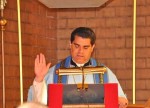 On Friday December 25, 2009, Bishop Gene Savoy Jr. delivered a Christmas message during the traditional holiday Communion of Fellowship Service at the Chapel of the Holy Child. A slightly edited version of the message is provided here:
Good morning and Merry Christmas!
Those of us gathered together in this Chapel dedicated to the service of God are drawn together from many faiths, but we are all one in the family of God.
We celebrate today as the birthday of the man Jesus. For twelve days, we of the Second Advent Church celebrate the Christmas Season, which culminates on the thirteenth day—January 6—the Day of Epiphany.
Epiphany comes from the Greek, meaning “manifestation” or “appearance,” and in the early Church, January 6 was the day that commemorated Jesus’s baptism at the Jordan by Saint John. The day celebrates the “shining forth” [another meaning of epiphany] or revelation of God in human form in the person of Jesus Christ, his manifestation as the Son of God to the world—the Word of God incarnate. The date of Epiphany on January 6 was very early fixed, and ancient liturgies speak of Illuminatio, Manifestatio, Declaratio: Illumination, Manifestation, and Declaration. The Gospel of Matthew [3:13-17] says:
Then Jesus came from Galilee to John at the Jordan, to be baptized by him. John would have prevented him, saying, ‘I need to be baptized by you, and do you come to me?’ But Jesus answered him, ‘Let it be so now; for it is proper for us in this way to fulfill all righteousness.’ Then he consented. And when Jesus had been baptized, just as he came up from the water, suddenly the heavens were opened to him and he saw the Spirit of God descending like a dove and alighting on him. And a voice from heaven said, ‘This is my Son, the Beloved, with whom I am well pleased.’
And the Gospel of Luke [3:21-22] says,
Now when all the people were baptized, and when Jesus also had been baptized and was praying, the heaven was opened, and the Holy Spirit descended upon him in bodily form like a dove. And a voice came from heaven, ‘You are my Son, the Beloved, with you I am well pleased.’
But a very important line has been deleted from both Matthew and Luke—one which is substantiated by other ancient scriptures more authoritative than Matthew and Luke. The line reads:
Today [or This day], I have begotten you.
So, let us read this again:
You are my son, the Beloved, with whom I am well pleased. This day I have begotten you. [Emphasis added]
In the ancient Christian Church, just as in Buddhism, this divine event—this “appearance” or “epiphany”—was a manifestation of Jesus’s immortal nature. The day commemorated the incarnation of Jesus as Christ, the moment when God appeared in Divine Light and ordained Jesus His son in Spirit. Thus, Jesus was given a new birth by God the Father. So we know that Jesus was not “born” the Son of God, but became the Son of God when the Word, the Divine Logos, incarnated within him, giving him new life of spirit. This was a fundamental concept in the Messianic or First Advent Church: that Jesus became Christ. And this is why Epiphany and the Christmas-Epiphany Season is so important to us, because it represents and symbolizes the birth of spirit—the epiphany of the Conscious Soul.
I made the reference to Buddhism because while Buddhists celebrate the birthday of Siddhartha Gautama on April 8, the day of his “enlightenment”—the day when he became the Awakened One, Bodhi Day—is honored on December 8 at sunrise. And, of course, we do this in the Second Advent Church. We honor the birth of the man Jesus on December 25, the old Roman festival of the Unconquered Sun, but more importantly, we celebrate Jesus’s spiritual birth—the day when the Word of God entered into him and he assumed the Holy Office of Christ. This we do on January 6 as a promise of the spiritual rebirth we are all heir to in the Second Advent of God’s Appearance.
Now, this morning, we learned of the passing of one of our Sisters in Light, Theresa Andronis. I was thinking of her first thing this morning, at about 6 a.m., and we learned that she passed shortly thereafter. This morning, we saw various forms and figures in the sun, and I felt her presence very strongly. So, while we may miss the human being Theresa, we know that she has ascended into the Light, and how fitting that she should transfigure as we begin our Epiphany Vigil, when we celebrate the birth of the Conscious Soul. We are also reminded that her pain and suffering has been conquered and that she is one with the Holy Beings of Light.
In hellenistic times, an epiphany of the divine in a person was a common theological concept. The celebration of Epiphany originated in the ancient Church, where it later included a commemoration of Christ’s physical birth in the Eastern Church. In Rome, however, by the middle of the fourth century, Christ’s physical birth was being celebrated on December 25, according to the Philocalian calendar.
A winter festival was the most popular festival of the year in many cultures. Reasons included the fact that less agricultural work needed to be done, as well as the expectation of better weather as spring approached.
The twenty-fifth of December was the Roman festival marking the “birth of the Unconquered Sun,” the natalis solis invicti, which celebrated the winter solstice and the lengthening of days. This celebration allowed several solar deities to be worshipped collectively, including the Syrian sun-god Elah-Gabal. It was also observed as the birth date of the god Mithras, the “sun of righteousness” and patron god of the emperors, who, five hundred years before the birth of Christ, was born of a virgin in a cave. We know that it was also connected in the Roman world to the saturnalia, a time of merrymaking and the exchanging of gifts. Charity was also emphasized as part of the Roman New Year.
The festival was placed on the date of the solstice because this was the day that the sun reversed its southward retreat and proved itself to be “unconquered.” Several early Christian writers connected the rebirth of the sun to the birth of Jesus. John Chrysostom wrote, “They call it the ‘Birthday of the Unconquered.’ Who indeed is so unconquered as Our Lord?”
Northern Europe celebrated a winter festival called Yule, held in late December and early January, and its traditions had a major influence on Christemasse or Christ’s Mass.
In the old Christian calendar, November 28 through January 6 was observed as the Festival of Lights, a vigil for the birth of the Cosmic Christ. Japanese Shintos honor the sun goddess Amaterasu on December 22. In ancient Egypt, December 21 to December 25 was the festival commemorating the birth of the god Horus by the goddess Isis; and in the Hopi nation, December is celebrated as a time of purification and renewal. So we can see that this time of year is universally recognized as a time when we come out of the darkness into light.
The contradiction between the Greek and Roman Churches led to a great debate in the fourth and fifth centuries, which culminated in the Eastern Church accepting the twenty-fifth of December as Christ’s birth and the Western Church celebrating Epiphany as the day the Magi visited the infant Jesus.
In the Second Advent Church, we honor both days and celebrate the Christmas-Epiphany Season from December twenty-fifth through January sixth. We commemorate Christ’s birth in physical form, but, as we have said, more importantly, we solemnize his spiritual rebirth.
Therefore, the message of the season is life of spirit. That was the essence of Christ’s teaching. And this is what the Christmas Season represents: Life, Birth and Rebirth – the cycle of renewal.
The lights and trees we display this time of year have always been symbols of everlasting life. In ancient Egypt, China, Israel, and the Celtic lands, evergreen trees, wreaths, and garlands were symbolic of eternal life. To us in the Second Advent Church, they also represent the True Light of God and the Tree of Life.
In the Middle Ages, Christmastide, or the period from the night of December 25 through the morning of January 6, was a period of continuous feasting and merrymaking. Twelfth night, or Epiphany Eve, as we call it, was forever solidified in popular culture when William Shakespeare used it as a setting for one of his most famous stage plays. In those times, Christmas was overshadowed by Epiphany.
American colonists brought their version of the Twelve Days over from England and adapted them to their new country, adding their own variations over the years. The modern-day Christmas wreath, for example, originated with these colonials. A homemade wreath would be fashioned from local greenery, and if fruits were available, they would be added. Making the wreaths was one of the traditions of Christmas Eve; then they would be hung on each home’s front door on Christmas Day, the First Day of Christmas, through the morning of Epiphany, when a special Epiphany cake was baked and all the remainder of the edibles from the previous twelve days consumed.
As said, this was a time of feasting, merrymaking, and otherwise celebrating the season. Sometimes gifts were exchanged each of the twelve nights and a candle lit each morning of the Twelve Days. And the evening before Epiphany was celebrated as the biggest night for dancing and gift-giving.
However, after the Revolution, Christmas and the Twelve Days fell out of favor in America because it was considered an English custom. It was not until the 1820s, when anti-British sentiments were fading, that people began to worry that Christmas was dying out. Writers, including Washington Irving and Harriet Beecher Stowe, imagined Christmas in Tudor days as a time of heartfelt celebration, and efforts were made to revive the holiday. Charles Dickens’s book A Christmas Carol played a major role in reinventing Christmas as a holiday emphasizing family, goodwill, and compassion, as opposed to communal celebration.
Latin nations also have various forms of celebrations for the Twelve Days of Christmas, the most popular being the cooking of traditional foods to celebrate Epiphany. In Hispanic America, a rosca de los reyes – a king cake – is baked. In France, a galette des rois is baked with a small china figure of the Christ-child inside. In some countries, children polish and leave their shoes by the doorstep, bed, or tree, ready for presents, before going to sleep on the eve of January 6. And in Italy, the tradition of La Befana, whose name is taken from the word Epiphany, is the bringer of gifts who arrives on the eve of Epiphany.
With the onset of more Americanized and secular traditions throughout the past two centuries, the traditions of the Twelve Days of Christmas have been largely forgotten. Indeed, contemporary marketing and media tend to espouse the erroneous belief that the Twelve Days end on Christmas, rather than begin on it. However, we of the Second Advent Community have held to our own favorite ways to celebrate the Christmas-Epiphany Season.
This year, let us concentrate not on gifts and splurging but on what is important : family and friends. These are hard times, and it’s not bad for children to understand the concept of hard times. With respect for what people are going through, we have forgone the traditional Christmas Eve dinner and New Year’s festivities that we have commonly celebrated. We will, of course, have the children’s tea and our Epiphany Eve banquet, but this year is a year to be frugal. I encourage you all to bear that in mind. Be sparing with your spending and hold to the family—the family of the community—that is truly important. That is the biggest gift we have been given, along with the gift of the Sun of Righteousness.
We are all both mortal and immortal beings. And as we feed our physical bodies we must also feed our spiritual bodies. Listen to the message conveyed by these words from the Odes of Solomon [Ode 38] that we recite at Christmastime.
I rested in the spirit of the Lord: and the spirit raised me on high. And made me stand on my feet in the height of the Lord, before His perfection and His glory, while I was praising Him by the composition of His songs.
The spirit brought me forth before the face of the Lord: and although I was a son of man, I was named the illuminate, a son of God. For according to the greatness of the Most High, so He made me: and like His own newness He renewed me, and He anointed me from His own perfection.
And I became one of His neighbors; and my mouth was opened, like a cloud of dew. And my heart poured out as it were a gushing stream of righteousness.
And my access to Him was in peace; and I was established by the spirit of His kingdom. And I went up to the light of truth which preserved me. And it became to me a haven of salvation and set me on the arms of immortal life.
Love begins in our family life, reaches out to our friends, and embraces our neighbors. Like a seed it must be planted before it can grow. Also, like a seed, it must be watered if it is to grow. A seed unwatered for many years will still grow many years later if it is given that precious and vital resource. If we can express love as we do at Christmastime throughout the whole year, we will begin to live the life exemplified by Jesus.
So let us each examine our hearts. The world and our flawed mortal natures take away our ability to love one another at times. This inability harms the spirit. Each one of us should strive to rise above the limitations of the physical world and embrace the spirit, which is expressed by love. By so doing, God comes to each of us, adopting us as His son or daughter; for we are all Children of God.
That is the message this Christmas Season. Let us make a commitment to each other today to love one another however unable we may have been able to previously express that love. We need to too. Let us make a commitment to forgive the transgressions of those we love and to apologize to those whom we may have transgressed upon. I certainly apologize to any of you I may have hurt this year and ask for your forgiveness.
In lighting the candles today in remembrance of those who have gone on to another life, let us place our trust in God who is the author of our spirit and soul. When death claims our physical bodies, it is the spirit and soul that endure and go on to a higher world if we can but experience the rebirth of spirit the we celebrate on January 6 . But if we not love – even if that love is not accepted – our spirits fade like a flame, ultimately going out. Love kindles and brightens the spirit and the soul. By loving we are made eternal, for God is Love. Love binds us to those departed, to those about us while we live, and it binds us to God. For if we do not have love, compassion, and kindness in our hearts, how can we ever hope to know God? There is no enmity so hard that goodness cannot melt.
Therefore, on this day commemorating the birth of Jesus, let us make a renewal to exemplify what he taught. This, I believe is the message of the Christmas Season: to open our hearts, forgive the transgressions of our loved ones/brothers and sisters, and love one another. To quote a line from one of the late Bishop’s previous Christmas sermons: “All men and women everywhere may shine forth as the Sun of Righteousness if they but live and exemplify the love of God in their daily lives.”
We should be proud of our accomplishments in this Community. Christmas is a time for celebration. So let’s celebrate! Let’s celebrate our Teaching; let’s celebrate our fellowship; and let’s celebrate our love for one another. The world is a crazy place. It is hard to find the friendship and the fellowship and the love that we experience in this Community, in spite of our familial difficulties sometimes.
This Community is moving forward, and we are growing. We are no longer concerned with merely surviving—those days are over. Not to say that we won’t have our ups and downs from time to time. But let’s celebrate the fact that we are here, that we are established in this world, and that we are a beacon of light to those who seek the Light.
Allow me to close this Christmas message with these words from the Gospel of John:
As the Father has loved me, so have I loved you; abide in my love.
If you keep my commandments, you will abide in my love, just as I have kept my Father’s commandments, and abide in his love.
I have said these things to you so that my joy may be in you, and that your joy may be complete.
This is my commandment, that you love one another as I have loved you.
No one has greater love than this, to lay down one’s life for one’s friends.
You are my friends if you do what I command you.
I do not call you servants any longer, because the servant does not know what the master is doing; but I have called you friends because I have made known to you everything that I have heard from my Father. [John 15:9-15]
I wish you all a very merry Christmas, a happy Epiphany, and a joyous New Year, filled with God’s many bountiful and beautiful blessings. Let us go forth from this place with renewed resolve to take the message of the Second Advent to all the world in greater power and glory, each of us shining like the Sun of Righteousness and striving to exemplify Christ in our daily lives.