A Note on Homogenesis, Part 1


Il nous est souvenu du lieu natal
o nous n’avons naissance

[With us is remembered the natal place
where we were not born]

— St. John Perse, Amers, IV
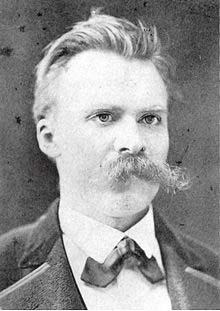
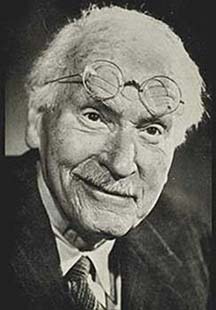
The process of human generation is psychic as well as physical. The fact of psychic phylogenesis was corroborated in clinical research a generation ago by the analytical psychologist Carl Jung. The dialectical process itself was intuited by the philosopher Friedrich Nietzsche three generations before that. Many years ago, as a university student, I traced out the principal facts of human genealogy in Nietzsche’s pages without complete awareness of their significance. I trace them again here, in these pages, with, I hope, more understanding.

In Beyond Good and Evil, section 257, Nietzsche observed:

Let us admit to ourselves, without trying to be considerate, how every higher culture on earth so far has begun. Human beings whose nature was still natural, barbarians in every terrible sense of the word, men of prey who were still in possession of unbroken strength of will and lust for power, hurled themselves upon weaker, more civilized, more peaceful races. . . . In the beginning, the noble caste was always the barbarian caste: their predominance did not lie mainly in physical strength but in strength of the soul–they were more whole human beings (which means, at every level, “more whole beasts”).

Foreseeing objections, he added in section 264:

One cannot erase from the soul of a human being what his ancestors liked most to do and did most constantly. . . . It is simply not possible that a human being should not have the qualities and preference of his parents and ancestors in his body, whatever appearances may suggest to the contrary. This is the problem of race.

In section 260, he had already stated:

There are master morality and slave morality – I add immediately that in all the higher and more mixed cultures there also appear attempts at mediation between these two moralities, and yet more often the interpenetration and mutual misunderstanding of both, and at times they occur directly alongside each other – even in the same human being, within a single soul. (SeeSupplement 1)

This invention of history, the subjective relationship of master and slave, predator and prey, grows into a conjugal relation which seems to me no less fantastic than the inventions of biology: Two peoples become absorbed in one another, they mingle and exchange what is in them, until they evolve or become a new kind of human being, collectively and individually.
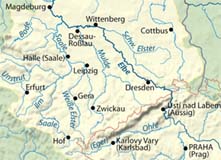
The triangle of European plain below the Baltic Sea, delimited on the west and east by the rivers Saale and Elbe and on the south by the Ore Mountains. PHOTO: Wikipedia

On a triangle of European plain in the fifth century of our era, such a relationship was consummated along the banks of the Elbe River between the Alan Serb and a handful of Western Slavic tribes. From that moment in time there has been the Sarmatian Slav – the East Alan Slav – identified in our time as the Serbian. Before that moment there had been two separate series of parental incarnations. On the paternal side, the Sarmatian East Alan, it is said, arose through a genealogy of cultures and races from the early nomads of the North Kazakhstan steppes, who themselves had derived from others who had peopled the Androvian or Alarodian culture of the Bronze Age, and earlier, from some as yet unknown people of neolithic times. On the maternal side, the Western Slav, through a vague genesis of circumstances and events, derived from the primordial Slav, the first Slavic race, who was born to a mother race sometimes called the “Veneti” and a father who is still anonymous to us.

This remembrance (I do not hesitate to use this ghostly noun) has not only convinced me of the barbaric origin of my mundane soul and human nature, my homogenized supersentient anima; this remembrance has also brought me face to face with the fact that my psyche is, among other things, a juncture and a blend of the mentalities, cultures, and primal natures of overlord and subject, master and slave, predator and prey. I am awed by the mere fact of this fierce marriage, but moreso by its proximity in time. Fewer than fifty or sixty couplings separate me from the origin of what nineteenth century historians had called my “nationality” and what twentieth-century anthropologists call my “racial stock.” The number of couples, men and women, involved in the direct line of my ancestral descent from that distant point of origin on a central European plain is fewer than the number which I, with modest means, might entertain at my own wedding. So it is with us all. No one alive – no one who has lived – escapes this sequence or this pattern. What a miscarried world that exists and reproduces itself in so rude a manner!

I offer these pages as an analogy, and my countenance as a parallel, to the reader’s own. The origin of every person of European descent is subject to the same irrefutable laws and is a reflection of similar ignominious events. What happened, for better or for worse, during the fifth and sixth centuries of our era to create the modern Serb and the Croat (See Supplement 2), the Pole and the Old Russian (both new and separate breeds of the Slav and the West Alan), the Avarized Slovene and the Germanized Czech, happened, in kind and at about the same time, to create the Bulgarian, the Rumanian, the Hungarian, the Spaniard, the African Berber, the North Italian, the English, the Swiss, the French, and another of the more recent complexions of the Russian (See Supplement 3); and what happened to create them happened also at other, earlier, times to create the Lapp, the Finn, the Basque, the Greek, the Irish and Scot, the German, the Scandinavian, and the Frison of the Netherlands. The same holds true for any of the myriad peoples who inhabit the valley of Mesopotamia or the Iranian plateau. Several times each millennium a new predator race drives out another from the steppes to introduce a new complication to the human event. (About 560 CE one of the most recent strains of the Turk sprang up there and extended itself, over a thousand years, across half of Europe.) The Indian and the Chinese, since neolithic times, have been shaped and revitalized continuously by the antagonists of the north and the south. The African, the dweller on the coast of Asia, the islander of Oceania, the American of pre-Columbian times – all are inventions of other rude, and nearly timeless, marriages.

Robert Petrovich 1995


< Read Part 2 >


POSSIBLE BOOKS: Carl Gustav Jung: The Collective Dream, Part 6

CONTENTS

PROLOGUE: “The Work of Art” (from CW 15)

PART I: LITERATURE: THE COLLECTIVE DREAM

THE RELATION OF ANALYTICAL PSYCHOLOGY TO POETRY
Chapter 1: “On the Relation of Analytical Psychology to Poetry” (from CW 15)
Chapter 2: Modes of Creation (from CW 5– 8, 13, 15, 16)
Chapter 3: The Symbol (from CW 3, 5, 6, 8, 9i, 10, 11, 13, 15, 16, 18)
Chapter 4: The Dream (from 3, 4, 7, 8, 9i, 12, 14, 16, 18)

CRITIQUES
Chapter 5: Introduction to a study on the Dream of Poliphilo (from CW 18)

Significant Authors
Chapter 6: Pierre Benoit (from CW 7, 9i, 10, 13, 15–18)
Chapter 7: Arthur Conan Doyle (from CW 10, 15)
Chapter 8: Rider Haggard (from CW 5, 7, 9i, 9ii, 10, 13, 15-18)
Chapter 9: E. T. A. Hoffman (from CW 5, 6, 8, 9i, 14, 15, 18)
Chapter 10: Herman Melville: Moby Dick (from CW 15)
Chapter 11: H. G. Wells (from CW 7, 9i, 10, 13, 18)

Psychological Authors
Chapter 12: Johann Wolfgang von Goethe: Faust, Part I (from CW 4–8, 9i, 10, 11, 13, 14, 16)

Visionary Poets
Chapter 13: William Blake: Painting and Poems (from CW 6, 11, 12, 15)
Chapter 14: The Stammerings of Jacob Boehme (from CW 9i, 9ii, 10–12, 14–16, 18)
Chapter 15: Dante Alighieri: Divine Comedy (from CW 5, 6, 9i, 11–16, 18)
Chapter 16: Johann Wolfgang von Goethe: Faust, Part II (from CW 5–7, 9i, 11–14, 18)
Chapter 17: The Shepherd of Hermas (from CW 6, 9i, 9ii, 14, 15, 18)
Chapter 18: The Dionysian Exuberance of Friedrich Nietzsche (from CW 5, 7, 8, 9i, 11, 12, 15)
Chapter 19: Carl Spitteler: Olympian Spring (from CW 3, 5-7, 9i, 9ii, 12-15)

Analogs of Neurosis
Chapter 20: Lord Byron: “Heaven and Hell” (from CW 5)
Chapter 21: Paul Verlaine: “Mon reve familier” (from CW 5)

Analogs of Schizophrenia
Chapter 22: Friedrich Holderlin (from CW 5, 6, 9i–10, 13–15)
Chapter 23: James Joyce: Ulysses (from CW 15)
Chapter 24: Henry Wadsworth Longfellow: “Hiawatha” (from CW 5, 7, 9i)
Chapter 25: Gerard de Nerval (from CW 5, 7, 18)
Chapter 26: Edgar Allan Poe: “The Raven” (from CW 5)

The Transcendental Function
Chapter 27: Gerard de Nerval’s Aurelia (from CW 18)

THE LITERARY MANDALA AND ITS CENTER
Chapter 28: Implications of the Collective Self (from CW 4–8, 9i, 10, 12–18)
Chapter 29: The Human Self, the Psychic Self, and the Spiritual Self (from CW 6, 9i, 11– 14, 16)

PART II: SOLVING THE PSYCHIC EQUATION

COMMENTARIES ON THE LITERATURE OF ALCHEMY, PHILOSOPHY, AND SCIENCE
Chapter 30: “Foreword to Wickes: The Inner World of Childhood ” (from CW 17)
Chapter 31: “Foreword to Jung: Configurations of the Unconscious” (from CW 18)
Chapter 32: Praise for Rider Haggard (from CW 5, 7, 9i, 9ii, 10, 13, 15–18)
Chapter 33: “Foreword to Brunner: The Anima as a Problem in Man’s Fate” (from CW 18)

REPRESENTATIVE AUTHORS
Chapter 34: Significant and Psychological Authors (See Part I above, chapters 2–8)
Chapter 35: The Vision of Love (See Part I above, chapters 11–13)
Chapter 36: Representatives of Neurosis and Psychosis (See Part I above, chapters 16– 23)
Chapter 37: Authors Appearing in “The Miller Fantasies” (from CW 5, et al.)

PSYCHOLOGICAL TYPES: FORM AND EXPRESSION
Chapter 38: “The Type Problem in Poetry” (from CW 6)
Chapter 39: “Schiller’s Ideas on the Type Problem” (from CW 6)
Chapter 40: Homer (from CW 6, 12, 14, 14, 16, 18)
Chapter 41: Friedrich Schiller (from CW 3, 5, 6, 8, 10, 12, 15, 17, 18)
Chapter 42: Carl Spitteler (from CW 3, 5–7, 9i, 9ii, 12–15)

EPILOGUE: Analysis of the Collective Dream (from CW 5, 7, 10, 18, et al.)


POSSIBLE BOOKS: Carl Gustav Jung: The Collective Dream, Part 5

SUPPLEMENTS

Supplement 1
The theory of literature that Jung propounded has been in existence now posthumously for more than thirty years and has inspired the production of a myriad of works of Jungian literary criticism long before the appearance of this published volume by “the master.” Most recently, we note the prominence given to the Trickster figure by Gary Snyder in his “New Nature Poetics” (A Place in Space, 1995, p. 171). By way of Marie-Louise von Franz, one of the theory’s major exponents for decades (through her books Puer Aeternus and Shadow and Evil in Folktales), images of primordial images have reentered literature consciously through the poems of Robert Bly and through his discourses with The Shadow (A Little Book on the Human Shadow, 1988). Directly from the works of Jung have come the pattern of the novels of the Canadian Robertson Davies, who is in line of descent from Jung’s German adherents, Herman Hesse and Thomas Mann, and the last collections of short stories by Jack London (The Red One and On the Makaloa Mat). Acquaintanceship with Jung’s theories lend archetypal significance to the characters of the novels of D. H. Lawrence and Patrick White, and two plays by Eugene O’Neill, The Great God Brown (1925) and The Emperor Jones (1921), bear witness to the author’s reading of Jung.

In the early 1920s, around the time that Jung himself first related archetypes and dream symbols to literature, other literary critics applied his science to literature in tentative essays. After these first beginnings, it took surprisingly long for Jungian criticism to develop. The two pioneering works were published by English women, Maud Bodkin and Elizabeth Drew. Archetypal Patterns in Poetry (1934), Bodkin’s book, rich and sensitive, discusses her own responses, and those of some other well-known critics, to the archetypal patterns of rebirth, heaven, hell, devil, hero, and God in European writers like Homer, Virgil, Dante, Shakespeare, Milton, Goethe, and T. S. Eliot. For many years hers was the only extensive Jungian study of literature.

After the Second World War, when Jungian criticism slowly began to gain ground, more so in America than in England and Europe, the second landmark in Jungian literary criticism appeared: T. S. Eliot: The Design of His Poetry (1949) presents the perceptions of Elizabeth Drew on the major poetic achievements of T. S. Eliot in light of psychoanalytic theory. In the brutal figure of Apeneck Sweeney she sees the projection of T. S. Eliot’s Shadow; in his famous long poem The Wasteland, she sees his archetypal quest for meaning amidst the spiritual aridity of modern society; in the poem “Ash Wednesday,” she sees descriptions of a series of meetings with powerful positive anima figures; in Four Quartets she sees Eliot’s poetic career come to a close with the achievement of psychic wholeness expressed in symbols of quaternities and in the centering of the mandala in the image of the “still point of the turning world.” Her book provides an example of what is possibly the most fruitful way to apply Jung’s psychology to literature: illuminating, sensitive, and sensible interpretation that does not reduce the work of art to something else. In the work of literary critics like Richard Chase, Francis Fergusson, Philip Wheelwright, and the “archetypalist” Northrop Frye ( author of Anatomy of Criticism, 1954), the influence of Jung’s combination of psychology and myth is clear, but their studies apply only to plot patterns, genres, and literary conventions. Jung’s most influential followers—Erich Neumann (The Origins and History of Consciousness, 1949; The Great Mother, 1955), Joseph Campbell (The Hero with a Thousand Faces, 1949; The Masks of God, 4 vols., 1959–1968), and James Hillman (Re-visioning Psychology, 1975; The Dream and the Underworld, 1979; Healing Fiction, 1983)—do not only apply Jung’s idea of the “archetype” to literature as a structuring element, they study the psychological aspects of literary characters and symbols, both in themselves and as expressions of the author’s collective psyche.

The great stimulus for literary application of Jung’s ideas came in the 1960s through the radical questioning of the youth counterculture. In the 1970s we were given a number of Jungian studies of Shakespeare; two or more each of Blake, Melville, and Doris Lessing; a pleasant and witty book on Tolkien; and a brilliant study of H. P. Lovecraft’s horror fiction. There are now Jungian books on Bunyan, Keats, the Brontë sisters, D. H. Lawrence, W. B. Yeats, E. M. Forster, Norman Mailer, Charles Olson, Patrick White, and Robertson Davies, but until the publication of The Collective Dream: The Literary Criticism of C. G. Jung 1912–1961 there is not one by Jung himself!

In more recent years, a number of studies written from a Jungian perspective have contributed to the interpretation of Poe, Emerson, Whitman, Dickinson, and Hawthorne. In 1975 the poet-critic Albert Gelpi published a study of the poems of the American Romantics (The Tenth Muse: The Psyche of the American Poet). His sensitive readings (he sees a poem as the poet’s effort to integrate the conscious and unconscious aspects of his psyche) find fruitful support in archetypal psychology. Martin Bickman’s excellent cumulative study The Unsounded Centre (1980) summarizes and extends some of the work done by critics in the 1970s. One of these critics, Barton Levi St. Armand, relates Poe’s known interest in hermeticism and alchemy to interpretations of some of Poe’s stories, which Armand sees as journeys toward the reconciliation of psychological opposites. Bickman himself uses anima theories to explore the feminine elements in Poe’s work, and he argues that Poe’s theme of psychic dissolution includes a complementary vision of psychic expansion.

Hermann Melville, the most mythical and symbolical of American authors, has been the subject of more than twenty Jungian interpretations, four of them of book length. In the one-hundred-page introduction that established his reputation as a Melville critic, Henry Murray gives an uncommonly thorough and perceptive analysis of Melville’s wildly uneven novel Pierre. In Ishmael (1956), a fine Jungian study named for the narrator of the tale of Moby Dick, James Baird distinguishes six archetypal symbols; the most striking, of course, is the mythic “chaos-dragon,” the white whale.

The entire history of Jungian literary criticism is reported by university lecturer Jos von Meurs in the introductory survey to his book Jungian Literary Criticism, 1920–1980: An Annotated, Critical Bibliography of Works in English. According to that report, there are excellent Jungian critiques written by literary scholars Evelyn Hinz, Lorelei Cederstrom, Nancy Bailey, Annis Pratt, and Stephanie Demetrakopoulos.

Supplement 2
Jung makes a similar statement about the dreams of individuals: “Dreams may sometimes announce certain situations long before they actually happen. This is not necessarily a miracle or a form of precognition. Many crises in our lives have a long unconscious history. We move toward them step by step, unaware of the dangers that are accumulating. But what we consciously fail to see is frequently perceived by our unconscious, which can pass the information on.” (“The Function of Dreams,” CW, Vol. 18)

Supplement 3
For details on this concept, see my note “The Possible Book and the Preface.”


< PART 6 >


POSSIBLE BOOKS: Carl Gustav Jung: The Collective Dream, Part 4


The Central Symbol
At the center of Jung’s theory of literary criticism is his concept of the symbol. The symbol is brought to account for both poetry’s mythic nature and its significance. A symbol is

the intimation of a meaning beyond the level of our present powers of comprehension. . . . When something is “symbolic,” it means that a person divines its hidden, ungraspable nature and is trying desperately to capture in words the secret that eludes him.

The primordial image or archetype, whatever else it may be, is a mythological figure that constantly recurs in the course of history, and wherever creative fantasy is freely expressed, that fantasy appears in order to give form to the countless typical experiences of our ancestors. The recurrence of a mythical situation is always marked by a peculiar emotional intensity. We are stirred by an archetype expressed through the spoken word. Its impact summons up a voice that is stronger than our own. Whoever speaks in primordial images speaks with a thousand voices and transmutes our personal destiny into the destiny of mankind: that is the secret of great art and of its effect upon us.

The concept of the symbol is also brought to account for the rediscovery of authors. When a poet who has gone out of fashion is suddenly rediscovered, it means that our conscious development has reached a level at which the poet can tell us something new. That “something” was always present in the poet’s work but was hidden in a symbol. The eyes of the poet’s time, the eyes of the old society, could see only what they were accustomed to see, but when the spirit of a time is renewed, we are permitted to read the symbol’s meaning anew. In his essay “On the Relation of Analytical Psychology to Poetry,” Jung warns us that experiences of this kind should make us cautious.

Literary Analysis and Dream Analysis
Jung recognized the limits of psychological criticism, and he stated them clearly:

Whatever the psychologist has to say about poetry will be confined to the process of poetic creation and has nothing to do with its innermost essence. He can no more explain this than the intellect can describe or even understand the nature of feeling.

The creative aspect of life that finds its clear expression in a work of art baffles all attempts at rational formulation. And further:

The golden gleam of poetic creation is extinguished as soon as we apply to it the same corrosive method which we use in analyzing the fantasies of hysteria.

And finally:

In order to do justice to a work of art, analytical psychology must rid itself entirely of medical prejudice; for a work of art is not a disease, and consequently requires a different approach from the medical one.

For Jung, literary criticism, like dream analysis, is not so much a technique that can be learned and applied according to rule as it is a dialogical exchange between two personalities. The work of art, he says, “presents us with a finished picture, and this picture is amenable to analysis only to the extent that we can recognize it as a symbol.” To grasp the meaning of the work of art, “we must allow it to shape us as it once shaped him.” Psychology can do nothing toward the elucidation of the visionary imagery of the poet “except bring together materials for comparison and offer a terminology for its discussion.” In Jung’s terminology, that which appears in the vision is the collective unconsciousness.

*

I hope my reader is now thoroughly convinced, if not of the complete viability of Jung’s theory then at least of its great influence and fecundity. My initial claim, which may have sounded pretentious, is a legitimate one. The written material Jung has produced is undeniably substantial. Anyone who imagines that I exaggerate, or believes my claim is extravagant, has only to follow his or her own trail through these pages.

P.S. The volume I have been speaking of in this preface is, unfortunately, imaginary; that is, only a possible book. (See Supplement 3) So far no publisher has accepted the task of constructing such a volume. This situation permits me to propose only the possibility of this possible book. The final arrangement of the book as yet remains to the reader, who may rough it out for him- or herself with the aid of the index entries that appear at the end of each volume of Jung’s Collected Works.

R.G. Petrovich
1996


< PART 5 >


POSSIBLE BOOKS: Carl Gustav Jung: The Collective Dream, Part 2

Modes of Creation

The creative process of the poet, so far as Jung was able to follow it, consists in the unconscious activation of an archetypal image and its elaboration into a finished work. By giving it shape, the poet translates it into the language of the present and so makes it possible for us to find our way back to the deepest wellsprings of life. Primordial images, numerous in themselves, appear in works of art or in the dreams of individuals only when they are called into being by the waywardness of the general outlook; they are activated, one might say, “instinctively”; they come to light to restore the psychic equilibrium of the epoch. In dreams we can see this process quite clearly: The dream picture is “symbolic”; it states the situation indirectly “by means of a metaphor.” The metaphor is not a deliberate disguise but, quite simply, a formation of emotionally charged language that reflects the deficiencies in our understanding. The similarity of the personal dream to the collective dream is made clear enough by Jung in a single sentence: “A great work of art is like a dream; for all its apparent obviousness it does not explain itself and is never unequivocal.”

The creative impulse, according to Jung’s theory, arises in the poet from the unconsciousness—strong, capricious, and willful. The process of creation is a living thing implanted in the human psyche. In the language of analytical psychology, this living thing is an autonomous complex, a split-off piece of the psyche that leads a life of its own outside the hierarchy of consciousness. The nascent work of art is a psychic formation that remains unborn or subliminal until its “energy-charge” is sufficient to carry it over the threshold into consciousness. The energy needed for such a transformation is naturally drawn from the consciousness of the poet, unless the bearer of that consciousness happens to identify with the complex and loses himself. Once born, the work of art can be neither inhibited nor voluntarily reproduced; it can only be perceived: therein lies its autonomy.

Representative Authors
Psychological Authors, Significant Authors, and Visionary Authors
“The Work of Art” (1930), excerpted from Psychology and Literature, is the essay which opens this collection. It is Jung’s unofficial prologue. In it Jung distinguishes the two modes of literary creation, the psychological and the visionary. These two modes of creation are treated again more thoughtfully in the second essay, “On the Relation of Analytical Psychology to Poetry” (1922). Straight off, Jung distinguishes from the “psychological” those works of literature in which the author does not give a psychological interpretation of his characters. To this class of significant authors belong E. T. A. Hoffman’s tales, with their scurrilous but magnificent imagery, the fantastic romances of Pierre Benoit, English fiction in the manner of Rider Haggard, including that vein that Conan Doyle exploited to yield the detective story, H. G. Wells’s novels of inner transformation and mythical compensation, and Melville’s Moby Dick.

Countless literary works belong, on the other hand, to the class of psychological creations: novels of love, environment, family, crime, and society; didactic poetry; the larger number of song lyrics; and drama, both tragic and comic. No obscurity surrounds their themes: the themes repeat themselves millions of times in daily life and are responsible for the monotony of their manifestations in social creations like the police court and the penal code. Jung calls their mode of creation “psychological” because nowhere do these works transcend the bounds of psychological intelligibility. The author of the so-called psychological novel, to whom the layman often goes for “psychology,” attempts to reshape his material consciously in order to raise it from the level of crude contingency to that of psychological exposition and illumination.

The procedure of conscious tampering with the messages of the unconscious is not restricted to the novel. Jung points to this procedure again when he compares the first and second parts of Goethe’s Faust drama:

The two parts of Faust demonstrate by way of extremes the profound distinction between the two modes of literary creation. . . . The love-tragedy of Gretchen explains itself; in the second part, the richness of the imaginative material so overtaxes the poet’s formative powers that nothing is self-explanatory. It is a strange something from the hinterland of man’s mind that suggests the abyss of time or evokes a super-human world of contrasting light and darkness.

This visionary mode of artistic creation exemplified in the second part of Faust, he says, “astonishes us, confuses us, puts us on our guard, even disgusts us. . . and we demand explanations and commentaries.”

Jung finds such vision also in The Shepherd of Hermas, in Dante, in Nietzsche’s Dionysian exuberance, in Spitteler’s Olympian Spring, in the paintings and poems of William Blake, and in Jacob Boehme’s philosophic and poetic stammerings. In the chapter on Dante, Jung shows us how the poet has smoothed out the approach to the vision by cloaking it in historical facts. Other writers, and Jung enumerates them, use the story as the primary means of giving expression to significant material. This much Jung makes clear: While we, in our everyday lives, strive to construct a safe and manageable world in which natural law holds the same place that statute law holds in a republic, the poets in our midst now and then glimpse spirits, demons, and gods and have presentiments of incomprehensible happenings in the pleroma. They, and Jung, see something of the psychic world that once struck terror in the primitive of antiquity and still strikes terror in a part of ourselves.

Visions of Love
The reverberations of the initial love-experience, expressed in The Shepherd of Hermas, in the Divine Comedy, and in the Faust drama is shown by Jung to be completed and fulfilled by a vision. The author of Hermas, Dante, and Goethe can be taken as three steps in a sequence that stretches across nearly two thousand years of human development; in each we find the personal love-episode to be not only connected with the weightier visionary experience but frankly subordinated to it. It seems as if the love-episode served as a release, as if the personal experience were nothing but the prelude to the all-important “divine comedy.” This is the point: to reduce artistic creation to merely personal factors takes us away from the psychological study of the work of art and confronts us with the psychic disposition of the poet himself. The work of art is something in its own right, and the actual task is to interpret the work of art psychologically. For such an undertaking, it is essential to give serious consideration to the basic experience that underlies it—namely, to the vision.


< PART 3 >


POSSIBLE BOOKS: Carl Gustav Jung: The Collective Dream, Part 1

From POSSIBLE BOOKS


Carl Gustav Jung: The Collective Dream: The Literary Criticism of C.G. Jung, 1912–1961.

EDITOR’S PREFACE

Out of the work of a lifetime has grown a complete anthology of literary criticism and, flowering at its center, an enchanting theory of literature. To introduce it to the reading public, and to justify it, is the purpose of this preface. The grandness of the task prevents me from heeding the otherwise good advice of Quevedo to keep a preface brief. My purpose requires that I employ instead the French mode, in which a book of one thousand pages is introduced by a preface of one hundred, without, I hope, the tiresome characteristics of that genre: structureless critique and self-centered analysis.

Until now this book has been largely unrecognized, embedded in the mountain of Carl Jung’s Collected Works. (See Supplement 1) A petal of it was discovered by me through serendipity, the entire flower through many hours of reading and research. The author himself was probably not entirely aware of its existence. Ultimately, it is immaterial whether Jung recognized it himself or not. A corollary of his literary theory is that what an author has to say about his own work is often far from being the most illuminating word on the subject: a work is an author’s fate, which is best left to the judgment of others. Jung, like the visionary poets and the significant novelists he examined, was essentially the instrument for his work and subordinate to it.

It is a principle of Jung’s psychology that the human psyche is the womb of all human arts and sciences. It is a principle in the psychological study of art that a product of the psyche is something in and for itself. Jung recognized both principles as valid, and he explored the perspectives of both. Yet all of Jung’s literary commentaries were the results of clinical encounters and were written for professional purposes. This collection has one other limiting factor. The basically earthy nature of Jung the Swiss has shown a marked predilection for literature written in languages and composed by human natures close to his own. Never in the twenty volumes of his collected works do we find mention of Franz Kafka’s atrocious fantasies of behavior and feeling; never the negative themes of Stephane Mallarme or the dark splendors of Charles Baudelaire and Thomas de Quincey, who dramatized their unhappiness in famous volumes; neither the admirable plots of Henry James nor the mortal chaos of the Russian novel; neither the joyous, semidivine hero of Leaves of Grass created by the man of letters Walt Whitman nor the resigned and insipid days remembered by Marcel Proust.

The commentaries Jung made on works of dubious aesthetic merit, which often held great interest for him as a clinical psychologist, are also excluded from this anthology by design. This collection of essays represents solely Jung’s attention to familiar works of world literature, primarily those of the West, and primarily those in verse. Noticeably absent from this anthology as well are many of Jung’s voluminous commentaries on Goethe and his beloved Faust. To include all of his personal feelings and insights here would have thoroughly changed the character of the present volume and trebled its length. These have been retained for publication in a separate companion volume, Goethe According to Faust. Jung’s important theoretical works on mythic archetypes written in collaboration with Karl Kerenyi are also absent. The scope of these monumental works disqualifies them, or even parts of them, from entry into this volume: folktales, cultural myths, and epic song cycles represent the expressions and spiritual excursions of collective authors; that is, whole cultures, not individual authors.

The commentaries that appear here on the vast literatures of alchemy, philosophy, and science are exceptional. Those that are included are short forewords written by Jung for books of other psychologists that happen to approach literary themes directly. In one, Jung absolves fantasy, and, by extension, fantasy literature, of its reputation as an unnatural and morbid activity (see the foreword to Wickes, The Inner World of Childhood). In another, he vindicates the function of poetry and recounts the archetypal and redemptive process represented in drama (see the foreword to Jung, Configurations of the Unconscious). In a third, he praises Cornelia Brunner’s discussion of Rider Haggard, the Victorian spinner of yarns who developed the motif of the anima in the purest and most naive, if not the most aesthetic, form in his novel She (see the foreword to Brunner, The Anima as a Problem in Man’s Fate).

The individual chapters of this book do not require extraneous elucidation; the method of their arrangement, however, does. A careful disorderliness, the method suggested by the narrator of Moby Dick, is the blameless order of this volume. The world proposed by this book of literary criticism is not systematic, and neither is Jung’s manner of studying it. The chapters of Part I are sequestered in three major sections. The first section is theoretical and defines his views on the relation of analytical psychology to poetry. The second section examines the works of particular authors for evidence of the psychic events that transpired in their creation; this section, titled “Critiques,” is by far the longest section of the book and almost a critical anthology in itself; in it individual authors are arranged not alphabetically nor chronologically but according to the mode of creation they employ or the pathological process their works resemble. The third section exposes the central archetype of Jung’s literary theory. The sequence of chapters listed in the table of contents may not appear inspired, but it is certainly not arbitrary: it constitutes an outline of Jung’s thought on modern Western literature. The format of Jung’s book portrays his aversions and recognitions. It also suitably obscures the boundaries of verse and prose. The lack of distinction made between genres adds a special texture to the collection and at the same time supports more essential distinctions. The intimate network of relations between Jung’s theories and his application of them to specific works will become fully apparent to anyone who pursues a single topic of special interest through the extensive listings in the topical index of Jung’s Collected Works. Finally, it should be mentioned that the editor has attempted to introduce each chapter and section of this book with the kind of care and understanding that Robert Bly has imparted to his charming anthologies.

Just as the first section of theoretical essays in Part I engenders the second section of critiques, those two sections together beget Part II, a statement of the essential theory behind them both: the equation of literature and dream. The necessary root of this equation, the poet who functions as dreamer, is clearly assumed. The authors who are examined individually in Part I are identified in Part II as the natural and active agents of a collective dream, a kind of congress of local representatives who speak with our voices. The poet, Jung says, has moods and a will and personal aims as a human being; but as a poet he is a “collective man,” one who carries and shapes the unconscious psychic life of mankind:

An epoch, like an individual, has its own limitations of conscious outlook, and therefore requires a compensatory adjustment. This is effected by the collective unconscious in that a poet allows himself to be guided by the unexpressed desire of his times and shows the way, by word or deed, to the attainment of that which everyone blindly craves and expects —whether this attainment results in good or evil, the healing of an epoch or its destruction. (See Supplement 2)

In this statement lies the social significance of poetry: It is constantly at work educating the spirit of the age, conjuring up the forms in which the age is most lacking.


< PART 2 >


“Synchronicity, Intent, and Conscious Creation”

Dr. Stephan Fuelling. PHOTO: Stephan Fuelling

Dr. Stephan Fuelling’s presentation at the 2012 Cosolargy Conference was titled “Synchronicity, Intent, and Conscious Creation.” Dr. Fuelling addressed synchronicity, or “meaningful coincidence,” through a series of personal experiences as well as through the use of the I Ching and other ancient arts of divination from the perspective of modern physics and to bring about changes. He also described how our inner personal world connects to the outer world from the perspective of modern physics, how Carl Jung’s concept of synchronicity relates to the alchemical concept of Unus Mundus (One World), how the physicist’s tale “Schrodinger’s cat” explains the workings of quantum being, and how the “Copenhagen concept” explains the fact that if something can’t be seen it doesn’t exist. His talk closed with a plug for the global consciousness project at Princeton ( http://noosphere.princeton.edu/ ).

Biographical Note:
Dr. Fuelling is a Research Assistant Professor in Physics at the University of Nevada, Reno. His areas of interest include atomic physics, plasma physics, experimental designs and applications, investigation of current and laser-driven plasmas for fusion energy, radiation production, and materials. His background includes electrical engineering, and he has served as a scientific advisor in private industry. He has been a coauthor of numerous research publications on topics ranging from X-ray spectroscopy to atomic collisions. Dr. Fuelling has been a resident member of the Academy of the Jamilian University for many years.