The Solar Christ in Nahuatl Doctrinal Texts
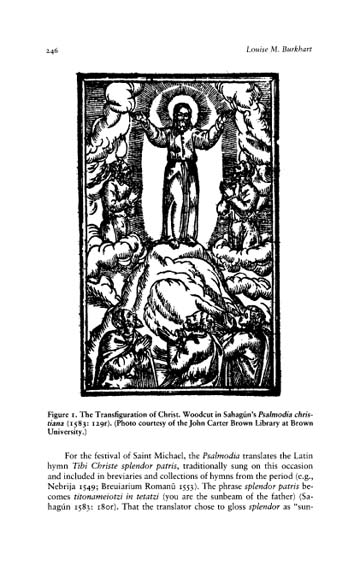
The Transfiguration of Christ, a woodcut in Sahagun's Psalmodia christiana, from page 14 of "The Solar Christ in Nahuatl Doctrinal Texts of Early Colonial Mexico."
“The Solar Christ in Nahuatl Doctrinal Texts of Early Colonial Mexico” by L.M. Burkhart (1988)
Ethnohistory, vol. 35, no. 3, pp. 234–56.
A reprint published by Duke University Press and housed at JSTOR.ORG, “The Solar Christ” is not an easy read, but I think I can say, in view of everything else, that this article looks like an important piece of information missing from mainstream Christianity and could be easily swept under the rug (or almost has been). Mostly when I search for articles connecting the Christ with the sun, I look for articles concurrent to the period of the New Testament and as far back as the Ancient Egypt Motherhood, and geographically mostly to the European, African, and Asian continents. I always come up short-handed when hoping for a more unified “big picture.” Well, it now looks like we might not have to go all the way back to the beginning every time, but to look to a more recent period (the sixteenth century) when friars and monks had knowledge of another side of Christianity. Why this became an isolated instance of departure from the more or less standard Christian conversion is not known, but it is known through this article that an exception was made because of the unique view of the cosmos that the Nahua had.
This article, consisting of twenty-three pages, states that Indians today view Christ as a solar deity, using the symbolism of sun and light to express their views. As stated in the first page citation:
The Mendicant friars who converted the Indians of Mexico to Christianity after the Spanish Conquest left behind a large corpus of Christian doctrinal literature in Nahuatl and other Mesoamerican languages. These texts include sermons, catechisms, biblical excerpts, dialogues. hagiography, meditations, hymns, and confession manuals. They were written by friars conversant in the native languages, in collaboration with indigenous students who were educated in Spanish and Latin and who had considerable influence on the native-language texts. Because of their dominantly European content, these texts have received relatively little attention from ethno-historians more interested in the indigenous side of Indian-Spanish contact. Thus these texts constitute a largely unexploited ethno-historical resource of great value for interpreting colonial culture, particularly in regard to religion but also to language, political and social relations, and other aspects of Indian life….
This article, per Internet usage, can only be found in full at JSTOR.ORG. JSTOR is part of ITHAKA, a not-for-profit organization helping the academic community use digital technologies to preserve the scholarly record and to advance research and teaching in sustainable ways. The article is available to membership or costs fifteen dollars otherwise.
Another article related to the above that is helpful and references Burkhart’s “The Solar Christ” is Sacred Books and Sacred Songs from Former Days: Sourcing the Mural Paintings at San Miguel Arcangel Ixmiquilpan by Elanor Wake, circa 1992,and about thirty-six pages long. This article has illustrations of the paintings at the San Miguel Church accompanying the text. The illustrations are thought to be converted native song(s) synthesized with the new Christian teaching. There is no charge associated with this article (found elsewhere than JSTOR at dialnet.unirioja.es, to name but one of many sites).
Optional Reading http://www.albany.edu/anthro/nah_theater/nah_home.htm
This web page is devoted to Nahuatl theater, especially the Nahuatl Theater Set co-edited by Louise M. Burkhart and Barry D. Sell, published by the University of Oklahoma Press.
Louise M. Burkhart is professor of Anthropology at the University at Albany, State University of New York (SUNY).
Barry D. Sell is an independent scholar residing in Glendale, California.
Submitted by Jim Elliott, November 2010.
We are making the article available to you in PDF format in accord with the terms and conditions established by JSTOR: Solar Christ in Nahuatl
Please read the terms and conditions of use before downloading.