Project “X” Tours Japan Day by Day: DAY 5
13 MAY
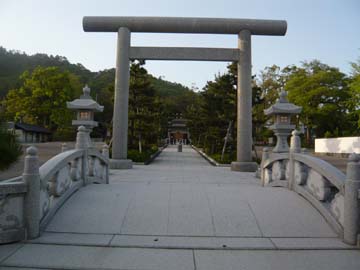
Entryway to Kono Shrine. PHOTO: Sean Savoy
Breakfast at the hotel. Then, visit the Izumo Grand Shrine, Japan’s oldest and second most important Shinto shrine. After lunch, see nearby Kono Shrine, the oldest shrine in Japan, and neighboring Manai Shrine, the original Grand Shrine where the sun goddess Amaterasu was enshrined. Dinner and overnight at the Ark Hotel Fukuchiyama.
“This day is definitely a special one for us. The sun in the morning is manifesting. I am immediately drawn into the rays and find it difficult to break away to join the others for breakfast.
“Alongside the waterway across the street there are archetypal symbols embedded in the shore’s concrete sidewalk — and they are gleaming in the mists of the crashing lake waves.”
—Journal entry by Gary Buchanan
IZUMO GRAND SHRINE
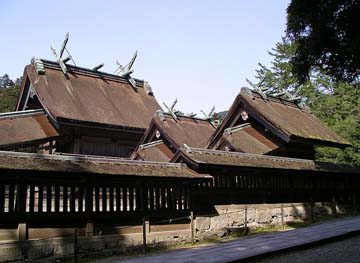
Izumo Grand Shrine (Izumo-taisha) is one of the most ancient and important sacred places of Shinto. The hall and its buildings are designated National Treasures of Japan. PHOTO: Blue Lotus
According to the oldest chronicles, Izumo Grand Shrine was the largest wooden structure in Japan when it was originally constructed. The main structure is built in the oldest style of building shrines. In 2008 the inner shrine was opened to the public for the first time in sixty years.
This sacred site is said to enshrine Okuninushi, the deity of marriage and considered to be the creator of Japan. According to the oldest chronicles of Japan, Okuninushi granted his country to Ninigi, grandson of the sun goddess Amaterasu, when he descended from heaven.
For more on Izumo Grand Shrine and a photo gallery, read the article “Izumo-taisha” in Wikipedia.
KONO SHRINE
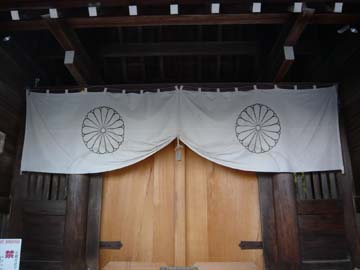
Kono Shrine, the most important shrine in Tango Province and the oldest shrine in Japan, is said to be founded more than 2,000 years ago. Pictured here is the main door to the shrine. PHOTO: Sean Savoy
Kono Shrine is, with the neighboring Manai Shrine, the original Grand Shrine where the sun goddess Amaterasu was enshrined before she resided at the present Grand Shrine in Ise.
Kono Shrine is built in a unique architectural style that is seen nowhere else but the Ise Grand Shrine.
Some recent theorists have suggested Jewish and Syrian origins for some of the peoples and religions of Japan and point to evidence for their theory with symbols found at Kono Shrine.
“We drive a couple of hours to visit the Kono Shrine. It is almost sunset, and the sun continues to manifest.
“On the way we visit a winery near Kono and check out the products. The light outside is irresistible, so I spend most of my time on the outside porch observing the light over the vineyards and local lake.
“Following the winery visit, we drive only a couple of blocks to the Kono Shrine, oldest in Japan. It is now sunset, and even though we can take photos out front and watch the setting sun over the shrine, the shrine proper is closed and gated off.”
—Journal entry by Gary Buchanan
Link to the Kono Shrine official web site.
MANAI SHRINE
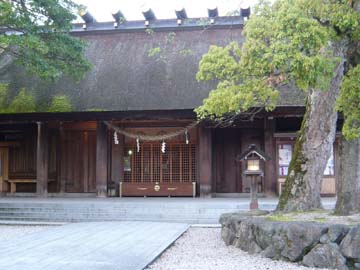
Manai Shrine, dedicated to the god Izanagi, is located behind Kono Shrine and is part of the original Grand Shrine. Pictured is the main entrance. PHOTO: Sean Savoy
“We begin walking west and up another high hill to the Manai Shrine — that of ‘eating and wellness,’ from ‘manna.’
“While we are ascending the stairs up to the shrine, I hear people calling my name and telling me to hurry.
“As I reach the top, along with the others there is a fellow standing directly in front of the shrine with his back to us.
“Then, just as I arrive and take my directed position behind him, he begins playing an ancient stone flute melody, with long, drawn-out high tones, in worship. He is cycle-breathing, and the piece goes on for quite some time.
“I hasten to pull out my camera and begin videoing his performance.
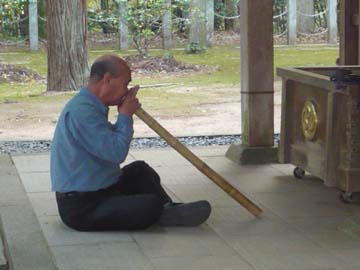
Musician playing bamboo flute at Manai Shrine. PHOTO: Sean Savoy
“Next, he changes his stone flute (iwabue) to one in a higher range. This was followed by a vocal chant — quite strongly delivered. Finally, he picked up a bamboo didgeridoo and began playing — clearing the shrine — then turning and pointing the sound at each of us in the assembly.
“I am able to capture a bit of both the flute and vocal chant before my video card is full.
Gary and other tour members visit with the musician after his performance. PHOTO: Sean Savoy
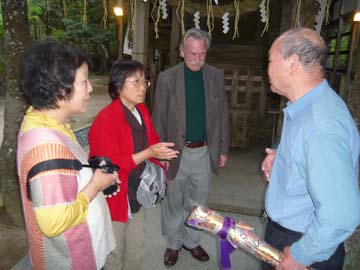
“Afterwards, the musician meets with me — with lots of hugs and smiles, incredible warmth — as we stand together for photos. Our Japanese Consociates explain to him that I am the musician in our religion back in the U.S.
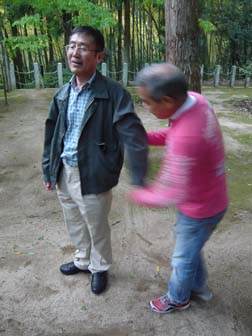
Shinto priest "clearing" field of Yukinori at Manai Temple. PHOTO: Sean Savoy
“Meanwhile, the other Shinto priest in attendance (from the Ise Shrine), over to the side, is treating Yuki — working on clearing his aura, swishing with his hands and whistling, pulling negative influences out and throwing them away.
“Gene also meets with the priest and they discuss a potential future visit to Reno for sunrise services, perhaps upcoming conference in September, etc.
“We leave the hill feeling as if ALL has been perfect on this sunny day!”
—Journal entry by Gary Buchanan
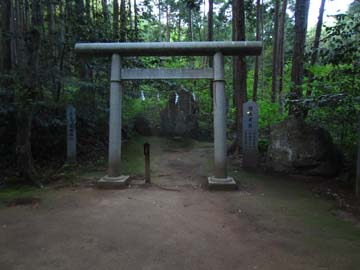
One of the smaller shrines at the larger Manai Shrine. PHOTO: Ron Theriault
Watch “Manai Sunset,” a video of the Japanese musician’s performance on YouTube.