The Thiasos of Plato, Part 3
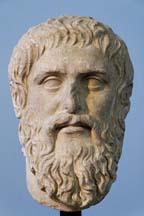
Plato sculpted by Silanion circa 370 BCE
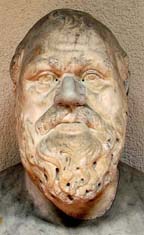
Socrates portrait by Palermo copied from the 4th-century original
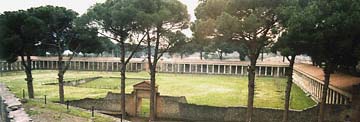
Pompeii gymnasium seen from the top of the stadium wall PHOTO Haiduc
Plato as a child had attended an exercise garden other than this one, the private gymnaseion of the grammatist Dionysios. There he had learned to compose tragedies and dithyrambs from famous teachers of music, and there in the palaistra of Ariston of Argos he had trained to compete as a champion wrestler in the Panhellenic games. As a youth, however, Plato studied philosophy at the Academy. (We have it on the word of Aristotle that he studied Heracleitus with Cratylus; according to another tradition, he studied Parmenides here.) It was also at the Academy that Plato was formally presented to Socrates on the morning after Socrates had dreamed a prognostic dream in which he recognized Plato (a young swan flying out from the altar of Eros and settling in his lap, transforming into a full-grown swan and taking off into the sky again, singing a song that charmed all who heard it). In his twentieth year (407 BCE), after he had listened to Socrates discourse at length while the first tragedy he had ever composed played out on stage in the theater, Plato committed the decisive act of burning his poetry in a public spectacle at the Theater of Dionysius Eleuthereus during the Dionysiac festival. From that moment, Plato turned from his purely poetic ambitions and devoted himself to Socrates and the Pythagorean love of wisdom.
A year later, Socrates committed the first of the public acts that drew the derision of leading citizens of the polis. Plato continued to associate with him, and Socrates continued to teach for another eight years. Then a series of court trials aimed at religious impiety charged the atmosphere of Athens. The series culminated with an affidavit against Socrates that accused him of impiety and of corrupting the youth of the polis. The charges were serious. During the trial, Plato mounted the platform to speak on behalf of Socrates as one of the youths who had not been corrupted by him but was shouted down. The proceedings ended with the conviction of Socrates and the death sentence. During Socrates’ last month of life, Plato visited him in prison; then he exited the scene.
After a self-imposed exile spent in Egypt, in Cyrene (Libya), in Italy, and in the cradle of the spiritual community of Pythagoras, Sicily — ten years following the judicial murder of Socrates, his exemplar and the midwife of his soul — Plato returned to the Academy to memorialize the teachings of Socrates and to celebrate them on the sanctuary grounds where Socrates had taught. He gathered together a community of spiritual companions and organized them into a thiasos, then acquired for this new religious association a sacred plot of land (temenos) in the Academy and erected upon it a shrine to the Muses (Mouseion), an appropriate act in this sanctuary dedicated to education. (See Supplement 3) At first, the shrine was perhaps no more than a small altar in a small section of the grounds that served as a gathering place for the members of Plato’s Academy. Later, perhaps, a moderate building was constructed to surround it; but it was the shrine that represented bonded property on public land. Here Plato’s Academy of higher education celebrated the original arts of the Muses: Here they were free to give voice (Aoide) to divine truths and to the maieutics that bring them to birth, in oral teachings, in lectures, and in dramatic dialogues; here they observed liturgical occasions (Melete) with symposia and with all-night vigil feasts; and here they practiced the techniques of spiritual recollection (Mneme).
In time, Plato acquired a little garden estate near Colonos, not far from the sanctuary grounds of the Academy. (See Supplement 4) Plato taught at the sanctuary both in the exercise garden and in his Mouseion, and he taught outside the sanctuary in his Garden. Both Mouseion and Garden were parts of Plato’s Academy. Public lectures might have been delivered in one of the pillared halls of the exercise garden or in the exedra, the three-walled open room furnished with benches, nearby. There might have been another exedra constructed on Plato’s temenos near the shrine for seminars and feasting; and perhaps a third in Plato’s own Garden, where he had his private quarters, and where, it seems, he met with his closest companions for private teaching and discussions. (See Supplement 5)
<READ PART 4>
SUPPLEMENTS
Supplement 3:
Plato’s Shrine to the Muses
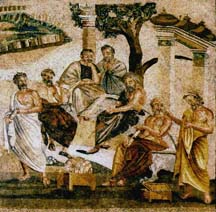
Philosophers debating by “the tree against which young Phaedrus leaned,” in a first-century mosaic of Plato’s School from Pompey
In his Phaedrus, another kind of shrine to the Muses, Plato recalls Socrates and Socrates’ praise for Calliope, “the oldest” among the Muses, and Urania, “the next after her,” who “preside over the heavens and all discourse, human and divine, and sing with the sweetest voice,” and also for their devotees, those “who honor their special kind of music by leading a philosophical life.”
Supplement 4:
A King’s Ransom for Plato’s Private Garden
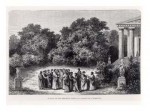
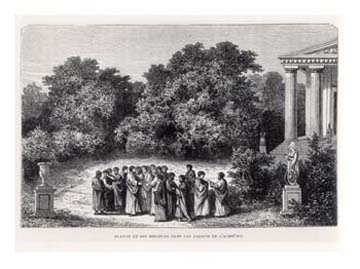
“Plato and His Disciples in the Garden of the Academy” by Alexandre De Baer (circa 1874), from La Vie Des Savants Illustres
Plutarch tells us that when Plato traveled to Syracuse a second time (360/361 BCE), he fell into disrepute with its tyrant, Dionysios, who entrusted the philosopher to a Spartan ambassador with instructions to dispose of him. The ambassador attempted to sell Plato on the island of Aigina, but a certain Annikeris, who was passing through on his way to Olympia, ransomed him. Dion, a friend of Plato and the political opponent of Dionysios, attempted to return to Annikeris the money he had paid for Plato; but Annakeris refused and used the money to buy for Plato the little garden estate near Colonos.
Supplement 5:
The Private Garden of Plato
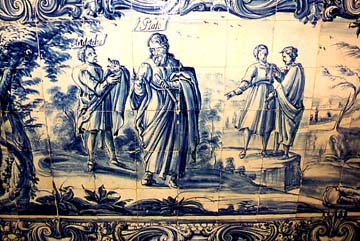
A representation of Aristotle and Plato discussing philosophy in a garden, from a tile design at the 16th-century Jesuit university St Francisco at Evora, Portugal. PHOTO gardenvisit.com
The Garden of Plato was acquired in addition to the original Academy sanctuary. A tale of Plato’s old age suggests that Plato had his personal quarters there.* The use of the Garden seems to have changed upon Plato’s death. Plato’s chosen successor as scholarch, his nephew Speusippo, did not live there, but a later successor, Polemon, seems to have spent all his time there. It is plausible that the thiasos formally acquired the garden property sometime around Plato’s death, if not before. It was not disposed of in Plato’s will, yet it was in the possession of Xenocrates, Polemon, and their successors all the way into the sixth century of the Christian era. The sanctuary of the Academy was destroyed in 88 BCE by the invading Roman army of Sulla, who cut down the groves sacred to Athena for timber to build siege engines to attack Athens, but the Garden remained in the hands of the Academy until its last scholarch, Damascius, escaped the statutory persecutions of Justinian in 529 CE and fled with his companions and the Academy library to Sassanid Persia, and later found sanctuary in Harran, near Edessa, where the students of the Academy-in-exile remained until the tenth century, aiding the Islamic preservation of Hellenic medicine and philosophy.
_______
* One day, while Plato, then about eighty years of age and to some extent losing his memory, was walking the colonnades of the Academy alone without anyone to stand by him (Xenocrates was abroad and Speusippos was ill), Aristotle ambushed him with a gang of his own persuasion, questioning Plato aggressively and elenctically. Plato retreated from the sanctuary. When Xenocrates returned from abroad, he saw Aristotle perambulating on the colonnades (peripatos) where he had left Plato three months before and observed that Aristotle did not go back to Plato’s but instead went off to his own place in town. Xenocrates, suspecting that Plato was ill, asked a companion where Plato was. The companion replied, “He is not ill, but Aristotle has been giving him a hard time and has forced Plato to retire from the peripatos, so he is philosophizing in his own garden.”