Project “X” Tours Japan Day by Day: DAY 7
15 MAY
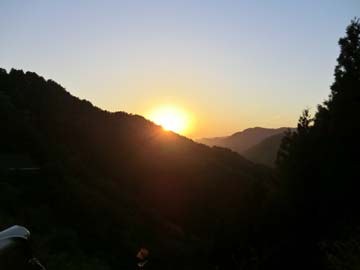
Sunrise at Mount Koya. PHOTO: Keiko Inoue
Sunrise at Mount Koya. Attend Buddhist service and breakfast at the temple. Then, on to visit temples at the old Japanese capital city of Nara, including Tachibana Temple where Prince Shotoku was said to be born in a manger like Jesus, and Todai-ji Temple. After lunch, continue on to visit Heijo-kyo or the “citadel of peace.” Dinner and overnight at Hotel Sun Route Nara.
SUNRISE SERVICE
“We are up at 3:30 AM for departure by bus from the temple to a spot on Mt. Koya for a Sunday Divine Sunrise Service. Gene, Sean, Yuki, and I wear collars and vestments.
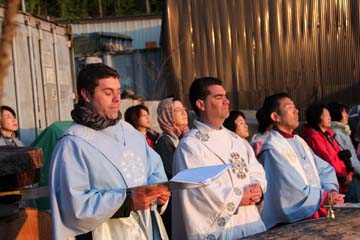
Sunrise Divine Service on Mt. Koya. PHOTO: Rob Roy
“Yuki and his team have found a select site, a construction yard on the side of Mt. Koya facing the eastern horizon. It is actually quite appropriate, as it brings to mind our construction yard at Red Rock Consecrated Sanctuary back home.
“At the site we set up a table for Gene, Sean, and Yuki to officiate. I set up just behind them on a large, flat, wooden table top — sitting on a plank — and playing the small piano keyboard.
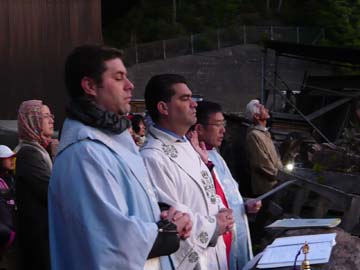
PHOTO: Sean Savoy
“We have a slightly altered Divine Service, including prayers by Yuki in Japanese, and the singing of ‘Grant Life Unto Me’ in Nihon by our Japanese Community members.
“Shortly after 5:00 AM the sun makes its way up through the trees on the horizon.
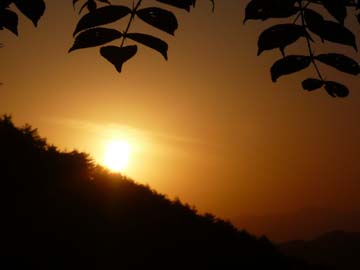
Sunrise on Mt. Koya. PHOTO: Sean Savoy
“It is a soft and comforting sun, quite special.
“We then intone the “AOUMENIMs” and set the disk in motion.
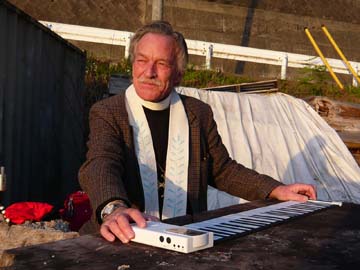
PHOTO: Sean Savoy
“After the concluding prayers I play ‘Meditation II,’ and we remove ourselves to the side for unvesting. We quickly disassemble the set-up for return to the temple.
“At 6:30 AM we attend a half-hour Buddhist service in the temple.”
—Journal entry by Gary Buchanan
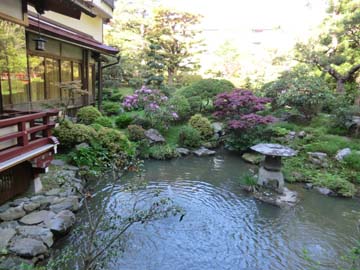
Sekisho-in Temple garden. PHOTO: Keiko Inoue
NARA AND TACHIBANA TEMPLE
In the prefecture of Nara, covered by mountains and forests, the group visits Asuka National Historic Park. Here there are located numerous ancient temples of the Nara Period of Japan (710-794), the time when the royal court of Nara established relations with Sui and then Tang China.
Even today strict rules govern construction in this historic town.
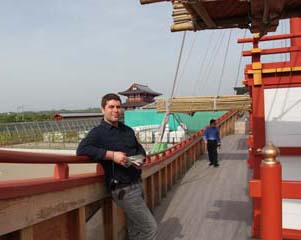
Sean Savoy in Nara on replica of diplomatic ship used for envoys to Tang China. PHOTO: Rob Roy
For a photo gallery of the ancient temples of Asuka National Historic Park, visit the official web site.
For information on Nara prefecture and maps of its location, read this article on Nara Prefecture in Wikipedia.
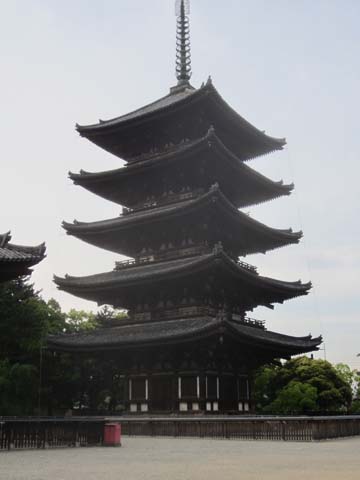
The unique five-storied pagoda is the tallest wooden tower in Japan. PHOTO: Ron Theriault
The entire city of Nara is a protected preserve for deer. Deer are everywhere, roaming the streets, filling the parks, and children and tourists are everywhere petting and feeding them.
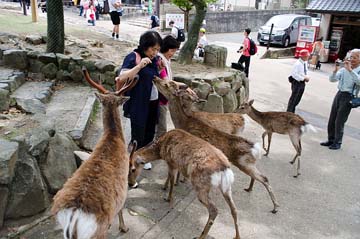
Deer being fed by tour members. PHOTO: Jim Elliott
Among the many temples located in this area is Tachibana Temple, where Prince Shotoku (574-622 CE) was said to have been born in a manger like Jesus; one of seven major temples built by Shotoku.
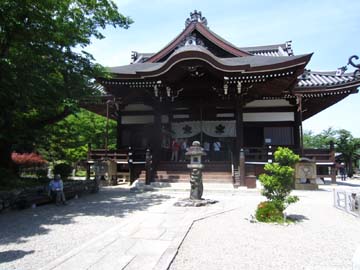
Tachibana Temple. PHOTO: Ron Theriault
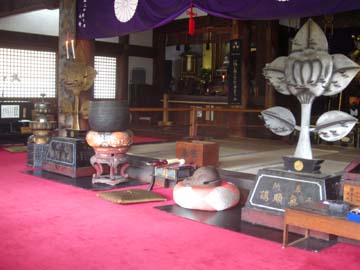
Tachibana Temple interior shrine. PHOTO: Ron Theriault
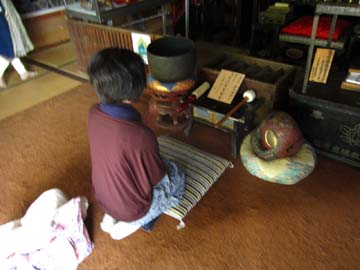
Tour member paying respects at a shrine. PHOTO: Ron Theriault
HEIJO-KYO
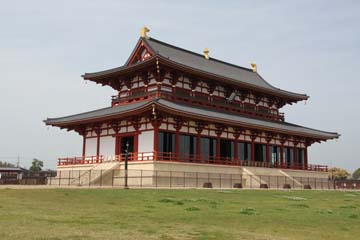
Building from the Nara Period in Heijo-Kyo. PHOTO: Rob Roy
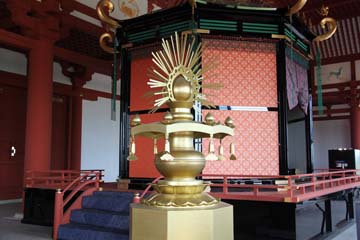
Interior of the building pictured above showing sunburst figure. PHOTO: Rob Roy
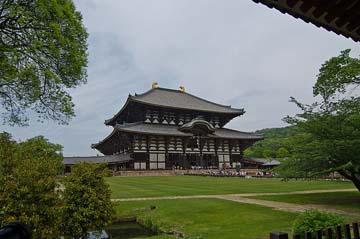
Exterior view of Todai-ji Temple in Nara. PHOTO: Jim Elliott
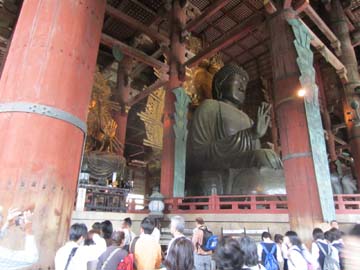
Todai-ji Temple interior with seated Buddha. PHOTO: Ron Theriault
“Heijo-Kyo, the ‘Citadel of Peace,’ is amazingly BIG! It is the largest wooden building in the world — with tens of thousands of visitors daily. The largest statue of Buddha in the world is inside.”
—Journal entry by Gary Buchanan
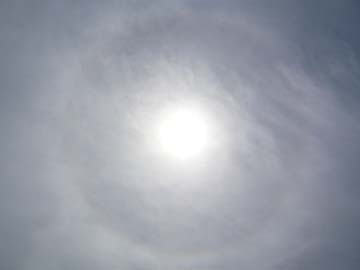
Sun over Heijo-Kyo. PHOTO: Sean Savoy
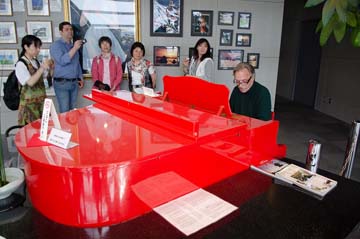
Gary at the piano in the Pearl Falco shop in Nara. PHOTO: Jim Elliott