The Thiasos of Plato, Part 4
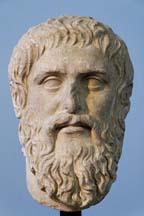
Plato sculpted by Silanion circa 370 BCE
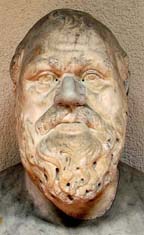
Socrates portrait by Palermo, copied from the 4th-century original
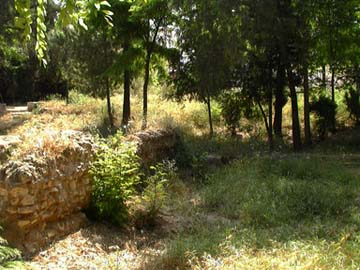
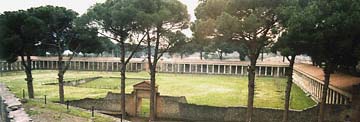
Present-day view of a grove at Plato's Academy. PHOTO: gardenvisit.com
The creation of a thiasos allowed the teaching of Plato to exist. Its creation was a necessary legal condition to own a shrine on public land and to hold banquets in a public gymnaseion. Like the establishment of a modern church, it was primarily a financial arrangement. (See Supplement 6) Generally speaking, every thiasos in Athens was an institution organized for religious observance and for fellowship; the thiasos was a public construct guided by law; its duties were narrowly defined public activities; however, neither the general duties nor the organizational structure reveal the character of Plato’s thiasos, any more than the corporate structure and by-laws of a modern church reveal its character. The duties of a thiasos were distinct from its functions; its legal obligations, from its formal purpose; its social standing, secondary to its religious concerns and educational purposes, as they are with a modern church. There was a multitude of thiasoi in Athens; they were integral to society, and they followed no uniform structure. One general principle, however, did hold: Athenian law recognized a thiasos not as an individual entity but as several joint owners with a common interest; and the law recognized a single individual of that association who served to hold the properties for the thiasos — the archon (or in Plato’s case scholarch); but the law did not recognize the privilege of that single individual to mortgage or to sell any part of a thing held in common by the thiasos. In this, too, Plato’s Academy resembled a church. (See Supplement 7)
There is one other clear indication of the independent legal standing of Plato’s Academy: Neither the Mouseion nor the Garden appear in Plato’s will, which does mention two other estates. Plato did not need to bequeath the Mouseion or the Garden to the Academy because the temenos, and thus the Mouseion, was administered through the thiasos, and the Garden was owned by it.
The establishment of the thiasos on the public land of the Academy, instead of on private land, ensured its survival in perpetuity. This act of Plato is a testament to his wisdom. After Plato’s death, a law sponsored by one Sophocles of Souion (the law was enacted in 307 BCE and repealed in 306 BCE) made it illegal, under penalty of death, for any philosopher to be appointed head of a school without the consent of the boule (the senatorial administrative council) and the ecclesia (the general legislative assembly) of Athens. For a time, that law sent all other philosophers packing. (See Supplement 8 ) The institution of Plato’s Academy remained untouched for a thousand years.
This much can be said of Plato’s Academy by evidence of ancient sources and of history. To go further, to find out what Plato taught at the Academy or how, requires another source of information and another approach.
Now that I have arrived at this point in my comparison, and look back over this page, it is clear to me, as it may be already clear to you, that I, too, like the other academicians before me, have recognized in Plato’s Academy the one of which I am a part. I hope it is clear as well that my method is different from theirs. Where others have clouded the past with images of themselves, I have simply noted the resemblance.
Robert G. Petrovich
February 22, 2010
SUPPLEMENTS
Supplement 6:
The Sacred Academy of Plato
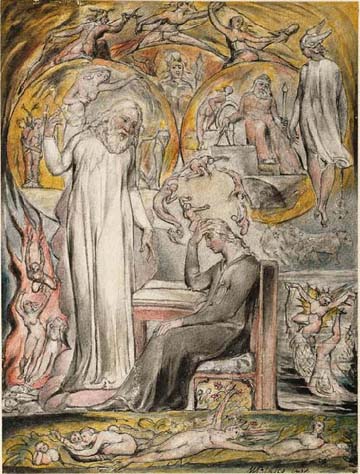
William Blake’s vision of Plato inspiriting a student
Plato’s Academy was a complex society within the Athenian political community, with its own obligations and privileges. A legally recognized religious-social-political organization, its relationship to the Athenian politea was strong, well defined, and direct. There would have been a public forum with regular meetings, elections for priest, treasurer, and other official positions, decrees posted and voted upon, oversight of land management, shrine upkeep, recording of finances, etcetera. How like a church established in the United States of America this is, where Articles of Incorporation create a legal person and deem it a body politic with continual perpetual succession and with power to acquire and possess property, with its purpose and privileged position in society delineated with by-laws, and with rules that regulate its internal functions; there are files and records to keep on local, state, and federal levels, and there are the same concerns of management and upkeep.
Plato’s Academy and a modern church even operate, in their respective societies, according to the same social design: separation from the mundane, in activity and in space. A temenos in classical Athens was a piece of land “cut off” and assigned as an official domain, an area reserved for worship, a territory or field of deity or divinity. A church in the United States by its nature is “exempt” from taxes; which is to say, it is kept outside the world of commerce and the everyday. The two words — temenos and exempt — have the same meaning: The word temenos is from the Greek verb temeno, “to cut”; the word exempt, from the Latin exemptus, past participle of eximere, “to take out.” The law of the state of Nevada, where I reside, puts it succinctly enough: “. . . buildings used for religious worship, with their furniture and equipment, and the lots of ground on which they stand, . . . owned by some religious society or corporation, and parsonages so owned, are exempt from taxation” (Nevada Revised Statutes 361.125). In the state of California, even the real estate of a scientific organization can qualify for tax exemption if it is used for religious purposes.
The courts of California have defined worship as the formal observance of religious tenets or belief. These are the elements they have used to define religion (Fellowship of Humanity v. Alameda County):
(1) a belief,
(2) a cult involving a gregarious association openly expressing the belief,
(3) a system of moral practice directly resulting from adherence to the belief,
(4) an organization within the cult designed to observe the tenets of the belief.
The content of a religious belief is not of government concern. Examination of the truth or validity of religious beliefs is foreclosed by the First Amendment of the United States Constitution. The Supreme Court of the United States has ruled that government has no authority to pass judgment on the legitimacy of a religious belief or to define permissible religious belief (Fowler v. Rhode Island) Federal law has also left the definition of the term church to “common meaning and usage” (De LaSalle Institute v. U.S.).
The terms church, religion, religious purpose, religious organization, etcetera are found, but not specifically defined, in the Internal Revenue Code. In that code, certain characteristics have been developed by the Internal revenue Service, and by court decisions, and are attributed generally to churches. The Internal Revenue Service uses a combination of these characteristics, together with other facts and circumstances, to determine whether an organization is to be considered a “church” for federal tax purposes. These characteristics on the list describe Plato’s Academy: distinct legal existence, formal code or doctrine and discipline, literature of its own, established place of worship, regular religious services, a school for the preparation of its members. The following are other characteristics on the list that may apply to Plato’s Academy, but for which we have no proof: recognized creed and form of worship, definite and distinct ecclesiastical government, distinct religious history, membership not associated with any other church or denomination, organization of ordained ministers, ordained ministers selected after completing prescribed courses of study, schools for religious instruction of the young.
Section 501(c)(3) of the United States Internal Revenue Code provides for the types of nonprofit organizations that are exempt from federal income tax. Exemptions apply to nonprofit corporations organized and operated exclusively for religious, scientific, literary, or educational purposes, to promote the arts, or to foster national or international amateur sports competition, among others. (Another federal provision provides a deduction for some donors who make charitable contributions to these types of 501(c)(3) organizations.) There is no doubt in my mind that Plato’s Academy, if established in the United States of America, would qualify as a 501(c)(3) organization. You will have to judge for yourself.
There is also one more point of equivalence which I would like to bring to your attention: the question of funding, a question which gives us the opportunity to dispel another common misconception. To manage the temenos, and the Mouseion within its boundaries, together with its shrine and its banquets, the Academy thiasos needed funding, just as a church needs funding to carry out its liturgical and educational activities. How did Plato’s Academy manage to exist financially? The answer is donations. We have this much on the word of Damascius, the last scholarch of the Academy: “. . . the property of Plato’s successors did not come, as most think, from Plato’s own fortune, for Plato was poor . . . [but rather] because many people, as they died, left their property to the School.”
Supplement 7:
The Legal Standing of Aristotle’s Lyceum
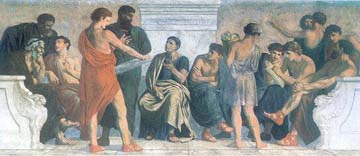
Aristotle’s Lyceum by German artist Gustav Spangenberg (1828-1891)
By comparison, the legal standing of Aristotle’s Lyceum bears no resemblance to Plato’s Academy. If Aristotle had formed a thiasos to administer his Lyceum, it would have been barred from ownership or administration of the underlying property since he was a metikos, a foreign resident.
Supplement 8:
Aristotle, the Foreign Philosopher
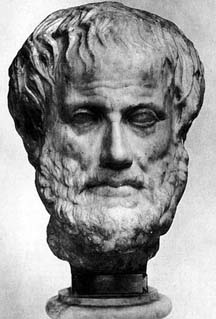
Aristotle (sculptor unknown)
Aristotle, the tutor of Alexander the Great of Macedon, fled the anti-Macedonian sentiment of Athens in fear of his life soon after the death of his famous student in 323 BCE, and died the following year of stomach problems. Seventeen years later, the same sentiment drove out Aristotle’s successor, Theophrastus, along with all the others. Plato served as head of the Academy until his death around 347 BCE; by the time the law of Sophocles of Souion was enacted in 307 BCE, Polemon had succeeded Plato, Speusippus and Xenocrates as scholarch; and no existing source for the life of Polemon mentions his flight in the face of that law.