Mar Iazed-buzid, the Great Donor: Part 3A
 

PART 3: THE JADE TENT

When the Secretariat Director,
Duke Kuo Tsu-i, Prince of the Fen-yang Commandery,
first commanded troops in the Northern Regions,
Su-tsung ordered him
[I-ssu] to accompany the expedition.
Though treated with friendship in the Prince’s sleeping-tent,

he made no distinction between himself and others on the march.
He was nails and teeth for the Duke,
and was ears and eyes to the army. . . .
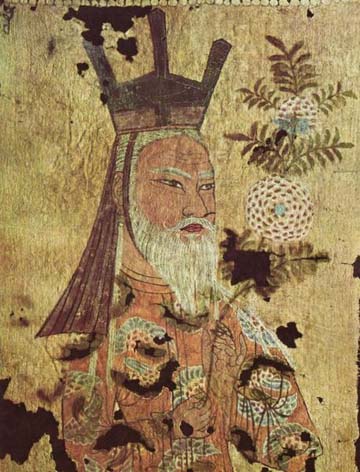


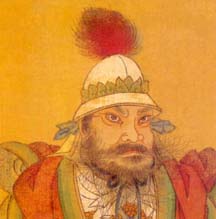
Portrait of Tang Dynasty Uighur Khagan


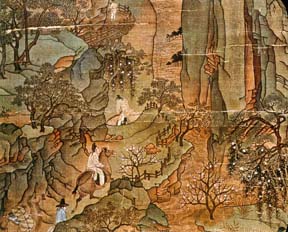
At Ling-wu, tens of thousands swelled the imperial forces of the new Emperor as the units led by generals Li Kuang-pi and Kuo Tzu-i arrived from the eastern front. (See Supplement 1) Immediately Kuo Tzu-i put his armies to work fortifying the city that was to be the root of the restoration. His armies walled in three cities beyond the Great Wall to form protecting wings for Ling-wu, which stood backed up against the Great Wall. Now the Tibetan Turfans came to the aid of Su-tsung, and the Uighurs (hui ho) at their camp in Hua-men became imperial allies. Mounting horses in the distant desert, four thousand hui ho crossed the long province of Lin Tao to vow their devotion to the Emperor and to hold back the rebel hordes. Led by their endearing qaghan, they took an oath to “turn the Emperor’s red shame white” and, as an earnest of good faith, gashed their faces until the blood ran. One by one, minor officials from the confines of Chang-an strengthened Su-tsung’s court by simple addition (See Supplement 2): at times hiding from the rebels to avoid being taken into service at the rebel court in Lo-yang, at times moving freely through the city, they, like I-ssu, had finally escaped and made their way to the exiled court for appointment by their Emperor. Although weak and in exile, Su-tsung’s Throne found the absence of the normal horde of bureaucrats an advantage. The army met its need for food and horses out of local requisitions, and a straightforward field command structure established itself.

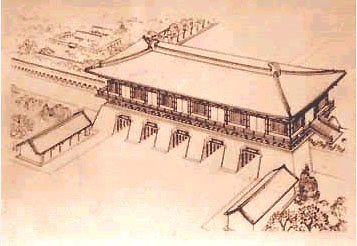
Here I-ssu received his imperial commission. From the Jade Tent of Kuo-Tzu-i at the Ling-wu base in the Northwest, I-ssu commenced his command as Joint Military Vice Commissioner of the Northern Region. For at least the next three years, his generosity and fiery influence on the battlefields balanced him between the hui ho and the throne in loyal personal service to the martial governor Kuo Tzu-i. (See Supplement 3)

Beyond these few facts, it is not possible to portray I-ssu’s personal experience during these years but only the collective experience of war.


< READ PART 3B: THE JADE TENT >


SUPPLEMENTS

Supplement 1:
The Northwest Command
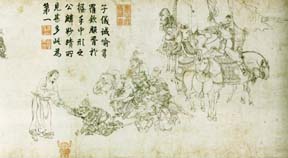
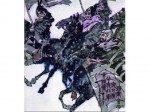
Duke Kuo Tzu-i receiving homage of Uighurs. Detail from Song Dynasty painting.

Early in 756 Hsuan-tsung had placed the Northwest Command, the large armies immediately north of Chang-an and the only force of experienced fighting men in the Empire, under the supreme command of Kuo Tzu-i. Kuo had been chief lieutenant in that army under An Lu-shan’s cousin, An Ssu-shun, who was removed for obvious political reasons. Another of An Ssu-shun’s commanders, the Khitan Li Kuang-pi, had been made acting military governor of Ho-tung. The Emperor had sent Kuo Tzu-i’s armies to aid Li Kuang-pi in the northeastern province of Ho-pei in the second moon of 756. Now they had returned.


Supplement 2:
The Official Life of the Poet Tu Fu
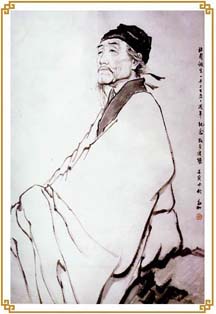
The poet Tu Fu. Anonymous artist's conception.

Among the minor officials who escaped was the poet Tu Fu. Months later, in May 757, before the reconquest of Chang-an, Tu made his way to the exiled court at Feng-hsiang. When he arrived there, he was appointed Reminder. According to tradition, the duty of Reminder was to advise the Emperor and to point out any errors or oversights he might make. In Tu’s time, however, Reminders were expected to do little more than take part in the imperial pageantry. The new Emperor, Su-tsung, who was becoming suspicious and unreasonable, soon demoted one of his highest officials, Fang Kuan. Tu, taking his traditional advisory duties quite seriously, pointed out the Emperor’s shortsightedness. The demoted official was Tu’s patron and friend. Su-tsung immediately had Tu arrested, and only after the intervention of several other ministers was he released.

Tu had by now been separated from his family for a year, and he had no idea what might have befallen them. The war had reportedly reached the city of Fu-chou, where he had left them, so he suspected that his family had been killed or driven away. Finally, in September, he received a letter from his wife. With news of them, he was now anxious to return to his family, and the Emperor was hardly reluctant to allow the pesky man a leave of absence from the court. After a difficult journey, he arrived home at the beginning of October.

A month later, loyal forces drove the rebels from the capital and soon recovered Lo-yang as well, driving the rebels into the east. Tu Fu, overjoyed, returned to Feng-hsiang and joined in the Emperor’s jubilant return to the capital. In January 758, his family joined him in Chang-an, where he was happily attending court and accompanying the Emperor in victory celebrations. By spring, however, the poorly advised Emperor began to banish worthy officials, notably Fang Kuan and his associates, many of whom were Tu Fu’s close friends. That summer, because of his association with the Fang Kuan group, Tu Fu himself suffered a mild form of banishment. He was sent to a town between Chang-an and Lo-yang, where he served as Commissioner of Education.

The following January, apparently on official business, Tu went to Lo-yang. He used this opportunity to advise the commanders who had been sent to subdue the remaining rebels. His advice was ignored, though it was, as it turned out, quite astute, including specific warnings against the very dangers that led to the unforeseen and disastrous defeat for the loyal forces. A surprise attack staged by the most powerful rebel commander threatened Lo-yang, and its people fled. Tu Fu also fled, returning to his small-town home.

Because his bureaucratic routine was unbearably tedious and his position in government a source of danger, Tu soon began to consider leaving official life and devoting himself to writing. In late August, famine and the intensifying rebel threat compounded his frustrations; he resigned his post and moved his family three hundred miles to the west.

The sequence of collected poems in Chang-an II and Chin-Chou/Tung-Ku are Tu Fu’s lyric reports, still vivid and direct; they read like correspondence from those times and those places.


Supplement 3:
Associate Lieutenant General I-ssu
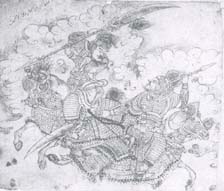
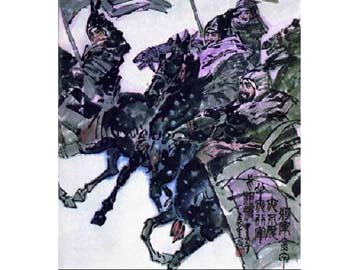
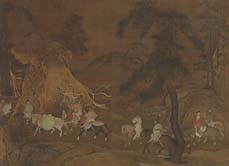
Uighur cavalry. Detail from Song Dynasty painting.

To lead thousands of hui ho mercenaries together with their chief, acting as associate lieutenant general, I-ssu must have been a master of the Uighur language, as was KuoTzu-i. Monks of the Luminous Religion had long served as interpreters in KuoTzu-i’s armies, and others before them had evangelized among the hui ho for decades and gifted their tribe with an alphabet and script.
Mar Iazed-buzid, the Great Donor: Part 2D


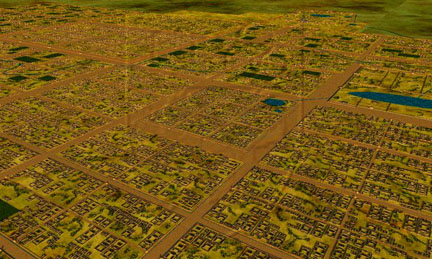
Tessellated bird's-eye view of Chang-an during Tang Dynasty. Designed by Mazlin Ghazali.

(B)

If I-ssu had not soon followed on the emperor’s southern path, now, with An Lu-shan’s jackals in the blood-drenched city of Chang-an, he hid in the monasteries for days or weeks, like other officials and prominent men, to avoid conscription into the ranks of the confederate dynasty. On one of those undivulged nights, after rumor had transformed Prince Chung into a Dragon who marshaled his forces in the wilds at Ling-wu, the dark pathway of the sky grew lofty and transcendent, and, while other men of the capital turned their faces to the north in grief, waiting for the army’s fires to appear on the hills, I-ssu secreted himself out.

Over a course of nights, while screech owls moaned in yellowing mulberry trees and field mice scurried to prepare their own holes, the refugee I-ssu fled four hundred miles in search of the new emperor’s palace. At first guided across the plains by stars, and nights later, by following the lines of deep-cut ravines that stretched like sunken paths into the Northwest, I-ssu reached the Traveling Palace, risen anew, with its back against the Great Wall. On a spring day months later at the South Gate of Ling-wu, Prince Chung, still a Dragon Without Horns, addressed the people of one hundred surnames to announce that he would accept the Great Seal in the seventh moon, on the day of Chia Tzu, when a new cycle would begin. Immediately, the prince began to organize the fighting men of the surrounding loyal province. He summoned the aid of loyal tribesmen – the Pei Ti of the North, the Uighurs at Hua-men, Tibetans and the Hsi Jung from the West – and of client kingdoms in the Tarim as far west as the Central Asian city of Farghana. On the day of Chia Tzu, with no more than thirty officials to aid him, and the eastern and western capitals in the hands of rebels, Prince Chung – known to history by his posthumous temple name, Su-tsung – changed the fifteenth year of his father’s second reign to the first year of his own, and he styled his reign Chih Te, “Virtue Drops as a Bird to Earth.” Just as the sunflower and the clover lean toward the light, and the ants are jealous of their own holes, so every living thing has its essence which cannot be snatched away. Now two emperors, at two separate Traveling Palaces, ten thousand li apart, performed the formalities of predicating a court in exile. One in Cheng-tu, where the old emperor, and a diminished entourage of thirteen hundred persons, had stopped on the road to Szechuan. (See Supplement 7) The other, at the headquarters of the northern command. Here the new emperor, Su-tsung, and his council prepared the portico and front hall of the empire; but officials and soldiers, the beam and the wall, were lacking.

*

By one of the two possible routes of time and events described above, I-ssu reached the imperial headquarters in the north at Ling-wu. After the period style had been changed, and while promotions were being made in the official ranks, I-ssu, like all the others, approached the new emperor in his tent and, kneeling before the Imperial Couch, placed his head on the Green Rush Mat to tender himself, as if he were in Palace Audience Hall.

<PART 3A: THE JADE TENT>


SUPPLEMENTS

Supplement 7:
The Last Days of Hsuan-tsung

Hsuan-tsung's flight. Song Dynasty; artist unknown.

Hsuan-tsung was still on the road to Szechuan at the time. Unaware that he had been created Above Emperor by his son’s act, Hsuan-tsung arrived in Cheng-tu on the twenty-eighth day of the seventh moon and went through the formalities of establishing a court in exile. It was not until the twelfth day of the eighth moon that envoys from Su-tsung reached Cheng-tu to announce his usurpation of the throne. The old emperor, exhausted and racked with remorse for the death of his imperial consort, gave his consent without protest and on the eighteenth day, dispatched his own trusted ministers to Su-tsung’s headquarters, bearing the Instruments of Abdication and the State Signet, and a great deal of jade.

Hsuan-tsung remained in Cheng-tu until the tenth moon of 757, when, after Kuo Tzu-i had recovered the two capitals from the rebels, Su-tsung summoned his father back to Chang-an, where he was received with honor and allowed to reside at first in his favorite Hsing-ching palace. Later, in the seventh moon of 760, he was moved to quarters in the imperial palace, probably because he still retained the loyalty of many of the court and posed a potential threat to his successor as a possible focus of factional intrigue. He died in the fourth moon of 761 at the age of seventy-seven.


Mar Iazed-buzid, the Great Donor: Part 2C


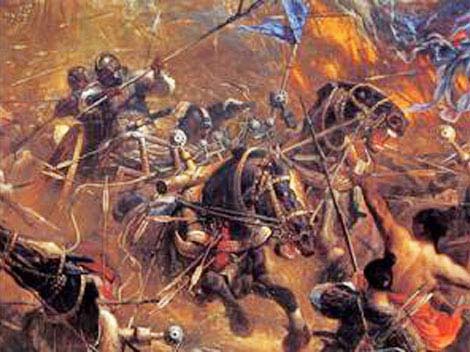
An Lu-shan's forces advancing to the capital. Modern artist's rendering.

(A)

If I-ssu did flee along the same path as the emperor, the next days made him a witness to the events that removed Hsuan-tsung from the throne and set up his son, the heir apparent. At a midday stop along the road, the distinguished fugitives discovered that, in their haste, they had left without provisioning themselves or the soldiers who escorted them. The next day they rested again, at the post station of Ma-wei, forty miles west of Chang-an. Here the solders – hungry, discontented, mutinous – broke out in open rebellion and, within earshot of emperor Hsuan-tsung’s camp, murdered the chief minister, Kuo-chung, whom they charged with the cause of their present disaster. The emperor, now completely at the mercy of his subjects, was given a choice: his own life or the life of his imperial consort, the chief minister’s corrupt and ostentatious cousin. In agony, the emperor gave his order. In a nearby Buddhist temple, his beautiful consort was strangled. When her body was displayed, the soldiers, satisfied, at once returned to their duty and allegiance. The imperial records tell us that the emperor was so overcome by the spectacle of his lover’s death that he no longer desired to be emperor and resigned the Dragon Throne. The same record tells us that his son, Prince Chung, reluctant to take the honor which belonged to his father, yet responsive to the will of his counselors and the people, finally accepted it, with suitable misgivings. In another version of the incident, the son usurped the throne a month later. In a fourth, it is said that the heir simply intended to assemble and equip an army to launch the recapture of the capital in preparation for his father’s triumphal return and did not receive the imperial insignia until summer; in this version, Prince Chung, the Dragon Without Horns, carries out an act of filial piety that cannot be greater, which the chorus of advisors who appear in this version of the story are quick to point out. Whichever version of the story historians prove to be correct, at Ma-wei, or some days later at Kuan-chung, two thousand men enrolled themselves for the defense of the empire, while the retired emperor continued his journey southward to Szechuan.

I-ssu, if he had followed the populace to Mai-wei, now joined the imperial heir on his forced march to the north. At the Wei River crossing, Prince Chung called on the riverside people to arrange for transport of his army of loyal volunteers. Three thousand responded. Moving further north, the army entered into a desolation of incomparable size and age, an accumulation of dust hundreds or thousands of feet thick that the wind had compressed and formed into crumbling hills and plains. The traveling army crossed this uneven, irregular land, descending into ravines, then ascending again onto cliffs and high ridges torn open by the angry wind. The great gashes in the land, making their steps tediously varied, repeated themselves in dull lines before them. Of the two thousand men who accompanied the prince through this surly and monochromatic land, less than five hundred remained by the time they reached Peng Yuan. The army that continued on to Ping Liang still called for men. Only a few hundred responded. Once, at the head of the Yellow River south off Feng Ming, the prince stopped to consider that the stream that runs there in a net of waters might provide him protection; then he turned again, further into the dark northern regions. The prince arrived with his small army at Ling-wu on the ninth day of the seventh moon. With him was I-ssu.

Reports came from the capital. A few days after the incident at Mai-wei, riders had appeared across the river from Chang-an. Then, suddenly, ten hundred hu brigands descended on the city. The rebels decimated the palace and destroyed the Spirit Tablets of the Imperial House. The Ancestral Temple, guarded only by stone unicorns, they consumed with fire. The Jade Dragon Throne they overturned. At yellow dusk, iron-mounted horsemen came in, line on line, and filled the ancient capital with their dust. By dawn of the next day, treasure-laden asses were scattered along the streets. The ancient capital was filled, in time, to overflowing, with humped camels trailed in from the East. By mid-August, when An Lu-shan arrived, the wind wafted the rank smell of blood. The self-proclaimed emperor of Yen called for public executions on the street in Chung-jen Ward. At his command, An Lu-shan’s men tore out the hearts of his choice of Palace Ladies, who had been left behind by Hsuan-tsung, and offered them as compensation to the ghost of An Lu-shan’s son, whom the emperor had put to death six months before in reprisal for An Lu-shan’s rebellion. Then, to repay the partisans of his arch-enemy Kuo-chung and others obnoxious to him, An Lu-shan ordered his men to pry off the tops of their heads with iron claws. After the street ran with their blood, An Lu-shan turned to hunting down the imperial clan, the Dragon-Seed. (See Supplement 6)

<PART 2D: THE RED COURT>


SUPPLEMENTS

Supplement 6:
Detection of the Dragon-Seed

Emperor Hsuan-tsung. Tang Dynasty; source unknown.

The Dragon-Seed, or clan of Tang, was naturally considered different from other men. The famous aquiline, or “dragon,” nose, which we describe as “Roman,” was looked upon as a feature peculiar to members of the royal house and made easy the detection of clansmen left behind by Hsuan-tsung when he fled. An Lu-shan’s intended execution of the members of the royal clan was a simple continuation of the ageless Chinese custom that had been followed by all pretenders to China’s throne – annihilation of the royal branch that one wished to supplant.


Mar Iazed-buzid, the Great Donor: Part 2B


Emperor Hsuan-tsung (685-762) fleeing to Sechuan during the An Shi Rebellion. China, Tang dynasty, 8th century.

We have the winter scene of Hsuan-tsung’s final days as emperor on the good authority of Tu Fu, the poet of whom the Chinese say “to read his poems is to read Chinese history.” In the central hall of the palace, the poet tells us, the smoke of incense lilted from jade-white bodies of dancing goddesses, and grieving flutes harmonized with clear pure strings. While guests in warm sable coats savored camel’s hoof soup, fragrant whipped kumquats, and frosted coolie oranges, in the kitchen, blue-blooded families divvied up the imperial gold tableware. With music swelling, regal ministers stayed up late taking their pleasure, bathed by their choice women, whom they pampered with silks that came slowly from the hands of shivering farm wives, whose husbands were horsewhipped by tax collectors demanding tribute for the palace and whose farms were beyond hope. The people’s wise monarch, wishing them well, sent them baskets and bushels full of sincere gifts. Outside the imperial-red gates lay the frozen dead and the twisted paths along which noble men were driven. Simple-hearted people, frantic, ran themselves ragged. The one hundred grasses were in tatters, and banners trailed out into the stars. War-bound men, each wearing quiver and bow, were herded about like chickens and dogs to the borderlands, where meals, like day and night, passed indistinct, and blood swelled up like seawater. Lament seized every district. The elusive engines of grief loomed like a mountain, ready to heave and swing loose. . . . Tu Fu was a palimpsest, and his work a reflection, of those times. It is inevitable that I-ssu, perhaps at the time already an attendant at the palace, received similar impressions.

In the last month of the final year of Hsuan-tsung’s reign (AD 755), the pretender to the throne, General An Lu-shan, lifted his childlike mask. With his armies coiled in the northeast, he raised the standard of rebellion. At first An intended to wait until the death of the emperor, but now, fearing that insinuations made by the new chief minister could lead to his destruction, he struck, and paralyzed, the eastern capital of Loyang. In that city An found himself in an imperial dream: at the head of 150,000 men, proclaiming himself emperor, and proposing the new dynasty of Yen. The bravest generals of the day, Kuo Tzu-i and Li Kwang-pi, were dispatched at once into Honan against him. The counterfeit general took the road south, announcing his desire to kill the emperor’s new chief minister, Yang Kuo-chung. Several battles were fought. On the seventh day of the sixth moon in 756, at a place called Ling-pau, Ko Shu-han, one of Kuo Tzu-i’s generals, was defeated and captured. (See Supplement 5) On that day, Ko Shu-han unwittingly made a place for I-ssu to become his military successor. By the ninth day, fugitives from the battle arrived continually at the capital and filled the minds of everyone with fear when they told the story of the terrible combat and the treason of Ko Shu-han. (It was said, “Ko Shu-han’s eyes turned on a new emperor.” Whether Ko Shu-han actually joined An Lu-shan or was secretly put to death by him is uncertain.)

The bright emperor Hsuan-tsung watched anxiously from the top of the Flower and Calyx Belvedere for the “fires of peace.” Lighted each night on little watchtowers built a few li apart, this shining chain of torches signaled security between Chang-an and the Pass. But on the twelfth night of the sixth moon, there was no chain of light. In the icy dawn of the thirteenth day, a small and pale retinue accompanied the Son of Heaven through the western gates of the city with a quota of armed men. As day broke, Hsuan-tsung passed through the Gate of Lingering Autumn in his chariot. Golden whips were broken in haste. In a downpour of rain, the emperor fled among the shadows that towered over the imperial highway, leaving members of his own clan to fend for themselves. For I-ssu, circumstances now left only two possible courses of action. We do not know which he took: Either (A) he now joined with the hordes of populace who were passing before and behind the imperial retinue, polishing smooth the way southward to Szechuan where the emperor’s soldiers and adherents were numerous, or (B) he remained in the city multitude and witnessed the arrival of the barbarians and their acts of slaughter.

<PART 2C: THE RED COURT>


SUPPLEMENTS

Supplement 5:
The Capture of Ko Shu-han

General An Lu-shan

After Loyang sunk under waves of invasion, the horses of 300,000 hu barbarians dashed against Lofty Barrier Pass, the single crossing between Honan and Shensi. The pass was held by Ko Shu-han and 200,000 men. The new chief minister, Yang Kuo-chung, impatient and consumed with anxiety for his own life, persisted in urging the emperor to order Ko Shu-han to leave his safe position and advance through the pass until the imperial army prevailed. Ultimately, orders from the palace, inspired by Yang Kuo-chung, forced the fiery Khitan general, a seasoned military governor of the northwest since AD 747, to abandon his safe position, to meet and be engulfed by the oncoming waves of An Lu-shan’s barbarians.

Ko Shu-han led his men through the towering walls. At Dividing River, several hundred groups of hu barbarians suddenly appeared on horseback. The general urged his horse, and the imperial army moved onto the heights. By sunset, the fume of his marching men pervaded the forest on the winding mountain summits. Like clouds and mists, the imperial troops and their horses massed themselves, clinging to cold rocks on precipitous paths. At one moment, the glint from the surface of the mountain waters was pierced by shining arrowheads; at the next, the imperial forces were defeated and Ko Shu-han captured.


Mar Iazed-buzid, the Great Donor: Part 2A

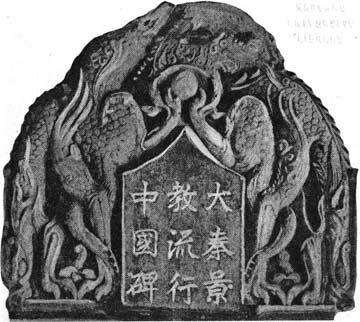
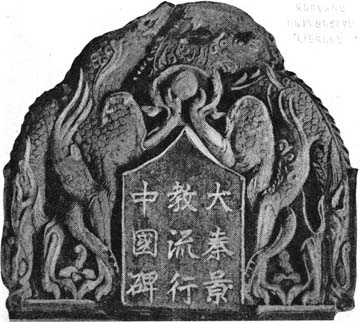
Monument headstone


PART 2: THE RED COURT

His learning was highly exalted during the reign of the Three Emperors;
his skills were extensive and perfectly complete.
First performing certain faithful service in the Red Court,
his name was eventually inscribed in the Dragon Book.


Main Gate of Chang-an in Tang times. Artist's rendition

We do not know whether I-ssu approached the towering gateway of Chang-an in autumn, when ripe persimmons hung scarlet in the trees, or in the spring, when the foothills were a soft haze of plum blossoms. Neither is it certain when I-ssu first distinguished himself at the Red Court in the private apartments of the Imperial Palace, whether it was before AD 743 or after 753. We do know that there were no new court appointments for a decade before the death of chief minister Li Lin-fu in 753. During those ten years, whenever Emperor Hsuan-tsung ordered special examinations for accomplished scholars who were not already employed in the government, Li Lin-fu, the administrator of the exams, failed all candidates; the minister then flattered the emperor that he had already brought into his services every worthy man in the empire. This perversion of official duty won Li Lin-fu his timeless infamy. His second notorious manipulation of the amiable emperor he accomplished during the last five years of his life: Jealous of power and fearful that some of the generals might win fame enough in their wars with the Turcomans to eclipse his own royal favor, Li convinced the emperor to dispense with large imperial armies on the frontiers and appoint to their defense instead the new barbarians who had recently submitted themselves to China. When the imperial troops were withdrawn, the tribes of the northeast, and barbarian generals with no real loyalty to Tang, willingly carried out the expansionist program that the Li advised the emperor to pursue. Warlords of the Khitan and the Hsi came to rule vast territories with autonomous armies while the emperor was left in control of only the palace guard. With these two ruses, the one aimed at the empire’s center, the other stretched along its perimeter, Li engineered the field of social forces to which I-ssu would have to conform his life. (See Supplement 1)

The circumstances of I-ssu’s life indicate that he most likely signed the imperial Dragon Book to consummate his first year of faithful service to the Court sometime during the desperate final years of Hsuan-tsung’s reign (See Supplement 2) – after the death of Li Lin-fu and before the dynastic eruption that raised up another emperor. During those years, the emperor played – at entertainments, at the inferior Taoist pursuit of the material pill of immortality, at the Tantric mysteries, and at love. So enamored was the emperor with his son’s beautiful concubine that he took her for his own (See Supplement 3) and left the affairs of state to Li. So distracted was the emperor by his passion for this woman that, after the death of Li and the appointment of Yang Kuo-chung as new chief minister, the jealous rival of Li’s successor – An Lu-shan – was able to rise to insurrectionary power without the emperor taking notice. (See Supplement 4)

<PART 2B: THE RED COURT>


SUPPLEMENTS

Supplement 1:
Early Infamies of Li Lin-fu

An Lu-shan. Portrait by modern artist

These infamous actions of Li Lin-fu had been preceded by others that established him in power. Two years before the appointment of Li Lin-fu to the office of chief minister, a great battle had been fought against the barbarian Khitans. The emperor proposed to make the victorious general, Chang Kiu, his chief minister. Chang Kiu, because he recognized the position was too important to be given away to a merely successful general, simply refused. The next year a Chinese army was led against the Khitans by a young man and suffered absolute annihilation. By Chinese reckoning, this act warranted the young man’s death. When Chang Kiu sent the young man, who was named An Lu-shan, before the emperor to plead for his life, the emperor, disregarding General Chang’s protest, not only forgave An Lu-shan but gave him a commission in Shantung.

Another time, when Chang Kiu warned the emperor against deposing the heir-apparent to put his eighteenth son next in line to the throne, Li Lin-fu espoused the cause of the distant young prince and, together with the child’s mother, filled the royal ear with such complaints that the emperor dismissed Chang Kiu from court and sent him to take charge of the far off district of Chihli. With General Chang’s departure from the palace, the reins of power fell into the hands of Li Lin-fu. From this time on, no one dared express honest opinions.

Years later, the emperor put An Lu-shan in charge of the northeast troops at Chihli, with disastrous results. Too late the emperor found out that when he had rejected Chang Kiu he had rejected the one man who could have saved him from the sorrows that embittered his last years as emperor.

Supplement 2:
The Virtues of Hsuan-tsung’s Early Reign

Court Ladies of Hsuan-tsung

The virtues of Hsuan-tsung’s early reign are recounted in the stanzas of the Inscription’s ode:


Hsuan-tsung with might and main pursued The Way of Truth.
The temple-names written by the Emperor shone forth.
The tablets of the celestial handwriting reflected gloriously.
The Imperial Domain was embellished and studded with gems.

[Explanation of the lines: His court was splendidly elegant. He established the long-enduring Hanlin Academy to harbor talented scholars and literateurs and an institute of music and dance to train theatrical performers for palace entertainments. He restored ancient temples and palaces throughout the Empire, and geniuses of culture flourished.]

The least and the remotest places attained the highest virtue.

[Explanation of the line: He abolished capital punishment and continued to follow the vigorous foreign policy of his predecessors.]

All sorts of works undertaken by the people flourished throughout the land, and each man enjoyed his own prosperity.

[Explanation of the line: He purged the bureaucracy of parasites and favorites, reduced court extravagances, and made special efforts to keep informed about the conditions among the people. At his capital, blue-coated scholars and men of talent assembled in the Garden Where the Talented Are Perched to await examinations or further orders. So grand was his design, Hsuan-tsung banished the mundane name of year and measured his reign in planetary revolutions instead, marking clearly his Empire’s time by the circuit of his planet about the sun.]

All of this passed, however, with the first period of his reign, which he styled “The Opening of Origins” (712–741). Had Hsuan-tsung died in middle age, his name would have been remembered with unqualified admiration. But he lived too long. By the time of I-ssu’s arrival, the emperor’s first long reign had passed into a second, styled “Supreme Virtue” (741–756), that was already near its end. The once direct, simple, and self-controlled monarch was by then turning into a besotted old man under the influence of lovely ladies, and nepotism was blooming large again.

Supplement 3:
The Emperor’s Concubine and the Five Households of Yang

Emperor Hsuan with his concubine Yang Kuei-fu and attendants on a terrace. 16th-century painting on paper by Kano Eitoku.

Yang Yu-han (“Jade Armlet”) came to be known by her title, Kuei-fu (“Exalted Imperial Concubine”), and was treated as an empress. According to the account in the Tang History, she was perspicacious, while her modest air and sidelong glances “lifted the Brilliant Emperor to the clouds.”

Her three beautiful and talented sisters were given titles coined from the names of states, as well as the revenue derived from those states: Han Kuo, Kuo Kuo, and Chin Kuo. They were each allowed annually a string of one thousand cash for their toilette, their powder, and their make-up. Their mansions were altered to resemble palaces. Before a horrified court, these three, though married, accepted the attentions of the emperor and went about in the palace as they pleased.

Besides the three sisters, two brothers also required imperial assistance. These Five Households of Yang—that is, the establishments of the three sisters and the two brothers—were thronged by people of the Four Quarters, more numerous than the people who filled the marketplace, begging favors and offering bribes. The orders that went out from these sycophantic households were obeyed with even greater celerity than the behests of the emperor himself. When Yang Kuo-chung, their cousin, became chief minister, the blossom of their nepotism reached its fullness.

Supplement 4:
The Rise of An Lu-shan

General An Lu-shan

With tragic fatality, the gigantic effort of the Brilliant Monarch to turn the vast empire into a centralized state degenerated into the satisfaction of the personal ambitions and grand desires of others. Emperor Hsuan-tsung, through his chief minister, Li Lin-fu, had induced such powerful centrifugal forces that, under Li’s suppression, these forces grew stronger, more conscious, and more cunning. For many years, the corpulent Turk An Lu-shan had often played an infant at court, cooing and even dressing in diapers, until he became too much favored by the aging emperor and his intoxicating consort. The Exalted Imperial Concubine adopted An as her son (and as her lover); the emperor himself was never content unless he had his Lu-shan in the palace.

But soon An Lu-shan would step onto the stage in the role of avenging nemesis, the huge bulk of his body representing the colossal principle of destruction that the dictator’s system had nurtured in spite of itself.

After Li Lin-fu fell ill during the tenth moon of the eleventh revolution of Tien Pao (752), Yang Kuo-chung, Yang Kwei’s cousin, returned from the West a day or two before Li’s death and succeeded him. An Lu-shan, a man of profound dissimulation, had waited until his court patron Li Lin-fu was dead; now, at the prodding of the new chief minister, he saw to it that the body of Li Lin-fu, the man most high in royal favor for nearly twenty years, was despoiled by royal command. Claiming that Li Lin-fu had been planning an uprising just before his death, An cleared himself of treasonable charges at the same time that he won new affection from the emperor.

Under the ministry of Li Lin-fu, An Lu-shan had been an awed and obedient servant of the regime, but he adopted no such attitude to the successor. Once freed from Li, the one man whose power he dreaded, An Lu-shan began to take a new and independent position of spite and disobedience toward the new chief minister. For the next three years, An Lu-shan and Yang Kuo-chung entwined in a struggle of ever-increasing intensity. While the aging, pleasure-loving emperor, half-conscious of the danger, tried to ignore what was happening, the two intrigued venomously. On the frontiers, where An Lu-shan had been already much better established, each attempted to build up military strength. In their maneuvers at court, An was bested by Yang. In the end, An Lu-shan decided that his only course lay in armed intervention.


Mar Iazed-buzid, the Great Donor: Part 1

Monument headstone

PART 1: THE EASTERN PATH

 . . . a man of harmonious nature and loving to do good,
hearing The Way and diligently practicing it,
from far out of the City of the Royal Palace
came all the way to the Middle Kingdom. . . .


Balkh is indicated on the map as Bactria.

Along about the 100th year of the Hegira (AD 722), the man named Iazed-buzid (whom the people of Tang in China would later style I-ssu) was born in the remote Tang vassal state of Takhuristan at the time when the surrounding native tribes were rising up on the high tide of Arab expansion and pressing north in rebellion, with the Arabs, toward Samarkand. Throughout Iazed-buzid’s childhood and youth, Chinese armies crossed the mountains and deserts of his homeland to suppress the rebels. During the confusion among the tribes of the Eleven Hordes in the 121st year of the Hegira, the Chinese army destroyed a large part of them, while the tribes farther east, the hui ho, or Uighurs, and the Ko Lo Lu, combined to elect a common chief among them. This new chief of the Hordes, confirmed by the Chinese emperor Hsuan-tsung, a year later sent the severed head of his rival to the emperor; but in the 129th year of the Hegira, a coalition of Arabs and Western Turks routed the Chinese armies in a momentous battle near Samarkand: the Chinese had joined their troops and their vassal hordes with those of the king of the Pa Han Na and advanced against the Arab and Turk alliance; ultimately, however, the Ko Lo Lu at the Chinese army’s rear revolted and annihilated the Chinese on the banks of the Talas River. Four years later, in the 133rd year of the Hegira, or Flight, all the imperial troops of Tang were recalled from Central Asia. Thereafter, the people turned away from the consolation of the Buddha and toward the sabered moon of Islam.

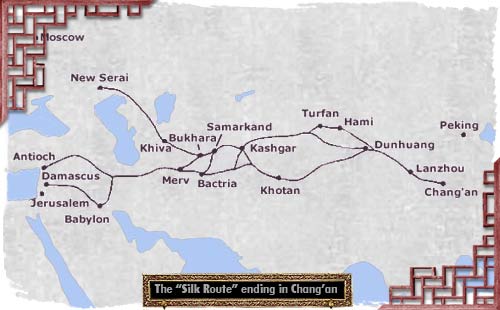
Like so many of the seventy who are listed in Syriac columns down the side of the Monument stone, sometime before the year 133 of the Flight (755 AD), Iazed-buzid left his home at Balkh, once the royal capitol of Bactria and his father’s Metropolitan See, now the main Arab military forward base in the north of Asia. Leaving behind the walls of that weary city and the hundreds of huge circular stupas constructed there by Buddhists centuries before, he sought his fortune as an educated provincial candidate for government service in the Chinese capital. (See Supplement 1) Crossing the river, perhaps in the entourage of traders, Iazed-buzid passed across the moated citadel of Balkh, the caravan palace and its gardens. On horseback or on foot, he traveled north beyond the Oxus River through the snow-clad Hissar Mountains toward the fertile high-plain valley of Zerafshan that surrounds Samarkand, the next Metropolitan See. Passing through the narrow, winding streets of that yellow maze of houses nestled among trees, at one time the Sogdian capital but now a Muslim town, he turned east and followed the latter half of the same missionary path that his predecessor, Rabban A-lo-pen, had taken more than a century before: He headed southeast more than twenty-seven hundred miles along the Great West Road from the center of far Takhuristan to the end of the road at the opulent Western Capital of China: Chang-an, the largest city in the world, rivaled in size and splendor only by al-Rashid’s Baghdad.

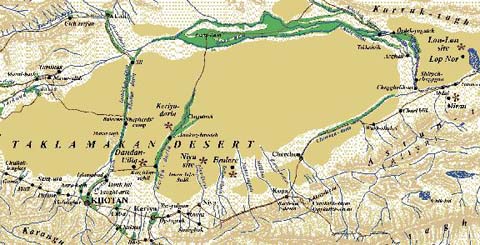
Along high mountain passes through Chinese Turkestan, Iazed-buzid made his way to the highland oasis of Kashgar, where midday was white and dazzling when it was not dimmed by the clouds of dust that choked the inhabitants and left a gray film on the black clusters of grapes. From the gardens and vineyards and pastures that sadly overlooked the desert with him, the way began to curve round the southern rim of the wide desert basin called Tarim, the storehouse of the prevailing winds that visited Kashgar two hundred days a year. Two thousand miles away, far past the other end of the shimmering desert whose sun engendered fever and whose moon engendered chills, was the next Metroplitan See, his destination: Chang-an.

Tarim Basin


From the gate of the caravan’s resting place outside the city of Kashgar, where the color of the sunset would have been the color of the sand, his caravan began its five-hundred-mile circuit against the wind to the terraces of the hospitable Aryan settlement of Khotan, the most luxurious oasis on the southern rim and the Tang garrison center guarding the key link from India and Middle Asia. From there, he moved through the trade cities of Tun-huang and Lanchow. Then, winding across Asian deserts, the caravan, descending the successive levels of the Dragon Mound, crossed two hundred miles of the emperor’s pasture to reach the central plain and finally arrive at its center: the imperial Western Capital, Chang-an.

<PART 2A: THE RED COURT>


SUPPLEMENTS

Supplement 1:
Provincial Candidates

Heart Sutra in standard style calligraphy, Tang Dynasty

The digest in the Tang history dealing with the choice of good men for office (Tang Shu Hsuan Chu Chih) states that every prefecture (hsien) and district (chou) under the Tang was provided with an Assembly Hall (kuan) for the use of students. Each year during the second of the three winter moons (the eleventh month of the year) the official in charge selected the most promising from among the body of students who had “perfected” their studies. These men, called “country candidates” (hsiang kung) offered their services in the Department of State Affairs (shang shu sheng), connected with the palace. After inspection in the Ministries of Revenue (hu pu), they reached the “barrier of examination” before the vice director (yuan wai lang).

Before Tang, the successful examination candidates, and other meritorious persons who were sent to the capital by provincial governments for employment at court, were considered part of the imperial tribute required of the area from which they came.


Mar Iazed-buzid, the Great Donor: Introduction

Monument headstone


____________
____           ____
____________
____________
____           ____
____________


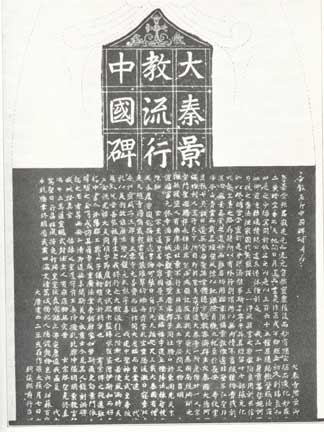
Our Great Donor,

Grand Master of the Palace with Golden Seal and Purple Ribbon,

Joint Military Vice Commissioner of the Northern Region,

Director of the Palace Administration by examination,

and granted the purple clerical robe,

the monk I-ssu,

a man of harmonious nature and loving to do good,

hearing The Way and diligently practicing it,

from far out of the City of the Royal Palace

came all the way to the Middle Kingdom.

His learning was highly exalted during the reign of the Three Emperors;

his skills were extensive and perfectly complete.

First performing certain faithful service in the Red Court,

his name was eventually inscribed in the Dragon Book.

When the Secretariat Director,

Duke Kuo Tsu-I, Prince of the Fen-yang Commandery,

first commanded troops in the Northern Regions,

Su-tsung ordered him to accompany the expedition.

Though treated with friendship in the Prince’s sleeping-tent,

he made no distinction between himself and others on the march.

He was nails and teeth for the Duke,

and was ears and eyes to the army.

He distributed his rewards and gifts,

laying up nothing in his own house.

He made offering of the crystal granted him by the Emperor;

he dedicated the cloth of gold granted him when he retired and sought rest.

He restored some of the old monasteries to their former condition;

in others he enlarged the worship halls,

elevating and ornamenting their corridors and walls;

roofs and flying eaves with colored tiles

appeared like pheasants on the wing.

He exerted himself beyond measure for the Luminous School;

making benevolence his rule, he dispersed his wealth.

Every year he assembled monks from the monasteries of the four quarters;

the hungry came and were fed;

the cold came and were clothed;

he healed the sick and raised them up;

he buried the dead and laid them to rest.

Among the purest and most self-denying God-fearing men,

such excellence was never heard of;

but now the white-robed members of the Luminous Religion

see it in this man.

— the seventeenth paragraph of the Chinese inscription on the Monument for the Propagation of the Luminous Religion in the Middle Kingdom


“In the year one thousand ninety-two of the Greeks,

Mar Iazid-buzid,

priest and chorepiscopus

of Khumdan, the royal city,

son of the departed spirit, Milis,

priest from Balkh, a city of Takhuristan,

erected this monument of stone,

on which are written the Law of Him, our Savior,

and the preaching of our forefathers

to the rulers of China.”

— from the Syriac inscription at the base of the Monument.


<PART 1: THE EASTERN PATH>


THE LUMINOUS TEACHING STONE OF CHINA AND THREE SETTINGS: Preface to “Mar Iazed-buzid, the Great Donor”

FIRST SETTING: Mar Iazed-buzid, the Great Donor


Three men are mentioned in the Inscription on the Luminous Teaching Stone who are especially notable: (1) the old Syrian Church Father and historian who authored the text of the Inscription, (2) the talented young Chinese calligrapher who cut the words of the text into the stone of the Monument, and (3) the wealthy Turkic bishop who sponsored the Monument and its raising. The lives of these men suggest the three time settings for the Stone: (1) the Church Father/historian represents the past, from the origins of The Teaching in Syria, nearly eight hundred years before the Stone was raised, and its spread across the Middle East to China; (2) the calligrapher represents the future, from the time the Monument was buried to hide it from destruction shortly after it was raised until the Teaching was finally and completely dissipated shortly before our time; and (3) the episcopal sponsor/donor of the Stone, who represents the time contemporary to the raising of the Monument.

The word setting is used in the title with a prescribed intention. The primary usage is obvious: the frame in which a precious stone is set. Each of the settings shares in this image. But the word setting holds at least three other usages: the setting of a dramatic scene, a setting of eggs for incubation, and a table setting. The literary image—the time and place of a dramatic scene—is enacted repeatedly throughout the narrative that is attached to Father Adam, the author of the Inscription, who is a historian and, however mediocre, a poet. This setting is an expansion of the historical Preface that Father Adam himself composed for the Inscription, embedded in the wider history of the Church and told from a millennial perspective. I hope the reader will recognize that the setting named for the calligrapher Lu Yen grows out of the nesting image: a batch of eggs for incubation. Lu Yen’s story traces the development of new forms of the Luminous Teaching in China from their conception (when the seeds of Eternal Truth still remaining in the eighth-century Oriental Church animated a teaching of native Chinese stock), through their generations, and on toward our own time. The next setting is named for the celebrated Bishop I-ssu, who, in the Syriac portion of the Inscription, is called Mar Iazed-buzid; this setting partakes of the familiar banquet image—a table setting—but in an imperial manner. As the reader will see, this setting has much in common with the image of a table setting for a festal meal. Bishop I-ssu’s story is an expansion of the seventeenth paragraph of the Inscription, fashioned from the time immediately surrounding the inaugural raising of the Stone.

The tale of the past, “Father Adam, Author,” and the tale of the future, “Lu Yen, Calligrapher,” are not included here. These two narratives will be presented at another time. Only the biographical note “Mar Iazed-buzid, the Great Donor,” originally completed in 1989 and recently updated, appears here.

One last word. It may appear that an element of fantasy enters the makeup of these stories, but they are in no way fictions. The stories are fashioned entirely out of commonplaces, but it must be remembered that what were commonplaces for people in their time are for us fantastic details. Whatever is factually accurate I owe to the work of historians and commentators who precede me; whatever color there is in the telling I owe to English renderings of the poets of the time. The narratives are limited by the amount and kind of information that was available to me at the time of writing. For this reason I am able to say of the verity of these stories only this: If these stories are not true, there are others like them that are true.

Explanations of political and cultural undercurrents, condensed but still too ponderous to find a place in the narrative, have been drawn out of the text and channeled into supplements at the end of each section. These are designed to assist the reader along the way.

<INTRODUCTION>


TABLE OF CHINESE PERSON AND PLACE NAMES (in alphabetical order)

Wade-Giles transliteration

Pinyin transliteration

A-lo-pen

Alopen

An Lu-shan

An Lushan

Chang-an

Changan

Chang Kiu

Zhanggiu

Cheng-tu

Chengdu

Chia Tzu

Qiazu

Chou-chih

Zhouzhi

(Prince) Chung

Zhong

Chung-jen (Ward)

Zhongren

Feng-hsiang

Fengxiang

Feng Ming

Fengming

Hsi Jung

Xirong

Hsiu-shan

Xiushan

Hsuan-tsung (2)

Xuanzong

Hua-men

Huamen

I-ning

Yining

I-ssu

Yisi

Kuan-chung

Guanzhong

(Yang) Kuei-fei or (Yang) Kwei-fei or (Yang) Guifei

Yang Yuhuan

(Yang ) Kuo-chung

(Yang) Guozhong

Ko Shu-han

Ge Shuhan

Kuo Tzu-I

Guo Ziyi

Lao-tzu

Laozi

Li Fu-kuo

Li Fuguo

Li Kwang-pi

Li Guangbi

Li Lin-fu

Li Linfu

Ling-wu

Lingwu

Loyang

Luoyang

Lu Yen

Luyan

Ma-wei

Mawei

Pei Ti

Beidi

Ping Liang

Bingliang

Shih Ssu-ming

Shi Siming

Su-tsung

Suzong

Szechuan

Sichuan

Ta-chin

Daqin

Tai-tsung

Daizong

Ta-ku

N/A

Te-tsung

Dezong

Tu Fu

Du Fu

Uighurs (Uyghur)

Weiwuer

Wu-chun

Wuzhun

Wu-tsung

Wuzong

(Yang) Yu-han

Yang Yuhuan

Yin Hsi

Yinxi

Yu-hsien

Yuxian