Mar Iazed-buzid, the Great Donor: Part 5D
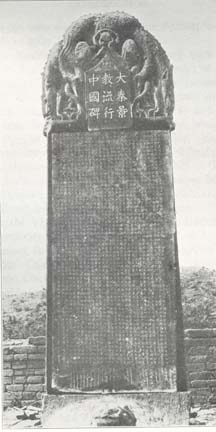
Luminous Teaching Stone of China
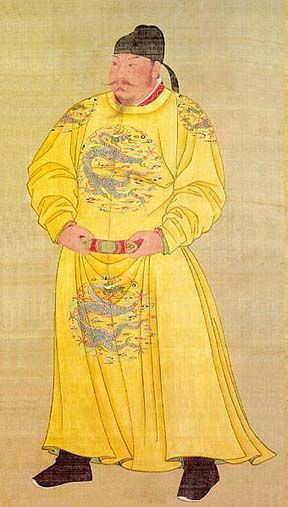
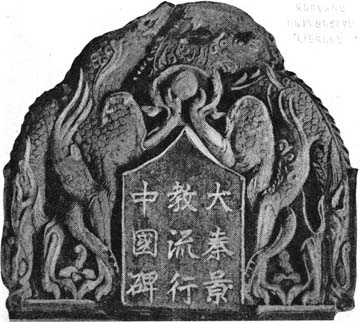
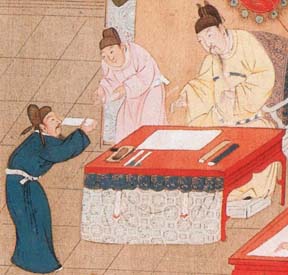
In 781 the beneficent Mar Iazed-buzid raised a Monument to commemorate the mission of the Luminous Religion in China, as well as his own part in its restoration. (See Supplement 24) The task of forming the characters of the Inscription and etching them into stone was granted to the young calligrapher Lu Yen. (See Supplement 25) The young Chinese calligrapher, who held a prestigious title but no office, and was quite likely unemployed at the time (he had been engaged formerly as a personnel manager of requisitioned labor on the east coast), yielded to his humble, careful task: to inscribe the characters of his native language onto stone that was paid for by a Turkic benefactor in order to formulate a tract composed by a Persian father. He thereby created a document that would become, a millennium later, the single most valuable testament to the existence of the Luminous Religion in China.
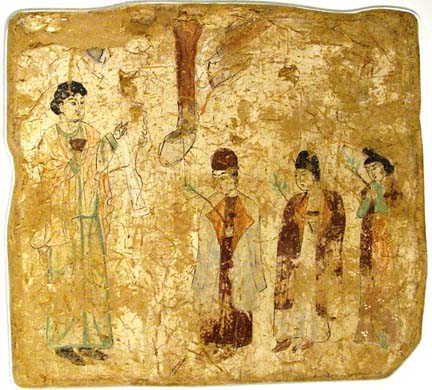
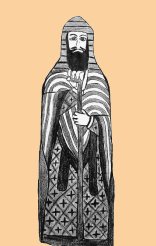
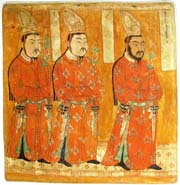
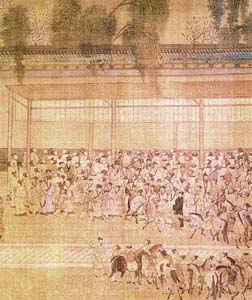
On February 4, 781, (See Supplement 26) a Sunday during the patriarchate of the Great Catholicos Mar Timothy I (See Supplement 27)—five days after New Year in the second year of the Chien-chung period under Emperor Te-tsung and the last day of the Great Cold before Spring’s beginning—the sacristan of the monastery, at the order of the abbot, summoned the congregation out of doors for the raising of the stone. (See Supplement 28) When the boards cracked the icy winter air, human chatter stilled, and churchmen from the monasteries of the four quarters took their places in ceremonial array. The distinguished abbot Ye-li led the elders: the country-bishops Mar Iazed-buzid, from the region northwest of Chang-an, Mar Sergius, from southwest of the capital, Mar Gabriel, head of the church of the two capitals, and the Persian father Ching-ching, who had written the long preface and mediocre verses that commemorate the diffusion of the Luminous Religion in the Middle Kingdom. (See Supplement 29) These and other gray presbyters were followed by the priests Ling-pao, Hsing-tung, and Sabran-Yeshu, who had aided in the raising of the Monument, and by the youths the deacon Adam, Mar Iazed-buzid’s son, and the calligrapher Lu Yen. Perhaps among them also were the seventy other missioners whose names were carved in the Stone: bishops in white turbans holding pastoral staves; priests in black turbans and cassocks; monks in tunics girded in leather and adorned only with a cross, their tonsured crowns covered with black turbans and in their hands the staves of the ascetic. (See Supplement 30)
When we read between the lines of the Syriac that commemorate Mar Iazed-buzid, we come to recognize I-ssu, and the story of the Asian mission that is written in the Inscription is brought to completion for us. We see the distinguished presbyter Mar Iazed-buzid, kind and gracious, provisioning the orphans and the poor at the monastery for fifty days, just as he had provisioned imperial guests daily at the imperial table of the palace as the young and wealthy I-ssu. Each year he laid that table ready at all times with good, substantial food, as much for the stranger who came there as for the brothers who were appointed; the sick were given holy water to drink, and disciples were healed according to monastic custom – by touch and word, without medicines or drugs.
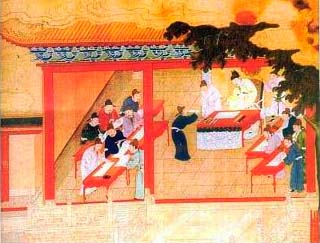
As the courtier I-ssu, Mar Iazed-buzid had been a man of great power and influence in civil and military affairs; (See Supplement 31) here at the monastery, among the white-robed scholars of the Luminous Religion, he wore the purple clerical robe. Mar Iazed-buzid had secured his fate in this transitory and conditional life by cultivating himself and awaiting his allotted time. Now he walked through the doors of the lovely pavilion to keep an appointment within the walled enclosure when the boards were struck at the hour of repast. The meals came from the kitchen cooked and served by the brothers; the wine stores in the pantry were emptied from their skins for the banquet table. Here there were no civil robes, no pendant badges of rank. Only rows of monks and churchmen, assembled silently at long tables on each side of the hall, before their simple meal of bread and vegetables. Novitiate brothers sat and ate together with their prestigious guests and with the ascetics, who had come from their separate cells away in the hills to the commons on this feast day. The abbot, too, sat with them in the assembly on this day. The hearts of the guests were purified. All annoyance was stilled. When the sacristan rose up to beat the board for evening office, black night had already enclosed the courtyard.
< PART 5E: IN THE LIGHT OF THE SETTING SUN >
SUPPLEMENTS
Supplement 24:
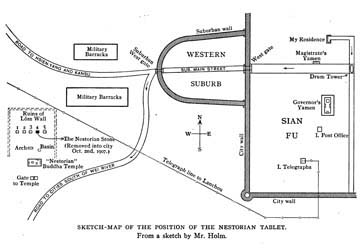
The Original Location of the Monument Stone
There are two possibilities for the original location of the Monument Stone:
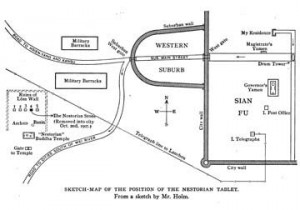
Position of the monument before its removal in 1907
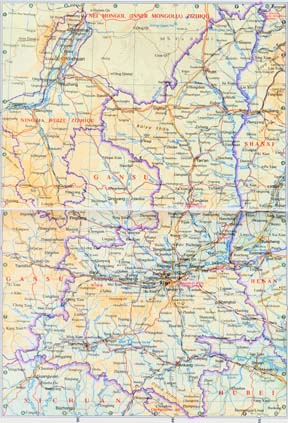
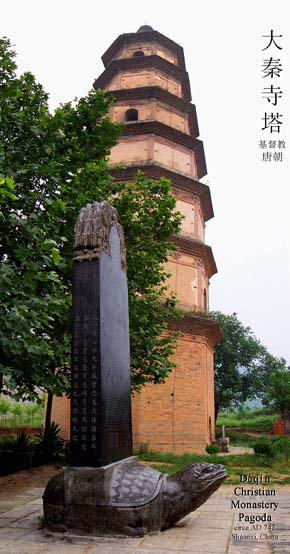
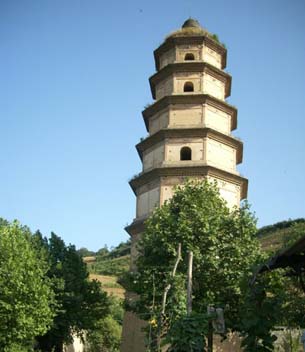
(1) the monastery at I-ning Ward where it stood for 500 years until the Danish explorer Frits Holm found it in 1907. (According to Dr. Kuwabara’s report from the 1930s, which is reprinted in Saeki’s book, the Buddhist monastery where the monument stood from 1625 to 1907 corresponds exactly to the old site of I-ning Ward of Chang-an; that is to say, the Buddhist monastery that Frits Holm visited in 1907 was the site of the 638 Ta-chin monastery at I-ning Ward.)
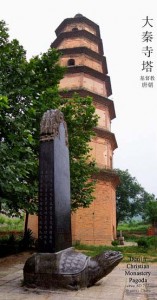
Postcard of Ta-chin (Daqin) Tower and replica of the monument stele
(2) at Wu-chun, the Ta-chin monastery on the slope of South Mountain in Chou-chih, where it is believed that I-ssu retired (The location of Wu-chun is not far from the spot where the Stone was unearthed in 1625 at one of the seven post towns that existed then between Chang-an and Chou-chih).
Supplement 25:
The Calligrapher Lu Yen
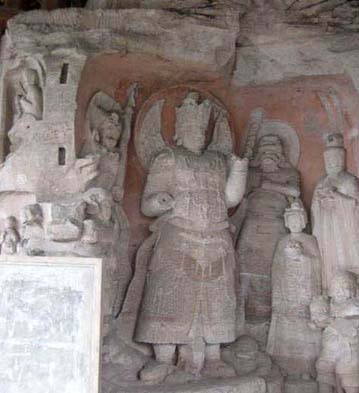
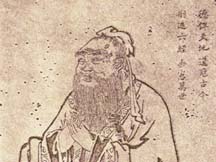
Sculpture of Lu Yen (755-805 CE) as the immortal Lu Dong Bin. By 892 CE his visage was carved into the Caves of Baishan, located in the Dazu region south of Chang-an (presentday Xian). The influence of the Persian Church of the East figures in the angel wings rising from his back and the solar cross on his chest. PHOTO Dale A. Johnson
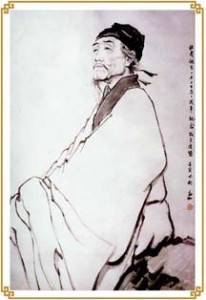
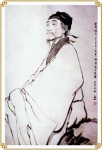
Although Lu Yen’s beautiful writing, even in the abnormal form of some of its characters, had been quoted as a model of good form in Chinese cursive style since the discovery of the Stone in 1625, the Chinese themselves record the name of Lu Hsiu-yen nowhere else among calligraphers. But if we accept the suggestion of more than one mystic sinologue, this same Lu Yen gained renown as a poet and calligrapher some years after the raising of the Monument and, as the Taoist founder of the Golden Elixir of Immortality Religion (Chin-tan-chiao), received, however partially, the knowledge that the Apostle Thomas is said to have transmitted seven centuries before to the enlightened schools of China.
Supplement 26:
The Founding Date of the Monument
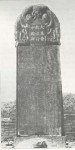
Luminous Teaching Stone of China
February 4, 781, was the date according to the Old Style, or Julian, calendar. The Gregorian date was Sunday, February 8, 781.
Supplement 27:
The Discrepancy of Dating by Patriarchate
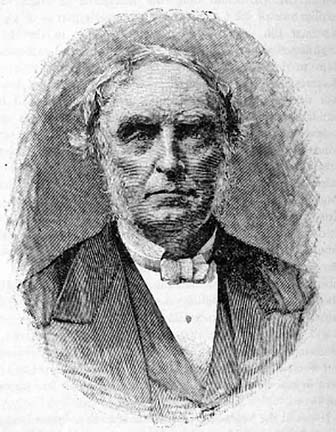
James Legge (1815-1897), Congregationalist missionary to China and first professor of Chinese at Oxford University.
The Syriac of the Inscription says: In the days of the Father of Fathers, Mar Hananishu, Catholicus, Patriarch. No two authorities agree on the date of Hanan-Ishu’s death, whether it was 778, 779, or 780. On the other hand, we are told by Dr. Wright and others that eight months elapsed between the death of Hanan-Ishu and the final election of his successor, Mar Timothy. If Hanan-Ishu died sometime in October or November of 780, the closest possible date to the date of the Inscription, the consecration of Mar Timothy could have been as late as May 781. The missionaries in China could not possibly have known of Hanan-Ishu’s death at the end of 780, when the stone was finished and waiting for the day of unveiling.
James Legge, the distinguished nineteenth-century professor of Chinese language and literature at the University of Oxford, explained this discrepancy in a footnote to his translation of the Inscription:
This is an important note of time, and occasions some little difficulty. We know from he Bibliotheca Orientalis Celementino Vaticana of J. S. Assemani that this Hanan-Yeshu’ was created Patriarch of the Nestorians at Baghdad in 774, and died in 778; whereas here is this monument erected in 781. But is not this discrepancy rather a proof of its genuineness? The news of the patriarch’s death had not reached them at Chang-an. In fact, according to Assemani (vol. iii I, 347), the canon for communication between the more distant metropolitan sees and the patriarchate required the interchange of messages only once in six years.
Mar Timothy I, whose name has already appeared in our narrative, was elected Patriarch after Hananishu, serving from sometime in 779 or 780 to sometime in 820.
Supplement 28:
The Passing of Ko Tzu-i
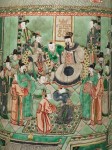
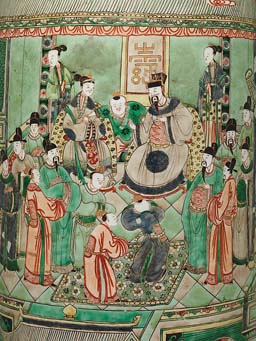
Birthday reception for Duke Kuo Tzu-i Qing Dynasty porcelain vase
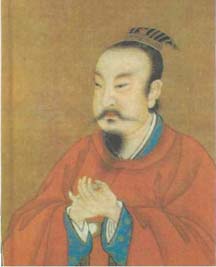
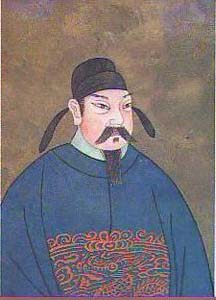
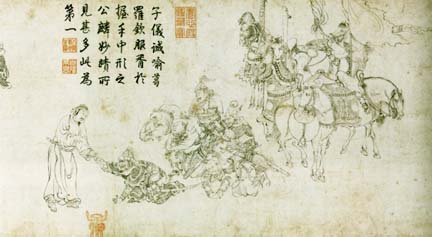
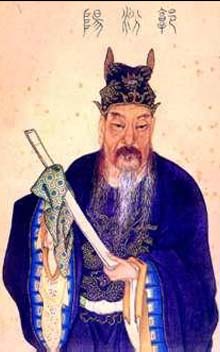
In the same year as the unveiling, Ko Tzu-I (himself suspected by historians of being an adherent to the Luminous Religion) retired from office and passed away at the advanced age of 85, still clear-headed and respected. Though many tried to injure his character, none ever dared question his loyalty. His eight sons and seven sons-in-law all held high government offices, and, at the time of his death, three thousand of the family that had grown around him recognized him as their head.
Supplement 29:
The Imperial Office of Abbot Yeh-li
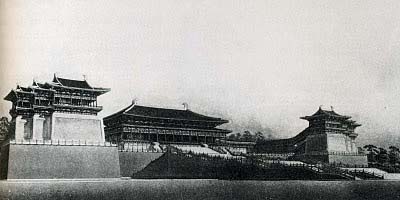
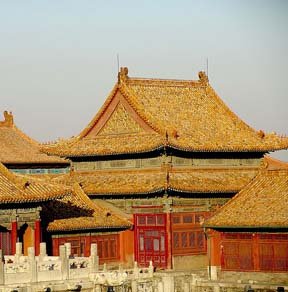
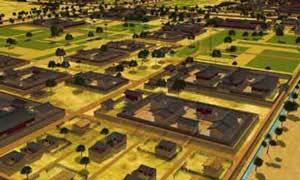
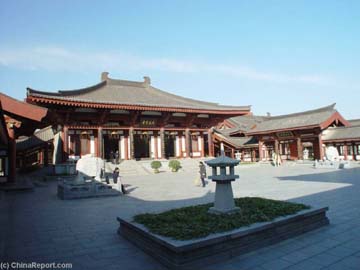
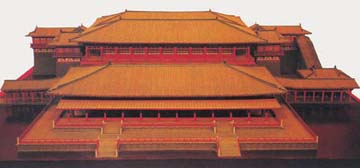
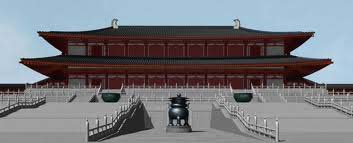
Hypothetical reconstruction of Hanyuan Hall at Daming Palace, where many state ceremonies were conducted.
The Chinese Inscription identifies Abbot Yeh-li as assistant supervisor of the erection of the tablet and “t’ai-ch’ang-ch’ing by examination, granted the purple clerical robe.” This secular title is the common official designation for the office of Chamberlain for Ceremonials. He, a chief minister or chamberlain (ch’ing), passed the government examination to be Minister of the Court of Imperial Sacrifices and was ranked 3a, as I-ssu had been. The agency for which he was ranked, and in which he may have served, was one of the Nine Courts in the central government, and the foremost in prestige. The unofficial title of his office literally evokes his image as standard bearer and the imperial decoration of the sun, the moon, and the dragon.
The court was generally responsible for the conduct of major state sacrificial ceremonies according to the regulations prescribed by the Ministry of Rites. Through its several subordinate agencies, the Court of Imperial Sacrifices was responsible for the rite of ritual slaughter, especially at the Imperial Ancestral Temple and the imperial mausoleums. Through its four minor agencies, all staffed by state slaves, the court maintained the ceremonial implements of imperial sacrifice: hu battle gear captured in battle, treasures of good omen for display, the emperor’s apparel, and all musical instruments, grains, and utensils.
All responsibility for the ritual and for the agents of imperial sacrifice – the provision of imperial fifes and drums and dancing, the provisions of living grains and animals to be sacrificed, the preparations for the imperial rites and their conduct at national altars and at the temples of the dynastic capital, all the forms of sacrificial divination (including the use of tortoise shells and the ancient divination text, the I-Ching) – were under the court. The court was also responsible for suggesting posthumous titles of emperors, such as those that appear in the preface and verses of the Inscription.
Supplement 30:
The Seventy
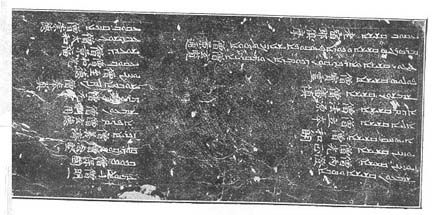
Seventy Syriac names in rows on the narrow sides of the stone with corresponding Chinese characters
Scholars till disagree on the significance of the catalogue of seventy names that cover the edge of the stone, but the East Syrian Bible, the Peshitta, records that Jesus appointed the same number.
Supplement 31:
A Note on the Imperial Office of Monastics
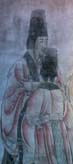
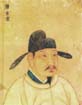
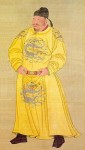
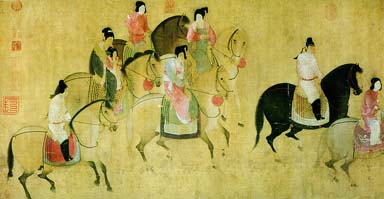
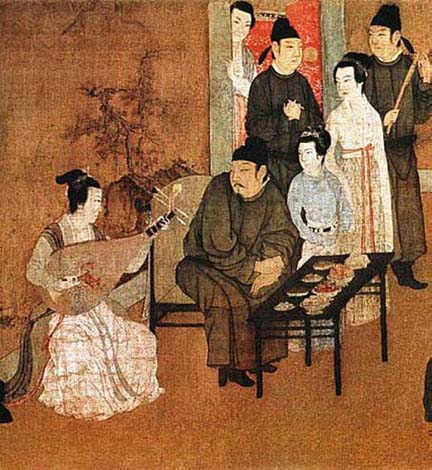
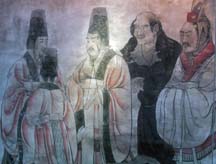
Tang officials Artist unknown
This is not unprecedented in Chinese history, especially during the Tang era; even among the monastic orders there were many instances of priests serving as soldiers or secular officials.