ALFRED RUSSEL WALLACE: On the Tendency of Humans Towards Spiritual Being, Part 6B
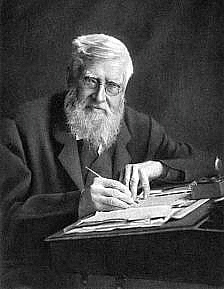
Alfred Russel Wallace (1913) near the end of his life.
Wallace’s striking example of a species that perpetuates itself abundantly without large broods requires some historical emendation and, in my view, expansion. The corollary of Wallace’s theory states that a constant supply of wholesome food is almost (a fateful qualifier) the sole condition requisite for ensuring the increase of any species. In 1858, when Wallace wrote the passage in which this corollary appears, the number of individual members of his exemplary species was estimated to be in the billions. By 1870, an advance of a mere twelve years, the number had dwindled precipitously, and by 1914, to zero, as a result of the unrestrained attacks of man. Wallace, in his time, was perhaps too optimistic to foresee this possibility or to admit the morbid power of the predatory nature of humans.
Just as the eradication of the passenger pigeon had always been a potentiality, so has the extinction of the Eternal Race always been a danger, and in all regions of the world where it has appeared in the past, all of them locales where the supranatural Food spoken of was no less abundant than elsewhere. 5
It appears that members of this Race gathered in great cultural concentrations of thousands and tens of thousands for the last times on earth among the communities of Israel and Egypt around the opening of the Common Era and in the Americas, where the remnants of once vast spiritual cultures remained for a time after they were conquered by the Incas and Aztecs, until they were finally annihilated together with their conquerors by the invading Spaniards some five hundred years ago. A list of spiritual peoples, the conditions of their destruction, and the names of their destroyers would no doubt serve to indicate the vast scope of the one-time existence of the Eternal Race and its all-time destruction; but such a list is not possible in this brief note. It should be obvious, however, that the increase of any endangered species requires more than a constant supply of wholesome food. It requires an additional condition: the protection of a nation or nations.
Endangered species of plants and animals are protected in the United States by the Endangered Species Act and internationally by the acts and charters of the International Union for Conservation of Nature. Similar provisions are presently being enacted to protect endangered indigenous peoples. 6 The Eternal Race requires the same protection. The legal encouragement of freedom of religion by nations of the past, however imperfectly conceived or applied, provided this protection with varied success in previous times. 7 These are the precursors to what is required today.
To encourage the spiritual variety of human, a nation must be protected itself by perfect and unequivocal spiritual freedom. Such is the experiment actively pursued today, first and foremost, by the peoples and in the laws of the United States of America. In San Francisco in 1962, The Universal Proclamation of Human Spiritual Rights, the most extensive statement of spiritual rights and freedoms made to date, was ratified by the International Community of Christ, Church of the Second Advent; in 2000 it was adopted by the Advocates for Religious Rights and Freedoms. The adoption of this Universal Proclamation by an entire nation, or by several nations, and the protection of its principles, may be all that is needed to ensure the future increase and development of the spiritual variety of the human—the Eternal Race—because the Food is provided, and all are invited to the Banquet.
Robert G. Petrovich 2000, 2010
FOOTNOTES
5. I will use the bare records we have of the life of one of its peoples, the one perhaps least strange to us today, that of ancient Judea, to provide an example of the pattern of extinction. The pattern is dramatic and cyclic: retreat into the wilderness under a righteous teacher to avoid unrighteousness and a return a marked time later to restore righteousness, the return followed by genocidal persecution of a wicked priest under the political rule of a man of lies. One such sequence played out in the eighth century BCE: The prophet Isaiah leads a community of the Sons of Light into the desert wilderness to avoid the rule of the evil king Manasseh; the king captures Isaiah and brings him back to the city, where he is executed at the hand of the false prophet Balchira, who had first accused Isaiah to the king; upon the death of Isaiah, his disciples follow his instructions and flee to the lands of Tyre and Sidon. The story is told in The Ascension of Isaiah:1–5, a noncanonical recount and expansion of events reported in 2 Kings: 21. Another version of the archetypal cycle of events is told in the Pesher Habakkuk and Damascus Document of the Dead Sea scriptures: Sometime in the first century BCE, a congregation of the Sons of Light returns again to the cities of Israel and Judah under a messianic “Teacher of Righteousness” (who is not named) to free the people from the domination of the new priests of the Jerusalem Temple; the Teacher is put to death by a “Wicked Priest” (also unnamed), and a long period of persecution follows; the congregation, again driven from the land, withdraws to the north, into Syria, and to the south, into Egypt, to avoid extinction under the Hasmonean kings. Decades later, the Herodian kings, who are the successors to the Hasmoneans under the Romans, execute the messianic forerunner, John the Baptist, judicially murder the Aaronic Messiah Jesus and his brother James, and kill a great many of the new messianic community as well as those of the old community. The new community, forced into exile by the persecutions of Agrippa I and his high priest Ananias, retreats under Peter to the north, there to establish settlements in Syria and in the Roman province of Asia (present-day southwestern Turkey). Other remnants of the Nazarenes and Essaei seek refuge in Tyre and Sidon and beyond the Jordan in Peraea. These final acts are recorded in the canonical and noncanonical New Testament books and in the first-century histories of Josephus. Over the several centuries that follow, the sacred knowledge of the Eternal Race, which had been entrusted into the care of these remnants, is shattered, and its members are hunted down to extinction by Roman authorities.
6. The Nukak of Colombia are represented by the National Indigenous Organization of Colombia. The Mansi of Russia are protected by the Association to Save Yugra. The Nomlaki people of Northern California have been restored to full tribal status and given the ability to acquire land by the federal government of the United States. The government of India would protect the few hundred Sentinelese of the North Sentinel Island but is prevented by the violent resistance of the Sentinelese to outsiders. Certainly there are other such peoples in other locales.
7. There had been the policy of religious freedom permitted throughout the Achaemenid Empire founded by Cyrus the Great in the sixth century BCE and documented on the Cyrus Cylinder, the freedom of religious worship established in the Maurya Empire of India by Ashoka the Great in the third century BCE and encapsulated in the Edicts of Ashoka, the free practice of religion decreed by the emperors of Tang China during the seventh and eighth centuries CE, the religious freedom declared by Muhammad in the seventh century CE in the Constitution of Medina, the religious freedom permitted by nearly all rulers of India until the invasion of the Indian sub-continent by Islamic sultanates in the thirteenth century CE, the toleration of all religions throughout the continent of Asia during the reign of the Mongols in the thirteenth and fourteenth centuries, the religious tolerance practiced in the Norman Kingdom of Sicily under Roger II and his heirs in the thirteenth century, the free practice of religion extended in Romania by the Transylvanian Diet of Turda in 1568, the long tradition of religious freedom in Poland officially recognized at the signing of the Warsaw Confederation in 1573, the personal freedom of religion declared in the Netherlands by the Union of Utrecht in 1579, the peace between Protestants and Catholics in France formalized by Prince Henry IV in the Edict of Nantes in 1598 and in force until the Edict was repealed by King Louis XIV in 1685. There was the freedom of religion applied as a principle of government for the first time in the founding of the colony of Maryland in 1634, the freedom of religion guaranteed in New Amsterdam (present-day New York) by the Articles of Capitulation when the Dutch city surrendered to the English in 1664, the Virginia Statute for Religious Freedom drafted by Thomas Jefferson in 1779, and the guarantee of religious freedom in the Bill of Rights of the United States and in the French Declaration of the Rights of Man in 1789. There is in our time the United States Commission on International Religious Freedom, established by the International Religious Freedom Act of 1998 to investigate violations of the principle of religious freedom; there is the constitutional protection of religious freedom provided by numerous states throughout the modern world; and there is the religious affirmations of religious freedom made by the International Religious Liberty Association of the Seventh-day Adventist Church, by the Church of Jesus Christ of Latter-Day Saints, by the Roman Catholic Second Vatican Council Declaration Dignitatis Humanae, and by the official position of the Eastern Orthodox Ecumenical Patriarchate; there is the contentious debate over religious freedom among the modern schools and states of Islam; and there is the protection of the freedom of religion and belief in international law that has been enforced by the International Covenant on Civil and Political Rights since 1976.