ADVOCATES OF HUMAN SPIRITUAL RIGHTS: Francis of Assisi, Part 2
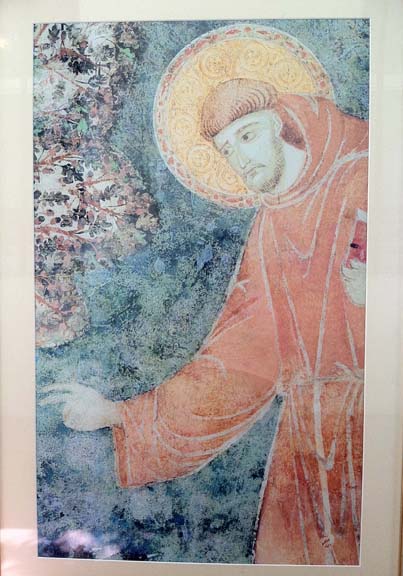
Detail of Francis from the fresco "St. Francis Preaches to the Birds" painted on the west side of the nave of the lower basilica in the Basilica of St. Francis in Assisi.

Detail of Francis from the fresco “St. Francis Preaches to the Birds” painted on the west side of the nave of the lower basilica in the Basilica of St. Francis in Assisi.


News of disturbances among the friars in Italy reached Francis in the East and compelled him to return: The two vicars-general whom Francis had left in charge of the Order had convened a chapter in his absence to impose innovations more severe than the rule required, and the papal protector, Cardinal Ugolino, had conferred on the Poor Ladies a written rule practically identical to that of the Benedictine nuns, which the friar charged with their interests had accepted. To make matters worse, one of the first companions of Francis was attempting to form a new brotherhood of lepers, and rumors were circulating that Francis was dead. Five thousand friars and five hundred novices were present at this famous Chapter of Mats held at the Portiuncola during the season of Pentecost 1220–1221. The simple and unceremonious ways that had characterized the movement disappeared. Cardinal Ugolino had undertaken the task of “reconciling inspirations so unstudied and so free with an order of things they had outgrown.”* It was on this occasion that Francis resigned direction of the Order.

In the last years of his life, while his fraternity was passing through its transition under papal influence, Francis grew increasingly ill. In the summer of 1224 he retired with some brothers to the rugged mountain retreat of La Verna (Alvernia), not far from Assisi, where it is said he beheld a marvelous “seraphic” vision. (After the death of Francis, Brother Elias announced to the Order by circular letter that as a sequel to the vision Francis had received the five wounds of the stigmata, and after the canonization of Francis, Brother Leo, the saint’s confessor and intimate companion, left a written testimony of the event.) Francis lived two years longer. At times his eyesight failed him and, during an excess of anguish, Francis paid a visit to Clare at St. Damian’s. There, in a little hut of reeds made for him in the garden, he composed the “Canticle of the Sun.” Not long afterwards, the pope ordered that Francis undergo an operation on his eyes which entailed cauterizing his face with a hot iron. Although the operation was unsuccessful, at the urging of others, Francis underwent further medical treatment until 1226, when alarming dropsical symptoms developed. He grew increasingly ill and was carried to his beloved Portiuncola, where he passed his last days near the chapel in a tiny hut that served as an infirmary. On his last day, Francis removed his shabby clothing and lay down on the bare ground in the form of a cross and, facing the sun, made his transition, asking that his soul be released from its prison.

On July 16, 1228, Francis was canonized by the newly elected pope, Gregory IX (the former Cardinal Ugolino, the papal protector of the Friars Minor) at St. George’s in Assisi. From that moment and for the next two hundred years, the influence of Francis and his name was the greatest power at work in the growing civilization of Europe. The Franciscan movement advanced with astonishing rapidity and, in the course of a few years, established over all of central Italy a network of religious houses in his name. The new pope saw in the mendicant Order a means for counteracting the love of luxury, a weapon for suppressing heresy, an army of soldiers ready to preach the gospel at the risk of their lives; and in the Third Order, unlike anything attempted before, he saw a way to draw laypersons from the entire continent into a magic circle supposed to secure the hereditary inheritance of Franciscan principles. Sporadic attempts to revive the authentic concepts of Francis, such as that of the spiritual Franciscans, met powerful resistance, and by the end of the fourteenth century, the movement had more or less spent its strength.

On the day following the canonization of Francis, Gregory IX laid the first stone of the church in Assisi erected to honor the new saint. That church grew into the Basilica of St. Francis, which became the birthplace of a new age in painting and European art. Frescoes were begun in the lower basilica around 1250. Within a few decades, the walls of the upper and lower basilica were covered with religious scenes illustrating the stories of the Bible and the lives of the saints. The life of Francis became a passionate tradition painted everywhere, full of color and dramatic possibilities, inspiring more iconographic cycles and more allegorical scenes than any other saint. And as the life of Francis brought about the birth of Italian art, his love of song called forth the beginning of Italian vernacular poetry: “The Canticle of the Sun” is one of the earliest poems written in Italian. Italian poets of the 13th- and 14th-century dolce stil nuovo (“sweet new style”), which reached its greatest brilliance in the lyric poems of Dante, have as their precursors Francis and the troubadours of Provence.

_______________________

* It is not difficult to recognize Cardinal Ugolino’s hand in the important changes made in the organization of the Order. And it is clear that the rule of the Brothers and Sisters of Penance, in the form it has come down to us, and confirmed by Pope Nicholas IV in 1289, does not represent the original rule. The customary date to assign for the foundation of this new Order—which was later used by the Roman Church to re-Christianize medieval society and whose members came to include Dante, Petrarch, Tasso, Giotto, Michelangelo, Christopher Columbus, and Galileo—is 1221.

—Robert Petrovich, 2003

* * *

REFERENCES

Historical sources on Francis are his own writings, as they are preserved, early papal bulls, and a few diplomatic documents. The Franciscan friar Thomas of Celano wrote his hagiographic “First Life” of Francis by order of Gregory IX soon after the canonization of Francis; a “Second Life,” which reflected the new official perspective in France, between 1244 and 1247 by commission of Crescentius, the then minister general of the Order; and a treatise on the miracles of Francis about ten years later at the bidding of John of Parma, the successor of Crescentius as minister general of the Franciscan Order. In addition to these Lives are a joint narrative compiled by his intimate companions Leo, Rufinus, and Angelus about 1246, a legend of Francis by Bonaventure about 1263, a more polemic legend attributed to Brother Leo, several 13th-century chronicles of the Order and a few later chronicles. Upon these works are based all later biographies of Francis. In recent years, a large controversial literature has grown up around them. In addition, energetic research work has recovered several important early texts and resulted in the careful reediting and translating of Francis’s own writings and of the contemporary manuscript authorities bearing on his life.

What still remains is to review the life and works of Francis in light of the Second Advent.


ADVOCATES OF HUMAN SPIRITUAL RIGHTS: Francis of Assisi, Part 1

Detail of Francis from the fresco "St. Francis Preaches to the Birds" painted on the west side of the nave of the lower basilica in the Basilica of St. Francis in Assisi.

Detail of Francis from the fresco “St. Francis Preaches to the Birds” painted on the west side of the nave of the lower basilica in the Basilica of St. Francis in Assisi.


All praise be yours, my Lord, through all that you have made,
And first my lord Brother Sun,
Who brings the day; and light you give us through him.
How beautiful is he, how radiant in all his splendor!
Of You, Most High, he bears the likeness.
— “The Canticle of the Sun,” Francis of Assisi


Francesco di Pietro di Bernardone (born 1181/1182, Assisi—died October 3, 1226, Assisi, Italy), known as Francis of Assisi, is the principal patron saint of Italy, the original founder of all Franciscan Orders, and the leader of Roman Catholic reform movements of the early 13th century. His father was a wealthy cloth merchant; his mother, a noble woman from Provence. He was born and grew into adolescence in warring times, when it was customary for nobles of neighboring towns to engage in military skirmishes and while the popes of Christendom called up the Third and Fourth Crusades against the Islamic forces in Palestine. In youth Francis was handsome, gallant, courteous, and witty, a humorous imp and king of frolic who would as soon empty his pockets for a beggar as for himself, popular with everyone in town and the romantic ringleader of the young nobles. He fancied himself a disciple of the Provençal “joyous science,” a troubadour. He early resolved on a military career, and in late 1205 he attempted to join the papal forces against Frederick II, the Holy Roman emperor; Francis’s biographers tells us that a series of dreams or visions urged him back to Assisi where, after a period of uncertainty, he began to seek an answer to his calling in solitary prayer. Not long after, as Dante sings, Francis solemnized his nuptials with Lady Poverty. In 1208, while Pope Innocent III proclaimed a crusade against the “Albigenses” that eradicated the language and culture of Provence, Francis exchanged the remnant of his fashionable clothes for a single tunic in the style of the poorest Umbrian peasant and wandered into the hills behind Assisi, improvising hymns of praise and identifying himself as “herald of the Great King” and “God’s troubadour.” Whatever he did in the name of God he did with the same appearance of great import and seriousness and the same light humor and grace he had used in younger days, mischievous and merrily sly, to undermine the tyrannies that complicate human life.

He evolved into a profound mystic and teacher. He made his life into a drama, at times as an example, at other times as a lesson to be watched and not imitated, in order to awaken and return a half-dead Christendom to God. Thoroughly in touch with his age, he used his life to reflect and evoke what was in the heart of the people, and from him the people learned to live in the hope of immortality. He blended the natural and the supernatural so closely in his life that he clothed his asceticism in romantic charm and impregnated his language with the chivalry and poetry of the chanson de geste. In his concept, Courtesy was the younger sister of Charity and one of the qualities of God himself; the Divine was reflected in all things; there were sermons in stones; and all things were his brothers and sisters. The life he wished to communicate was the life of Christ, “The Mirror of Perfection,” and he took on the persona of Christ as a role he played. He never intended to found an Order (he was ordained a deacon later in life under protest) but a brotherhood that expressed God’s brotherhood, of which all created things were a part. He did not intend to be a reformer: He tried to correct abuses by holding up Images of God. To those who sought “better gifts,” he opened his arms; the others he left alone. His mission was to rekindle the love of God in the world and to reanimate the life of the spirit in the hearts of all.

His example began to attract followers in 1209. When the number of his companions numbered eleven, Francis drew up a rule of life for them to follow, styled his group the Penitents of Assisi, and set out for Rome to seek the approval of the Holy See. Accounts of their reception differ, but it seems Pope Innocent III verbally approved the Rule, and so the members received the ecclesiastical tonsure. (This “first Rule,” as it is now called, has not come down to us in its original form.) After their return to Assisi, the brethren, now called by Francis the Friars Minor— that is, the Lesser Brothers—obtained a permanent foothold near Assisi about 1211 through the generosity of the Benedictines of Monte Subasio, who gave the brethren the little chapel of St. Mary of the Angels, the now-famous Portiuncola. Adjoining this humble sanctuary, a few small huts of straw and mud enclosed by a hedge became their first convent and the central spot in the life of Francis. From here, Francis sent forth the Friars Minor two by two like children “careless of the day,” singing in their joy and calling themselves the Lord’s minstrels. During Lent 1212, Clare, a noble eighteen-year-old heiress of Assisi, sought out Francis to become his spiritual student. In her, Francis found the embodiment of the Lady Poverty whom he had served from afar. Francis gave her a religious habit similar to his own and eventually lodged her in the church of St. Damian with her sister Agnes and a few other female companions who followed her. Thus was founded the sisterhood of Poor Ladies (now known as the Poor Clares).

Francis convoked the first general chapter of the Friars Minor at the Portiuncola in May 1217. At this gathering, Francis apportioned the provinces of the Christian world into so many missions. Francis reserved France for himself, but he was dissuaded from going there by Cardinal Ugolino (soon after made protector of the Friars Minor by Pope Honorius III), who sent Francis to Rome to preach before the pope and cardinals in the pope’s own cathedral of St. John Lateran in order to allay the prejudices that had been growing among the Roman Curia at the methods Francis was using. At the second general chapter of the Order in May 1219, Francis assigned a separate mission to each of his foremost disciples. For himself, he selected the seat of the newly pronounced Fifth Crusade against the Saracens. In June he set sail for Egypt with eleven of his companions. Francis was present at the siege and the taking of the city of Damietta by the Christian crusaders. In the midst of the battle, Francis preached to the crusaders, then passed over to the enemy camp where he was arrested and led to the sultan. It is reported that the sultan received Francis with courtesy and gave him permission to visit the holy places in Palestine. It is also reported that the sultan, charmed by Francis, said: “I would convert to your religion, which is a beautiful one—but both you and I would be murdered.”

< PART 2 >


ADVOCATES OF HUMAN SPIRITUAL RIGHTS: Robert Henry Charles

What the Divine plan of his life is, man can only learn as he advances faithfully and adventurously along the path which is marked out for him by God, and which he can never be at a loss to know, if he but seeks to know it. But since the path is of God’s devising and not man’s, it follows that it must be one of high adventure, and one that is often beset with clouds and darkness. The life of the faithful man must, therefore, be one of constant discovery: on the one hand of the goodness and love of God, on the other of his own growing power and destinies.
—R. H. Charles, Gambling & betting: a short study dealing with their origin and their relation to morality and religion, 1925


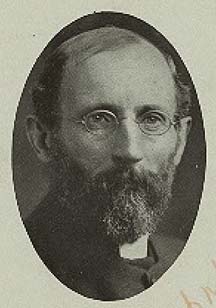
R. H. Charles

R. H. Charles

Robert Henry Charles (1855–1931) received a doctor of divinity degree from Trinity College and a doctor of letters from Oxford, was accepted as a Fellow of the British Academy, and in 1919 was appointed archdeacon of Westminster. Charles began his education at a private school near his home in Ulster, Ireland, but was dissatisfied with the quality of instruction and requested to be transferred to Belfast Academy. He made rapid progress and soon entered Queen’s College, where he earned his B.A. (1877) and M.A. (1880) with first-class honors. During his undergraduate years at Belfast, he passed through a spiritual crisis that led him to seek ordination; accordingly, he entered Trinity College, Dublin, and there opened a brilliant career in classics and theology. He served as professor of biblical Greek at Dublin, as lecturer at Oxford, and as canon and, later, archdeacon of Westminster. But it was his rare work as a scholar of Jewish eschatological, apocryphal, and apocalyptic literature that distinguished him and brought him fame.

In 1880, at the end of his master’s courses at Queen’s College, Charles spent some time in Germany and during his stay at Heidelberg met the woman who would later become his wife. He was ordained a deacon in 1883 and a priest in 1884. During the succeeding six years he served curatorships in Whitechapel, Kensington, and Kennington with such zeal and energy that his health was seriously impaired and prolonged rest became necessary. With his wife he went to Germany for a year. It was during this visit that he began his study of religious developments within Judaism during the intertestamental period, particularly the exposition of the apocalyptic literature of that age. When Charles returned to England, he settled at Oxford and began the publication of a long series of works of first-rate importance. The series opened with an English translation of the Book of Enoch (1893) and was crowned by a massive edition of the Apocalypse of John or Book of Revelation in two volumes (1920) and a great commentary on the Book of Daniel (1929). In the intervening years he published masterly English translations, with reliable commentaries, of many apocalyptic works that had only recently come to light. To do so he made himself a master of the languages of the genre—Hebrew, Greek, Latin, Syriac, Armenian, Ethiopic—by years of industrious and concentrated study.

His knowledge was vast and accurate. His critical editions of the Book of Jubilees, Enoch, and Testaments of the Twelve Patriarchs still stand as models of scholarship and remain indispensable for students. While pursuing his own researches with characteristic zeal, he gathered about him at Oxford a band of scholars with similar interests and abilities. The result of their joint labors was the two volumes of The Apocrypha and Pseudepigrapha of the Old Testament in English (1913), in which, besides the general editorship, Charles contributed a large share of the detailed work. He had worked at and revised his own contributions to that collection—2 Baruch, 1 Enoch, 2 Enoch, Martyrdom of Isaiah, Book of Jubilees, Assumption of Moses, Testaments of the Twelve Patriarchs, and Fragments of a Zadokite Work—over a period of nearly twenty years. His Ethiopic version of Enoch was edited from twenty-three manuscripts with additional Greek and Latin fragments; his Testaments of the Twelve Patriarchs, from nine Greek manuscripts with Armenian, Slavonic, Hebrew, and Aramaic versions. Like the unequaled scholar of a later generation, Theodor Gaster, R. H. Charles produced excellent translations of scriptural texts newly come to light and believed it to be his duty as a scholar to present them to laypersons for their elevation.

Robert Petrovich, 2002


ADVOCATES OF HUMAN SPIRITUAL RIGHTS: Jacquetta Hawkes

     It seems that a new religion must exalt the Sun of Life more successfully than Christianity has ever succeeded in doing. . . . Akhenaten in his gardens by the Nile had a vision of what might be, but it was too soon. If we cannot move nearer to this vision now, it will be too late. . . .
      Meanwhile the sun shines upon us all in turn. . . . There is just a chance that it may awaken us to a Good Morning.
Man and the Sun, Jacquetta Hawkes


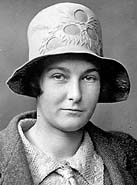
A young Jacquetta Hawkes PHOTO:  Nicholas Hawkes

A young Jacquetta Hawkes PHOTO: Nicholas Hawkes

Jacquetta Hawkes (1910–1996) was the daughter of Nobel Prize–winner Sir Frederick Hopkins, the first cousin of poet Gerard Manley Hopkins. Hawkes began to grow an awareness of the poetry of history at an early age and was drawn to archaeology, which she read for her degree at Newnham College in her hometown of Cambridge. In 1931 she began her lifelong work conducting research and excavations in Britain, Ireland, France, and Palestine. Her first book was on the archaeology of ancient Britain; her last, on the archaeology of the entire ancient world. During and immediately after World War II, she held several government posts and founded the United Kingdom Commission for UNESCO, the United Nations education and cultural organization. Over the next forty years Hawkes wrote prolifically, authoring bold and poetic books on archaeology, geology, and the history of humankind.

In 1962 she published Man and the Sun. The book was regarded by some to be a belated product of the school of comparative religion founded by Sir James Frazer. Her earlier book Man on Earth (1954) had been an informative and beautiful synthesis of science and imagination that attempted to give to the layperson an impression of what has been happening to humankind on earth, a history of the emergence of the human species. Man and the Sun went further. This book was a synthesis of cosmography, geology, biology, archaeology, and the cultural history of religions in which Hawkes showed her wide and deep learning in condensed and felicitous language and provided poetic descriptions that detail not only humanity’s physical dependence on the radiations of the sun but also the sun’s pervasive effects on human minds and spirits. Her marvelous presentation of the early history of the Roman Church, its marriage to the older religions that flourished in the empire, and its emergence as an organized and universal state religion graphically depicts the transition of Christianity from a mystical Church into a temporal one. Her treatment of the older religions that revered the sun contributes greatly to humanity’s knowledge of the past. The book also contains the hope for a future religion of Christianity that will respond to the higher aspects of the sun and the Intelligible Light that it transmits to the world.

What Jacquetta Hawkes wrote on the subject of religion enlightens the reader and leads to new avenues of thought. Her writings are a valuable contribution toward general recognition of the future and the importance of a newly emerging Christianity.


Robert Petrovich
October 2002


ADVOCATES OF HUMAN SPIRITUAL RIGHTS: Theodor Herzl Gaster

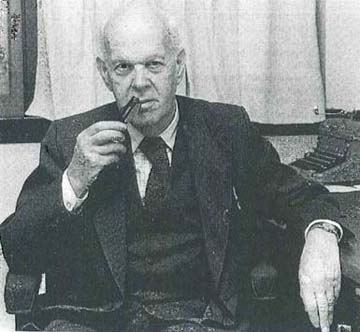
Theodor Gaster ARCHIVE PHOTO

Theodor Gaster. ARCHIVE PHOTO

Even if the Torah be correctly expounded by prophet and teacher, men, it was held, can and will receive it only if they be correctly attuned. And that attunement comes—if we may mix the metaphor—through inner “enlightenment.” . . . The acquisition of that light, however, was not attributed to any sudden, spontaneous act of grace. Rather it was the result of man’s own voluntary exercise. . . . The choice of using it or ignoring it had been left, in the case of man, to his individual will. If he heeded the gift, he achieved harmony with the eternal cosmic scheme and broke the trammels of his mortality. Automatically, he was embraced in the communion of eternal things; he became one with the great forces of the universe, with what we would call Nature, and with the non-mortal beings of the celestial realm-—the “holy ones” who stood for ever in direct converse with God. He achieved, in short, what mystics term the “unitive state.”

It was this state that the members of the community claimed for themselves. This was the ultimate goal of their entire spiritual adventure; the aim and raison d’ tre of the Torah and of the disciplined life which it enjoined. They held that by virtue of their “enlightenment” they were members not only of the consecrated earthly brotherhood but eo ipso of the Eternal Communion. . . . This is . . . the sound mystic sense that, given the right spiritual posture, given the victory over that darkness which is set before him along with the light, man may live even on earth in a dimension of eternity.
— T. H. Gaster, Dead Sea Scriptures in English Translation, pp. 6–7

Theodor Herzl Gaster (1906–1992), a scholar of comparative folklore, had an academic career that spanned five decades. He was one of the world’s most distinguished Hebraists and an authority on the intertestamental period, from which the Dead Sea Scrolls derive. His father, a recognized scholar of Samaritan literature and biblical studies, went blind when Gaster was a boy, and the boy became responsible for reading books out loud to keep his father abreast of scholarship, an experience that heightened Gaster’s interest in language, scholarship, and mythology. In his youth he studied Greek, Latin, and archaeology at the University of London; in 1943 he received his PhD from Columbia. During his academic career, Gaster wrote ten major books and contributed numerous articles to periodicals, encyclopedias, and dictionaries. Of the ten books, two were translations, The Oldest Stories in the World (1952) and Dead Sea Scriptures in English (1956), and five dealt explicitly with Jewish myth, legend, and folklore—all focused on the traditions of the Near East.

Like his contemporary Joseph Campbell, Theodor Gaster had a gift for storytelling, and he applied his historical and linguistic acumen to the texts and societies of the early Hittites, Canaanites, and Hebrews. Unlike Campbell, who saw myth as a story from which the modern-day reader may gain some insight, Gaster saw myth as a testament to a different mind-set. Gaster’s goal was to understand myths in the context of the time in which they were created. All words, he said, are only translations of the thoughts behind them. Gaster gave us a clue to the deep significance this statement had for him when he wrote his commentary on a fragmentary text from the Dead Sea Scrolls:

The interpretation rests on the device . . . of reading further meaning into a text by mentally correlating it with other passages in which the same words are used in different contexts.

This, he said, is the way ancient words were interpreted and elaborated by the authors of the Scrolls and is a device of rabbinic tradition. Gaster might also have said that this statement serves to describe his own scholastic method as well.

Gaster was able to work in twenty-nine languages and dialects, an ability that enabled him to amass the cross-cultural parallels of whatever he was working on from the original sources. Gaster considered Sir James G. Frazer, the author of The Golden Bough and of Folklore in the Old Testament, to be his “great predecessor” whose “disjointed disquisitions” on the Old Testament he, Gaster, was able to bring to complete coverage (The New Golden Bough, 1959). Yet Gaster recognized that he did so “by standing on the master’s shoulders” and by applying Frazer’s method of comprehensive comparison. Gaster’s published researches—his books—are each in their own way intended to be exhaustive. Gaster worked from a card file that he began to compile in 1934. The file had run to seventeen thousand items by the time he wrote his last major work, Myth, Legend, and Custom in the Old Testament. This last book, published in 1969, was, in his words

an attempt to gather into one place all that can be derived from Comparative Folklore and mythology for the interpretation of the Old Testament. . . . What I have done, then, is to go through the Old Testament from cover to cover and pick out, verse by verse, anything on which Comparative Folklore or mythology may throw light. In this effort, I have kept my sights not only on elucidating the overt sense of the text but also on recovering by the aid of such material the undercurrents of thought and the subliminal elements of the writers’ minds.

Of his method of interpretation in this project he had this to say:

In interpreting . . . I have generally used the control of context, choosing that explanation which best accords with the acknowledged tenor and meaning of other usages with which it is ceremonially associated.

Gaster employed a similar method to produce his translation of the Dead Sea Scrolls. With Dead Sea Scriptures in English Translation his purpose was to provide a complete and reliable translation of all the principal and intelligibly preserved documents retrieved from the Dead Sea caves, together with the related Zadokite Document, which was discovered nearly fifty years earlier in an old synagogue in Cairo. Gaster concerned himself only with what the scrolls themselves had to say, not with what was being said about them. In this way, he provided us with his most valuable contribution: his interpretation of the Dead Sea Scriptures, an expression made in both his careful translation of the Scrolls and the considered commentaries on the Qumran Community that he was able to draw from them. Gaster recognized that the scriptural passages that were interwoven in all the texts of the scrolls by their authors were often understood by them in an uncommon way. He consulted ancient versions of Old Testament texts in the original languages in the attempt to recover from those sources any traces of the tradition that the authors may have followed, and he found in them clues to expressions in the scrolls that would otherwise be obscure. He combed through New Testament texts to find the affinities there, and he compared the practices of the spiritual Community described in the scrolls with the practices and traditions of the edah Community of the early Church in Palestine, of the Mandeans, of the Samaritans, and of the Manichaeans—all in order to approach the same understanding of the words of the scrolls as the authors themselves had. Gaster earned significant recognition in the late 1940s when he was among the first scholars to examine the newly discovered scrolls. His Dead Sea Scriptures, one of the first English translations of the Dead Sea Scrolls, he single-handedly edited and translated from facsimiles of the original scrolls at a feverish pace, taking only thirty days, during which he consumed vast amounts of hot tea and wrapped his head in cold towels to ward off sleep.

Dead Sea Scriptures sold over 200,000 copies from the first edition in 1956 to the last edition in 1976. Today it is out of print. Perhaps this fact is significant. A comment he makes in the final paragraph of the preface to Myth, Legend, and Custom in the Old Testament, his last book, about the difficulties he had faced throughout his career is telling:

I have had no help from colleagues in preparing this book, and have indeed been constrained, over these long years, to plow a lonely furrow.


Robert Petrovich
October 2002