Mar Iazed-buzid, the Great Donor: Part 4A
PART 4: COURT CIRCLES
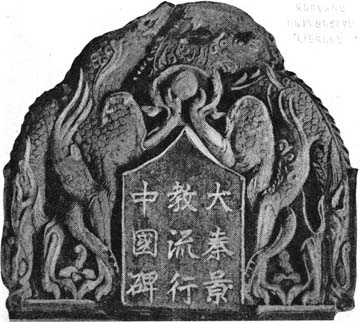
. . . Grand Master of the Palace with Golden Seal and Purple Ribbon,
Associate Military Vice Commissioner of the Northern Region,
Director of the Palace Administration by examination . . .
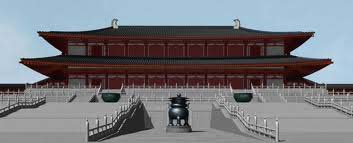
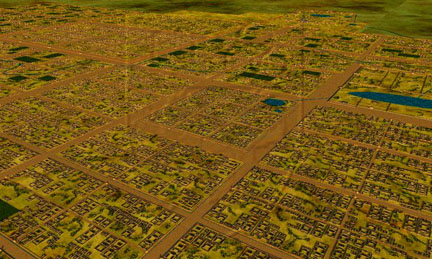
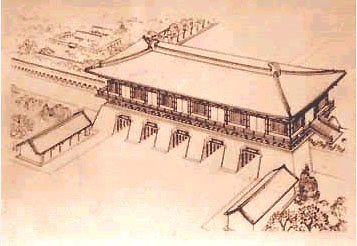
Tang Dynasty Imperial Palace: "The Red Court" Artist's conception
The final lines of the Inscription substantiate I-ssu’s illustrious existence in Chang-an imperial circles, but only the words of historians and chroniclers can substantiate the existence of those circles, and only the words of poets can substantiate their diminishing splendor. These I have read, not only to discover what is immediately apparent but also to draw out from their words (the only material I have to work with) the typical figures that will appear in this narrative. I have made no attempt to place them into I-ssu’s personal life, where his relationships can be only a matter of conjecture, but into those nodal zones that still can be remembered, where life merges with custom, institutions, and law; that is to say, his public life. Although there was some risk of getting lost in such a project, I have attempted to yield as much specific detail as possible.
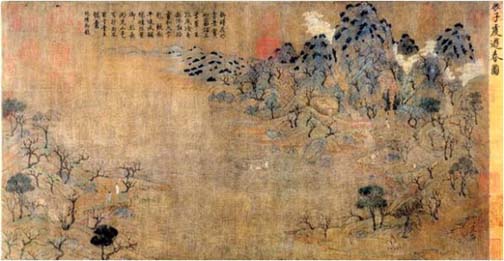
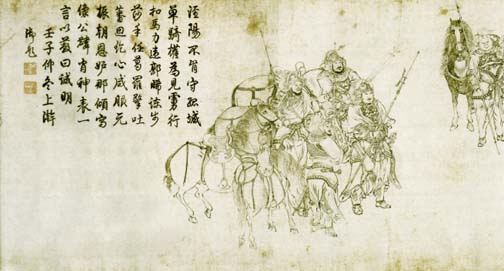
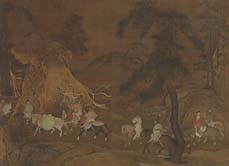
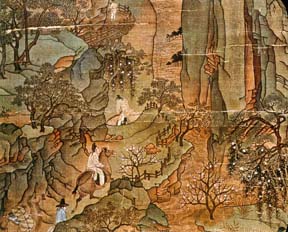
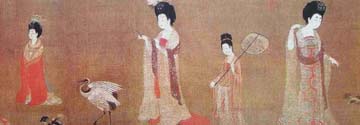
"Traveling in Spring" Tang Dynasty painting by Zhan Kigian
Rivers and mountains survive broken countries. In spring, four months after the new emperor’s return, the city grew lush again. Su-tsung insisted that possession of the palace signified restoration; defeat of the insurgents, he believed, was only a matter of time. On the fifth day of the second moon of the third revolution of Chih Te (759), while Kuo Tzu-i, and perhaps I-ssu with him, were awaiting their orders anxiously at Hsian-wei, Emperor Su-tsung changed the period name to Heavenly Origin (Chien Yuan), abandoned the term “revolution,” which his father had instated, and reintroduced the term “year”; and the ancestral temple burned down by An Lu-shan he restored. Five months later, Su-tsung sent off his fourteen-year-old daughter to become the bride of the hui ho qaghan to cement the alliance of their peoples. In the city, the people already looked down upon those whom they had praised as heroes only months before. Proverbially among the sons of Han, when an educated person visited the home of a lowly person, he was said to “brighten the room.” Now the educated southerners said the palace was “darkened” with the comings and goings of the sons of the Northern Regions, the hui ho, whose arrogance reached to the skies, who gashed their faces as an earnest of sincerity (and who smelled because they wrapped themselves in furs and gorged themselves with flesh food), who were overbearing to the last degree, and who, on top of everything, recently revived their custom of dashing across the frontier to seize the harvests of the sons of Han in high autumn when their barbarian horses were sleek and fat.
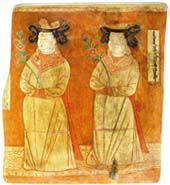
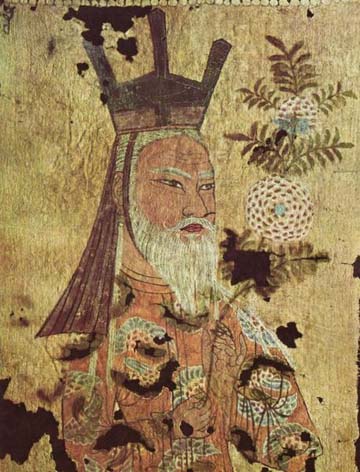
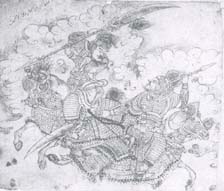
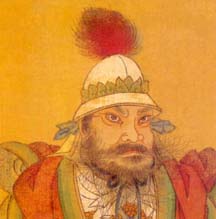
Uighur princesses Wall painting from Bezeklik caves
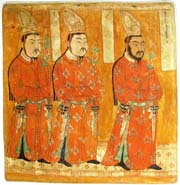
- Uighur princes in robes and headress Wall painting from Bezeklik caves
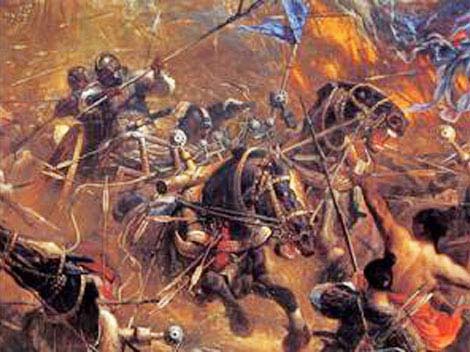
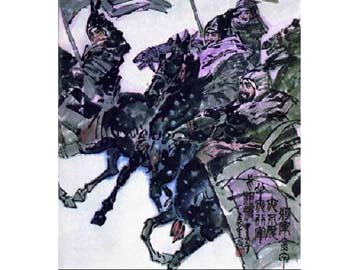
Perhaps on one of those days after the emperor had recalled the war hero Kuo Tzu-i to sit at court in the capital, where he might be watched and not influence the events taking place on the frontier, the valiant-hearted duke rode out of the gates of the capital to weep alone by funereal trees. For him the rebellion in the north had stained the blue sky. His Dragon Sword cried out, yet he was left there idle to shake his sleeves and stroke his cross guard. Kuo Tzu-i knew that the maze of women’s gates and eunuch pavilions (See Supplement 1) around the jade towers of the Vermillion City prevented him from explaining to the emperor the gravity of the situation. On this day the visible symbol of the duke’s high rank, the golden fish he wore on a chain from his waist, swung slowly to the gait of his horses, while the eunuch commanders, the powdered-lady generals, were riding under the fiery banners. He knew the iron horsemen of the Northeast could smell from afar the ornate arrows in their perfumed quivers when they called for their own metal lances; on the frontier, thoroughbreds were eating cold weeds, while the useless nags he saw row on row in the high-beamed palace stables were stuffing themselves on green grass and drinking white water.
Just as it is not certain whether I-ssu (C) had continued on to the East with Kuo Tzu-i in the autumn of 757, after the capital had been restored to Tang, neither is it certain whether I-ssu returned in 760 with the pacified commander or at some earlier or later date. But it is certain that when the Court returned to Chang-an, from that time forward, the physical facilities, personnel, and supply of the forbidden districts of the palace were entirely in the hands of eunuchs, and in these surroundings I-ssu learned the Confucian honor of service.
The phrasing of the Inscription, in combination with my ignorance of exact Tang usage, leaves me uncertain about I-ssu’s life during the next several years. However, the phrasing leads me to believe that I-ssu (E) received his official honors and awards from Su-tsung, who reigned for only three years after the Tang restoration of the capital, until 763, and not (F) from Su-tsung’s successor and son, Tai-tsung. The time frame of the events mentioned in the Inscription is vague. (Perhaps the vagueness is intentional, to avoid the embarrassment of mentioning I-ssu’s many years of diligent but uninspiring government service. Delicacy requires that timeless official inscriptions praise only the extraordinary.) The Inscription’s narrative sequence of events, as much by what it says as by what it does not, suggests Emperor Su-tsung’s high favor of I-ssu and the likelihood that I-ssu led the common life of an imperial noble for many years before he retired to monastic life.
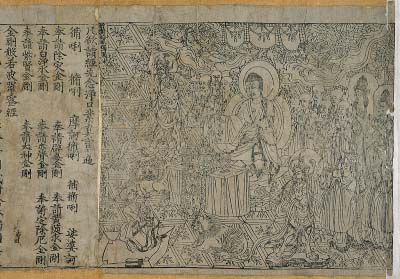
Buddhist Diamond Sutra Tang Dynasty print
(E)
By the time I-ssu appeared in court circles to offer himself for government service, the shocks of repeated rebellion had begun to crack open the Tang social order, and powerful popular forces were already rushing in. The egalitarian traditions of the nomadic Eastern invaders had wedged in and countered the vigorous efforts of the northern aristocracy, the settled descendants of invaders from an earlier dynasty, to expand their political control. The emphatic compassion of the people was beginning to wash away the ruling sentiments that had marked them for ill treatment for centuries. The people, whose influence rose as the influence of their religion rose, now accepted gratefully the Buddhist offering of a secure and respectable status outside the established hierarchy, and in such great numbers that decades later the government would restrict the growth of religious establishments. The civil service, by weakening the rigid shell of the traditional titled class through procedures of social engineering, allowed a fresh new respect for individual human dignity to emerge and ultimately to become the prominent characteristic of the age. Even Buddhist monasteries, through their social welfare program, educated promising young men in the Confucian classics so they might compete in the civil service examinations.
In this heartbreaking and melancholic age, a man of value who wished to dedicate himself to government service had only two paths open to him. Following one, a man became a candidate for years, seeking recruitment through a series of recommendations and examinations in a long and symbolical ritual of state. (See Supplement 2) I-ssu, like the ancestors of the northern elite who had founded the dynasty of Tang, took the other path: He rose swiftly through the ranks of military service to a generalship by his personal powers alone, (See Supplement 3) and when he entered civil service, the prestige of his rank transferred with him.
SUPPLEMENTS
Supplement 1:
The Rising Status of Li Fu-kuo
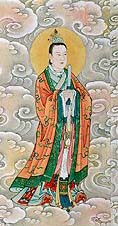
Empress Chang (Zhang)
At Ling-wu, money had been scarce; to pay the troops, the new government resorted to the fatal method of mai kuan, selling official ranks. To the great annoyance of the ministers, men of rank then mingled with undersecretaries, and eunuchs appeared in positions where no eunuchs should have been. At Ling-wu Emperor Su-tsung had recognized the talents of the eunuch Li Fu-kuo by making him chief administrator of the armies on campaign. Now Li Fu-kuo busied himself in affairs of state. By the time the imperial armies reached Feng-Hsiang, Lady Chang ruled the emperor, and the eunuch Li Fu-kuo had grown arrogant. When Li Fu-kuo assumed the duties of secretarial chief of staff in the palace at Chang-an, his personal status rose even higher.
Supplement 2:
The Ritual of Government Recruitment
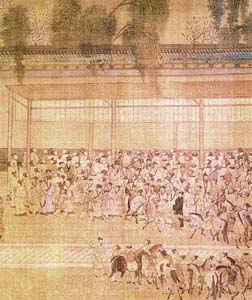
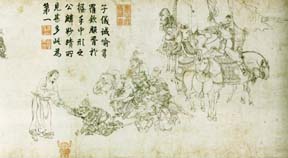
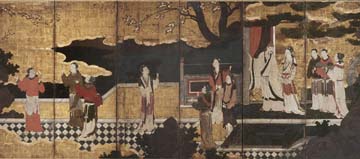
Scholars wait for results of civil service exam. Handscroll attributed to Qiu Ling (c. 1530)
The ritual begins with a recommendation given by the official of the candidate’s district and success on the district and provincial exams, continues with the recommendation of the prefect of his province and acceptance for study in the national university, and ends with the completion of one of the metropolitan degree examinations held each autumn at the capital. The highest degree was given for literary talent, the next for classical scholarship or one of the other less-esteemed degrees in law, calligraphy, or mathematics. Success in one of these selection examinations assigned a man an official status and a rank through the government’s Ministry of Rites and qualified him for appointment through the government’s Ministry of Personnel but guaranteed him nothing. Far more men prepared for examinations than passed, and far more became qualified than were ever employed. One in ten gained a government post; the others languished in the large pool of unemployed inside the capital, from which a few were drawn out now and then to be used in education or administration at the local level. A candidate might spend twenty years or more reaching the selection examination. Half of those who succeeded were already gray-haired men.
Supplement 3:
Rising Through the Ranks of Military Service
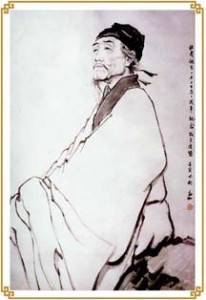
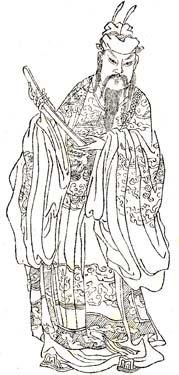
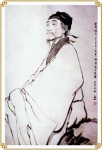
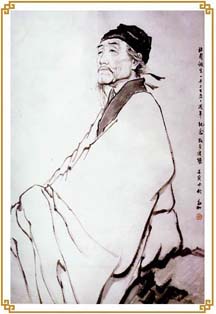
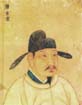
The poet Tu Fu. Anonymous artist's conception.
The renowned poet Tu Fu, whose talents had been rewarded by the government with tedious posts and a minor rank, observed that, whereas study and the arts of peace should bring the most highly coveted awards, under the condition of strife, the ambitions of men are best realized by military success.