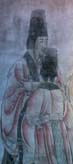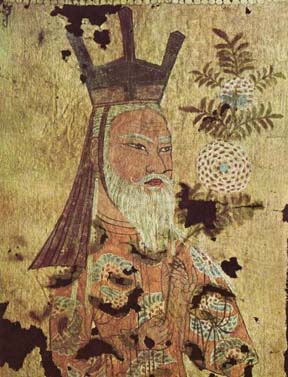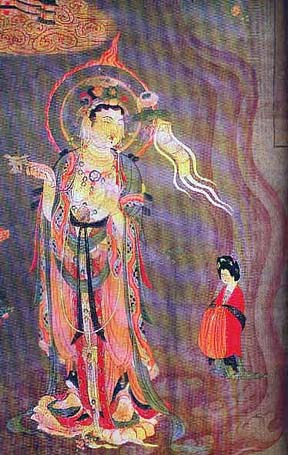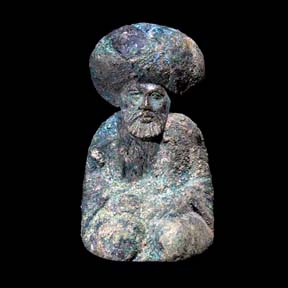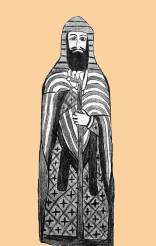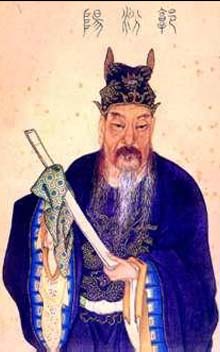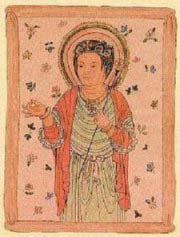
Restoration by Robert MacGregor of the original silk painting of a missionary bishop of the Church of the East, discovered at Dunhuang in 1908 by Sir Aurel Stein in a cave sealed since 1036 CE.
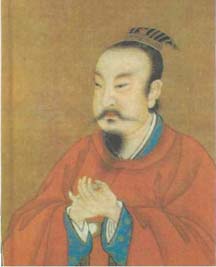
When I-ssu put aside his cap of gauze and came to live under new vows, he bowed his head for Rabban to replace his official top knot with the tonsure of “wheel and crown.” Whether it was in middle life or in old age, (See Supplement 14) after the period of probation, he must have served for some time as head priest of a city or large town, with several priests as his assistants, before he became Mar Iazed-buzid and was elevated to the dignity of country bishop, first by election of his future parishioners and then by confirmation with the laying on of hands, and only later could he have received his staff of office to become chorepiscopos of Khumdan (Chang-an).
As chorepiscopos, Mar Iazed-buzid was second only to metropolitan bishops in the rank of church dignitaries. His province at the time of the raising of the Monument extended north of the capital to the city of Ling-wu, the same northwest district of yellow clay and dust where he had once commanded an army. Mar Iazed-buzid employed clerks, readers, and deacons (among them, no doubt, his son) in numbers proportionate to the size of the several parishes in his ecclesiastical pasture and according to his own needs as governor of his province. (See Supplement 15) At that time he, like Mar Sergius, mentioned in the Inscription, had functions identical to those of Mar Gabriel, the archpriest in the capital, and all three exercised episcopal functions in the absence of a regular bishop. Each day Mar Iazed-buzid conducted the morning service, then followed his daily routine of civil duties in bearded state and in the black cloak and turban of his predecessors. With the responsibilities of a regular bishop, his office as chorepiscopos was of extreme importance and delicacy: he had to deal directly with the uneducated and illiterate.
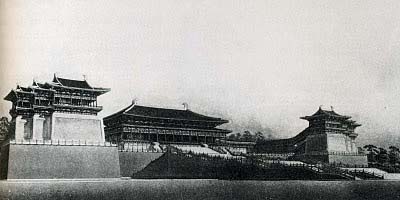
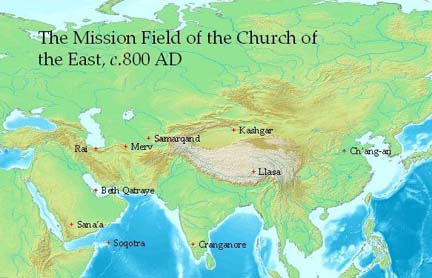
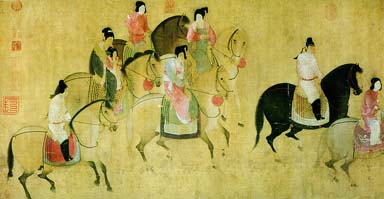
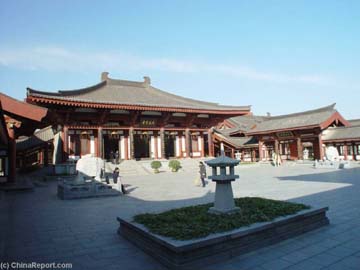
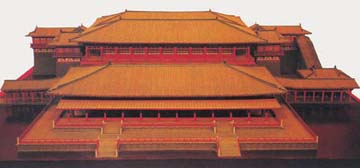
Over a period of more than seven centuries – first in Egypt and Syria, then in Mesopotamia and Persia – countless men before I-ssu had put aside their noble birth or station and laid in their wealth to take on the religious life of service. (See Supplement 16) Not unlike his predecessors, and even superseding them, I-ssu had distributed his riches over the entire region of the Western Capital. (See Supplement 17) The Inscription tells us that the mythic pheasant of five colors spread its wings (See Supplement 18) in flying eaves and roofs of colored tile when this generous patron of the Luminous School enlarged the worship halls and ornamented walls and galleries to restore the old monasteries with the noble adornments of their former condition. (See Supplement 19) In our own time the monasteries are all in ruins or simply erased from the face of the earth, but we may partially remember their images in the images of others preserved for us in ancient journals: the Pearl Tower built by men of Ta-chin in Szechuan province at its capital of Cheng-tu, where, a medieval passage tells us, the ten rooms of the gate tower all had blinds made of strings of pearl and blue jade; (See Supplement 20) the tiles of the temple at Wu-chun, “dazzling in the golden rays of evening”; (See Supplement 21) the splendor of I-ning monastery, whose buildings “shone forth like the light of the sun”; the vermillion tablets that hung high in the air above the monastery gates inscribed with Dragon-writing in kingfisher green; (See Supplement 22) the faithful portraits of the sacred emperors copied on the walls of the monastery at I-ning to “confer great blessing” and “illuminate the church.” (See Supplement 23)
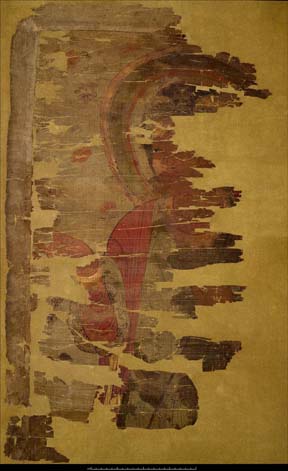
Original silk painting of a missionary bishop of the Church of the East, discovered at Dunhuang in 1908 by Sir Aurel Stein in a cave sealed since 1036 CE.
< PART 5D: IN THE LIGHT OF THE SETTING SUN >
SUPPLEMENTS
Supplement 14:
The Office of the Ascetic
Ascetics could be solitary brethren who lived in a monastery or else bishops and metropolitans.
Supplement 15:
The Religious Provinces
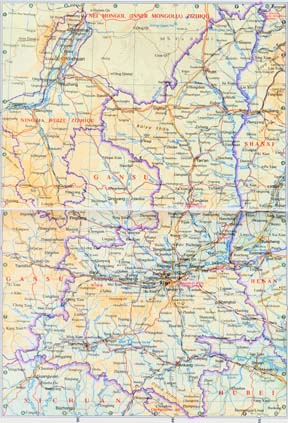
Map of modern province of Shensi (Shaanxi) outlined in purple.
What are called dioceses in the West were called provinces in the Church of the East.
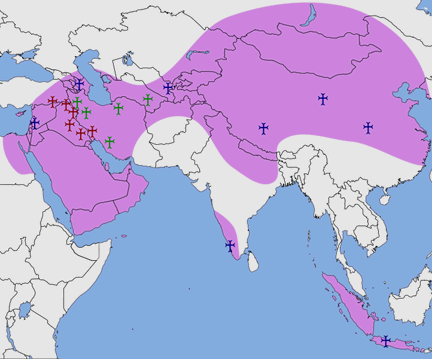
To Professor Saeki it seems that if Mar Iazed-buzid were chorespiscopos of Khumdan (Chang-an), he must have been bishop of the northwestern portion of the modern Chinese province of Shensi. If we accept this determination of Professor Saeki, the size of Mar Iazed-buzid’s province was great.
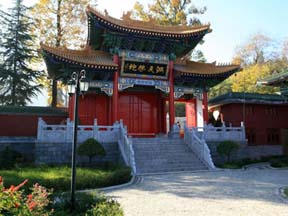
Mar Sergius, listed among the seventy, must have been chorepiscopos of the southeastern portion, according to Professor Saeki. In the southeast of Shensi, in what was Mar Sergius’s province, is the temple dedicated to the originator of the Golden Elixir of Immortality religion, Lu Yen. This temple is commonly known as the “Monastery of the Purple Door.” In the eighth century, it might have been a temple of the Luminous Religion and Lu Yen its consociate.
Supplement 16:
The Religious Candidate
It was both noteworthy and commonplace for a monk to make large gifts to the monastery upon entering it and to bequeath to the monastery all his inheritance of the house of his fathers.
Supplement 17:
The Ta-chin Monasteries of Tang
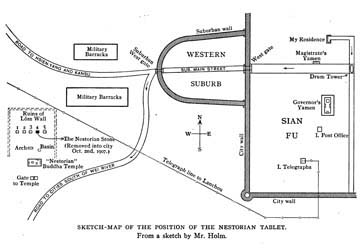
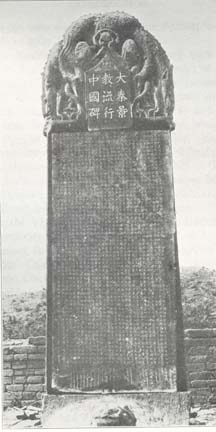
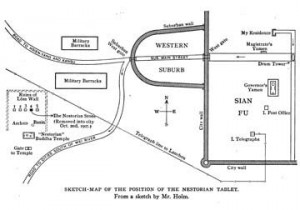
Position of the monument before its removal in 1907
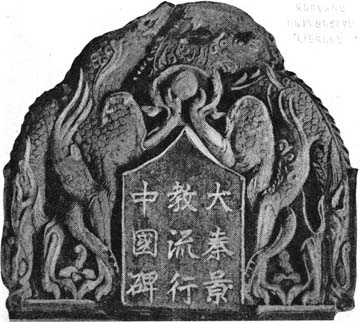
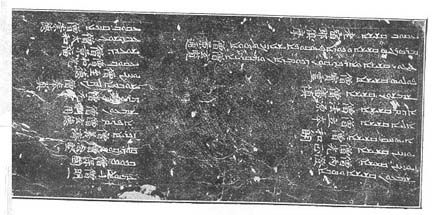
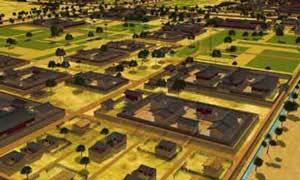
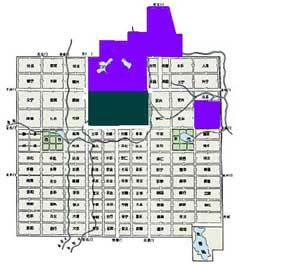
Tang city annals record the locations of several Ta-chin monasteries up to I-ssu’s time. The earliest monastery of the Luminous Religion of Ta-chin in Tang times stood two blocks west of the imperial palace at Chang-an, on the northeast corner of I-ning Ward, not far from the place where the Monument was resurrected in modern times and remained until the beginning of this century. The city wards (fang) were large rectangular blocks of buildings east and west of the Imperial City of Chang-an, divided by cross streets into four parts. The wards themselves were spaces between the streets. I-ning (“Righteousness Repose”) Ward was in the extreme west of the city, two streets down from the imperial palace. The monastery seems to have been in the northeast angle of the cross formed by the two main streets. Moule, in 1930, says: “It ought to be possible to identify the site within a few yards, but I am not aware that this has yet been done.” City records of the time referred to it as a “foreign monastery of Persia.” The founding of another Persian monastery at Chang-an, this one for Manichees or Mazdeans, was recorded in 631. Emperor Tai-tsung built the monastery in I-ning Ward for the sturdy Persian “monk of great virtue” A-lo-pen in 638. At the end of the next century it was also the home of the monk Ching-ching, translator of books and in 781 the author of the monument Inscription that commemorates the emperor, the monk, and the erection of the monastery itself.
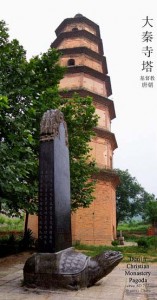
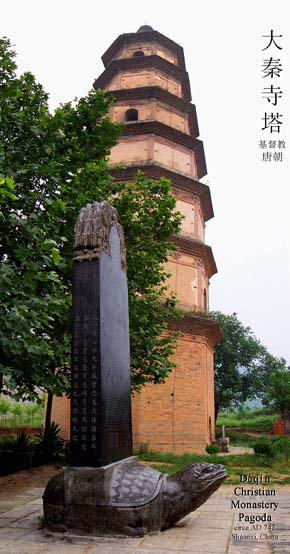
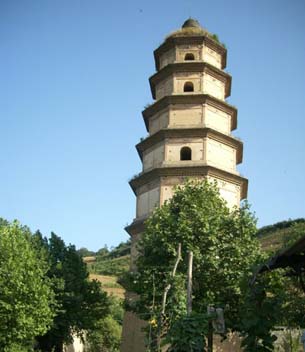
According to an old tradition, the monastery at Wu-chun was formed by a company of five brethren who partook of the Immortals’ food and from whom a new brotherhood arose. Another old tradition has it that Emperor Tai-tsung, who welcomed Rabban A-lo-pen in 635, built the White Tower of the Ta-chin temple on the grounds adjacent to Wu-chun. If these traditions are true, the monastery at Wu-chun was connected to the western lands from very early times and must have been built around the same time as the first monastery in I-ning Ward, perhaps earlier than those at Loyang and Ling-wu. In 1444 the Ta-chin monastery near Wu-chun was in a place called the village of Ta-ku in the Yu-hsien section of the district of Chou-chih. According to the epitaph still in existence there in 1932, this same monastery had been called the Ta-chin-ssu ever since the Tang dynasty. There is no longer any trace of the Tang village of Wu-chu. The tower is called Chen-hsien-pao-ta (“Guarding Immortals’ Treasure Tower”).
The tenth paragraph of the Inscription tells us that the decrees of Emperor Kao-tsung (650–683) caused monasteries of the Luminous Religion “to be founded in every prefecture.” In 627 Kao-tsung’s father, Tai-tsung, had divided the whole empire into ten prefectures (shih tao). This imperial favor had already been granted to the Buddhists for many years under Tai-tsung’s reign. In 666, the Taoists received this privilege for the first time under the reign of Kao-tsung. Under Kao-tsung, it says the “True Religion gained the proper elegance and finish” and the Law of the Luminous Religion spread throughout the ten prefectures. Annals also record that in 677 the king of Persia, Pi-lu, made a request to build a Persian monastery in the Li-chuan Ward. (In 708, during the unstable and embarrassingly intriguing period of imperial strife during the Ching-lung years, AD 707–710, the building was moved to Pu-cheng Ward.) There is reference to a Ta-chin monastery being built in the city of Chaun-chou in Min during the sixth year of Hsuan-tsung’s reign, which may indicate either 718 or 747, depending on whether the reference is to the sixth year of the first period if his reign or the second period. (The same monastery was called the Shui-lu monastery in 1638.) Sometime before the An Lu-shan rebellion in 755, a monastery was also built in the northwest at Ling-wu.
Sometime after 638 there was a monastery built in Hsiu-shan Ward of the eastern capital of Loyang (called “Sarag” in the Inscription), one other than the Persian Zoroastrian or Manichean temple already there, and another in Cheng-tu, capital of Szechuan, in the south.
Supplement 18:
The Pheasant Spreads Its Wings
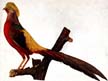
Chinese or golden pheasant
Professor Legge points out that the phrase “till they appeared like pheasants on the wing” is a direct quote from the ancient Shih Ching, a narrative poem on the completion of a palace titled “Sze Kan” (Part II, Book iv, ode v, verse 4).
Supplement 19:
The Restoration of the Monasteries at Ling-wu and Wu-chun
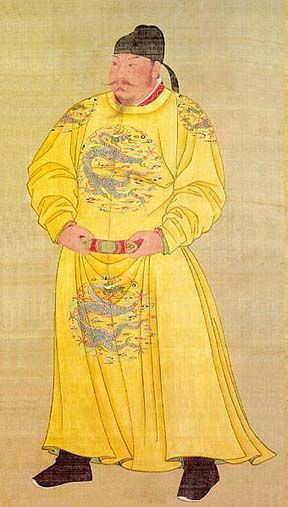
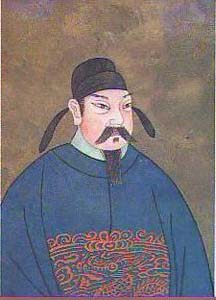
Emperor Tai-tsung (Taizong) Color on silk from hanging scroll
The Inscription also tells us that Emperor Su-tsung (756–762), under whom I-ssu served as a general and palace director, restored the monasteries at Ling-wu and Wu-chun. Su-tsung must have rebuilt the monasteries at Ling-wu and Wu-chun following the rebellion, soon after he entered the capital, because the Inscription says the God of Spirit continued to assist Su-tsung after the two monasteries were rebuilt and his reign began anew. The monastery at Wu-chun, where I-ssu’s influence became strong, seems to have been the center of all the four monasteries located in or near the western capital by I-ssu’s time. Wu-chun literally means “five prefectures” and is the proper name of a place within the district of Chou-chih. During the reign of Emperor Hsuan-tsung, the monastery at Wu-chun was destroyed by an earthquake. It exceeded in grandeur and rank the monastery at Ling-wu and was in fact the model for rebuilding Ling-wu. It was said that the White Tower, and the monastery itself, were originally built in accordance with the imperial order of Tai-tsung (627–649), patron of the first missioner of the Luminous Religion, Rabban A-lo-pen. According to the Inscription, the emperor made the monastery at Ling-wu “equal to” the grand monastery that already existed at Wu-chun. I-ssu might have been the overseer of this imperial work, whether after an early retirement to monastic life or while still in government service.
Supplement 20:
The Stone Bamboo Shoots
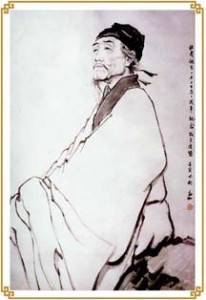
The poet Tu Fu. Anonymous artist's conception.
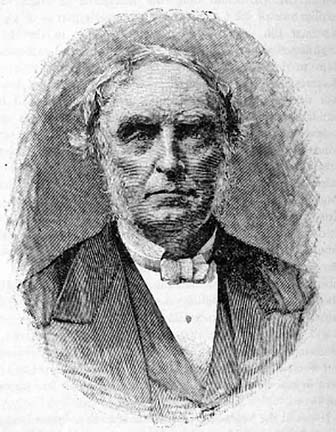
The poet Tu Fu (712–770) wrote a poem on the stone bamboo-sprouts at Cheng-tu (Poetical Works of Tu Fu, vol. 7). The verses by Tu Fu do not mention the monasteries themselves, but the commentary on the verses does. All the medieval commentaries on Tu Fu’s poem were notes on the single line: “When a heavy rain falls people often find she-she.”
The stone bamboo-sprouts were a pair of stone pillars outside the west gate of Cheng-tu. In 1930 it was reported that the bamboo-sprouts were still there. The north one was 16 feet high and 9 feet around; the south one, 13 feet high and 12 feet around. On the site where the stone bamboo-sprouts stood, the stone that once belonged to the attached pavilion also remained. In Tu Fu’s time, whenever it rained, people picked up pearls, gold, blue jade, and other rare things (she-she). Some of the small pearls there, with the appearance of greenish-yellow millet, had lobes in them through which silk thread might be passed.
The Sung scholar Wu Tseng (960–1127), who recorded and corrected other earlier scholars, tells us that long ago foreigners came to this place and built a monastery named Ta-chin monastery, whose gate tower had ten rooms, every one of which had a blind made of strings of pearls, blue jade, and white gems; later, he said, the tower was broken to pieces and fell to the ground. The scholar explains that what the people called the stone bamboo-sprouts were not the Pearl Tower itself but that the tower was built very close to the site where the stone bamboo-sprouts stood. Wu Tseng’s article concludes: “It is said the Kingdom of Ta-chin produces precious stones like jasper, pearls, and night-shining stones. From this place the water canal-way leads to Yung-chang-chun, I-chou of Shu province, where many rare things are produced; that is why this monastery was built by the people who came from the Kingdom of Ta-chin. But the scholar Tu Tien, quoting from a book called Yu-yang-tsa-tu, said that the city of Shao-cheng in Shu province was beautifully decorated with gold, gems, pearls, and blue jade, and that General Huan Wen got angry at such luxurious decorations and burned down the city so that the people would have nothing more to do with the Ta-chin people. But what Tu Tien said was entirely wrong.”
Supplement 21:
The Tiles of Wu-chun Temple
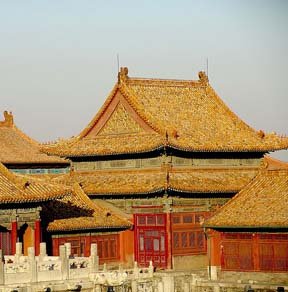
Buildings with traditional imperial yellow roof tiles
General Yang Yung-I, in a poem written in 1200 upon the occasion of his visit to the Wu-chun temple, described the tiles of the temple at Chou-chih in this way.
Supplement 22:
The Dragon Writing on the Monastery Gates
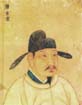
Emperor Hsuan-tsung. Tang Dynasty; source unknown.
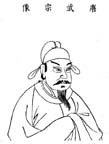
The twelfth and thirteenth paragraphs of the Inscription establish the later reign of Hsuan-tsung (745–755) as the time when the Luminous Religion began to become clearly again a state-protected religion. In these paragraphs it is reported that in 744 Emperor Hsuan-tsung himself composed the official monastery names that appeared on the monastery gates, and the front-tablets bore the inscription in the emperor’s own handwriting. The official, or monastery, name of the Ta-chin monastery at I-ning Ward, Ta-chin-ssu, originated in 745, although the monastery had been built in 638. Prior to 745, it had been known simply as the Persian monastery. According to Professor Saeki, nearly every monastery had a “mountain title” (such-and-such shen) and a “monastery name” (such-and-such ssu) as every Buddhist monastery did. Although Saeki was not able to ascertain any of the mountain titles, the fact that the monasteries of the Luminous Religion had a monastery name (-ssu) indicates that the church was a state church under imperial patronage.
Supplement 23:
The Imperial Portraits at the Monastery of I-ning Ward
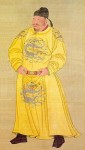
Emperor Tai-tsung (Taizong) Color on silk from hanging scroll
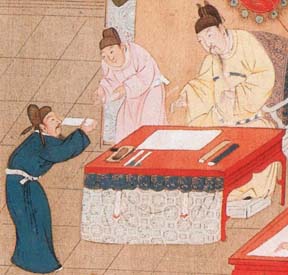
Sometime during the first two years of Hsuan-tsung’s later reign (742–743), he decreed that the likenesses of the five sacred emperors were to be placed in the original monastery of I-ning Ward at the capital as a mark of favor, along with gifts of silk. His wording of the Inscription suggests that the adherents of the Luminous Religion could from this time on expect the protection of the emperor’s bow and sword.
The eighth paragraph of the Inscription records that the monastery at I-ning Ward was adorned with the portrait of the reigning emperor, Tai-tsung. Immediately after the monastery was built in 638, officials were ordered to take a faithful portrait of the emperor and have it copied on the walls of the monastery “in variegated colors” and “with dazzling splendor.” That the monastery was built and supported by the government is indicated by the force of the term “attached to it” and its official name: Ta-chin-ssu.