ALFRED RUSSEL WALLACE: On the Tendency of Humans Towards Spiritual Being, Part 6B
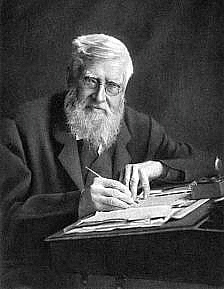
Alfred Russel Wallace (1913) near the end of his life.

Wallace’s striking example of a species that perpetuates itself abundantly without large broods requires some historical emendation and, in my view, expansion. The corollary of Wallace’s theory states that a constant supply of wholesome food is almost (a fateful qualifier) the sole condition requisite for ensuring the increase of any species. In 1858, when Wallace wrote the passage in which this corollary appears, the number of individual members of his exemplary species was estimated to be in the billions. By 1870, an advance of a mere twelve years, the number had dwindled precipitously, and by 1914, to zero, as a result of the unrestrained attacks of man. Wallace, in his time, was perhaps too optimistic to foresee this possibility or to admit the morbid power of the predatory nature of humans.

Just as the eradication of the passenger pigeon had always been a potentiality, so has the extinction of the Eternal Race always been a danger, and in all regions of the world where it has appeared in the past, all of them locales where the supranatural Food spoken of was no less abundant than elsewhere. 5

It appears that members of this Race gathered in great cultural concentrations of thousands and tens of thousands for the last times on earth among the communities of Israel and Egypt around the opening of the Common Era and in the Americas, where the remnants of once vast spiritual cultures remained for a time after they were conquered by the Incas and Aztecs, until they were finally annihilated together with their conquerors by the invading Spaniards some five hundred years ago. A list of spiritual peoples, the conditions of their destruction, and the names of their destroyers would no doubt serve to indicate the vast scope of the one-time existence of the Eternal Race and its all-time destruction; but such a list is not possible in this brief note. It should be obvious, however, that the increase of any endangered species requires more than a constant supply of wholesome food. It requires an additional condition: the protection of a nation or nations.

Endangered species of plants and animals are protected in the United States by the Endangered Species Act and internationally by the acts and charters of the International Union for Conservation of Nature. Similar provisions are presently being enacted to protect endangered indigenous peoples. 6 The Eternal Race requires the same protection. The legal encouragement of freedom of religion by nations of the past, however imperfectly conceived or applied, provided this protection with varied success in previous times. 7 These are the precursors to what is required today.

To encourage the spiritual variety of human, a nation must be protected itself by perfect and unequivocal spiritual freedom. Such is the experiment actively pursued today, first and foremost, by the peoples and in the laws of the United States of America. In San Francisco in 1962, The Universal Proclamation of Human Spiritual Rights, the most extensive statement of spiritual rights and freedoms made to date, was ratified by the International Community of Christ, Church of the Second Advent; in 2000 it was adopted by the Advocates for Religious Rights and Freedoms. The adoption of this Universal Proclamation by an entire nation, or by several nations, and the protection of its principles, may be all that is needed to ensure the future increase and development of the spiritual variety of the human—the Eternal Race—because the Food is provided, and all are invited to the Banquet.

Robert G. Petrovich 2000, 2010


FOOTNOTES

5. I will use the bare records we have of the life of one of its peoples, the one perhaps least strange to us today, that of ancient Judea, to provide an example of the pattern of extinction. The pattern is dramatic and cyclic: retreat into the wilderness under a righteous teacher to avoid unrighteousness and a return a marked time later to restore righteousness, the return followed by genocidal persecution of a wicked priest under the political rule of a man of lies. One such sequence played out in the eighth century BCE: The prophet Isaiah leads a community of the Sons of Light into the desert wilderness to avoid the rule of the evil king Manasseh; the king captures Isaiah and brings him back to the city, where he is executed at the hand of the false prophet Balchira, who had first accused Isaiah to the king; upon the death of Isaiah, his disciples follow his instructions and flee to the lands of Tyre and Sidon. The story is told in The Ascension of Isaiah:1–5, a noncanonical recount and expansion of events reported in 2 Kings: 21. Another version of the archetypal cycle of events is told in the Pesher Habakkuk and Damascus Document of the Dead Sea scriptures: Sometime in the first century BCE, a congregation of the Sons of Light returns again to the cities of Israel and Judah under a messianic “Teacher of Righteousness” (who is not named) to free the people from the domination of the new priests of the Jerusalem Temple; the Teacher is put to death by a “Wicked Priest” (also unnamed), and a long period of persecution follows; the congregation, again driven from the land, withdraws to the north, into Syria, and to the south, into Egypt, to avoid extinction under the Hasmonean kings. Decades later, the Herodian kings, who are the successors to the Hasmoneans under the Romans, execute the messianic forerunner, John the Baptist, judicially murder the Aaronic Messiah Jesus and his brother James, and kill a great many of the new messianic community as well as those of the old community. The new community, forced into exile by the persecutions of Agrippa I and his high priest Ananias, retreats under Peter to the north, there to establish settlements in Syria and in the Roman province of Asia (present-day southwestern Turkey). Other remnants of the Nazarenes and Essaei seek refuge in Tyre and Sidon and beyond the Jordan in Peraea. These final acts are recorded in the canonical and noncanonical New Testament books and in the first-century histories of Josephus. Over the several centuries that follow, the sacred knowledge of the Eternal Race, which had been entrusted into the care of these remnants, is shattered, and its members are hunted down to extinction by Roman authorities.

6. The Nukak of Colombia are represented by the National Indigenous Organization of Colombia. The Mansi of Russia are protected by the Association to Save Yugra. The Nomlaki people of Northern California have been restored to full tribal status and given the ability to acquire land by the federal government of the United States. The government of India would protect the few hundred Sentinelese of the North Sentinel Island but is prevented by the violent resistance of the Sentinelese to outsiders. Certainly there are other such peoples in other locales.

7. There had been the policy of religious freedom permitted throughout the Achaemenid Empire founded by Cyrus the Great in the sixth century BCE and documented on the Cyrus Cylinder, the freedom of religious worship established in the Maurya Empire of India by Ashoka the Great in the third century BCE and encapsulated in the Edicts of Ashoka, the free practice of religion decreed by the emperors of Tang China during the seventh and eighth centuries CE, the religious freedom declared by Muhammad in the seventh century CE in the Constitution of Medina, the religious freedom permitted by nearly all rulers of India until the invasion of the Indian sub-continent by Islamic sultanates in the thirteenth century CE, the toleration of all religions throughout the continent of Asia during the reign of the Mongols in the thirteenth and fourteenth centuries, the religious tolerance practiced in the Norman Kingdom of Sicily under Roger II and his heirs in the thirteenth century, the free practice of religion extended in Romania by the Transylvanian Diet of Turda in 1568, the long tradition of religious freedom in Poland officially recognized at the signing of the Warsaw Confederation in 1573, the personal freedom of religion declared in the Netherlands by the Union of Utrecht in 1579, the peace between Protestants and Catholics in France formalized by Prince Henry IV in the Edict of Nantes in 1598 and in force until the Edict was repealed by King Louis XIV in 1685. There was the freedom of religion applied as a principle of government for the first time in the founding of the colony of Maryland in 1634, the freedom of religion guaranteed in New Amsterdam (present-day New York) by the Articles of Capitulation when the Dutch city surrendered to the English in 1664, the Virginia Statute for Religious Freedom drafted by Thomas Jefferson in 1779, and the guarantee of religious freedom in the Bill of Rights of the United States and in the French Declaration of the Rights of Man in 1789. There is in our time the United States Commission on International Religious Freedom, established by the International Religious Freedom Act of 1998 to investigate violations of the principle of religious freedom; there is the constitutional protection of religious freedom provided by numerous states throughout the modern world; and there is the religious affirmations of religious freedom made by the International Religious Liberty Association of the Seventh-day Adventist Church, by the Church of Jesus Christ of Latter-Day Saints, by the Roman Catholic Second Vatican Council Declaration Dignitatis Humanae, and by the official position of the Eastern Orthodox Ecumenical Patriarchate; there is the contentious debate over religious freedom among the modern schools and states of Islam; and there is the protection of the freedom of religion and belief in international law that has been enforced by the International Covenant on Civil and Political Rights since 1976.
ALFRED RUSSEL WALLACE: On the Tendency of Humans Toward Spiritual Being, Part 6A

Alfred Russel Wallace (1913) near the end of his life.

First Corollary to the General Theory of Natural Selection Applied to the Spiritual Variety of Homo sapiens sapiens 1

It is a corollary of Wallace’s Theory of Natural Selection 2 that the procuring of a constant supply of wholesome food is almost the sole condition requisite for ensuring the increase of a given species. The statement of this corollary appears in a passage of Wallace’s first essay on natural selection, “On the Tendency of Varieties to Depart Indefinitely from the Original Type” (1858) following a long discussion of examples from nature. The passage is excerpted here for reference (emphasis is my own):

. . . It would appear that, so far as the continuance of the species and the keeping up of the average number of individuals are concerned, large broods are superfluous. This is strikingly proved by the case of particular species; for we find that their abundance in individuals bears no relation whatever to their fertility in producing offspring.
Perhaps the most remarkable instance is that of the passenger pigeon of the United States, which is said to rear generally but one young one. Why is this bird so extraordinarily abundant, while others producing two or three times as many young are much less plentiful? The explanation is not difficult. The food most congenial to this species is abundantly distributed over a very extensive region. . . . This example strikingly shows us that the procuring of a constant supply of wholesome food is almost the sole condition requisite for ensuring rapid increase of a given species, since neither limited fecundity nor the unrestrained attacks of man are sufficient to check it.

It may be somewhat unexpected to common sense that large numbers of offspring are not a requirement for the increase of a species, but the example clearly shows the validity of Wallace’s statement.

There is no reason to doubt that the corollary would not apply as well to the species Homo sapiens sapiens. In these pages, I would like to show briefly how this corollary applies to the special variety of human identified in the first century CE by Pliny the Elder and described in some detail by Philo of Alexandria and Flavius Josephus. (We will follow the suggestion of Pliny and employ the term “Eternal Race” to refer to the collective representatives of this human spiritual variety irrespective of place and time.) 3 These first-century scientists and historians persuade us that the Eternal Race is a separate variety of human, distinct from common historical human cultures but capable of being derived or produced from all or any of them: a spiritual variety. 4 They also tell us that the customs and practice of this Race in their time indicate that its members were able to procure a supranatural Food but were not permitted to reveal to the uninitiated either its nature, or its source, or how it may be procured. The observations of Philo and Josephus suggest, however, that this spiritual Food was supremely accessible and abundant. We know it to be found in sunlight, in the spiritual nutriment or information that light carries—the Light of light. What food could be more “constant” or more “wholesome”? Yet the ancient Race described by Pliny and Philo and Josephus is no more.

< PART 6B >


FOOTNOTES

1. All the essays of Wallace quoted herein may be found in Natural Selection (1891).

2. For a discussion of Wallace’s theory, see Part 1: “First Theory of Natural Selection.” For a discussion of the general principles of this theory as they apply to humans, see Part 5: “The General Theory of Natural Selection Applied to Homo sapiens sapiens.”

3. The Eternal Race was represented by the peoples collectively called “Essenes” in the locale of Judea, and in Egypt, “Therapeutae.” Early in the first century CE, this Race was found in many places throughout the known world, in gardens or villages or lonely bits of country outside the gates of cities. The most adept of the Race journeyed to their centers: in Judea, to one of the major settlements on the west side of the Dead Sea just out of sight of Jerusalem, and in Egypt, to a place finely situated above Lake Mareotis near the Mediterranean seaport of Alexandria. Philo estimates their number in Judea at 4,000, a number corroborated by Josephus. Philo gives no numbers for Egypt, but he reports that the Race abounds in each of its nomes (departments) and especially around Alexandria. Pliny provides an explanation for their numbers: new adherents, weary of the ephemeral battles of life, are drawn by their divine doctrines to keep up and renew the numbers of “this solitary race . . . strange above all others in the entire world. . . . Thus for thousands of ages (strange to tell) the race is perpetuated, and yet no one is born into it” (Naturalis Historia, 5:17). Josephus provides additional details on the mysterious increase of this race, obviously not productive of large broods: “They [the elders and highest orders of Essenes] neglect wedlock, but choose out other persons’ children . . . and esteem them to be of their kindred, and form them according to their own manners”; these children, he tells us, are of “another order of the Essenes, who agree with the rest as to their way of living, and customs, and laws, but differ from them in the point of marriage” (Wars of the Jews, Book 2, 8). In Egypt, too, their communities were populated both by men and women of childbearing age and by elders who had divested themselves of their possessions (On the Contemplative Life, “Fourth part Concerning Virtues” 2:18, 3:32). In Judea it was the custom of the Race to hold all in common and to share common meals, to commune with God through the sun each day at its rising and to labor through the day at the arts in which they were skilled, and on the seventh day to leave off work and meet in their synagogues (Wars of the Jews, Book 2,8:2–14). For the Egyptian colonies of this Race, we have the firsthand account of Philo: “The Therapeutae desire the vision of the Existent and soar above the sun of our senses. They keep the memory of God alive and never forget it, so that even in their dreams the picture is nothing else but the loveliness of divine excellence and powers. . . . Twice every day they pray, at dawn and at eventide. The interval between early morning and evening is spent entirely in spiritual exercise. . . . None of them would put food or drink to their lips before sunset. . . . Some only after three days. . . . Others only after six days. Still they eat nothing costly, only common bread with salt for a relish and their drink is spring water. . . . For six days they seek wisdom by themselves in solitude. But every seventh day they meet together as for a general assembly. . . . The common sanctuary in which they meet is a double enclosure, one portion set apart for the use of the men, the other for the women” (On the Contemplative Life, “Fourth part Concerning Virtues,” 2:11, 3:26–30, 3:32, 4:34–37).

On the Essenes see: Philo of Alexandria: Quod Omnis Probus Liber, Hypothetica, 11:1–18; Flavius Josephus: Wars of the Jews, Book 2, 8:2–14; Antiquities of the Jews, Book 13, 1:5, 5:9, Book 15, 10:5, Book 18, 1:5. On the Therapeutae see: Philo of Alexandria, On the Contemplative Life, “Fourth Part Concerning Virtues,”1–4 (1–39), 8–11 (64–90).

4. This special variant of the human has been called by various names at various times and in various cultures in Persia, Greece, Egypt, India, China, the Americas, England, Ireland, Germany, Russia, and elsewhere. In ancient Judaea alone, local variants of the Eternal Race have been known to ancient authorities and to modern historians by many names: Zadokites, Baithusians, Simseans, Hiketeans, Assideans, Hasideans, Hemerobaptists, Nazarenes, Essenes, et cetera.


ALFRED RUSSEL WALLACE: On the Tendency of Humans Toward Spiritual Being, Part 5

Alfred Russel Wallace (1913) near the end of his life.

General Theory of Natural Selection Applied to Homo sapiens sapiens

Wallace theorized that moral and ethical refinements are the ultimate object of Man’s future spiritual developments and that these refinements will be evidenced in the flesh of Man’s animal nature in the head and face alone. I intend in this note to suggest how Wallace’s General Theory of Natural Selection 1 can be taken further yet, in a direction which he never stated himself and of which he probably never conceived.

Wallace’s General Theory of Natural Selection allows us to extrapolate from it another, one that applies specifically to the present varieties of the human species, Homo sapiens sapiens. By simply adding to Wallace’s General Theory of Natural Selection a few more details from Wallace’s other statements on Man for clarity and explanation, 2 we arrive at what we may call Wallace’s General Theory of Natural Selection Applied to Homo sapiens sapiens:

There is a general tendency in nature which will cause a certain variety of the human to survive the parent species of Homo sapiens sapiens, and to give rise to successive variations departing further and further from that original type, variations of a spiritual nature superadded to the animal nature and capable of progressive development under favorable conditions, 3 and which also produces, in those varieties induced by the guiding influence of some higher intelligent beings, 4 that is, spiritual forces of a superior intelligence acting through natural and universal laws 5 (the modern equivalent of angels and archangels, spirits and demons), the tendency to return to the parent form by means of some more subtle agencies than we are acquainted with. 6

The statement of the theory is complex and may at first seem hyperbolic—especially to the natural scientist, the skeptic, the agnostic, the atheist, the “nonbeliever.” Yet a careful perusal of Wallace’s published statements on the evolution of man as a distinct order of being will show that the General Theory of Natural Selection Applied to Homo sapiens sapiens is nothing more than a précis, a concise expression, of what Wallace has said elsewhere, and everywhere, regarding the spiritual nature of Man and the future evolution of the human—no matter that it produces unexpected results.

This theory is stated generally enough to be applicable even beyond our third-dimensional world of time and space. I ask that you take a moment to consider it, for example, in relation to and in the context of one of the universal doctrines on the cosmic and spiritual nature of man. A summary statement of the doctrine should suffice to provide the context 7 : “There are two separate and substantial Creations, one of Light and one of Darkness, and man’s life in this transitory world, and this world itself, is an outgrowth of the Worlds of Darkness; man’s mutable material fate is a miscarriage of his spiritual destiny, a counterfeit of another life in the immortal Worlds of Light.” 8 Wallace imagined that we may be growing in countenance more and more like the Angels who guide our development, and who are our spiritual ancestors. Yet Wallace, avowedly ignorant of spiritual cosmology, simply could not conceive of the possibility that man may be able to form another kind of body, a solar body, the light body of our nearest spiritual ancestors, the Dark Angels; nor could he conceive that man is consciously able to develop a body of a yet higher form, the immortal spiritual body, the body of Divine Light, a body like that of the Angels of Light, the Heavenly Host.

Some will consider this doctrine, especially in collaboration with Wallace’s theory, to be absurd or overwrought or unfounded. For them, there are the doctrines of the atheist or the fundamentalist or the conventionally orthodox. You who recognize the validity of this doctrine will find that Wallace’s theory, examined thus in the light of the eternal as well as the historical, gives scientific expression to the continuity that exists between the developments of Man’s physical nature and the development of Man’s spiritual natures, and you will find as well a new and refreshed understanding of the old Hermetic principle recorded in The Emerald Tablet: “As above, so below.” 9

Robert G. Petrovich 2010

< PART 6A >

FOOTNOTES

1. See Part 4: “First Theory of Natural Selection Applied to the Animal Nature of Man.”

2. For reference, see Part 2: “A Postulate on Man’s Spiritual Destiny” and Part 3: “A Postulate on Man’s Spiritual Origin.”

3. For identification and discussion of this phrase, see Part 3: “A Postulate on Man’s Spiritual Origin.”

4. For identification and discussion of this phrase, see Part 2: “A Postulate on Man’s Spiritual Destiny.”

5. For identification and discussion of this phrase, see Part 3: “A Postulate on Man’s Spiritual Origin.”

6. For identification and discussion of this phrase, see Part 3: “A Postulate on Man’s Spiritual Origin.”

7. This summary originally appeared in an earlier note, “The Human Face of A.R. Wallace.”

8. In the same note, I summarized the history of this doctrine: “This is one of the universal doctrines restored by Zoroaster to the righteous of Persia in the first millennium B.C.E. and recorded nearly a thousand years later in the Gathas of the Zend Avesta. It was not the only time immortal Spirit made such an observation. That doctrine was also restored by Buddha to the righteous of India, by Mani to the righteous of Babylonia, by Jesus and his forerunners to the righteous of Israel, and by other Teachers of Light to the righteous of China, Greece, Northern Europe, Egypt, Arabia, Oceania, the Americas. Oral tradition, and the sacred literature derived from that tradition, abounds in allegories on the spiritual origin and evolution of man.”

9. The first lines of The Emerald Tablet as rendered into English by Isaac Newton (with modern spelling):

(1) ’Tis true without lying, certain most true.
(2) That which is below is like that which is above, that which is above is like that which is below to do the miracles of one only thing.

A contemporary rendering of the same lines from the Latin text of Chrysogonus Polydorus (Nuremberg, 1541):

(1) True it is, without error, certain and most true
(2) That which is below is as that which is above, and that which is above is as that which is below, to perform the miracles of the one thing


ALFRED RUSSEL WALLACE: On the Tendency of Humans Toward Spiritual Being, Part 4

Alfred Russel Wallace (1913) near the end of his life.

First Theory of Natural Selection Applied to the Animal Nature of Man 1

Wallace’s First Theory of Natural Selection 2 is expressed thus:

There is a general tendency in nature which will cause a certain variety to survive the parent species, and to give rise to successive variations departing further and further from that original type, and which also produces, in those varieties induced by the guiding influence of men, the tendency to return to the parent form. (“On the Tendency of Varieties to Depart Indefinitely from the Original Type,” 1858)

In order to discuss the application of the principles of this theory to the nature of Man, the theory itself must be restated in a more general form. Wallace’s First Theory of Natural Selection, as it was originally conceived in 1858, does not account for the genus Homo—Man—but only for the purely animal and plant species. Wallace himself, however, suggests the means by which his original theory may be modified to accommodate Man. In “Limits of Natural Selection as Applied to Man” (1870), Wallace points out the similarity between domestication, the influence of men on certain species of plants and animals, and the influence of spiritual forces on Man, forces of “a superior intelligence” that have “guided the development of man in a definite direction, and for a special purpose, just as man guides the development of many animal and vegetable forms.” He also makes this additional point of clarification: “The essentially human portions of man’s structure and intellect may have been determined by the directing influence of some higher intelligent beings, acting through natural and universal laws.” Thus to arrive at a version of Wallace’s First Theory of Natural Selection that applies as well to plants and animals as it does to humans, we may modify the first theory by simply replacing the term men with the term some higher intelligent beings :

There is a general tendency in nature which will cause a certain variety to survive the parent species, and to give rise to successive variations departing further and further from that original type, and which also produces, in those varieties induced by the guiding influence of some higher intelligent beings, the tendency to return to the parent form.

The statement of the theory of natural selection in this more general form, which presumes only that Wallace considered men to be higher intelligent beings than plants and animals, will allow us to discuss the application of this theory, and the principal statements of the law of natural selection which it contains, to the nature of Man.

The first proposition of this general theory, that nature tends to produce a certain variety of a species that will not only survive its original type but also give rise to a succession of varieties that depart further from the original parent type, when it is applied to the genus Homo, states the principle behind a tendency that has been in operation upon the physical nature of Man over millions of years and through various species—Homo habilis (2.3 to 1.4 million years ago), Homo ergaster (1.9 to 1.4 million years ago), Homo erectus (1.8 to 1.3 million years ago), Homo antecessor (1.2 million to 800,000 years ago), Homo heidelbergensis (600,000 to 400,000 years ago), Homo neanderthalensis (130,000 to 30,000 years ago)—until the present time and up to the development of the present recognizable variations of Homo sapiens sapiens (600,000 years ago to the present). 3 Wallace himself describes this tendency in the history of Man’s physical evolution. An abridgement of his description follows:

We know positively that man was contemporaneous with many extinct animals, and has survived changes of the earth’s surface fifty or a hundred times greater than any that have occurred during the historical period. . . . But while these changes had been going on, his mental development had, from some unknown cause, greatly advanced, and reached that condition in which it began powerfully to influence his whole existence, and would therefore become subject to the irresistible action of natural selection. This action would quickly give ascendancy to mind . . . and from that moment man, as regards the form and structure of most parts of his body, would remain stationary. But from the moment that the form of his body became stationary, his mind would become subject to those very influences from which his body had escaped. . . .
We may trace back the gradually decreasing brain of former races, till we come to a time when the body also begins to materially differ. There we shall have reached the starting-point of the human family. Before that period he had not mind enough to preserve his body from change, and would, therefore, have been subject to the same comparatively rapid modifications of form as the other mammalia. . . . Man may continue to exist through a series of geological periods which shall see all other forms of animal life again and again changed . . . while he himself remains unchanged, except in two particulars—the head and face, as being immediately connected with the organ of the mind and as being the medium of the most refined emotions of his nature.
(“The Development of Human Races Under the Law of Natural Selection,” 1864)

I wonder what you think of this proposition. To me, it seems impossible to deny, for it has the integrity of a statement ipso jure, an outgrowth of the law of natural selection itself. And, of course, it is just that. Wallace’s formula reconfigures clearly an event that is evidently complex: the face expressing a mind developed in a culture that manifests, however imperfectly, an expression of spirit. In “The Limits of Natural Selection as Applied to Man” (1870), Wallace suggests that man is gradually moving or evolving toward participation in the Eternal: Wallace contemplates the possibility that the development of the specifically human portions of man’s structure and intellect have been determined by the directing influence of more highly intelligent beings, perhaps encompassing layers of them, and that some more general and fundamental law underlies the law of natural selection. (I see behind Wallace’s idea the general and ancient idea of the Fall of Man and the generations of humans who long for redemption. It may be that the writers of scripture who recorded the Fall of the Heavenly Host inspired Wallace to respond to the significance of that allegory with courage and science.)

With this description, Wallace offers not only support to the first proposition of the General Theory of Natural Selection applied to Man, but also an explanation for many of the physical changes which anthropologists have categorized and catalogued in their taxonomy of the species and types of the genus Homo that have gone extinct thus far. For our own present varieties of the species Homo sapiens sapiens, Wallace’s proposition predicts the possibility of continued existence through coming series of geological periods, with physical changes to occur only in the head and face. These changes, according to Wallace, will occur in response to further developments within Man’s human nature, the higher nature of Man, which Wallace speaks of elsewhere as having its source in Man’s spiritual nature. 4

Wallace’s image of the evolution of Man, as he intended it to be understood, accounts for the refinements of Man’s animal nature, in the flesh and its concomitant unconscious processes, as humans tend towards what Wallace calls “higher existences than ourselves” 5—it goes that far and no further.

Robert G. Petrovich 2000, 2010

FOOTNOTES

1. All the essays of Wallace quoted herein may be found in Natural Selection (1891).

2. For a discussion of this theory, see Part 1: “First Theory of Natural Selection.”

3. The list here provides conventional naming and dating and does not intend to promote one taxonomic subtheory related to Man’s development over another.

4. For discussion, see Part 3: “A Postulate on Man’s Spiritual Origin.”

5. For discussion of this tendency, see Part 3: “A Postulate on Man’s Spiritual Origin.” Wallace is not alone in the recognition of the evolutionary process that he was the first to notice. At least two twentieth-century variations of this same theory may be found: one in the observations of this same tendency by the historian Oswald Spengler, the other in those of the paleontologist Pierre Teilhard de Chardin. They are traced out in my note “The Human Face of A.R. Wallace.”


< PART 5 >


ALFRED RUSSEL WALLACE: On the Tendency of Humans Toward Spiritual Being, Part 3

Alfred Russel Wallace (1913) near the end of his life.

A Postulate on Man’s Spiritual Origin 1

If man has a spiritual destiny, it stands to reason that man also has a spiritual origin. Toward the end of his first essay on man, “The Development of Human Races under the Law of Natural Selection” (1864), Wallace cautiously extends this proposition: “If the views I have here endeavored to sustain 2 have any foundation, they give us a new argument for placing man apart, as not only the head and culminating point of the grand series of organic nature, but as in some degree a new and distinct order of being.” (Bearing on the Dignity and Supremacy of Man, p. 181) In the conclusion to this same essay he states: “I am forced to conclude that it is due to the inherent progressive power of those glorious qualities which raise us so immeasurably above our fellow animals, and at the same time afford us the surest proof that there are other and higher existences than ourselves, from whom these qualities may have been derived, and towards whom we may be ever tending.” (Conclusion, p. 185) 3

In a footnote appended to the fifteenth chapter of his second essay on man, “The Limits of Natural Selection as Applied to Man” (1870), Wallace further predicates the initial proposition he made in 1864 by identifying a direct influence: “Now, in referring to the origin of man, and its possible determining causes, I have used the words ‘some other power’ – ‘some intelligent power’ – ‘a superior intelligence’ – ‘a Controlling intelligence,’ and only in reference to the origin of universal forces and laws have I spoken of the will or power of ‘one supreme Intelligence.’ These are the only expressions I have used in alluding to the power which I believe has acted in the case of man, and they were purposely chosen to show that I reject the hypothesis of ‘first causes’ for any and every special effect in the universe, except in the same sense that the action of man or of any other intelligent being is a first cause. In using such terms I wished to show plainly that I contemplated the possibility that the development of the essentially human portions of man’s structure and intellect may have been determined by the directing influence of some higher intelligent beings, acting through natural and universal laws.” (Summary of the Argument as to the Insufficiency of Natural Selection to Account for the Development of Man, note 1, pp. 205–206). Earlier in the same footnote, no doubt to exonerate his proposition in the eyes of scientific readers, Wallace exhibits the incapacity of the modern cultivated mind to realize the existence of any higher intelligence between itself and Deity: “Angels and archangels, spirits and demons, have been so long banished from our belief as to have become actually unthinkable as actual existences, and nothing in modern philosophy takes their place.

But Wallace had prepared his readers to accept the existence of Angels in a previous chapter, where he asks a pointed question, one that calls attention not only to man’s spiritual nature but to man’s spiritual guidance and, therefore, man’s destiny: “How could natural selection, or survival of the fittest in the struggle for existence, at all favour the development of mental powers so entirely removed from the material necessities of savage men, and which even now, with our comparatively high civilization, are, in their farthest developments, in advance of the age and appear to have relation rather to the future of the race than to its actual status?” (The Origin of Some of Man’s Mental Faculties, by the Preservation of Useful Variations, Not Possible, p. 199). To this question Wallace appends a footnote that refers the reader to the extended argument and new illustrations given in his book Darwinism. The argument appears in his 1889 essay “Darwinism Applied to Man.” It should suffice to quote two points: (1) “The point to which I wish specially to call attention is, that to prove continuity and the progressive development of the intellectual and moral faculties from animals to man, is not the same as proving that these faculties have been developed by natural selection” and (2) “I purpose to show that certain definite portions of [man’s intellectual and moral nature] could not have been developed by variation and natural selection alone, and that, therefore, some other influence, law, or agency is required to account for them.” (The Argument from Continuity, pp. 463–464).

Wallace’s argument, which is extended over pages 461–471, discusses the metaphysical faculty and the peculiar faculty of wit and humor in addition to the three primary faculties— the mathematical, the artistic, and the musical—and prepares his readers for the hypothesis stated on page 474, one which Wallace had developed over a period of more than twenty years: “The special faculties we have been discussing clearly point to the existence in man of something which he has not derived from his animal progenitors—something which we may best refer to as being of a spiritual essence or nature, capable of progressive development under favourable conditions. On the hypothesis of this spiritual nature, superadded to the animal nature of man, we are able to understand much that is otherwise mysterious or unintelligible in regard to him . . . .“(The Interpretation of Facts, p. 474) The essay concludes: “The Darwinian theory, even when carried out to its extreme logical conclusion, not only does not oppose, but lends a decided support to, a belief in the spiritual nature of man.” (Concluding Remarks, p. 478)

From this array of Wallace’s general statements on the spiritual nature of man, which Wallace himself identifies with the essentially human portions of man’s nature, it is possible to derive his postulate on man’s spiritual origins. The postulate itself is deep and complex, and shows surprising connections between areas seemingly disparate—the physical and the nonphysical, the natural and the supranatural, visible and invisible dimensions—yet it is simple to state:

Man represents a new and distinct order of being, whose essentially human portions—a spiritual essence or nature, superadded to the animal nature of man and capable of progressive development under favorable conditions—may have been derived from higher intelligent beings.

Robert G. Petrovich 2000, 2010

FOOTNOTES

1. All the essays of Wallace quoted herein may be found in Natural Selection (1891), with the exception of “Darwinism Applied to Man,” which may be found in Darwinism (1889). The emphasis added to the passages quoted is my own.

2. The views Wallace mentions are enumerated and discussed in Part 2: “A Postulate on Man’s Spiritual Destiny.”

3. This passage is discussed further in Part 2: “A Postulate on Man’s Spiritual Destiny.”


< PART 4 >


ALFRED RUSSEL WALLACE: On the Human Tendency Toward Spiritual Being, Part 2

Alfred Russel Wallace (1913) near the end of his life.

A Postulate on Man’s Spiritual Destiny 1

In the first essay that Alfred Russel Wallace devoted exclusively to the law of natural selection and man (in truth, the first essay devoted exclusively to the law of natural selection and man), “The Development of Human Races Under the Law of Natural Selection” (1864), Wallace already remarks that the steady and permanent advance of society toward moral and intellectual elevation cannot be imputed in any way to the survival of the fittest: “I am forced to conclude that it is due to the inherent progressive power of those glorious qualities which raise us so immeasurably above our fellow animals, and at the same time afford us the surest proof that there are other and higher existences than ourselves, from whom these qualities may have been derived, and towards whom we may be ever tending” (Conclusion, p. 185). This human tendency towards spiritual or “angelic” being Wallace merely mentions in his first essay on man. In his second, “The Limits of Natural Selection as Applied to Man” (1870), Wallace exemplifies this tendency with a short list of faculties and characteristics that he believes cannot be the result of natural selection alone: the organ of the mind prepared in advance for the moral and intellectual development of human nature; naked and sensitive skin; erect form; the perfection of the vocal organs; feelings of abstract justice and benevolence; conscience, or the moral sense; the capacity to form ideal conceptions of space, time, eternity, and infinity; the capacity for intense aesthetic pleasure in form and color and composition. This class of phenomena, evidently essential to the perfect development of terrestrial man as a spiritual being, Wallace suitably introduces and then humbly infers: “. . . a superior intelligence has guided the development of man in a definite direction, and for a special purpose, just as man guides the development of many animal and vegetable forms.2 Later, on the same page, he makes this suggestion: “. . . if we are not the highest intelligences in the universe, some higher intelligence may have directed the process by which the human race was developed, by means of some more subtle agencies than we are acquainted with. At the same time I must confess that this theory has the disadvantage of requiring the intervention of some distinct individual intelligence, to aid in the production of what we can hardly avoid considering as the ultimate aim and outcome of all organized existence – intellectual, ever-advancing, spiritual man” (Summary of the Argument as to the Insufficiency of Natural Selection to Account for the Development of Man, pp. 204– 205). In the 1889 essay “Darwinism Applied to Man,” Wallace transforms the inference he made in 1870 into a bold and forceful statement: “To us, the whole purpose, the only raison d’être of the world – with all its complexities of physical structure, with its grand geological progress, the slow evolution of the vegetable and animal kingdoms, the ultimate appearance of man – was the development of the human spirit in association with the human body” (Concluding Remarks, p. 477).

The above statements, trimmed of all merely rhetorical phrases and joined together into a single statement of teleological principle, we now assume to form Wallace’s postulate on the spiritual destiny of man:

Those glorious qualities which raise us so immeasurably above our fellow animals may have been derived from higher existences than ourselves towards whom we may be ever tending – some higher intelligence that has guided the development of man, just as man guides the development of many animal and vegetable forms, by means of some more subtle agencies than we are acquainted with – to aid in the production of ever-advancing, spiritual man, which, to us, was the whole purpose, the only raison d’être of the world: the development of the human spirit in association with the human body.

Though tentative, this glorifying sentence does contain phrases that some may find questionable. I will attempt briefly to address these questions.

First, you may ask, what are the glorious qualities which raise us so immeasurably above our fellow animals? In his 1870 second essay on man, Wallace gives us a list of these qualities (reproduced above). In his 1889 essay, he suggests the addition of three primary faculties – the mathematical, the artistic, and the musical – as well as the “metaphysical faculty” and the “peculiar faculty of wit and humor.” I see no reason to modify Wallace’s list, except to add to it the spiritual faculty, to which the world’s sacred records attest and to which I, and others, can attest from personal experience. (If you attribute these glorious qualities to some more mundane source, I would beg an answer to the question: “What are the fiduciary credentials, spiritually speaking, of the intellectual authorities in whom you bank your trust?”)

Next, you may ask, what is this superior intelligence Wallace speaks of, and what is the nature of its subtle agencies? This is a question that holds its meaning outside of time and space – in sequences without duration, in forms without spatial limit, incalculable and primary – one of those questions that is called “eternal.”3 Some would deny me this adjective and construct instead some image of the universe that accounts only for what can be perceived and measured by the senses of the terrestrial body or by those same senses refined by technology. To do so, it seems to me, can only result in oversimplification. For myself, I find enough coincident evidence for such a superior intelligence and its agencies, beyond my own experience even, in the formulas and commentaries that remain of the spiritual sciences which the adherents of True Religion have applied over millennia, even since the latest great catastrophe changed again and for all time the rules of physical existence for our world.

Finally, there is the question: Can it actually be that the whole purpose, the only raison d’être of the world is the development of the human spirit in association with the human body? 4 For me, the answer can only be yes. No science, no religion offers another. At best there arises here and there in the intellectual fray a philosophical suggestion, or a theoretical argument, that the world has no purpose or that that purpose cannot be known. The notion that the world has no purpose must, in effect, always be expressed as a kind of tautology, an explanation of the perception of the limits of physical life with perceptory senses that are derivatives of that limited life; in other words, a statement in which like is more or less explained with like, and so, ultimately, a statement in which nothing is more or less explained with nothing – no matter what opposing terms are used to convey the processes of life and nihility. The notion that the purpose of the world cannot be known always betrays a sense of tragic insufficiency, an inability to go deeper than the creation of a formal argument that makes use of the unfortunate but unavoidable imprecisions inherent in human language and its premises; such a notion is the antithesis of the certain experience upon which the theories of science, and the tests of those theories, claim to be built. Both these alternatives are void and insubstantial, and so, untenable, as science.

Robert G. Petrovich 2000, 2010

FOOTNOTES

1. All the essays of Wallace quoted herein may be found in Natural Selection (1891), with the exception of “Darwinism Applied to Man,” which may be found in Darwinism (1889). The emphasis added to the passages quoted is my own.

2. For further discussion of this statement, I refer the reader to Part 4: “Corollary to the First Theory of Natural Selection.”

3. For future discussion of this superior intelligence and its subtle agencies, I refer the reader to Part 8: “General Theory of Natural Selection Applied to Man Under the Influence of the Dark Nature” and Part 9 “General Theory of Natural Selection Applied to Man Under the Influence of the Light Nature.”

4. For further discussion of this question, I refer the reader to Part 5: “General Theory of Natural Selection Applied to Homo sapiens sapiens.”


< PART 3 >


ALFRED RUSSEL WALLACE: On the Tendency of Humans Toward Spiritual Being, Part 1

Alfred Russel Wallace (1913) near the end of his life

First Theory of Natural Selection

The works of Alfred Russel Wallace, last reprinted only one hundred years ago, are perhaps as little known to our generation as the noncanonical scriptures of the ancients. His first major essay, “On the tendency of Varieties to depart indefinitely from the Original Type,” first appeared – without the author’s knowledge or consent – on July 1, 1858, at the famous meeting of the fellows of the Linnaean Society of London that introduced to the world Darwin’s theory of natural selection. At this meeting, Darwin’s two closest friends presented Wallace’s uncorrected manuscript draft as a foil for the famous naturalist’s incomplete work on the theory of natural selection, along with a few notes by Darwin.1 Years later, Wallace published the essay himself, clarified with section headings and footnotes, together with other essays on man and nature in Natural Selection and Tropical Nature (1891). Darwin’s celebrated Origin of Species continues to be reproduced annually by the thousands, despite the length of the volume and its assuming and domestic nature. Wallace’s ten pages of force and clarity have gone unnoticed and out of print. It is my purpose in these pages to raise up to view again Wallace’s version of the theory as it applies to Man so that it may be seen in the light of the new spirit of our age.

Wallace’s theory – when it is absolved of all exemplary beings (all woodpeckers, house sparrows, wild cats, rabbits, mollusks and crustacea, antelope, horses, and plants), all specific references (to wings, feet, velocity, defensive weapons, and the retractile talons of the falcon and cat tribes), all general discussion (of number, animal fecundity, migratory patterns, vicissitudes of seasons, escapes from enemies, peculiar variations in color, compensation for deficiencies, temporary superiority of special varieties), all mention of Tartarean deserts and luxuriant American prairies and pampas, and all of Wallace’s own personal renunciations (of the prejudiced and false assumptions of his Victorian contemporaries) – may be purely expressed thus:

There is a general tendency in nature which will cause a certain variety to survive the parent species, and to give rise to successive variations departing further and further from that original type, and which also produces, in varieties induced by the directing influence of men, the tendency to return to the parent form.

This colorless and abstract statement reflects nothing of the remarkable volcanic island in the Moluccas where the theory was conceived, nothing of the bright robe of its verdant rain forest, and nothing of the exotic splendors of Ornithoptera priamus (the rare bird of paradise) and rarerbutterflies. Neither does this statement reflect the mental and psychological circumstances: the catastrophic drought in Aru or the Galela men bearing sago and rice, the author’s extensive travel and long residence in the wild, the fever of imagination in which the theory had its origin. The sentence does, however, suggest a fundamental tendency or law that, according to Wallace, once governed the dramatic mutations of Man’s physical body and continues to govern the transformation of Man’s mind. Few researchers of our century have given their assent to Wallace’s variant of the theory of natural selection. The dissenters – those who have produced, and who maintain, the species of thought currently dominant – are legion.

Thanks to the efforts of our biologists, it is now common knowledge that 98 percent of all identified species have vanished from the face of the earth over time. The remnant of natural beings that now exist, the 2 percent, of which we are a part, are subject to the same fate as the other 98 : the inability to adapt, whether to showers of meteors and comets, to floods of waters or ice, to the elimination of food sources, to predatory attacks, or to radiations still mysterious to us. Students of ecology have added to this list of natural delimiters the unnatural menace of modern pollutants that may artificially induce or accelerate the process of our extinction. Our physicists have gone further. They have predicted the ultimate destruction of our terrestrial abode, the sun that nourishes it, and the entire space-time continuum that we know as the physical universe. In the popular terminology of physics, an abstract language more familiar to us today than the mythic narratives of ancient metaphysics, they have projected eschatological images that are perhaps more exact (more tedious and more limited in dimension) than the portraits drawn in ancient literature – and in several possible versions. None of them, however, varies substantially from either the traditional fire of New Testament eschatology or the in-breathing of multiple universes by Brahma. 2

Each of us is more or less resigned to the inevitable extinction of the physical organism of our individual beings. But what of our species? Our physicists have made it possible for us to conceive of this final event of nature. Is it also possible for us to conceive of a variety of our species able to survive the promised catastrophe? Certainly, this variety would require no body subject to natural laws (for there will then be no nature) and no mind to process the perceptions of physical senses (for there will then be no physical bodies); what is required is a being more radiant than the sun and a consciousness more extensive than space and time.

The law that Wallace has uncovered thus appears to me, in a more general form, to be applicable beyond terrestrial nature, beyond even the stars. Wallace, of course, never imagined his theory of evolution to be so all-encompassing. He, who postulated a spiritual origin for Man3 and a spiritual destiny,4 was not able to conceive of the means by which we humans may be able to produce, and reproduce, our spiritual (nonphysical) natures to become an Eternal Race; neither was he able to conceive clearly of the parent form of such a spiritual variety.

All natural laws remember, to some degree, the patterns of Heaven. The general law behind Wallace’s first theory in its precise and limpid form – angular, crystalline, almost transparent – does reflect the image of Man-becoming – the sequence of variant species of changing physical and mental forms over millions of years, from the time of the descent into matter (the time presupposed in Christian cosmogony and called “The Fall”) to the present time and our present varieties – as well as the image of the possible Man-to-come – a sequence of forms more and more spiritual, more transparent, more resistant to radiation, et cetera. This general law also reflects the image of the special variant of the human that each of us may realize now, individually: the spiritual being proposed for us long ago and exemplified in the Diamond Body of Lao Tzu and Lu Yen, the Golden Body of Buddha, the Sun Body of Viracocha, the Light Body of Jesus and his promise (John 14:2).

It is a demonstrated corollary of Wallace’s theory that procuring a constant supply of wholesome food is almost the sole requisite for ensuring the increase of a given species.5 The doctrines of the Eternal Race speak of a supranatural food, but its members were not permitted to reveal to the uninitiated either its nature or its source or how it may be procured. Their writings assure us, however, that this spiritual food is accessible and as abundant as daylight.

Robert G. Petrovich, 2000

FOOTNOTES

1. I refer the reader to my summary of the events surrounding the hidden public life of both the document and its author in “The Modesty of A. R. Wallace,” an address delivered in 1996 before the Advocates for Religious Rights and Freedoms at a celebration in Wallace’s honor.

2. The basic theory of the physicist may be stated in this way: The first law of thermodynamics declares that the energy of the physical universe is constant; the second, that this energy tends to noncommunication and disorder, although the total amount does not decrease (this gradual disintegration of the forces that compose the universe is called entropy). Once all different temperatures have been equalized, once the action of one body on another has been barred or compensated for, the world will be a fortuitous concurrence of atoms. In the deep center of stars, it is said, that difficult and fatal balance has been accomplished. By dint of interchanges, the entire physical universe will achieve it; and it will be tepid and dead. The variations of this basic statement involve time and the concept of single or multiple universes. One variation has it that light is losing heat, that the universe is becoming invisible minute by minute, and that, at some point, it will be nothing but heat – balanced, immovable, equal heat; then it will have died.

3. See Part 3: “A Postulate on Man’s Spiritual Origin.”

4. See Part 2: “A Postulate on Man’s Spiritual Destiny.”

5. For a discussion of this corollary and its application to a spiritual variation of the human, see Part 6: “First Corollary to the General Theory of Natural Selection Applied to Homo sapiens sapiens.


< PART 2 >


ALFRED RUSSEL WALLACE: On the Tendency of Humans Toward Spiritual Being, Foreword

Alfred Russel Wallace (1913) near the end of his life


FOREWORD

The series of notes collected here under the generic title “On the Tendency of Humans Toward the Spiritual” attempts to expand and develop, in a preliminary manner, the theory of Alfred Russel Wallace on the spiritual origin and nature of the human species. In his own time, the statements Wallace made as a scientist on Man’s spiritual nature, especially as the codiscoverer, with Charles Darwin, of the theory of natural selection, drew popular attention. His statements also attracted the attention of the antithetical and antispiritual proponents of Darwin’s version of Man’s nature, a series of men who, from that time to the present, have attributed to themselves the character of mean-spirited dogs—from the agnostic “bulldog” Thomas Huxley in Wallace’s time to the atheistic “rottweiler” Richard Dawkins in our time—in the interest of keeping modern science purely materialistic.

My purpose in these brief notes is to take the topic of the evolution of Man out of academic kennels and intellectual fighting pits and into more spiritually elevated pockets of general human consciousness. To accomplish this task, it seems to me best to arrange these little pieces of theory and mulled-over thoughts (each of which, I hope, is nourishing in itself and assimilable in a single bite) simply in the order in which they occurred to me. The first note expands upon Wallace’s first general statement of his theory on natural selection and applies this statement to the spiritual nature of man. The next two summarize Wallace’s thought on the spiritual origin and destiny of Man. The fourth note applies Wallace’s general statement on natural selection to the nature of Man as a physical being; the fifth, to the present varieties of the species Homo sapiens sapiens. The sixth posits a spiritual variety of the species and suggests what is needed to encourage the progressive development of this special and endangered variety.

Future notes will attempt to extend Wallace’s thesis into new dimensions, primarily as expansions of the notion of “angels and archangels, spirits and demons so long abolished from our belief as to have become actually unthinkable as actual existences” that are mentioned by Wallace in a footnote in one of his essays and that have nothing yet in modern philosophy to take their place.

December 24, 2012


< PART 1 >


A Note on Homogenesis, Part 2

SUPPLEMENTS

SUPPLEMENT 1

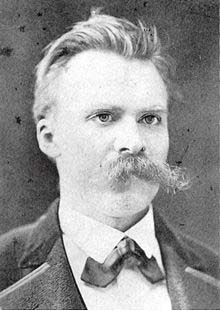
Nietzsche 1875

Translations by Walter Kaufman (Beyond Good and Evil; Prelude to a Philosophy of the Future, Friedrich Nietzsche, 1966).


SUPPLEMENT 2

Regional outgrowths of the Serbian – in Montenegro, in Bosnia, in Macedonia, in Lika, in Dalmatia, in the Baèka, Banat or Baranja regions of Vojvodina, in Slavonia, in Old Serbia, in Central Serbia – whether Muslim or Roman Catholic or Eastern Orthodox Christian – are really one racial family of peoples. The Croat (Khorvat) bears a heritage and fate similar to that of the Serb. The forms “Choratos” and “Chorouatos” have been found among inscriptions in ancient Tanais on the Don. According to the records of the Byzantine Emperor Constantine Porphyrogenitus (AD 912-925), the White Croats (Belochrobati), a “Slavic” people, occupied the upper Vistula and northern Bohemia. Arab travelers of the time noted certain Sarmatian characteristics among them: they had, besides the king, a viceroy called župan; they practiced artificial cranial deformation; and the names of their chiefs were non-Slavic. After the eclipse of the Huns, the Sarmatian Croats, like the Sarmatian Serbs, remained in northern Europe to rule the country themselves. Ultimately the Croats, like the Serbs, were slavicized, and their name was taken by the subject population. These new people were known as White (or Western) Croats just as the Serbs in Saxony were known as White Serbs (T. Sulimirski, The Sarmatians, pages 190-192). Such facts suggest that it may be more accurate to speak of the two modern peoples in adjectival form – the Croatian and the Serbian – to remind us that they are actually Sarmatian modifications of the West Slav.

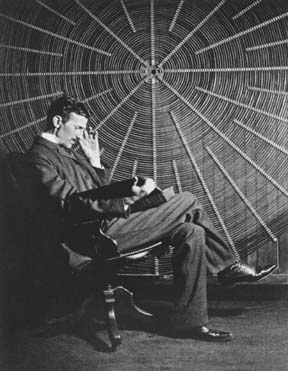
20th-century Serbian scientist and inventor Nikola Tesla


SUPPLEMENT 3
From standard references at hand I draw the following illustrations of these other complexes:


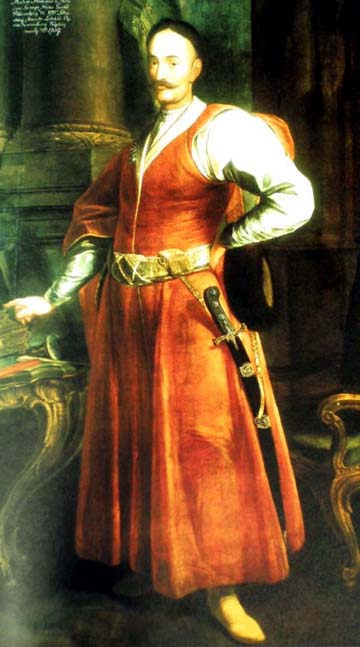
Polish noble Stanisaw Antoni Szczuka (1652-1710) in a representative Sarmatian-style outfit: a red kontusz tied with a pas kontuszowy. Underneath a żupan with a low collar. Left hand holds a fur cap with a low band. Characteristic hair and moustache. Unknown Polish artist.

The Pole and the Russian. No certain historical data exists for the Pole until the tenth century, but traditions of the West Alan (possibly the Alanic Antae) survived among them for centuries after the Alan’s fifth-century invasion and the consequent mixing with the indigenous Slavs who had arrived in the area during the first century of our era. The belief in a Sarmatian origin of Poland was widespread among the nobility of that nation for centuries. The most striking survival is in Polish heraldry: ancient tamgas, the religious monograms of the West Alan, appear in stylized form as crescents, arrows, and horseshoes. The beliefs associated with the tamgas spread also among the conquered Slavic population further east. The symbols turn up again in the coats of arms of the Rurikovich dynasty of Old Russia. Evidently the West Alan ruler was gradually Slavicized (a process completed not earlier than the sixth century) and the new breed was subjected to the Turkic Avar and the Caucasian Khazar before this vast disarray of people invited the Viking Rurik and his Swedish followers to govern them. With the assimilation of the Finn, beginning in the ninth century, Russian settlers in the country of the Upper Volga acquired the mental characteristics of steadfastness and fatalism that made them a new type, distinct from the Old Russian of Kiev and Novgorod. (The Tatar invasion of Russia during the thirteenth century practically mixed no blood.)

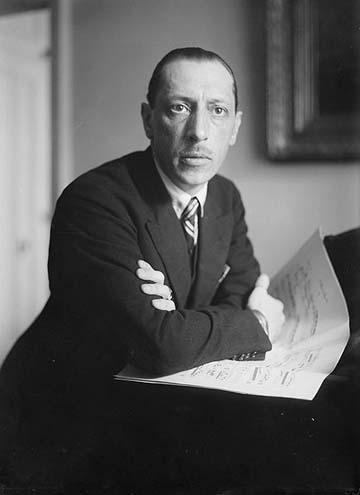
20th-century composer, pianist, and conductor Igor Stravinsky circa 1920-1930 PHOTO: George Grantham Bain Collection


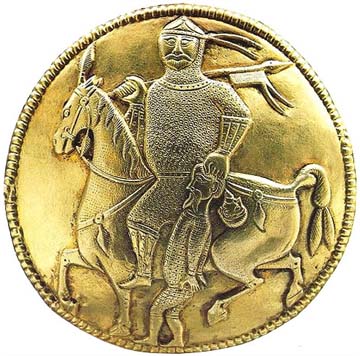
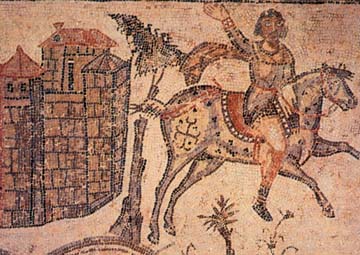
Bulgar warrior horseman of one of the steppe khanates 8th-10th century CE with captive, featured on an ewer from the Treasure of Nagyszentmiklos.

The Bulgarian. Of the Bulgars, a Turanian race who came westward after the Huns, a small horde of the Utigari tribe broke off to invade the Balkan peninsula and gradually merged into the Slavic population to form the modern Bulgarian.

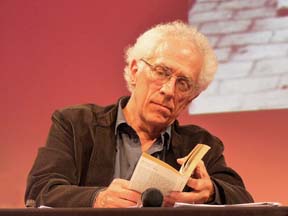
Tzvetan Todorov, 20th-century Bulgarian literary theorist, 2011 PHOTO: Ji-Elle


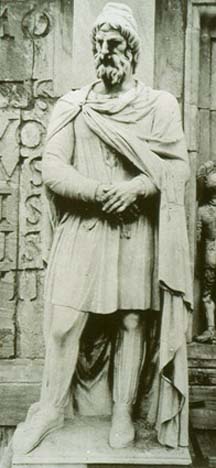
Statue of Dacian on triumphal Arch of Constantine, 4th century CE

The Rumanian. The eighth century blended the primary elements of the Rumanian nation: (1) a few remaining Dacians of the ancient Thracian stock called “Getae” by the Greeks and annihilated by the Romans; (2) the old growth of Roman colonists forsaken by Emperor Aurelian in the third century who had developed into bellicose, Latin-speaking nomads, the “Vlachs” or “Rumans”; (3) numerous Slavic newcomers. Not until the thirteenth century did Ruman state history begin.

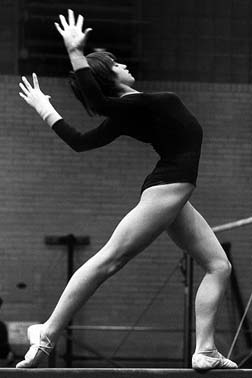
Romanian gymnast Nadia Elena Comăneci, Olympic gold medal winner and the first female to be awarded a perfect score of 10 in an Olympic gymnastic event, October 1977. PHOTO: Dave Gilbert


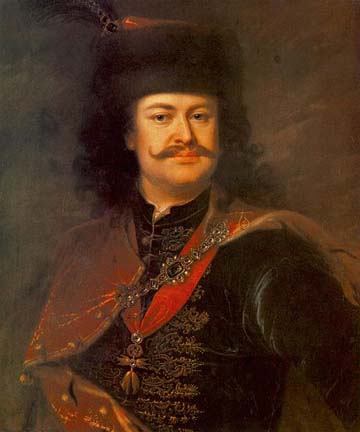
Francis II Rakoczi, 18th-century Hungarian aristocrat, 1724 PAINTING: Adam Manyoki

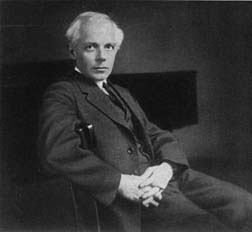
The Hungarian. The Hungarian nation appears in history under two names: “Magyar” (used by themselves) and “Hungarian” (used by foreigners). The predecessors of the Magyar, the Hun and the Avar, had ranged the Hungarian plain for two centuries before the Magyar arrived. At first, Roman emperors sought the aid of the seven tribes who were united under the Magyar chieftain to help them fight the enemies of Byzantium. In the ninth century perhaps as many as one million uninvited nomads, among them two hundred thousand men under arms, were led with discipline by their chieftain across the Carpathians. The new military state of Magyarska (Hungary) appeared about the year one thousand. In time, the Magyars mixed with the Slavs within the limits of their kingdom and with the descendants of Roman colonists to the southeast of it and thereby enhanced the complexion of their race. Attila “the Hun” was regarded as a Magyar hero. The national dress of the Magyar nobleman, worn until the early twentieth century, was named for him – the “Attila.”

Bela Bartok (1927), 20th-century Hungarian composer, pianist, and founder of ethnomusicology


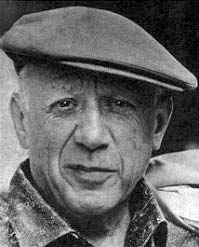
The Spanish. While Greece, the parent of classical European civilization, was still in a state of barbarism, the Iberian and the Celt amalgamated at the center of Spain in admirable cities where they taught philosophy and the arts. This early population was cultivated and, for several centuries, increased by the colonial soldiers of Rome. During the fifth century, the Vandal, the Suevi, and the Alan burst in and chose lots for the three administrative units of Iberia apportioned by Rome. A state of division and confusion was inaugurated and sustained for a thousand years: first by the stern authority of the Visigoth; next by the inconstancy of the Frank; and finally by the Arab, whose imposing slave armies brought them first victory and then destruction. When the slave armies disassociated themselves from the Arab, the Mauritanian Negroes, who formed one of the slave armies, came to be known as Moors. References at hand do not make clear whether the members of the second slave army, Slavs who were sold by the Germans to the Jews and then to the Arabs, remained as settlers.

Spanish painter, sculptor, and stage designer Pablo Picasso (1962), co-founder of the Cubist movement and one of the most influential artists of the 20th century


The Berber. The Vandals, pushed westward by the Huns in the fifth century, joined the union of German tribes and crisscrossed the Alps in search of a new home before they took possession of southern Spain and gave their name to Andalusia (Vandalusia). Later the Roman governor of Africa invited them to assist in putting down a revolt against the Empire. The Vandals crossed the Straits of Gibraltar in a body, took possession of the Roman provinces along the north coast of Africa eastward as far as Tunis, and made of these provinces a kingdom for a hundred years . . . until the Romans restored the region to themselves. The Vandals disappeared as a race, but their descendants, with light hair, blue eyes, and fair skin, still live among the valleys of the Atlas Mountains, where they are known as Berbers and keep themselves distinct from the Arab population.

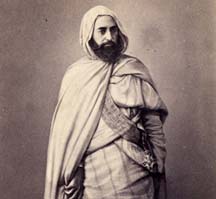
Banu Ifran Berber Emir Abd al-Qadir (1808-1883), Algerian Islamic scholar, Sufi, and political and military leader circa 1860


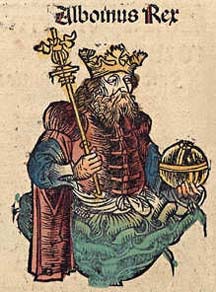
Alboin, king of the Lombards (560-572), led the Lombard migration into Northern Italy. IMAGE: woodcut from the Nuremburg Chronicle, 1493


The Northern Italian. The Lombards lent Attila their aid in his expeditions, and allied themselves with the Turkic Avars to drive out the Gepidae, before they descended from the Alps with their wives, children, wagons, oxen, and flocks to take possession of the whole of northern Italy. There, in the sixth century, this germanic people still drank liquor from the skulls of their enemies when they assembled at the festivals of Odin. The Goths, who had arrived before them, became a defeated people; those who remained gradually put aside their ferocious ways and mingled with the mild climate, the fertile soil, and the other Italians.

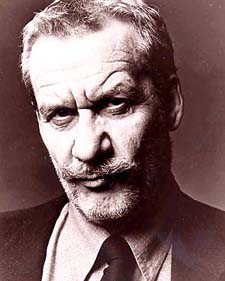
Contemporary Italian songwriter, singer, and pianist Paolo Conte.


Helmet from the 7th-century ship burial at Sutton Hoo, presumed to be of an East Anglian king.

The English. The ancestors of the modern English were known to the Britons of the fifth century (whom they displaced) as cruel and merciless pirates who captured men and women for the slave market and tortured to death one of every ten as a sacrifice to their gods. Those fierce and restless conquerors, for the most part young men who seized the daughters of slain Britons for their wives, gave to their new lands mild names: the South Saxons, Sussex; the East Saxons, Essex; the two gangs of Angles, the North folk and the South folk, the names Norfolk, Suffolk, and East Anglia.

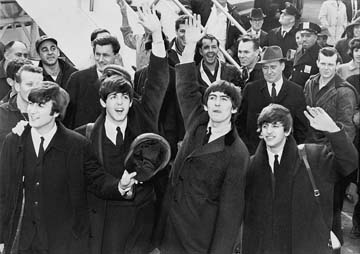
The Beatles John Lennon, Paul McCartney, George Harrison, and Ringo Star wave to American fans in 1964. PHOTO: UPI, photographer unknown


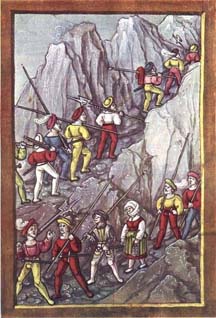
Swiss mercenaries crossing the Alps painted by Diebold Schilling (1513).

The Swiss. In the Swiss Alps, the Helvetian eked out an unquiet existence, and the Rhaetian and the Allobroge led wild lives of war and pillage, before Roman culture made the miserable conditions of these Celtic peoples vanish by degrees. The Allobroge exchanged the sword for the plow; the Rhaetian adopted the gentle habit of Alpine farmer or mountain guide. During the fifth century, the obstinate struggle between Roman and Teuton was decided in favor of the Teuton. The great migrations of the Alamanni and the Burgundians established in the Alps a germanic way of life. At the end of the fifth century, the Franks overcame the Alamanni who remained.


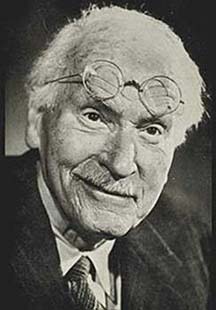
20th-century analytical psychologist Carl Gustave Jung


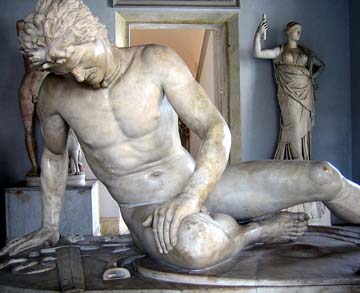
The “Dying Gaul,” an ancient Roman marble copy of a lost Hellenistic sculpture commissioned between 230-220 BC.

The French. The medieval French were a compilation of half-civilized Gauls, cultured Romans, barbarous Germans, and expatriated Britons – almost every physical type found in Europe – who had collected on the same countryside during two thousand years. The germanic Frank rudely shocked them all into transformation. Two peoples were exempted: the Celtic Gaul of Britanny and the Gascon, a descendant of the Iberian, were able to resist the germanic influx.

20th-century French poet Saint-John Perse (pen name of Alexis leger), who won the 1960 Nobel prize for Literature “for the soaring flight and evocative imagery of his poetry.”


A Note on Homogenesis, Part 1


Il nous est souvenu du lieu natal
o nous n’avons naissance

[With us is remembered the natal place
where we were not born]

— St. John Perse, Amers, IV

The process of human generation is psychic as well as physical. The fact of psychic phylogenesis was corroborated in clinical research a generation ago by the analytical psychologist Carl Jung. The dialectical process itself was intuited by the philosopher Friedrich Nietzsche three generations before that. Many years ago, as a university student, I traced out the principal facts of human genealogy in Nietzsche’s pages without complete awareness of their significance. I trace them again here, in these pages, with, I hope, more understanding.

In Beyond Good and Evil, section 257, Nietzsche observed:

Let us admit to ourselves, without trying to be considerate, how every higher culture on earth so far has begun. Human beings whose nature was still natural, barbarians in every terrible sense of the word, men of prey who were still in possession of unbroken strength of will and lust for power, hurled themselves upon weaker, more civilized, more peaceful races. . . . In the beginning, the noble caste was always the barbarian caste: their predominance did not lie mainly in physical strength but in strength of the soul–they were more whole human beings (which means, at every level, “more whole beasts”).

Foreseeing objections, he added in section 264:

One cannot erase from the soul of a human being what his ancestors liked most to do and did most constantly. . . . It is simply not possible that a human being should not have the qualities and preference of his parents and ancestors in his body, whatever appearances may suggest to the contrary. This is the problem of race.

In section 260, he had already stated:

There are master morality and slave morality – I add immediately that in all the higher and more mixed cultures there also appear attempts at mediation between these two moralities, and yet more often the interpenetration and mutual misunderstanding of both, and at times they occur directly alongside each other – even in the same human being, within a single soul. (SeeSupplement 1)

This invention of history, the subjective relationship of master and slave, predator and prey, grows into a conjugal relation which seems to me no less fantastic than the inventions of biology: Two peoples become absorbed in one another, they mingle and exchange what is in them, until they evolve or become a new kind of human being, collectively and individually.

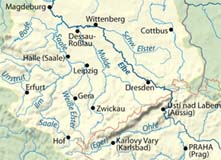
The triangle of European plain below the Baltic Sea, delimited on the west and east by the rivers Saale and Elbe and on the south by the Ore Mountains. PHOTO: Wikipedia

On a triangle of European plain in the fifth century of our era, such a relationship was consummated along the banks of the Elbe River between the Alan Serb and a handful of Western Slavic tribes. From that moment in time there has been the Sarmatian Slav – the East Alan Slav – identified in our time as the Serbian. Before that moment there had been two separate series of parental incarnations. On the paternal side, the Sarmatian East Alan, it is said, arose through a genealogy of cultures and races from the early nomads of the North Kazakhstan steppes, who themselves had derived from others who had peopled the Androvian or Alarodian culture of the Bronze Age, and earlier, from some as yet unknown people of neolithic times. On the maternal side, the Western Slav, through a vague genesis of circumstances and events, derived from the primordial Slav, the first Slavic race, who was born to a mother race sometimes called the “Veneti” and a father who is still anonymous to us.

This remembrance (I do not hesitate to use this ghostly noun) has not only convinced me of the barbaric origin of my mundane soul and human nature, my homogenized supersentient anima; this remembrance has also brought me face to face with the fact that my psyche is, among other things, a juncture and a blend of the mentalities, cultures, and primal natures of overlord and subject, master and slave, predator and prey. I am awed by the mere fact of this fierce marriage, but moreso by its proximity in time. Fewer than fifty or sixty couplings separate me from the origin of what nineteenth century historians had called my “nationality” and what twentieth-century anthropologists call my “racial stock.” The number of couples, men and women, involved in the direct line of my ancestral descent from that distant point of origin on a central European plain is fewer than the number which I, with modest means, might entertain at my own wedding. So it is with us all. No one alive – no one who has lived – escapes this sequence or this pattern. What a miscarried world that exists and reproduces itself in so rude a manner!

I offer these pages as an analogy, and my countenance as a parallel, to the reader’s own. The origin of every person of European descent is subject to the same irrefutable laws and is a reflection of similar ignominious events. What happened, for better or for worse, during the fifth and sixth centuries of our era to create the modern Serb and the Croat (See Supplement 2), the Pole and the Old Russian (both new and separate breeds of the Slav and the West Alan), the Avarized Slovene and the Germanized Czech, happened, in kind and at about the same time, to create the Bulgarian, the Rumanian, the Hungarian, the Spaniard, the African Berber, the North Italian, the English, the Swiss, the French, and another of the more recent complexions of the Russian (See Supplement 3); and what happened to create them happened also at other, earlier, times to create the Lapp, the Finn, the Basque, the Greek, the Irish and Scot, the German, the Scandinavian, and the Frison of the Netherlands. The same holds true for any of the myriad peoples who inhabit the valley of Mesopotamia or the Iranian plateau. Several times each millennium a new predator race drives out another from the steppes to introduce a new complication to the human event. (About 560 CE one of the most recent strains of the Turk sprang up there and extended itself, over a thousand years, across half of Europe.) The Indian and the Chinese, since neolithic times, have been shaped and revitalized continuously by the antagonists of the north and the south. The African, the dweller on the coast of Asia, the islander of Oceania, the American of pre-Columbian times – all are inventions of other rude, and nearly timeless, marriages.

Robert Petrovich 1995


< Read Part 2 >