“Biologically Focused Lighting for Health and Wellness”


I came across an interesting company, Bios Lighting, that has lighting technologies for healthy work and home environments.

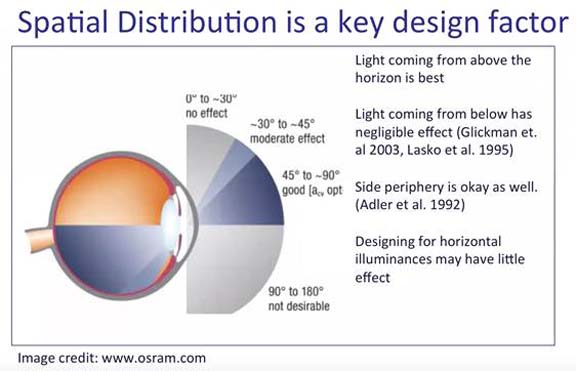
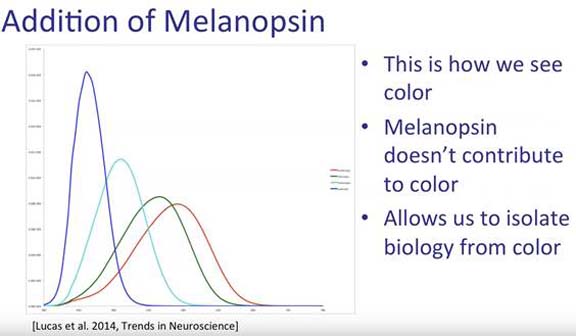
Their concept has to do with a non-vision receptor (melanopsin) in the eye, which lies in the blue-green (turquoise) spectrum and is responsible for the wake/sleep cycle. Adding this turquoise wavelength light leads to better concentration on the work place. Most important is that currently the commercially available LED replacement lights do not produce much in that wavelength range! While LEDs may put out too much short-wavelength blue light that can damage the eye. Same with LED computer and TV displays…

Another interesting aspect of that is, that these receptors are distributed in the eye such that they pick up this stimulus over the horizon.


This is quite amazing. Watch this 1-hour long presentation (or at least skip through it as I did):


Watch the video online at YouTube (1:03).


Article and link submitted by Stephan Fuelling


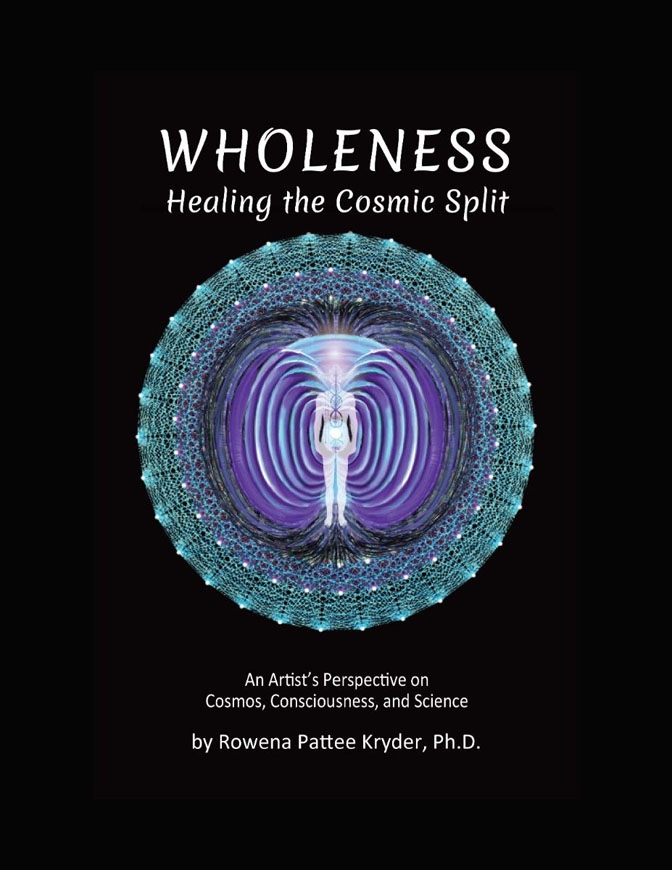
“Rowena New Book Release: Wholeness, Healing the Cosmic Split”


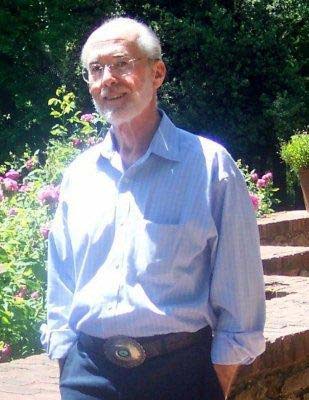
Rowena Pattee Kryder (October 29, 1935 – October 11, 2014) was a friend of the Community and a resident of Reno during the final years of her life. During those years, she gave of her time as a featured speaker at the “Spiritual State of the World” conferences held in Reno. Rowena was also a benefactress of the Church, donating her vast library of 2000 books to the Church before she moved here to Reno from Albuquerque, New Mexico be closer to the Community.

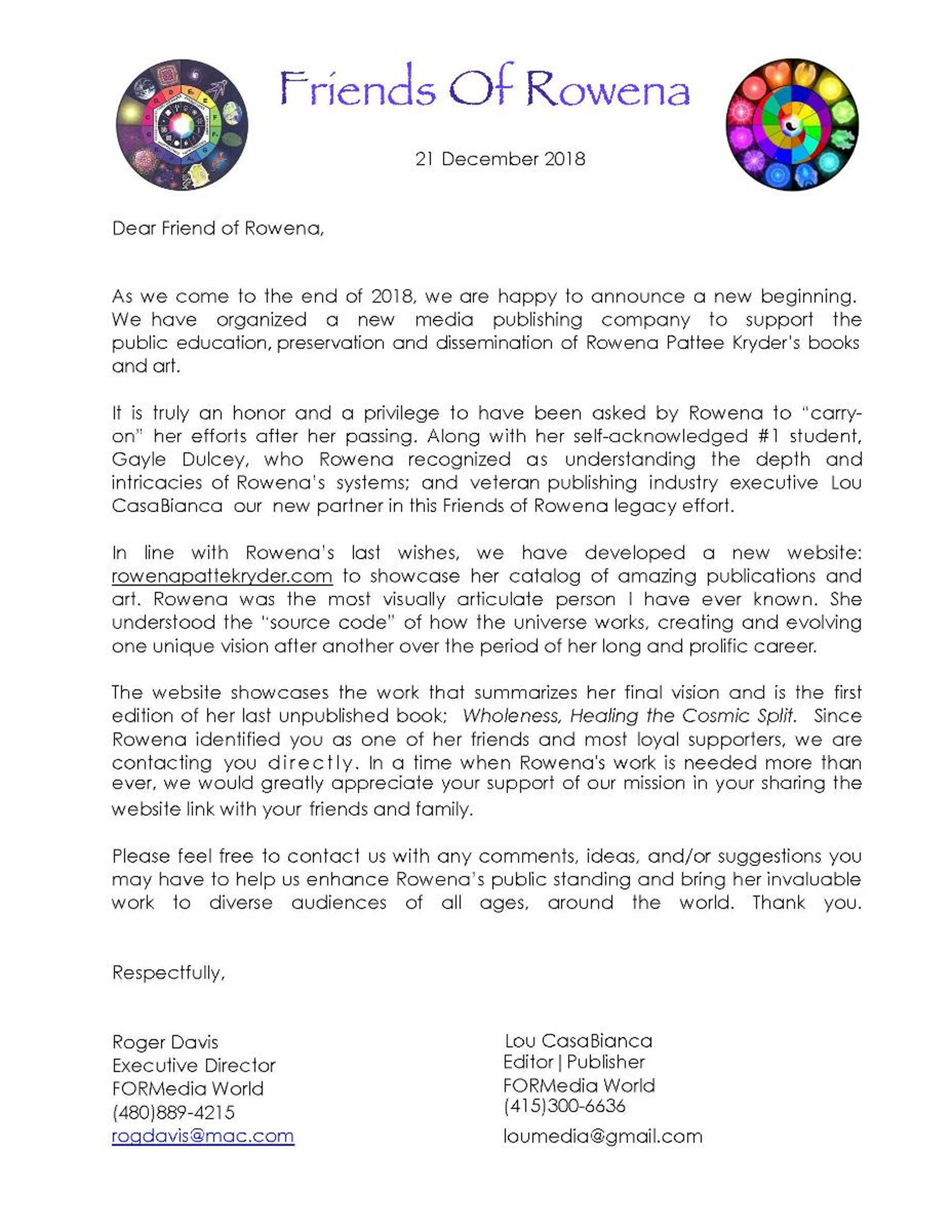
Now her legacy as an artist and author is being preserved by her friends and students through a web site dedicated to her work. Her final book, WHOLENESS: Healing the Cosmic Spirit, is being offered for the first time as an electronic book on this new web site.

VISIT ROWENA’S ONLINE STORE

For more info: rogdavis@mac.com or loumedia@gmail.com


In Support of International Community of Christ


 2012-REP-Tom Fee-FeeT 

Reno resident Tom Fee sent in a brief testimonial of his experiences with the Church. We thought we would share it with you. Here it is:

TO WHOM IT MAY CONCERN:

I am a 71 year resident of the Reno-Sparks area and served this area for 37 years as a special education teacher, a special education administrator, and as a school psychologist.

I’ve been interested in Religion and The Spirit since my discharge from the U.S. Navy in 1959 at the age of 20. I’ve attended services of a variety of groups, including The First Church of Religious Science, now known as The Center for Spiritual Living. In fact I was a member from 1977 to early 2008. I’ve also attended Unity Services, off and on , for a number of my younger years. These churches are somewhat philosophical and believe in the power of the mind and the power of thought. There is rare mention of Jesus Christ or the Spirit of God. They are not God centered or spirit centered, in my mind, although they have a wonderful philosophy of using affirmation, clear thought, and positive thinking to better themselves personally and financially. Yet God and Spirit does not seem to play a part in it.

As a psychologist, I do a great deal of observation. In my association with the International Community of Christ, I’ve noticed a heavy and consistent emphasis in their services on God, the Christ, the Christ Spirit, the Christ Light, and the Light. I’ve never experienced any other church with a greater emphasis on God, Christ, Spirit, and The Light.

Very sincerely yours,

Thomas S. Fee


NOAH and THE ARK: Part 3


2014-REP-ark 2


The Ark

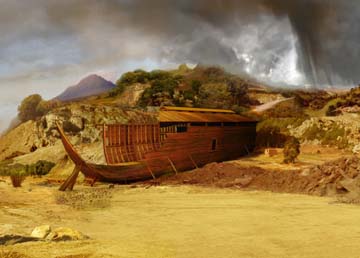
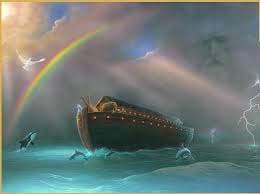
In Noah’s story (Genesis 6–8) we will begin with word ark. In Hebrew the word is tebeh, which frequently occurs in Noah’s story but appears only twice in the rest of the Old Testament (OT); both in Moses’s stream-drifting episode as an infant. So Tebeh is exclusive to Noah and Moses; all other accounts in the OT use the equivalent words boat, ship, or vessel.

Tebeh (Ark) has an explicit meaning, made up of the letters Tav, Bayt, and Hay:

Bayt—the archetypal container
Tav— the utmost resistance to influence or destruction
Hay— the essence/principle of primordial life

In other words: “The Ark is the most destruction-resistant archetypal container to support the essence of life.”

Noah in Hebrew letters is Noun and Hhayt:

Noun—individual existence
Hhayt— sphere for undifferentiated energy

In other words: “Noah is the embryo, the potential of every individual existence.”

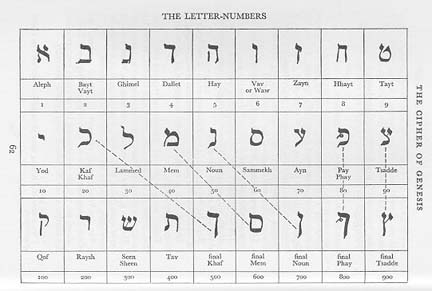
Traditionally, each Hebrew letter also represents a number. Aleph was 1, bayt was 2, etc., with the second row of letters signifying a series of tens: yod was 10, kaf was 20 and so on. The third row designated numbers by hundreds. To differentiate a letter from a number in any text, a line was simply drawn under the letter. With this in mind we can look at the cubit dimensions of the Ark: 300 (Sheen) x 50 (Noun) x 30 (lammed):

Noun—individual existence
Lammed—controls/connects primordial movement
Sheen—Breath of God

“The Ark dimensions are the atmosphere for the individual to be moved by the Breath of God: a sacred place.”

 When we put the Man Noah (the potential of individual existence) in the Ark (the most destruction-resistant archetypal container to support life) and add the ark dimensions (the atmosphere connected to the Breath of God), we can see the Ark is designed for a voyage that will exalt human potential. This is the blueprint for the entire episode of the Ark on the Flood Waters.

In constructing the ark, Noah is instructed to use “gopher” wood. The Hebrew word gopher (not to be confused with the English word for a certain rodent) appears nowhere else in the Hebrew Scriptures. A word that appears only once in a given document is called a hapax legomenon, a Greek term meaning “something that happens only once,” and is often abbreviated as hapax. Four hundred words in the Old Testament are true hapaxes, and twenty-nine of these have no meaning. Gopher falls in this latter category. The word is composed of three letters:

Ghimel—archetypal organic movement
Phay—essences; building blocks of individual life
Raysh—universal container

In other words: “Gopher is the building blocks of individual existence that can be organized into any form and any container.”

Genesis 6:14: “Make thee an ark of gopher wood, rooms shalt thou make in the ark, and shalt pitch it within and without with pitch.” The word pitch is translated from kopher in Hebrew, made up of the letters Kaf-Phay-Raysh. In the 106 other uses in the OT, kopher is translated to mean “atonement” or a synonym thereof. Genesis 6:16 is the only instance of the word’s being translated “pitch.” The key to understanding gopher is found in its relationship to kopher. The gopher wood is sealed with pitch on both sides; thus we have pitch-gopher-pitch. The matrix below reveals the true content of verse 14 and sweeps away all obscurity around the term gopher:


Pitch       Kaf          Phay    Raysh
Gopher  Ghimel  Phay    Raysh
Pitch       Kaf          Phay    Raysh

Immediately we can see the bonding of triple Phay and triple Raysh: an incredibly resilient structure. Kaf is the archetypal container for individual life and in Hebrew means “the hollow of the hand.” It is ready to receive all that comes. If you can imagine (Ghimel) the essence of organic movement expressing (Kaf) both hands stretching out to embrace all that may come, rooted upon an unshakable foundation . . . then you, the reader, are about to embark on the Ark.

The Ark story is not a single historical event, but a continuous one. It is the realization for the unbound capacity to explore the extent of the cosmos—be it inner or outer worlds—so the individual may flourish to become a ‘being’ beyond one’s personal gravity of prediction. The story has nothing to do with catastrophe, destruction, or divine revenge. The storyline, originally passed on as an oral tradition, is simply a vehicle for the inner message. The Rabbim would figuratively put this story on and wear it like a vest or breastplate; carry the inner message in their chest. When I first heard this it seemed like utter nonsense, when actually it is quite a pleasant experience. Most of us in the Western world conceive of thought as being located in our heads, but this is not true of all cultures. To give you a sense of this, read the following sentence, a memo that might show up on your desktop:

“The meeting for next Wednesday has been moved forward two days.”

Now answer this question: What day will the meeting occur? There are two correct answers. About half of people answer “Monday” and the other half will say “Friday.”

People that answer “Friday” perceive time as static and only they themselves move through the corridor and so they move themselves to a site in the future. People that answer “Monday” perceive themselves as static and see time moving or passing by them: since time moves past them it can only move to an earlier event: Monday. This cognitive preference is due to how we orient ourselves to objects. It also defines our ability to locate thought outside ourselves and place it between objects. If you look around the room you are in right now you might notice a table, chair, lamp, and other items. In and of themselves those items have little if any connection; it is our attention that bridges these items and brings continuity to the scene. In effect, our thoughts glue these articles together, and essentially our thoughts reside between the objects.

When an American is shown a picture containing a conspicuous object with other visuals as background, they will report more details about the conspicuous object than would a Chinese or Japanese person. By the same token the Japanese and Chinese can give more details of the background visuals than can an American. Americans are comparatively more object oriented than Japanese or Chinese, who are comparatively more environmentally oriented. There are several neurological studies—hard data, specific brain areas being active—that support these cognitive preferences within these cultures. It is not just a psychological phenomenon; the brain is actively different. We have the capacity to place our attention, our mental projections, and not confine them to areas strictly inside our heads.

When we gesture within the context of a conversation, motor neurons are responding to the visual, emotional, and or sensual content of our thoughts. Essentially our mental projections inhabit different parts of our body for brief moments and this is no less real than the neural activity prompting the movement or gesture. Going a step further we can allow those thoughts to inhabit and hold themselves in those gestural repositories in the same manner we would perceive thought to reside in our skulls. To have a feeling in our belly, chest, hands, or about the shoulders is no less peculiar than carrying or experiencing a “thought” in those same locales.

The key to posting thoughts in areas other than the head is in converting word content into images or concepts. It is simpler to mentally inscribe the figure of a triangle on one’s chest, say, rather than the letters t-r-i-a-n-g-l-e. It is more economical to use an image. By the same token, if one embodies the Noah story and firmly images the concepts, the story can be posted within the chest; the concepts can be absorbed into and expressed from the chest for extended periods with a minimal amount of personal administration. In this way the message contained in the storyline becomes a living artifact, rather than fractured moments of recollected memories coming to the surface of our attention. This is the purpose of autoit expression and at the heart of this qabalistic art as the biblical authors had originally intended.

In Genesis 6:16 Noah is instructed to place a window, one window, in the ark. Tsohar, tsaddle-hay-raysh, is the Hebrew word translated as “window” in the context of this verse. Tsohar appears 23 other times in the OT, and in every one of these instances it is translated as “noon,” “midday,” or “noonday”; Tsohar means light in its highest azimuth. The translation “window” can only be a deliberate allegory by the author; challown (pronounced khal-LONE) is most commonly used to indicate the word window in the OT. At this point, the reader should be able to assign his or her own interpretation of tsohar.

In the construction of the ark described in three verses—14 through 16—at the core of every element—ark, gopher wood, pitch, window, and the dimensions—there is a dense occurrence of words having exclusive meanings, singularities, and anomalies, which goes beyond any rich coincidence. All of this suggests that the English interpretation has been excessively suited to the view of the translators to such an extent that the story no longer reflects the original narrative. The story continues with the ark’s having three levels, for which the reader would have an array of interpretation for this allegory.

Genesis 6:17: “And behold, I, even I, do bring flood of waters upon the earth, to destroy all flesh, wherein is the breath of life, from under heaven: and every thing that is in the earth shall die.” To understand the interaction of the components in Genesis 6:17, we have to visit the first chapter of Genesis where after the creation of light, Elohim (God) separates the “waters” with a firmament. The firmament is renamed “heavens” and we then have this construction: waters<heavens>waters” or mayim<shamayim>mayim in Hebrew, and the schema is:

mem-yod-mem (Mayim or Waters)
Sheen-mem-yod-mem (Shamayim or Heavens)
mem-yod-mem (Mayim or Waters)

Sheen, traditionally, is equivalent to the “breath of God.” This is the second cosmogony (after Elohim creates a “double light”) in order to establish the potential for a physical realm. The archetypal or ethereal waters are infused with the breath of God that bonds and creates a material representation of the ethereal waters.

When God says “I, even I, ” will flood the earth with water, the “I, even I,” is critical and establishes that once again, as in the beginning, God will reestablish the heavenly waters upon the earth. The flood is not a threat but a restoration of Sheen “wherein is the breath of life, from under heaven,”. And the Ark containing Noah (the archetypal embryo) will be bathed in these waters that the human spirit can once again achieve its highest potential and return to a state that was originally in accord with God and the heavens. The waters only destroy that which is not aligned with Sheen; that is, no flesh can endure terrestrial waters but spirit can propagate and thrive upon the ethereal waters, and the Ark is the key for a safe voyage.

The Ark allows a terrestrial trek wherein one is not separated from the creator, and all of the human family—Noah’s wife, sons, and their wives—are afforded this opportunity. Noah is instructed that the Ark is to have all of life two by two and by this is meant nothing more than: Man is also a material being and as such must engage in the material world, but this is engagement need not be excessive. All the animals on the Ark are therefore not excessive, but only paired as a reminder that there is terrestrial food and there is also food of the spirit. To be truly human one must also feed the spirit.

We could continue through the end of Genesis 7, but at this juncture further exposure of Noah’s flight would become laborious for most readers. All the explanations, to this point, should give one a pretty good glimpse of how the ancients enabled the Torah in a much different fashion than readers of the modern times.

The segment that follows in the book turns to the other Ark—The Ark of the Covenant—discloses the true identity and location of this elusive artifact, and once and for all puts to rest any speculation on the matter that has ever existed. It is a much different exposé than Noah’s Ark, which turns out to be so obvious that originally the author was struck with disbelief. We look forward to presenting this next section of the book to Communique readers when it becomes avalable.


by Michael McIntyre, 2014


NOAH and THE ARK: Part 2


2014-REP-ark 1

Let us look at the Hebrew word AWR, which means “light.” This word is found very early in the Hebrew scripts: Genesis 1:3.

AWR is made of the three letters Aleph Waw Raysh.
Aleph, the unthinkable of all that is and all that is not, meets
Waw, the copulative or fertilizing agent, which connects
Raysh. Each germ of light has an envelope. Raysh is the ultimate expression of this. It is the cosmic envelope, conceivable in the same manner one might ponder the finiteness or limits of the physical universe.

The schema AWR can be cognized as the unconditional movement of the discontinuous and unthinkable Aleph imprinting itself on Raysh, the exalted multiple and infinitely expanding container. The true context of AWR is an ever-occurring primordial event. It is the Wedlock of Two Infinities. It is around all everywhere, in all everywhere, and beyond all everywhere—it is alive. It first appears in Genesis 1:3.

And God (Elohim in the original Hebrew) said, “Let there be light,” and there was light.

Poetic as this verse seems, it would have been just as easy for the author to state, “Then, God made Light”. Or, “God, then, made Light.” But, the word light is generated twice in this verse, and with reason. There are two functions taking place. In the first use, And God said, “Let there be light.” Light, or awr, is an issue of God’s breath. Awr in this usage has an etherical quality. In the second use, “and there was light,” awr has become more tangible. It embraces substance. The unseen light brings forth the visible light. There is an inner light. There is an outer light. The unseen light is the cause and support of the visible. The unseen light is closer to God. Realizations of these interactions can be endless.

Although each word or verse is designed to deliver a particular message, the constant underlying intent of these authors is to immerse the reader in a regenerated state of awe for the ever-unfolding revelation of creation that breathes from realms beyond our conception to the smallest, most minute and isolated expression; all of this is in the constant flux of existence reinventing itself. Eventually this venture gives way to Infinity, which instills the key to all riddles. The intention here is to unveil the mindset of a cultured and educated person, long gone, distanced from us by more than two thousand years. That is our interest. This is not a Bible interpretation. So, let’s look at the word God in Gen 1:3 And God [Elohim] said, “Let there be light.” Elohim in Gen 1:3 is composed of the letters Aleph-Lammed-Hay-Yod-Mem:

Aleph—all that is and that is not
Lammed—a connecting agent
Hay—potential of universal life
Yod—temporal existence
Mem—maternal waters of cosmic fertility

Elohim is the casual architect of temporal creation; a fitting name for God in Genesis. The entire verse can be viewed as Aleph generating the capacity to create, which first imprints on the unseen world . The unseen imprint then makes an imprint of itself in the physical world. Aleph generates a double light, which brings forth the creation of the physical world. This is Einstein’s contemplation, E=mc2. This small example typifies the wealth of information contained in the first chapter of Genesis, only accessible by means of the ancient qabalistic autoit art.

So if we can imagine an aged and bearded Hebrew rabbi, draped in coarse linen, a single-candled room, and he intent on a tattered and worn text. We can guess he is not just mentally regurgitating written script to form a linear sentence in his head. Here is a little story:

There wasn’t much time. The man hurried to his automobile and arrived at
at the airport at 8:00 am. His package was disintegrating. It wasn’t long before the
the police would notice him. His fear at this is point pounded his heart.
Bang! Bang! He heard he the gunshot. Quickly he hit it the floor and blood pooled 
from his head. Five of his of fingers were missing. The end was near.

If you carefully read through the story there are several errors:

There wasn’t much time. The man hurried to his automobile and arrived at
at the airport at 8:00 am. His package was disintegrating. It wasn’t long before the
the police would notice him. His fear at this is point pounded his heart.
Bang! Bang! He heard he the gunshot. Quickly he hit it the floor and blood pooled 
from his head. Five of his of fingers were missing. The end was near.

Oftentimes when reading we dismiss articles and smaller words like the, of, at, in, on, a, is, it. It is easier to remember 7 0 2 7 7 5 2 8 4 2 as 702- 775-2842 in telephone format. We take individual bits of information and group them into packets. It is more efficient to remember three groups of information rather than 10 individual parts. This is called ‘chunking’. “The feathered animal having claws and a beak lifted off a tall green monument and made its way to another tall green monument.” or “The bird flew from one tree to the next.” Language itself, is a form of chunking. When reading, people will often make several chunks from a sentence, instead of laboriously reading one word at a time, in order to absorb the material more quickly.

Aoccdring to rscheearch, it deosn’t mttaer in waht oredr the ltteers in a wrod are, olny that the frist and lsat ltteres are in the rghit plceas. We dno’t raed ervey lteter by ilstef but the wrod as a wlohe uint.

So we have this tendency to condense written language when reading. We easily dismiss small or article words. We contract groups of words into manageable units. Essentially we compress thought. For the autiot reader, every word breathes panorama. Releasing. Reaching. Escalating. Our language is one of exclusion. When we think the word ‘chair’, essentially we block out every thing except ‘chair’. We isolate and close the door to all other possibilities. Autiot blossoms and launches the reader. The mind of the modern reader isolates and compresses thought. Thoughts of the ancient Rabbim were mind expanding.

< PART 3 >


NOAH and THE ARK: Part 1


Michael McIntyre has a book in progress titled “The Restoration of Ezekiel Forty-One”. The book involves: language, linguistics, cognition, neuroscience, history, dreaming, little stories, and a fair amount of graphics; all bundled together to give the reader a tangible sense for the mindset of a cultured individual who lived more than 2500 years ago. Each chapter discloses a kaleidoscope of perceptive tools, taking the reader on a journey that allows them to grasp the experience of Ezekiel’s Temple Vision as documented in the Old Testament. This Vision has been reconstructed in an animated format on DVD, so that the reader can sit back and watch as the vision takes shape, in the form, as described, in Ezekiel 41: All the little pieces neatly interlocking to replicate a visual experience that has eluded scholars and proper conjecture for centuries.

The excerpt you are about to read is a section from one of the book’s chapters titled “The Two Arks: Noah and the Covenant.”


This section will explain the Old Testament story of Noah and The Ark using the ancient Rabbinical Tradition known as letter qabala or autoit, (the French transliteration of the Hebrew word AVTTYVT) . This qabala tradition does not engage techniques such as the calling of angels, entering other realms, or using any invocational chants; it simply embraces contemplation. Employing this tradition, or knowledge, to the Torah (first five books of the Old Testament) reveals to the reader all the wonder intended by the original authors. This mysticism is in accord with the Upanishads and the works of Lao-tzu, Kahlil Gibran, and other poets whose efforts were to elicit the spirit of humankind.

Before revealing the meaning of the story of Noah’s Ark, let me introduce you to this autoit qabala system, which will answer all the puzzling questions that the story evokes, like: How did Noah house all representative animal life on the planet in a vessel about the size of a large high school gymnasium?— not to mention the storage of the food that these creatures needed in order to survive a 12-month journey. And the animal droppings—only eight people to manage this task on a boat having one window and one door? Imagine the morning calls of 70,000 birds from a platform half the size of a soccer field. There would be carpets of insects, over 45,000 species of spiders and ants alone. Termites, woodpeckers, and beaver would receive quite the scolding for just doing what came natural to them. Picture 400 varieties of monkeys and apes in a high school cafeteria. Some might speculate on Noah’s Zoo in images such as these, but the Rabbim use different images.

The letters of the Hebrew alphabet have a numerical and a contextual designation. Each letter represents an archetypal essence. In word formation, the letter concepts interact to form a new concept. Let’s use the word sun for example:

Shemesh, one of the Hebrew words for sun, is composed of the letters Sheen-Mem-Sheen. Sheen is the cosmic breath in everything, everywhere. Mem is the pool of maternal waters. Here is what we have: Sheen (cosmic breath) catalyzes through Mem (maternal waters) acting upon itself—Sheen (cosmic breath). In other words Fusion! This simple example shows how the ancient reader would have had a much deeper sense of the word sun.

Let’s look at one more example before going on to the construction of the alphabet, which is quite fascinating and like the word constructions (from those ancient times) is in no way arbitrary.

Rayhha (or Raycha) is the Hebrew equivalent for “perfume” or “fragrance.” It is made of the letters: Raysh-Yod-Hhayt (or Chayt)

Raysh—the cosmic receptacle or the universe as an envelope
Yod—Projection into temporal existence
Hhayt—primordial substance, which can become a myriad of possibilities

Rayhha is temporal existence projecting a myriad of possibilities back into the limitless receptacle. It exalts its parts into the cosmic container; Organic disintegration; Posting the replication of oneself ethereally; Breadcrumb trails; A preview to: eventually all received must be returned. Applications can be endless. Poetry. Every autoit word is a poem.

Each translation of the outer world mimics a reflection of the inner world. Each artifact in a given scene is constructed of pliable elements. The elements then interact in such a way that “existence” seems to issue forth within every moment, continuously. We can more readily see this in the first ten letter constructions of the alphabet:

ALEPH (the first letter): All that is. All that is not. Aleph is unthinkable, timeless, elusive. From it all things issue yet it has no origin of issue. It does not possess the quality of existence-in-duration.

BAYT or VAYT (second letter): Bayt is the primordial container. The archetype of all dwellings. It allows energy to reflect so that energy can discern “that which is not itself.”

GHIMEL (third letter): Movement. Animation. Ghimel is motion expressed as uncontrolled function. Action that is not predisposed.

DALLET (fourth letter): Resistance. Dallet allows energies to resist influence and change, therefore allowing order.

HAY (fifth letter): Primordial life. Hay is the potential for all discernible existence; it does not, however, claim individual existence.

WAW or VAV (sixth letter): Fertility. Waw is a copulative agent.

ZAYN (seventh letter): Zayn is an opening to the myriad of possibilities.

HhAYT or Chayt (eighth letter): The primordial substances and energies by which the myriads of possibilities (Zayn) might be realized. It is similar to the concept of DNA, but of course is not any specific DNA itself.

TAYT (ninth letter): This is the force, or element, that allows the evolution, the building from the most fundamental to the most complex.

YOD (tenth letter): Projection into temporal reality: The principle of Recognizable Existence. It is the exact opposite of Aleph. Yod is intent on itself, whereas Aleph is open to all possibilities. This reality is not confined to physical reality but also applies to psychological life, ideas, and fleeting energies that are born, live, and then perish.

If we glance at this Alphabetic Order, we also see a cosmological construction.

Aleph is the unformable reflected in Bayt , the container.
Movement ensues with Ghimel and begins to organize Dallet .
Hay is the fulcrum for existence in the Ten Letter Schema.
Waw is the principle allowing combinations; it allows:
Zayn (myriad of possibilities) to access Hhayt (primordial library)
Tayt is the potential for blueprinting existence and, finally,
Yod – physical life.


2014-REP-autiot


There are twenty-two letters altogether (plus different forms for five letters when ending a word; see chart). The first nine letters are archetypal energies, concepts, or essences in primordial application. The second set of nine letters, beginning with Yod, are these same concepts applied to individual existence. The third and final group represents the concepts in their most extended, universal form.


< PART 2 >


Synesthesia


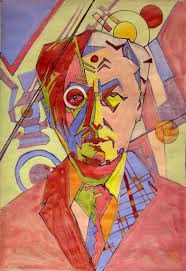
2014-REP-synesthesia.kandinsky2

In 1984 there were six reported cases of synesthesia in the United States.  Today this condition is thought to be more widespread. The following is a small excerpt from a book in progress that deals with cognition and the propensity for Visions. Although synesthesia is certainly not a prerequisite for visions, it is an interesting element that may contribute to the mix.


“Soft colors.”
“Dark sounds.”
“When I hear the name Derek it tastes like earwax.”
“Five. That number is hunter green and it is masculine. Very masculine.”
“The two o’clock sun in January is the metal silver—on the inside of my front teeth.”

 What do all these quotes have in common? They are expressions generated from the minds of synesthetes, people with a condition often known as synesthesia. Neuroscientist David Eagleman notes: “There are many different forms of synesthesia, but what they all have in common is that they represent a blending of the senses.”

If I were seated at a piano and hit a high note then a very low note, which one would you say is brighter? Which one is more heavy?  If you are like most people, the high note is brighter and the low note is heavy.  Brighter is an optical measurement and heavy is a spatial or tactile one; there is no reason why an auditory sound should neurologically excite visual or weight sensations—or is there?  Before we answer that question lets get a better sense of what it is, how it feels, to have this condition.

Take a look at the two figures below and decide which one is “kiki” and which one is “bubbu.”

2014-REP-synesthesia.kikibobo

Research shows that 99 percent of people identify the left figure as “kiki” and the right figure as “bubbu.”  This would suggest a kinesthetic value to spoken or written words. Gobbledygook is defined as language that is meaningless or is made unintelligible by excessive use of abstruse technical terms—basically nonsense. When saying gobbledygook out loud, the actual sound of the word phonetically mimics its definition. “Crash, hiss, buzz” also have this quality, which categorizes these words as onomatopoetic.  Some forms of synesthesia bring this ordinal lingual personification sensation to another level; for example, the letter A might be egotistical, while C is brave. Tuesday is sympathetic, whereas Thursday is driven.  In these cases ordinal lists such as the alphabet, numbers, and days of the week have assigned personalities. There is no sensory consensus between synesthetes, each seems to have his or her own association preferences.

Imagine a clock in front of you. Where would you place North and where would you place South? Most of us would place north at the 12 o’clock mark and south at the 6 o’clock mark, but true north and south are not actually where we place them in this instance.

Ok, now imagine a line in front of you running from left to right.  Where would you place “the past” and where would you place “the future”? Most Westerners assign “the past” to the left side and “the future” to the right side of the line. This is a cultural preference and not globally consistent. Ask a monolingual Mandarin-speaker to do this, and he or she most often assigns past, or earlier, events above the line and later, or future, events below the line. There are cultures that do not have words for left or right, past or future. For them these concepts do not have enough strength to exist in their vocabulary. You can ask some synesthetes, Where is February? and they will say, “At my left elbow.” And March? “At my right shoulder; that’s where it belongs.”  These people have an accelerated sense for spatial preference, referred to as spatial-sequence synesthesia. If outside this present conversation you ask any normal person, Where is February? or Where is March? or Where is August? and they will likely respond,  “Yeah. Uh huh. Ok, have you been taking your medications today?” 

 Many synesthetes are intelligent, well balanced, emotionally fit individuals.

A common form of synesthesia is musical-color, in which people view colors when listening to music or musical scales, harmonies, keys, or percussive timbres. Duke Ellington, for example, stated: “I hear a note by one of the fellows in the band and it’s one color. I hear the same note played by someone else and it’s a different color. If Harry Carney is playing, “D” is dark blue. If Johnny Hodges is playing, “G” becomes light blue satin.” Lexical-gustatory synesthesia is experiencing the sensation of taste that is triggered by specific words, such as exuberant, which might taste like spearmint, or keyboard might taste like dark chocolate.

Nicola Tesla: “When I drop little squares of paper in a dish filled with liquid, I always sense a peculiar and awful taste in my mouth.”

We’ve all heard the statement, “I got the blues,” and for us this is a completely understandable, logical, and sane remark. But does the speaker actually display or have a blue skin color? Usually not. Still, we subscribe to this type of thinking or metacognition. What is curious is how or why this phrase first originated.  Who was the person to initially inaugurate such a phrase, and why did it catch on and become so widely accepted?  There is a common type of synesthesia called grapheme-color where letters or numbers take on certain colors: the number 11 might be yellow or the letter A is red and so on. Each particular association is consistent for the synesthete and does not change. “Synesthesia is involuntary. It happens to you. You can’t make it happen, and you can’t make it not happen.”—Dr. Richard E. Cytowic of George Washington University Medical Center, Washington, D.C.

 What is interesting about number/color synesthesia is that number and color recognition occur in two brain areas that are right next to each other. “The number area and color area in the brain are right next to each other in the fusiform gyrus [part of the temporal and occipital lobes of the brain] and we have now done brain imaging experiments—there’s a paper coming out in the journal Neuron—showing that in normal people when you show [them] numbers, only the number area lights up in the fusiform gyrus. In synaesthetes both the number and color area light up, [and] they spill over across activation of the color region, occurring every time this chap sees a ‘black and white’ number or letter.” (V. S. Ramachandran, All in the Mind interview, 5/7/2005. (Full citation below).

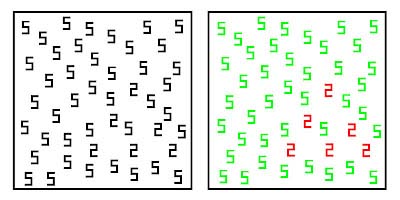
These people are not imagining this; they actually get a color visual when shown a number, as the neurons for color in the fusiform gyrus are firing. A black-and-white matrix, similar to the left frame below, is presented for testing this type of synesthesia.  
2014-REP_Synaesthesia numbers

The frame on the right might be what a verified synesthete would see. In the lab, researchers simply test controlled groups for their reaction time in identifying the ‘2’ formation, using a series of frames in black and white. If a person actually sees numbers as color their reaction time is of course much shorter, or faster—suggesting they actually can see numbers as colors, as in the right frame, where the triangular formation of the 2’s stands out clearly.

Jonathan Hsy, an English professor at the GeorgeWashingtonUniversity, is a verified synesthete. He sees the number 5 as cherry red.  Professor Hsy is also multilingual:

“Speaking from my own experience, it’s not so much that I “see” the letter E as bright lime green in “my mind’s eye,” but rather that “lime-green-ness” is inextricably tied to “E-ness” in my perception. In a similar way, five is inherently bright cherry red, no matter whether or not it’s transcribed as five, 5, or in any other language I happen to know: 五 [Chinese], fünf [German], cinq [French], etc.”  For Professor Hsy all letters, numbers, days of the week, and months all have distinctive colors.

Clinically, synesthesia is a perceptual experience in which stimuli presented through one modality will spontaneously evoke sensations in an unrelated modality.

This condition is present in 1 percent of the population, occurring in varying degrees and modalities. There is an estimated 60 different modalities of synesthesia.

One of the neurologically based theories for synesthesia is that there is more crosstalk between sensory modalities in the brain than normally occur.  This may be related to a neurological maturation process called “synaptic pruning.”

In a newborn, as the brain grows and new information is incorporated, the neurons develop synapses, which transmit information from one neuron to another. As these links are used repeatedly, the neurons develop a sheathing, making them stronger and thereby creating preferred pathways for information to travel. As the infant reaches toddler age, synapses between neurons are “pruned” so stronger neural pathways can transmit signals more efficiently. The synapses most activated in this early growth period are preserved. This process is most prevalent in the early years but continues to a lesser degree as life goes on. If this pruning mechanism were less diligent, more crosstalk might occur between different brain areas; this is one theory for the explanation of synesthesia, which brings up another question: Are all toddlers or babies synesthetes?  It probably won’t be long before we have that answer, as synesthesia is being researched and published in fifteen countries at this writing. The Oxford Handbook of Synaesthesia (2013) contains over a thousand pages. Compelling evidence suggests that synesthesia is genetic.

“Loud shirt.” “Sharp cheddar.” “Soft moonlight.” “Cool jazz.” “Use Exxon Gasoline. Put a tiger in your tank!”  Is metaphoric cognition a fragmented form of synesthesia inherent in the human condition?  Are dream formations, synesthetic echos?  Is there an evolutionary cognitive value for synesthesia?  Was this ability at one time more prominent in human beings? The following is taken from the Rig Veda 1.164,  “The Asya Vamasya Hymn”: 

“Speech was divided into four parts that the inspired priest knows.
Three parts hidden in deep secret, humans do not stir into action;
 the fourth part of Speech is what men speak.”
“Let him that really knows proclaim here the hidden place of that beloved bird.
The cows give milk from his head; wearing a cloak, they drank water with their feet.”


by Michael McIntyre


Sources used and for further information:

Richard E. Cytowic: “Wednesday Is Indigo Blue: Discovering the Brain of Synesthesia,” Music and the Brain series, Library of Congress podcast, October 30, 2009. http://loc.gov/podcasts/musicandthebrain/podcast_richardcytowic.html.

V. S. Ramachandran, interview with Natasha Mitchell, “The Marco Polo of Neuroscience: V.S. Ramachandran,” All in the Mind, Australian Broadcasting Corporation, May 7, 2005. http://www.abc.net.au/radionational/programs/allinthemind/the-marco-polo-of-neuroscience-vs-ramachandran/3440754#transcript.

David Eagleman, interview with Natasha Mitchell, “The Afterlife, Synesthesia and Other Tales of the Senses,” All in the Mind, Australian Broadcasting Corporation, June 20, 2009. http://www.abc.net.au/radionational/programs/allinthemind/david-eagleman-the-afterlife-synesthesia-and-other/3141400.

Alison Gopnik, “What Do Babies Think?, TED Talks Radio Hour, July 2011. http://www.ted.com/talks/alison_gopnik_what_do_babies_think.html.

Radiolab Podcasts, “Colors,” Season 10/Episode 13. http://www.radiolab.org/story/211119-colors/.

PubMed.gov also offers a library of clinical research on synesthesia.


© 2014 Michael McIntyre


ADVOCATES FOR HUMAN SPIRITUAL RIGHTS: Nestorius, Part 5


*

When therefore I had seen that these things were brought to pass by God, would you have wished that I should be silent and hide such a dispensation of God as all this? . . . The prophets of God, who had been cursed as lying prophets by lying prophets . . . would not have been distinguished, unless they had consented to be cursed by lying prophets for the sake of God.
– from The Bazaar of Heracleides

Mar Dinkha IV (2008)

Mar Dinkha IV (2008)


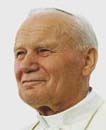
John Paul II (1993)

John Paul II (1993)

The entire dramatic action of the Nestorian controversy played out over fifteen centuries on several continents and reached an inglorious conclusion as a footnote of 1994. In that year, the modern representative of the Syriac Church, Mar Dinkha IV, Patriarch of the Church of the East, signs the “Common Christological Declaration” with Pope John Paul II of the Roman Church. The declaration does not mention Nestorius by name but does vindicate the term Christotokos by both churches. In addition, the Holy Synod of the Church of the East unilaterally decides to remove from its liturgical books and official publications all negative references to Cyril, who had been canonized a saint by the Western Church.

* * *


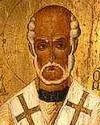
Nestorius, Patriarch of Constantinople

Nestorius, Patriarch of Constantinople

The writings of Nestorius, originally very numerous, were condemned to be burned by imperial edict in 435. The few works of Nestorius that are extant are the product of or derived from his engagement in the ecclesiastical polemics of 428–431: fragments of letters preserved among the works of those to whom they were written, some sermons collected in Latin translation by an African merchant doing business in Constantinople during the time of the dispute, a liturgy attributed to him that is still used in the Church of the East for five days of the year, and a pseudonymous and autobiographical account of the whole difficulty supposed to have been written by him (The Bazaar of Heracleides) and which was preserved in a single mutilated manuscript of styleless Syriac translation for several hundred years in a monastery in the Euphrates valley. In the fourteenth century, in addition to these, a collection of letters and a collection of homilies were still extant. They have since been destroyed in wars and natural catastrophes. The writings of the teacher of Nestorius have suffered a similar fate. Theodore of Mopsuestia, hailed as a great orthodox biblical scholar and theologian during his lifetime, was condemned as a heretic more than one hundred years after his death (at the fifth general council under the influence of Emperor Justinian in 553) because he was perceived to be a precursor of the heresy of Nestorius. From that time, even his name disappears in the West; and of the Syriac translations of his work, which once filled forty-one tomes, today only one remains.

Robert Petrovich
October 2005


ADVOCATES FOR HUMAN SPIRITUAL RIGHTS: Nestorius, Part 4


But I have endured the torment of my life and all my fate in this world as the torment of one day and lo! I have now already got to me the time of my dissolution, . . . [and mine] eyes have seen the salvation of God.
– from The Bazaar of Heracleides

Exile

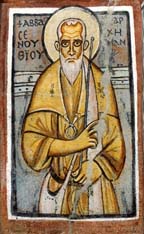
Schenoute I

Schenoute I

 In August 435 an imperial edict proscribes the writings of Nestorius and any meetings of his followers; Nestorius himself is dragged from retirement and banished to Petra in Arabia; a second decree sends him to the Great Oasis in the Libyan desert, known now as the Oasis of Kharijah. How Nestorius spends the remainder of his days is somewhat uncertain, but we know that at some point he is carried off in a raid by either Nubians or the Blemmyes and set free again circa 450 in the Egyptian Thebaid, with his hand and one rib broken. Nestorius gives himself up to the governor at Panopolis in order not to be accused of having fled, and then, there in the desert inhabited by thousands of orthodox monks and nuns in a city of monasteries, his persecution continues at the hand of Schenute (Shenoudi), the hero of the Egyptian monks, appointed by Cyril in 431 to act as archimandrite at the council that condemned Nestorius. In Panopolis Nestorius dies, still defending his doctrinal position. It is there in Egypt, probably during the final year of his life, that Nestorius writes The Book of Heracleides of Damascus (mistakenly translated into Syriac as The Bazaar of Heracleides), a pseudonymous defense of his teaching and a history of his public life.

Council of Chalcedon (October 8–25, 451)
After the death of Nestorius’s principal antagonist, Cyril, in 444, the ecclesiastical balance of the Imperial Church suffers another turn of events. At the so-called Robber Council of Ephesus (449), Cyril’s successor in Alexandria deposes the Bishop of Tyre, who was once a friend of Nestorius, and the Bishop of Edessa, who is known in his city as a great teacher, together with the Bishop of Cyprus and the new Bishop of Antioch, the nephew of John. Two years later, the new empress, the older sister of Theodosius II, succeeds her brother after his early death in a horse-riding accident and summons a council to meet at Nicaea. When the Hunnic invasion of Rome that year prevents the imperial representative from reaching Nicaea for fear of the Huns in Illyricum, he orders the bishops to move the council to Chalcedon. This council endorses a letter written by Leo, the new Bishop of Rome, in which he uses the term “Mother of the Lord”— somewhat as Nestorius had originally wished. At this council, the Bishops of Edessa and Cyprus both take the view that Leo’s Roman perspective helps rehabilitate Antiochene theology, and both bishops are restored to their sees. If we may believe the final pages of The Bazaar of Heracleides, Nestorius too rejoices at this reversal of Roman policy from the perspective of his exile during the last days of his life.

Missions East

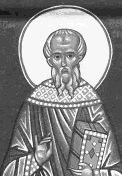
Theodore of Mopsuestia

Theodore of Mopsuestia

 In the Syriac-speaking world of the fifth century, Theodore of Mopsuestia was held in high esteem, and the condemnation of his pupil was not well received. After the deposition of Nestorius, whose doctrines had been theirs since the first century, a Great Syriac Church built up, and the Sassanid Persian kings, then at war with Byzantium, used the opportunity to assure the loyalty of their Syrian Christian subjects by supporting the division between the churches of the East and West: They granted protection to the adherents of Nestorius (462); they executed the pro-Byzantine Catholicos and replaced him with the bishop of the Persian city of Nisibis, Bar Sauma (484); and when the Byzantine emperor closed the school of Edessa for its heretical tendencies (489), they allowed the transfer of the school to Nisibis. After 489, the Church in Persia, which then called itself Chaldean, practiced an autonomy like that of the old eastern patriarchates. They did not accept the Councils of Ephesus and Chalcedon, and the great doctor of their school was Theodore of Mopsuestia. From the monastery of Beth ‘Âbh in Mesopotamia under the Sassanids, many missionaries traveled east into Asia from the sixth through the eighth centuries, even reaching China in 635.

Monastery Beth 'Abhe

Monastery Beth ‘Abhe


ADVOCATES FOR HUMAN SPIRITUAL RIGHTS: Nestorius, Part 3


Every one, of whatsoever city it may be, who has suffered therein on my account, would not be giving light, even as the sun, if I had looked towards my accusers and not towards God and if also I had not been deemed worthy to be given a share in those things . . . brought to pass by God; for this affair is not mine but Christ’s who made me mighty.
– from The Bazaar of Heracleides

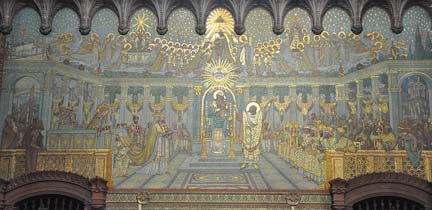
Representation of the Counceil of Ephesus 431, at the center Cyril of Alexandria shows the image of the infant and Mary, proclaiming her divine maternity. Image from the Church Notre-Dame de Fourvieres, Lyon, France

Representation of the Counceil of Ephesus 431, at the center Cyril of Alexandria shows the image of the infant and Mary, proclaiming her divine maternity. Image from the Church Notre-Dame de Fourvieres, Lyon, France

The Council of Ephesus (A.D. 431)
Soon after Pentecost, the bishops and imperial officials assemble at Ephesus. Only the famous Augustine of Hippo and the other bishops of North Africa are indisposed to attend, owing to the Vandal invasions of their territories. John of Antioch, held back by circumstances surrounding a drought in his territories, sends the message that he hopes to arrive in several days and not to wait for him to convene the council. Cyril and his followers, with the support of the Bishop of Ephesus and the populace of Ephesus, assemble in the Church of the Theotokos. Nestorius is summoned but refuses to attend until all the bishops are assembled. With the Gospels placed on the throne to represent the presence of Christ, Cyril proceeds to open the first session without delay. Creeds and letters are read at the first session. Cyril’s letters are received with acclamation, those of Nestorius with anathemas. The council deposes and excommunicates Nestorius. When John of Antioch and the bishops of the East arrive four days later, they immediately hold council to depose Cyril and excommunicate all those who will not repudiate Cyril’s twelve anathemas. Three days later, an imperial rescript arrives that rebukes Cyril for his haste and commands all the bishops to await the arrival of an imperial commissioner. Cyril continues the council anyway. Rome’s legates arrive and give their support to Cyril at a second session. During the fourth session, John sends the message that he refuses to have anything more to do with Cyril and his supporters.

In August, the imperial commissioner arrives. He deposes and arrests Nestorius, Cyril, and the Bishop of Ephesus; he also tries to persuade the Cyrillians to confer with the bishops of the East, who have drawn up a formulary of reunion, but the Cyrillians refuse and continue to stir up the clergy of Constantinople with their appeals. On September 11, the emperor receives seven delegates from each side at Chalcedon, but no agreement is reached. The emperor dissolves the council, sends Nestorius back to his former monastery at Antioch, per his request, and orders the consecration of a new Bishop of Constantinople, who proceeds to depose those bishops who continue to adhere to Nestorius. After the rival parties go home, Cyril is released from prison and, in October, arrives at Alexandria in triumph.

Rome, in exchange for the vote to depose Nestorius, gets Pelagius condemned by an ecumenical council and wins greater prestige in the East because Cyril, going over the head of the emperor, had appealed to the Bishop of Rome; in exchange for the vote to condemn Pelagius, the Alexandrians get Nestorius deposed, as well as Cyril’s explanation of the incarnation canonized over the doctrine of Nestorius.

The Reconciled and the Irreconcilable
In spring 432, the emperor suggests as a basis of reconciliation that the East give up Nestorius and that Cyril give up his twelve anathemas. By autumn, John of Antioch and a few others go ahead with the reconciliation; some waver; and others, like the Bishop of Hierapolis in Syria, stand out. Those for reconciliation send to Alexandria an envoy who brings the Formulary of Reunion and other propositions; when the envoy arrives, John is pressed to accept the deposition of Nestorius, whereupon he is received into communion at Alexandria and admitted to preach there on Christmas Day as an orthodox bishop. In 433 John and Cyril sign the Formula of Reunion, and it is ratified by the emperor. After this action is taken, whoever wishes to be part of the catholic and orthodox Imperial Church must, in their thought and speech, avoid denying the humanity of the rational soul of Christ and at the same time avoid dividing his two natures into two persons. Some bishops of the East acknowledge the orthodoxy of Cyril but refuse to accept the deposition of Nestorius; others denounce both. The following year, Proclus, the old adversary of Nestorius, is consecrated Bishop of Constantinople, and the emperor orders all bishops of the East to abandon their resistance to John and Cyril. Many obey, but eighteen are deposed; they are banished to the mines of the Egyptian Thebaid, as persecuted Christians in the Roman Empire had been since Diocletian.