Gallup Poll Reveals 9 in 10 Americans Believe in God

A Gallup poll released in early June 2011 reveals that the people of the United States remain extremely religious, unlike Canadians and Europeans. Read the article on the results of the poll online at Salon.com.


Post submitted by Roger Weld


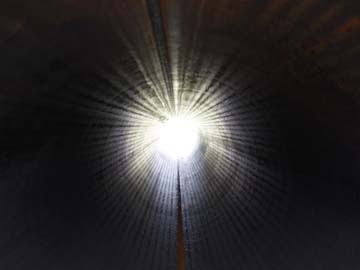
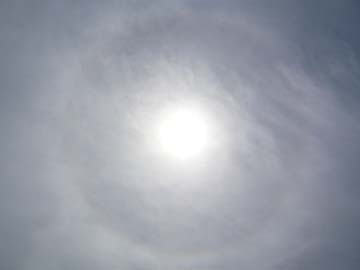
NASA Video of the June 7th 2011 Solar Flare

The NASA video of the June 7, 2011, solar flare appeared online on the NASA government mission pages under sun/earth news. The 60-second video is an amazing view of the solar flare.


Post submitted by Elizabeth Reece


New Film Release: Eat the Sun


Award-Winning Documentary "Eat the Sun" DVD Release: May 11, 2011

Award-winning and controversial documentary film Eat The Sun debuts Tuesday, May 11, 2011, on DVD with a Documentary Channel Broadcast Premiere to follow on Summer Solstice (June 21) at 8 pm. The film will also release on iTunes, on VOD and in specialty retailers later this summer.

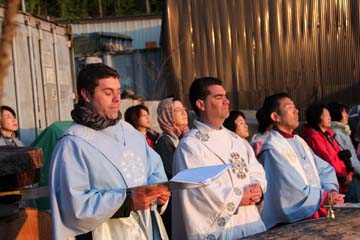
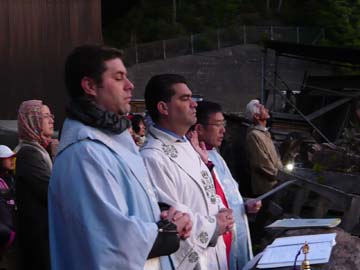
The film features major footage on the International Community of Christ, including clips of Sunrise Divine Service and interviews with Church members and leaders. DVD bonus features include an extensive interview with Bishop Gene Savoy Sr., one of the last filmed interviews he gave.

Street Date: May 11, 2011
UPC: 812616022327
SRP: $24.99
Website: www.eatthesunmovie.com
Directed and Produced by Peter Sorcher
Co-Produced by Diana Iles Parker

The film Eat the Sun is featured in an article on Cosolargy.net. The article contains links to the film trailer and to a film excerpt on Gene Savoy. To read more about the film on Cosolargy.net, click HERE.

To read more about the film on Shootonline, click HERE.


Journey of the Rising Sun

submitted by Frank Gadson (Adonistar)

Visiting the Cosolargy Center in Japan. Pictured from right to left, Miyuki Okayama, Yaeno Sanada, Frank Gadson, Koshu Kawahara, Eriko Ueno. PHOTO Frank Gadson

My Japan visit started in January 2011 when I landed in Okinawa to stay with family and continue my studies and transformation. Taking time off from my career as a recording artist and performer, I spent my days studying Cosolargy texts, researching, and writing a book on human spirituality.

When I joined the Jamilian University of the Ordained, I was told that the one and only other Cosolargy Center was in Japan. Unfortunately I was in Okinawa, which is an island an hour and a half away from mainland Japan, so a visit there was seemingly not in the future for me.

After a few months of steady focus on studying and writing, I decided to slowly start performing again. I was introduced to an event promoter, and he quickly booked me to headline a festival in Fukuoka (on mainland Japan) on 22 May 2011. I then found out that the Japan Cosolargy Center was in Kurume, which is a 30- to 40-minute drive from Fukuoka! “Wow!” I thought, how amazing is that!” The moment I decide to go back to work, I’ll have a paid flight, accommodations, and get paid a wage, all while being inches away from the destination that I wanted to visit most. This for me was nothing short of amazing.

Poster for the Sun Splash Festival in Japan where Adonistar (pictured upper right) was headlining the show.

I then found out that the Cosolargy tour in Japan was ending right around the dates I would be in Fukuoka. What perfect timing. It means they will definitely be back from their journey with lots of excitement and stories to tell.

After being put in touch with a contact at the center, the date was set. I would have a meet-and-greet along with a site visit to the center the day after my performance; the perfect end to my trip. This was adding the extra excitement I needed to power through my performance. I had never met another member face to face. This was my chance to feel the comfort and joy of standing next to people who experience the same beauty I do and knowing they fully understand.

When the morning finally arrived, I woke early to make sure all was packed and I was ready to meet my contact, Miyuki, who was coming to pick me up at my hotel. What a blessing! I didn’t even have to make my own way to Kurume.

When she arrived, I was greeted with a smile and felt so at ease in her presence.

On the journey, we immediately started talking nonstop, like two friends who hadn’t seen each other for a while. Question after question, sharing our Cosolargy journey and experience with each other was such a delight. She has a wonderfully Loving spirit.

We pulled into the parking lot where the center was located and started up the stairs to the top floor. I was following slowly behind her, but inside I was running up those stairs like a racehorse heading for the finish line. I entered the room, and the next bright spirit greeted me with a smile. The energy in the room was so peaceful and comforting. Then one by one another member would arrive and greet me with Love and inspiration. I felt like a kid in a candy store of happiness.

All four women, one man, and I sat around a table in the meeting area, and I was handed a guestbook to sign my name. Much to my surprise, I saw the names of Gene Savoy Jr., Sean Savoy, Jamila Savoy, and a few others that were there recently for the Japan tour. I looked up at them with the face of “You don’t seriously expect me to sign my name on this page do you?!” They smiled and said, “You are the first visitor we’ve had besides the bishops and their family and the highly ordained.”  I jokingly began to turn to a new page for beginners who are only six months into their studies, but they of course said, “No, sign right here on the same page.” Needless to say, I was honored, and quickly pulled out my camera to document the occasion. As we talked and had tea and other snacks, Miyuki showed me pictures of the Japan tour with the bishops and all the others. It seemed they’d been to many places in a very short time. But it all looked very beautiful and enlightening.

Guest book at the Japan Center with signatures. PHOTO Frank Gadson

My mobile phone soon rang an alarm informing me of different scheduled tasks I have in my day, and I showed Miyuki, saying, “Normally for me it’s yoga time.” They said, “Yoga time? Yes, let’s do it! We will do some now, too.” The next thing I knew I was standing in the sanctuary section of the center, and we all were there together and did some breathing and a few yoga poses. How awesome was this! The members stood right there with me and joined in on what I’m normally at home doing alone. That’s when it really hit me that I’m definitely in the right place, and this is my Community. An Essene prayer that I say daily began to stream through my mind:

… As for me I have known thy immense goodness and I have sworn an oath, not to sin against thee nor commit any evil in thy sight. Thus have I been brought into the society of the members of my community. Yea, according to their understanding I bring them in, and according to the inheritance (of your Grace) I Love them. …

After that, we began to play the singing bowls together. Enjoying the sound of Loving energy that we each created and transferred as we played. It was fabulous.

A view of the Cosolargy Center in Japan. PHOTO Frank Gadson

I also was given a 2011 Cosolargy calendar as a gift from them, which keeps me informed of Sun and moon cycles, special holy days, and much more.

I would just like to add the embarrassing fact that I had arrived in Fukuoka on Thursday the nineteenth and had had to rehearse with a band that had never played my material before, every day for 3 to 4 hours and then did the show that Sunday. So by that Monday afternoon I barely had any voice left. Here I am telling them I’m a singer and I can’t even speak! I was so hoarse and felt bad. But they of course laughed it off and made me feel comfortable.

We then went to lunch at a restaurant that they knew would accommodate my vegan diet. As we waited for a table, out of the seating area, just finishing their food, was a new Consociate that had joined their very rapidly expanding center. We were all very delighted at yet another warm coincidence. Our lunch was perfect. We enjoyed every bite. And after the meal they refused to let me pay. They picked up the tab and expressed yet again how happy they were for the visit.

We then said our good-byes, and Miyuki drove me all the way back to the airport. This was an ironically perfect place for me at that moment because now I would physically be in the clouds where my consciousness already was all day.

I recommend anyone who has the ability to travel to Japan for a visit to our only other site on the planet to do so. You’ll meet some of the most beautiful spirits in our Community, and they too will be uplifted by your presence.


“Physics and the Immortality of the Soul”


The Dirac equation: how electrons behave in the everyday world in relation to electromagnetism and gravity

In this guest blog published in Scientific American on May 23, 2011, physicist Sean Carroll shares his thoughts about the soul and modern physics. Here are some of his questions and conclusions:

“Does the soul respect gauge invariance and Lorentz invariance? Does the soul have a Hamiltonian? Do the interactions preserve unitarity and conservation of information?

“Nobody ever asks these questions out loud, possibly because of how silly they sound. Once you start asking them, the choice you are faced with becomes clear: either overthrow everything we think we have learned about modern physics, or distrust the stew of religious accounts/unreliable testimony/wishful thinking that makes people believe in the possibility of life after death. It’s not a difficult decision, as scientific theory-choice goes. . . .
“There’s no reason to be agnostic about ideas that are dramatically incompatible with everything we know about modern science. Once we get over any reluctance to face reality on this issue, we can get down to the much more interesting questions of how human beings and consciousness really work.”

We invite you to read the article “Physics and the Immortality of the Soul” online and share your comments with us. You may even want to share them with the readers of Scientific American in their comments section.


Post submitted by Frieda Nelson


FROM THE ARCHIATOR: More Protection from Radiation


Dr. Thomas S. Lee, NMD, APH

Dr. Tom Lee, Church Archiator, has submitted for publication the following open letter from dairy farmers on the Big Island of Hawaii that shares some solutions for working with radiation problems in milk. This letter augments the suggestions Dr. Lee made in his April 8, 2011, letter, published in the Communiqué.


Boron PHOTO hawaiihealthguide.com

Dear Milk Share Members,

Our goal to offer high quality, safe food to our community has recently been challenged by the reality of the radioactivity being released into our environment [by the Japanese disaster]. In the past weeks radioactive levels have increased in Hawaii, with high spikes and a more current leveling off of radiation levels. Milk from the large dairies in Hamakua and Hawi has shown elevated levels of radiation, from 400 to 2400 times the recognized safe levels.

Why is milk contamination significant in the world of agriculture? Because milk represents the overall condition of the entire food chain, since cows consume grass and are exposed to the same elements as crops. So, when milk tests positive for radiation, it indicates the entire food chain is contaminated. When grass is contaminated everything grown in the same soil is contaminated. This has proposed a serious concern to us farmers, with us asking what can we do? After much consideration, research, and conversations with much appreciated experts in the field of biological farming and human & animal health, we have found some things which we are able to do to protect our soil, animals, and bodies.

Aside from the much recognized supplement potassium iodine as a protection against radioactive iodine, there are a number of ways we can help. We have remembered our friend, elemental boron and the position it plays on the earth. Boron is the only mineral capable of accepting and ionizing radiation that never changes the innards or the nucleus of the cell. Spoken simply, boron can take radiation and release it without upsetting its own very delicate balance.

Boron is used extensively in the nuclear industry. Sodium borate is regularly used for standby liquid control systems, in case of emergencies. It was used in Cheronbyl in 1986 mixed with sand to prevent further radiation leakage. It was also used in 1999 in Tokaimura, Japan, to absorb the massive amounts of radiation after an accident at a plant. Currently it is being dumped on fuel rods and in surrounding waters of the Fukushima plant. Boron is widely recognized as extremely safe and can be used to capture radioactivity on our soils, gardens, orchards, etc. It also can be safely ingested by humans and animals. Boron will accept radiation and ionize it within our bodies, after which our bodies will safely excrement the boron and radioactivity.

We have begun feeding our cows and goats sodium borate at milking times, as well as adding it to free choice kelp and water troughs. In the past years we have monitored boron and other minerals in the soil and have added as necessary to bring levels up to recognized healthy levels. As a safety measure we are planning to implement a boron dosage to all of our pastures, as well as neighboring pastures. For humans, boron can safely ingested at a dosage of 4-10 mg per day. Borax, 11{1fa2ef75e2e78439128d99df03acfe1d8ee3047374abe3d4676fe3470ff8b909} boron, can be used as a tea and sprayed on your gardens, or land surrounding your home, at a rate of 10# of Borax per acre, 1#, if using elemental boron. Borax can also be ingested at 1/8 tsp to 1 litre water for women, ¼ tsp to 1 litre water for men. Fortunately, red wine and coffee are significant sources of boron, as well as non-citrus fruits, red grapes, plums, pears, apples, avocados, legumes and nuts! Boron is known to be non-carcinogenic, non-mutagenic and has been used internally to protect the astronauts in space as they leave the earth’s protective magnetic field.

Other things we can do to protect our bodies are to consume zeolites, use potassium iodine, receive plenty of glutathione, the best source of which is whey!, eat plenty of supergreens, such as kale, but including chlorella and spirulina, maintain healthy mineral levels, and eat lots of good healthy fats, including raw butter, and coconuts, which offer a fantastic layer of protection for our cells. Baking soda has been known to diminish the severity of change produced by uranium to the kidneys, which are the first to show radiation damages of uranium. Dosage is 1 tsp to 8 oz water for adults and ¼ tsp in 4 oz water for children.

According to Cheryl McCoy, Aboutclay.com, Calcium Bentonite Clay acts as a magnet absorbing anything with a positive charge, ie radiation and toxicity. She suggests washing all produce which may be considered radioactive in 1 part clay to 8 parts water in a non-metallic bowl, soaking for 10 minutes, then rinse and dry as usual. Bentonite clay can be added to catchment tanks, drinking water or raw milk to isolate radioactivity, which will not be released once captured by clay. Also, the body cannot digest clay, but will rather release clay through excrement. Clay can be added to milk or drinking water at a dosage of 1 oz liquid calcium bentonite to 1 gallon raw milk or drinking water. Either allow to settle and pour off or mix and consume clay and liquid. 1-2 oz liquid bentonite clay can be safely consumed per day by an adult, with significant detox abilities.

In these tenuous times it is all we can do to be honestly informed of the situation at hand and act accordingly. We are doing our best to protect our soil, animals and bodies from the elevated levels of radioactivity, and hope that you will also. Our prayers and blessings are with the farmers and families closer to the source of radioactive pollution. We send them our love and hopes for a green, safe future for all on this earth.

Blessings,

Britton & Shekinah
Milk and Honey Farm
Pahoa, Big Island Hawaii


THE LUMINOUS TEACHING STONE OF CHINA: The Stone Itself, Part 1: Supplements

SUPPLEMENT 1: FATHER ADAM (CHING-CHING 

The same monastery that Emperor T’ai-tsung built for the sturdy Persian “monk of great virtue” A-lo-pen in A.D. 638 was, at the end of the next century, the probable home of the monk Ching-ching, translator of books and in A.D. 781 the author of the monument’s inscription that commemorates the emperor, the monk, and the erection of the monastery itself. Ching-ching, also called a “monk of great virtue,” we know only from his Syriac epithets on the monument (“Adam, priest and country-bishop and papas of Zinistan”), a single allusion to his mission of translation in Chinese historical records, and the chiding remarks of a peevish Buddhist chronicler who accused him of vainglorious translation of the Buddhist Satparamita Sutra. Ching-ching, like A-lo-pen, is called a Persian, whether because of his race or religious party adoption, we do not know.  
SUPPLEMENT 2: MAR IAZED-BUZID (I-SSU 

With the exception of Ching-ching, historic memory confers identity on those who raised the monument nowhere but on the stone itself. This is true even of Iazed-buzid, the lavishly praised donor of the stone. The final paragraph of the inscription and the three imperial titles found there, substantiate the official life of Iazid-buzid under his Chinese name, I-ssu; his first year of faithful service at the court and the consummation of that service when he signed the imperial book to pledge himself a loyal subject, the generosity and fiery influence he balanced between the Uighurs and the Chinese Empire on the battlefields of the Northern Region in loyal personal service to the martial governor Kuo Tzu-i, the distinguished sweep of civil activities he carried out in high court circles, and the social privilege and repose conferred upon him by the Confucian honor of imperial service.  

SUPPLEMENT 3: THE ODE  

The ode of the inscription is composed in much the same form as the earliest attempts of Chinese poetical composition — lines consisting of four words that form, because of the nature of the language, four syllables. The first seven stanzas of the ode are composed in this form, which was called at the time “ancient” or “ballad” style. Of these seven stanzas, all but the second stanza is made of eight lines; the second is made of ten lines.  

The Chinese name for regular syllabic verse of this kind (2+2=4) is shih. As early as the time of Confucius (Chou times, circa 1027–256 B.C.) a collection of poetry called Shih had become part of the common heritage of all educated Chinese. Subsequently called the Shih-ching (“The Book of Songs”), the book is generally conceded to be the greatest single literary monument left from China’s formative age. No work is cited more regularly in later Chinese literature of all sorts. Several of its phrases appear here and there even in Father Adam’s composition.  

Most of the poems in The Book of Songs are in four-syllable lines, but there are instances of odes where stanzas of different lengths are mixed together, as they are in Father Adam’s ode. In the ancient poems there is no prescribed standard for meter and rhyme, although these were considered to be the essential poetic elements. Meter was considered to be no more than a syllabic measure on which other prosodic features could be ordered, and rhyme occurred in many patterns. The most common rhyme scheme, abcb, with the last words of the second and fourth lines rhyming, is the rhyme scheme Father Adam used to give the inscription’s ode its conventional antiqued finish.  

Composition in the ancient four-syllable meter continued for more than a thousand years, until the first centuries after Christ, when two new forms appeared. Probably from “below,” that is to say, from the songs and dances of professional girls, these new forms became not only respectable but the chief classical meters of all later Chinese poetry. Instead of the ancient syllabic measure 2+2=4, the new measures used the idea of a fixed but asymmetrical caesura. Father Adam imitated the most common of the two in the final stanza of his ode. The measure of its lines is 4+3=7.  

From 2+2=4 to 4+3=7 is a direct line of evolution, from the shih-form of The Book of Songs to the shih-forms of T’ang times, and Father Adam, a better historiographer than a poet, perhaps attempted to indicate this evolution in the shape of his verse. The lines are short by our standards but suited to the kind of poetry they helped to develop in succeeding centuries, culminating in the poetry of T’ang — a poetry that is light but strong as steel, concise but vivid. Nearly all of Tu Fu’s poems were written in this metric form. The measure of seven words is well adapted to the language and was preferred above all others up to the end of the nineteenth century.  

James Legge, the eminent sinologist and translator of the ancient Book of Songs, had this to say about the verses composed for the churchmen by Father Adam: “Of their eulogistic verse I do not need to say anything. . . . They give us no information beyond what we have in the two preceding parts of the Inscription; and the sixty-six lines of which they consist do not seem to me to possess, as Chinese verse, any remarkable merit.”  

SOURCES  

Florence Ayscough. Tu Fu: The Autobiography of a Chinese Poet. Vol. 1: A.D. 712–759. Boston & New York: Houghton Mifflin, 1928.  

Arthur Cooper, translator. Li Po and Tu Fu. Penguin, 1973.  

Charles O. Hucker. China’s Imperial Past. Stanford, CA: Stanford University Press, 1975.  

James J.Y. Liu. The Art of Chinese Poetry. Chicago: University of Chicago Press, 1962.  


SUPPLEMENT 4: LU YEN  

More than 1,750 Chinese characters were carved with supreme skill for Ching-ching (Father Adam) by the Chinese official Lu Yen. They are still in a state of splendid preservation; only two of the characters are in bad repair.  

The beautiful hand of the Chinese Consociate Lu Yen, though noticeably young, has been quoted as a model of good form in Chinese cursive style since the stone’s discovery in 1623, even in the abnormal form of some of its characters. Yet the Chinese records cite the name Lu Hsiu-yen nowhere else among calligraphers.  

If we accept the suggestion of more than one mystic sinologue, however, this Lu Yen is this same Lu Yen who, several years after the inscription was written, gained renown as a poet and calligrapher, and as the founder of the Taoist Chin-tan-chiao (Golden Pill of Immortality Teaching) who received, however partially, the knowledge of the Apostle Thomas that was transmitted seven centuries before to the enlightened schools of China.  

SUPPLEMENT 5: PROFESSOR P.Y. SAEKI  

Dr. P.Y. Saeki

Professor Peter Yoshiro Saeki (1871–1965) was a Japanese scholar of religion and law, who wrote, in his second language of English, several important books on the Church of the East, the so-called “Nestorian” Church, in China:  

The Nestorian Monument in China  

The Luminous Religion: A Study of Nestorian Christianity in China, with a Translation of the Inscription upon the Nestorian Tablet  

Nestorian Documents and Relics in China.  

Catalogue of the Nestorian Literature and Relics  

In 1962 he received an honorary doctorate from Waseda University in Tokyo.  

SUPPLEMENT 6: THE KUMBIRA  

Monument headstone

These two monstrous creatures inscribed on the monument are known as the Kumbhira. In his book The Nestorian Monument in China, the erudite Japanese sinologist P.Y. Saeki tells us that this Kumbhira design was quite common among Buddhists at the time and cites two examples: a monument at Seoul in Korea (illustrated in volume 1 of Mrs. Bird Bishop’s Korea and Her Neighbors) and the ceiling in the former throne-room in Keum-chying.  

Korean Turtle Stone

Mrs. Bird Bishop, after enumerating the main sights of the city of Seoul in a passage of her 1897 book, describes the setting of the monument at the center of the city, near the great bronze bell that has opened and closed the gates of the city for five centuries, and near the grand triple gateway of the Royal Palace, where there remained in Mrs. Bird Bishop’s time a partially dismantled seven-hundred-year-old Marble Pagoda:  

Every part is carved, and the flat parts richly so, some of the tablets representing Hindu divinities, while others seem to portray the various stages of the soul’s progress towards Nirvana. The designs are undoubtedly Indian, modified by Chinese artists, and this thing of beauty stands on the site of a Buddhist monastery…. Not far off is another relic of antiquity, a decorated and inscribed tablet standing on the back of a granite turtle of prodigious size.  

The illustration in her book shows the head of the stone at Seoul to be similar in design to the head of the Luminous Teaching Stone in China (See diagram above). And, like the tablet at Seoul, the Luminous Teaching Stone was mounted on the back of a granite tortoise, called by the Chinese a “fair pedestal,” when it was found by the Danish explorer Frits Holm in 1907. (Isabella Bird Bishop, Korea and Her Neighbors. New York: Fleming H. Revell, 1897.)  

Professor Saeki continues his explanation of the design with a quote from the Amitayussutropadesa or “Pure Land Sastra” to show that, to sixth-century Buddhists, the pearl signified the Law of Buddha.  

SUPPLEMENT 7: PISTIS SOPHIA  

In the Gnostic miscellany commonly called the Pistis Sophia, the form of the dragon figures as one of the emanations of the Authades, the powerful, disobedient archon of the thirteenth aeon who wished to lord over the whole thirteenth aeon and all those aeons beneath it. It is this archon who afflicted Pistis Sophia by surrounding her with material powers and swallowed her Light until she became like a counterfeit spirit filled with chaos. The region of the great dragon is identified as the outer darkness, and to dwell in the midst of the dragon is the punishment of the unrepentant and those who abandon the True Teachings of the First Mystery.  

Through the collection of episodes in the book, the narrator, Jesus, tells the story of his Light vestures and his coming down through the aeons into the physical realm. In the thirteenth aeon he meets with the spiritual being Pistis Sophia, who longs to reach the higher region of the Treasury of Light and praises the Regions of Light. At this point in the narration, prompted by a question Mary asks on the nature of Pistis Sophia, Jesus goes on to tell the story of her afflictions; the hatred held for her by the archons of the lower aeons, who joined together to torment her because she had ceased in their mystery and now longed for the Light above her; her repentance for the delusion that had led her to mistake the specious resemblance of the godlike, self-willed power of the Authades for the Light in which she had faith; and her final deliverance. (Pistis Sophia, trans. G.R.S. Mead. 1836. Reprint by John M. Watkins, London, 1963.)  

SUPPLEMENT 8: THE NINTH ACT OF THOMAS  

The Ninth Act of Thomas contains a song poetically attributed to the Apostle Thomas, the Apostle most highly regarded among Gnostics and the adherents of the Church of the East. The song tells the story of a primordial angelic being commissioned to retrieve the pearl, which is lost and guarded over by a roaring dragonlike serpent in the regions of outer darkness, in the dark sea of the world. By order of his Father, the immortal Child (the singer of the song) is divested of his divine raiment and the purple toga woven to fit him and sent away from his Father’s house with the promise that when he returns he will resume his divine raiment and become heir to the Kingdom together with his elder brother. Bearing abundant wealth from the Treasury of Light, the Child is accompanied by two guardians who guide him down the dangerous and difficult way to the dark regions and leave him at its borders. The Child moves straight to the serpent’s abode and settles down there to wait until the serpent sleeps, so that he might then take the pearl. Once in the vicinity there, he meets a noble youth of his own kind whom he warns of the dangers of the dark regions and with whom he associates and shares his wealth. The Child disguises himself in local dress to wait, but the locals find him out, and with their food they drug him into service of their king and the forgetful sleep of human life. His Father and the Angelic Host perceive his forgetfulness and together send the Word in a sealed message that speaks to the earthbound Child and arouses him from his sleep. The Child remembers the pearl and his commission. Then, charming the serpent with the name of His Father and Mother, he snatches away the pearl, casts off his mortal coil, and returns home along the Way led by the Word. When he is offered his colorful and luminous heavenly garment, whose design and brilliant colors he no longer remembers, the Child recognizes himself in it as if it were a mirror and runs to receive it. Thus clothed, he goes with his offerings and his pearl to present himself to the King, his Father.  

This story has a further and immediate significance when applied to the priests and bishops of Ta-ch’in. They, like other missionaries, and like the immortal Child of the story, arrived at their destination by way of trade routes and assumed the disguises of civil rank and official costume in order to undertake in China the retrieval of the lost pearl. It is also likely that by the end of the eighth century they too had fallen asleep.  

SUPPLEMENT 9: THE SCENE ON THE STONE  

Incised scene on the headstone

Professor Saeki has it from Dabry de Thiersant, the author of “Mahometanisme en Chine,” that Islam in China began when Muhammad sent his own maternal uncle, Wah Abi Kobsha, by sea in A.D. 628 as an envoy to Emperor T’ai-tsung, who granted him authority to build mosques in Canton together with the freedom to exercise that religion. For the Chinese, the Cloud described as a “Flying Cloud” or “White-cloud” is the characteristic symbol of Taoists and of Muslims in China. The White-Cloud religion (Pai-yun Chiao) is one of several Taoist secret societies which have continued into the twentieth century. The lotus is the characteristic emblem of Buddhists. 

SUPPLEMENT 10: THE CROSS OF THE APOSTLE THOMAS  

Cross on the tomb of Saint Thomas near Madras

The Jesuit missionary Alvarez Semedo, procurator of the provinces of China and Japan, went up to Hsi-an-fu (present-day Sian) to study the stone and its inscription in A.D. 1628, a few years after it was unearthed and moved to the capital. He describes the cross in his book History of the Great and Renowned Monarchy of China (translated into English from the Portuguese original in A.D. 1720).  

Diagram 1

Diagram 2

The exploits of the Apostle Thomas are described in the fourth century Syrian document known as the Acts of Thomas. This version of history records that the Apostle Thomas returned to India, where he was stoned by a mob incited by Brahmin priests. The tomb of Thomas, on which the cross is engraved, still stands at Meliapor in the south of India near Madras (See diagram 1). The same cross is found in a church at Funchal in the Madeira Islands off the coast of Portugal (See diagram 2).  

SUPPLEMENT 11: “REVELATION OF THE MYSTERY OF THE CROSS” 

In a section of the Acts of John called “Revelation of the Mystery of the Cross” is recorded a message reportedly revealed to the disciple John on the Mount of Olives through the Image of Jesus while the man Jesus was being tormented and crucified below in Jerusalem:  

… he showed me a Cross of Light firmly fixed, and around the Cross a great crowd, which had no single form; and in the Cross was one form and the same likeness.  

And I saw the Lord himself above the Cross, having no shape but only a kind of voice; yet not that voice which we knew, but one that was sweet and gentle and truly the voice of God, which said to me, “John, there must be one man to hear these things from me; for I need one who is ready to hear.  

“This Cross of Light is sometimes called Logos by me for your sakes, sometimes mind, sometimes Jesus, sometimes Christ, sometimes a door, sometimes a way, sometimes bread, sometimes seed, sometimes resurrection, sometimes Son, sometimes Father, sometimes Spirit, sometimes life, sometimes truth, sometimes faith, sometimes grace; and so it is called for men’s sake.  

“But what it truly is, as known in itself and spoken to us, is this: it is the distinction of all things, and the strong uplifting of what is firmly fixed out of what is unstable, and the harmony of wisdom, being wisdom in harmony.  

“But there are places on the right and on the left, powers, authorities, principalities and demons, activities, threatenings, passions, devils, Satan and the inferior root from which the nature of transient things proceeded.  

“This Cross then is that which has united all things by the word and which has separated off what is transitory and inferior, which has also compacted all things into one.  

“But this is not that wooden Cross which you shall see when you go down from here; nor am I the man who is on the Cross, I whom now you do not see but only hear my voice.  

“I was taken to be what I am not, I who am not what for many others I was; but what they will say of me is mean and unworthy of me.  

“Since then the place of rest is neither to be seen nor told, much more shall I, the Lord of this place, be neither seen nor told.  

“The multitude around the Cross that is not of one form is the inferior nature.  

“And those whom you saw in the Cross, even if they have not yet one form — not every member of him who has come down has yet been gathered together.  

“But when human nature is taken up, and the race that comes to me and obeys my voice, then he who now hears me shall be united with this race and shall no longer be what he now is, but shall be above them as I am now.  

“For so long as you do not call yourself mine, I am not what I am; but if you hear me, you also as hearer shall be as I am, and I shall be what I was, when you are as I am with myself; for from me you are what I am.  

“Therefore ignore the many and despise those who are outside the mystery; for you must know that I am wholly with the Father, and the Father with me.”  

Speaking in the voice of John, the author of these Acts closes the section with these words: “I held this one thing fast in my mind, that the Lord had performed everything as a symbol and a dispensation for the conversion and salvation of man.”  

SUPPLEMENT 12: THE LOST TEACHINGS  

The direct and indirect quotes that appear below in this supplemental note are drawn from the transcript of a formal address delivered by The Most Right Reverend Gene Savoy at the Chapel of The Holy Child: A Project X Symposium, Volume V: The Solar Cultures of China (International Community of Christ, Reno, 1980):  

The early Church left the teaching of The Way, which, if lived, could bless humanity and the world and help prepare the coming of the Lord God in the Sun of Righteousness. It was for this purpose that the apostles went forth teaching this One Way and the new supplemental revelation. Because it was an oral tradition kept secret and never put down in writing, except when shrouded in cryptic allegory and symbology, it did not survive with all the various persecutions throughout the world. The Romans, the Chinese, the Indians did an excellent job of destroying the Teachings.  

It is doubtful that the ancient Church of the East preserved the whole Teaching throughout its history. We must understand that there was a dark period between the time of the crucifixion and the coming of the Sun of Righteousness in our own age. The progressive revelation and the evolution of religion are like links of a chain, each link binding the whole together. It may be that the ancient Church of the East had a knowledge that it could not make public, and so revealed its teachings to disciples who then went into the world to carry on the work of the Apostles. We know that its teachings differed from the theology of the Western, or Roman, Church and from that of the Eastern, or Constantinopolitan, Church. If the ancient Church of the East possessed a Spiritual System of Transcendence, it simply died out. The System, we know, is not active in the churches today.  

Read THE LUMINOUS TEACHING STONE OF CHINA: The Stone Itself, Part 2: Discovery


THE LUMINOUS TEACHING STONE OF CHINA: The Stone Itself, Part 1: Introduction

The Monument at Peilin

In the year 781 of the Christian era, a monument was erected in the western suburb of the Chinese capital at Ch’ang-an to commemorate the mission of the ancient Church of the East to the great T’ang dynasty. With it begins the indisputable (accessible) history of Christians in China. (See footnote 1) The stone itself is a single slab of hard, grey limestone, nine feet in height, between three and four feet in width, tapering toward the top, and nearly one foot in thickness. The weight is rather more than two tons. Its inscription is written in both Chinese characters and a form of Syriac that, like the Chinese, is written vertically and from right to left. The stone is known as the “Luminous Teaching Monument” (ching-chiao pei) to the Chinese, who style it a “grand tablet” (feng pei), a term commonly and almost technically applied to tombstones.  

The nominal purpose of the monument is to praise the emperors under whom the East Asian Church had flourished. Nine large Chinese characters arranged in three rows form the titular heading of the stone read:  

Monument headstone

A MONUMENT COMMEMORATING THE PROPAGATION OF THE TA’CHIN LUMINOUS TEACHING IN THE MIDDLE KINGDOM

The verses of an ode and a long prose preface occupy the stone’s face. (See footnote 2) Both the ode and the preface were composed by a Persian father of the Church (named Ching-ching in Chinese and Adam in Syriac) who resided at the monastery at Ch’ang-an. (See Supplement 1)  

The narrative preface is arranged in eighteen paragraphs. The six paragraphs of the first part briefly outline the Teaching and the practices of its ministers. The first paragraph proclaims at once the existence of the True God, Elohim. The second introduces the etheric processes of creation leading to the formation of man. In the third, the ethereal theme digresses into a description of the Fall of Man and the subsequent degeneration of his descendants. God intercedes for man in the fourth paragraph: A Messiah announced by Angels appears in human guise, and the Persians are given knowledge of his birth in the land of Ta-ch’in by means of a star. The same paragraph sets forth the works by which the human Messiah brings the ancient law to completion. The theme of salvation thereby passes from the Messiah to his ministers and their customs. Here the doctrinal portion of the inscription changes into the historical narrative. A transition paragraph relates the difficulties of naming the true, unchanging System called the “Luminous Religion.”  

The next eleven paragraphs tell the story of the Teaching’s entrance into China and the patronage which the emperors of China extended to it for nearly 150 years. In the space of the first four paragraphs of the history, the missionary Rabban A-lo-pen arrives (A.D. 635), is favorably received, and conducts his first interviews with Emperor T’ai-tsung. The result of these initial meetings is the issuance of an imperial edict that authorizes the propagation of the new doctrines throughout the empire and the building of the first monastery (A.D. 638). This section closes with evidence of the continued favor shown to A-lo-pen by T’ai-tsung’s son, Kao-tsung. The seven following paragraphs trace the changing fortune of the Luminous Teaching after its establishment until the monument is raised: the disorderly years (A.D. 688–699) when audacious Buddhists influenced the usurping Empress Wu and raised their voices against the Luminous Teaching in the province of her Eastern Capital; the year of slander and ridicule in the Western Capital (A.D. 712) (See footnote 3) and the restoration of the Teaching under eminent monks; the granting of imperial protection (A.D. 742); the auspicious arrival of the priest Chi-ho from the West to reinforce the mission; the establishment of the religion under state sponsorship; the rebuilding of the monasteries; and the imperial favors and meritorious deeds of the most recent emperors. The final paragraph of the historical narrative, the seventeenth, describes the titles, virtues, and honorable imperial service of the priest I-ssu, the great benefactor of the Church. A line of the Syriac below the Chinese inscription identifies this same man under his Turkic name as the donor of the monument, Iazed-buzid. (See Supplement 2) The eighteenth paragraph is a short transition leading directly into the ode.  

The ode, composed in ancient style, is a eulogy to the five emperors who sponsored the Church of the East from the time of its first mission under Rabban A-lo-pen to the time of the erection of the monument (A.D. 781). In eight stanzas it covers the same ground as the long historical narrative that precedes it. (See Supplement 3) The inscription ends with the date the monument was raised (first, according to the Chinese calendar and then, in both Chinese and Syriac, by mention of the ruling patriarch of the time) and with identification of the calligrapher who wrote it: Lu Hsiu-yen. (See Supplement 4)  

At the foot of the stone, on the front face below the inscription, is a list of credits made partly in Syriac and partly in Chinese. The date, here given according to the calendar of the Greeks, is followed by the names of several individuals involved with the monument: the donor, his son, presbyters, church heads, and supervisors at the raising of the stone. The names of seventy monks, most with Syriac-Chinese equivalents, are catalogued in rows along the narrow edges of the stone. The back of the monument is innocent of inscription.  

The symbols cut into the crown of the stone, like the Syriac words at the foot of the inscription, are traced with a hand that is graceful but much less certain and positive than the young hand of Lu. The design of the figurehead adopted by the ancient churchmen is called by Professor P.Y. Saeki (See Supplement 5) “a Hindu idea that had become thoroughly Buddhistic”: an immense pearl held between two monstrous creatures with the bodies of fish coiled into the shape of snakes. (See Supplement 6) For all his comprehension, Professor Saeki fails to explain the obvious resemblance of the “pearl” to the Sun of Spirit and the significance of this mythologem to the early Christians, for whom the pearl also represented the latent spiritual nature of man. Neither does he mention the occurrence of similar dragon figures in the Pistis Sophia (See Supplement 7) and The Acts of Thomas. (See Supplement 8)  

Incised scene beneath the pearl in the center of the headpiece

Beneath the pearl in the center of the headpiece — framed on either side by sprigs of either myrtle or lily (the former a regular Buddhistic emblem, the latter a familiar Christian symbol) — is the apex of a triangle that forms a canopy over a significant incised scene: The Flying Cloud of Chinese Muslims and Taoists rising out of the Buddhist Lotus Flower to support the Cross of the Apostle Thomas, ignited from above. (See Supplement 9) It is the presence of this form of the cross that gives the monument its special appeal. Its presence signals that the inscription may hold trace elements of the one True Teaching (a teaching that is itself timeless and unchanging but is lost and then revealed cyclically again and again at various times and in various places), some evidence that a fragment of the Teaching still remained even into the eighth century of the Common Era.  

It is said that the cross on the stone is no longer very clear and must be searched for before it can be found. One authority suggests that its form may be a copy from memory of the Roman papal cross used up until the sixth century when it was discarded. The Portuguese missionary Alvarez Semedo saw it in the seventeenth century as “a beautiful cross, whose ends, finishing in fleurs de lys, resembles that carved upon the tomb of the Apostle St. Thomas in the city of Meliapor.” (See Supplement 10)  

From the information preserved in the Acts of John, we know that this form of the cross signifies not the wooden cross of crucifixion but the Cross of Light. (See Supplement 11) The descendants of the ancient Church of the East, still in existence but split and factioned among themselves, retain the same form of the cross as their sign. This cross, in silhouette, or shadow, form, has remained to our own time in the form familiar to us as the Greek, or Eastern Orthodox, cross.  

With rectified proportions and symmetry, the image of this same cross was revealed to the Second Advent Church, whose members know it also as the Cross of Enlightenment, the sign of God’s Image and Word in the Spiritual Sun, the Solar Cross, the representation of the Golden Flower, the Body of Light, the cross whose twelve sun symbols represent the twelve revealed religions of man and their cycles, the twelve great teachers, the twelve great nations, the twelve apostles, and the twelve signs of the zodiac — the cross whose numbers multiplied among themselves represent the sacred numbers of The Church. This cross was known and used in China by the Apostle Thomas, who had come to China to remind the people that he was part of the prophecy of the sages, to remind them that the Great Sun Teaching was part of their heritage and was held in their genes but had been forgotten. (See Supplement 12)  

Robert G. Petrovich  

1989, 2010 

FOOTNOTES  

(1) The inscription carved into its stone is one of the nine early Christian documents written in Chinese that have so far been uncovered in China. All of them have been placed within the context of the history related through the inscription by the twentieth-century sinologist Dr. P.Y. Saeki. He identified the inscription and four of the others as creations of the early seventh century and called them “Bishop A-lo-pen’s documents.”  

A-lo-pen (described in paragraphs seven and eight of the inscription) is the Persian missionary met by a Chinese guard of honor in the western suburb of Ch’ang-an in A.D. 635 and conducted to the palace, where he was interviewed by the emperor. Over the next three years, Rabban A-lo-pen translated in the imperial library at least one of the treatises attributed to him for the emperor’s personal investigation of “The Way.” Three years later, in 638, the emperor gave special orders for the propagation of the Teaching.  

The other four documents Dr. Saeki attributed to Bishop Chi-lieh, a missionary who (according to paragraph eleven of the inscription) came to Ch’ang-an with eminent priests and noblemen from the “Golden Region” shortly after the Christian teaching was slandered by inferior Taoist scholars from western Hao in A.D. 712.  

In addition, two ancient Syriac manuscripts have been discovered: one during the 1930s in a building attached to the imperial palace, the other in 1908 at the oasis city of Turfan in the northern desert of Central Asia.  

(2) The Chinese considered the prose foreword to a poem to be fully as important as the poem it prefaced. Often the author used his preface to create allusions to Chinese cosmogony and to convey secret thoughts through the veil of conventional phrasing.  

(3) The ode, like the preface, passes from A.D. 683, the end of Emperor Kao-tsung’s reign, to the reign of Emperor Hsuan-tsung, beginning in A.D. 712. While the eleventh paragraph of the preface gives some account of the period of disorder during the Sheng-li years, this same period in the ode is marked only by the space between the third and fourth stanzas, the stanzas that praise the emperors Kao-tsung (reign A.D. 650–683) and Hsuan-tsung (reign A.D. 712–755). 

Read THE LUMINOUS TEACHING STONE OF CHINA: The Stone Itself, Part 1: Supplements

Read <THE LUMINOUS TEACHING STONE OF CHINA: The Stone Itself, Part 2: Discovery>


Steamboat Healing Center staff visits Milwaukee

Sean Savoy, President of the Board at The Healing Center & Spa at Steamboat Hot Springs,

Elisabeth Weilharter, Healing Center manager, and Gary Buchanan, Sonatherapy research director, recently returned from a three-day trip to Milwaukee, Wisconsin.

They were visiting our affiliate healing center there, The Healing Place, directed by Peig Myota and Lee Ann Baum. Gary gave Sonatherapy sessions to many people while Elisabeth and our colleague Lee Ann observed and assisted. Gary then gave a full day Sonatherapy seminar to interested practitioners, while Sean gave small-group instruction in the healing arts and sciences of Cosolargy, the spiritual system of health of mind-body-psyche-spirit that informs Sonatherapy. While they were there, they also conferred about other healing modalities being undertaken at the Healing Place that we are looking forward to implementing soon at Steamboat. These include better light and color therapies.


Seminar April 30-May 1 at Mequon, WI


The Healing Place is very pleased to present two days of special classes:

INTRODUCTION TO THE SYSTEM OF COSOLARGY
Saturday April 30th 10AM to 11:30AM

ADVANCED COSOLARGY TEACHINGS
Saturday April 30th 1PM to 3PM

COSOLARGY, CYMATICS & SONATHERAPY
Sunday May 1 10AM to 4PM

The Healing Place
10500 N. Port Washington Rd.
Mequon, WI 53092
262-241-5056
www.healing-place.net

Click HERE for more information @ Cosolargy.net