INSIGHT POEM: “The Pain of Parting”


Tom Fee (aka Tom McFee)


The pain and sorrow 

of losing someone 

can be very deep 

yet 

seems to be 

in proportion to 

the joy and happiness experienced 

with that special someone 

with the sharing of deep thoughts 

and meaningful moments. 


In parting 

the tears of sadness 

are but a hint 

of the joys that will be missed 

and the pleasures known 

within. 


From Love and Other Painful Joys (1970) by  Tom McFee


The Thiasos of Plato, Part 2


Plato sculpted by Silanion circa 370 BCE

Socrates portrait by Palermo, copied from the 4th-century original


The Academy is located north of Athens. 

It seems appropriate to begin in regular Socratic fashion, by dispelling false conceptions and replacing them with true ones. Let us begin first with the name. The term Academy (Greek: Akademeia) was used to identify a location long before it identified Plato’s School. It was a public park in one of the most beautiful suburbs of Athens, a sacred precinct dedicated to the Attic hero Akademos, or Hekademos, who owned the property in the time of the legendary Theseus. Only later did the School become synonymous with its location. Second, Plato’s educational institution was not established as a school (didaskaleion) but as a religious association (thiasos) that taught a way of life (diatrib ) through educational forms that were commonly associated with schools: the lecture (schol ) and the seminar (diatrib ). Third, Plato’s Academy was not isolated like the proverbial ivory tower but incorporated into the much larger and more colorful setting of Athens and its collective hierarchical life of obligations and entitlements that was the public cult of the polis. Rich with religious celebration and with groves sacred to Athena, the Academy was the site of festivals and funeral games, and it was the turning point of the Dionysian processions that marched from the Theater of Dionysus Eleuthereus at the center of the city to the sanctuary and back.

The Dipylon (‘two-gated’) was the largest and most important of fifteen gates into the Classical city of Athens. The road leading through it was more than 20 meters wide and formed the major route to Athens from Boeotia, leading via Plato’s Academy into the city and on to the Agora and Acropolis. The corridor gate would have acted as a death trap to attackers. In times of peace, the Dipylon Gate had a more welcoming and a sacred aspect as it marked the transition from countryside to city. The interior court housed an altar for Zeus Herkeios (“of the Courtyard”), for Hermes (the divine protector of wayfarers and gates) and for Akamas, the local hero of the inhabitants of the surrounding township of the Kerameis. On entering the city, the weary traveler could refresh himself at the fountain house on his left. PHOTO: greeceathensaegeaninfo.com


The road from Plato’s Academy led up to the Dipylon, which was the city’s main gate while the Hiera Hodos (or “Holy Way”) from Eleusis led up to the Hiera Pyli (“Holy Gate”). Between the two gates stood the Pompeion which was the building from which the Panathenaean Procession used to set out. The Kerameikos Cemetery extended beyond the Dipylon Gate. Its most interesting section was the Street of Tombs (Hodos ton Tafon), flanked on either side by the tombs of wealthy Athenians. PHOTO: yasou.org

In Plato’s time, visitors from the city would have made their approach to the Academy past temples to Artemis and to Dionysius Eleuthereus, along a wide ceremonial avenue lined by funerary monuments to the honored dead. Off the road, behind the monuments on either side, rested garden plots, small houses, and the suburban residences of foreign residents (metikoi) and prosperous Athenian citizens; among them, the Garden of Epicurus and the house of Sophocles. Before the entrance to the sanctuary, there was an altar to Love (Eros), and beyond the ancient Wall of Hipparchus (See Supplement 2) that circumscribed the Academy and made it something like a vast courtyard, was the tree-filled sanctuary itself, crossed by many paths, which were bordered by altars to Prometheus, Hermes, Heracles, Hephaistos, Zeus Morios, and Kataibates. The paths within led through the groves of the twelve sacred olive trees called the moriai to either the altar and sanctuary of Athena or the exercise gardens (gymnaseion).

Diagram of the palaestra at Epidaurus

The gymnaseion complex enclosed a large rectangular court. At its center was the palaistra, a low building with its own central courtyard. Here boys were taught the art of wrestling. On the north, the structure was flanked by a bathhouse; on the other three sides, by pillared porticos that enclosed three oblong halls. These were inhabited by teachers and filled with tables for students, painted terra cotta metopes, wells, and great quantities of sculpture. As an institution, the gymnaseion at the Academy was one of three main centers of education for the men and boys of Athens. Here the body was trained through the sporting arts – running, wrestling, javelin throwing, boxing – and the mind through the arts of the Muses. This had been the custom for two hundred years, ever since Solon, a distant relative of Plato, made learning letters compulsory. Unlike elsewhere, both the palaistra and the exercise garden at the Academy were public and so full of activity that they frequently attracted the presence of Socrates. He is most famously depicted at the Agora, or center city plaza, searching for a citizen of the polis wiser than he, the one who knew that he knew nothing; but that is only a partial image: Socrates as “gadfly.” Socrates was most at home at the Academy.


<READ PART 3>


SUPPLEMENTS

Supplement 2:

The Wall of Hipparchus

Murder of Hipparchus by the tyrannicides Harmodius and Aristogeiton depicted on a Greek vase

This edifice is only one of the public works provided for the polis by Plato’s legendary relations. The wall surrounding the Academy is attributed either to Hipparchus, a well-known patron of the arts, or to his brother Hippias, tyrant of Athens (527-514 BCE). Both were sons of Peisistratos, tyrant of Athens (546-527 BCE), who was in turn related to Solon (638-558 BCE), the legendary educator of the polis, who traced his paternal ancestry back to the last king of Athens. The mothers of Solon and Peisistratos were cousins. All were distant members of the maternal family of Plato (427-347 BCE), whose lineage included Prometheus, Helen, and Aiolos. The family of Plato the son of Ariston of Kollytos of the Neleidai of the Athenoi, on his father’s side, claimed Poseidon as their founder through a long line of heroes: Neileus and Pelias, Nestor, Antilochus, and Melanthos; the sons of Melanthos, Kodros and Mendron, were the founders of the three great Athenian clans from which Plato descended. Solon, as the primary lawmaker of archaic Athens, ended aristocratic rule by reforming the rival hierarchies and deific loyalties of its powerful clans into the polis and by placing its control in the hands of the wealthy; Peisistratos unified classical Athens by increasing the prosperity of Athens in a short time and by promoting a Panhellenic culture; Plato completed this progression by establishing a Panhellenic institute of higher education and promoting the ethical rule of philosopher kings.


<READ PART 3>


Archaeologist William Saturno Makes Major Maya Mural Find

Saturno excavates the Xultun Room. PHOTO: Tyrone Turner

Mitch Battros discusses Saturno’s finds in the opening to his June 22, 2012, posting titled “Mayan Cosmology Reflects Biblical Creation and Scientific Discoveries”:

“The Maya conceived the world as a quadrangular space that was ordered and measured at the time of creation. The gods created the face of the Earth, ‘u wach ulew,’ as a favorable place for human life. The world creation is described in the ancient sacred book Popol Vuh – the “Bible” of the Maya. The book was found in the 16th century, in Chichicastenango, Guatemala, hidden in a church altar and written in Ki’ch’e. It originally was thought to be a type of fairytale or local folklore.

“However, in the recently discovered ancient Murals in San Bartolo located in Petén, Guatemala, evidence depicts the ‘Popol Vuh’ as being the Maya record of Creation. In March 2001, archaeologist Bill Saturno, during a trek through northern Guatemala in search of Maya hieroglyphics, crawled down a looter’s trench into the base of an ancient jungle-covered Maya structure. It was then he discovered some of the earliest Mayan glyphs yet found.” Subscribers to Battros’s web site, earthchangesmedia.com, can read the entire article online.

For the rest of us there is the current issue of National Geographic magazine online, where a brief article on the recent work of Saturno, which describes his work and findings in a more sober tone, with an emphasis on the mathematical and astronomical calculations that were found in the same room as the murals. At the end of the article there are links to both a video report and a written report on Saturno’s findings.

Read the article online in the September 2012 issue of National Geographic: “Explorers Journal – William Saturno.”


Higgs-Boson Particle in the News in July

An example of simulated data modeled for the CMS particle detector on the Large Hadron Collider at CERN. Here, following a collision of two protons, a Higgs boson is produced which decays into two jets of hadrons and two electrons. PHOTO: CERN

Articles announcing the discovery of the Higgs-Boson particle were prolific in July.

The first article we collected, originally posted at discovermagazine.com, gives a good layman’s explanation of what the particle is and what its discovery actually means to the past fifty years of particle theory. The punch line of the article also gives a clear sense that you get what you look for. As Consociate Robert Anderson puts it: “Everyone seems to forget that the original insight of quantum theory was that the observer is part of the phenomenon. If you’re looking for something specific, eventually you will find it, no matter how weird since your thoughts are part of the equation.”

Read the article online:  “We (Apparently) Found the Higgs Boson. Now, Where the Heck Did It Come From?”

Another article gave the early announcement of the discovery. Read this article online along with other related articles at bigthink.com:  “Scientists Announce They’ve Found the Higgs Particle”

Theoretical physicist Michio Kaku says that even with strong evidence of the Higgs Boson, it is not “time to pop the champagne.” Watch his four-minute video online at bigthink.com : “The Higgs Boson: Fireworks or Flameout?”


Links submitted by Frieda Nelson


The Thiasos of Plato, Part 1


Plato sculpted by Silanion circa 370 BCE


Socrates portrait by Palermo copied from the 4th-century original


Many images of Plato’s Academy have come down to us through the centuries: the idyllic robed band of secular humanists in every conceivable posture of inquiry and discussion that appears in Raphael’s fresco The School of Athens, a guild of scientific theorists, the intellectual salon par excellence, the ideal preparatory school. All are the constructs of one or another academician, from the Renaissance to the present, and all are far from true. Academies produced those images: the new Platonic Academy “revived” in 15th-century Florence by Cosimo de’ Medici; the ephemeral circles of friends that dotted the urban landscape of 16th-century Italy, who gave themselves fantastic names and called themselves academies; the technicians and researchers of the 17th– and 18th-centuries in the Academies of the Arts of Florence and Paris and London; the proliferation of Christian and secular and children’s academies in the 19th– and 20th-centuries. All have projected their own images onto this institution of the distant past until it became to them little more than a newly hatched larva in the first stage of becoming themselves, after pupating through the Dark Ages, and ultimately becoming for us the grand hive of intellectual speculation, experimentation, and peer review of Platonic “right opinions” that is the modern secular university. 


Plato’s Symposium by the German artist Anselm Feuerbach (1873)


Plato and His Disciples in the Garden of the Academy by Alexandre de Baer (circa 1874), from La Vie Des Savants Illustrés


Plato’s Academy depicted by Jean Delville (1867–1953)            PHOTO: theontologicalboy.blogspot.com


Whatever image we personally hold of Plato’s Academy could only be derived from one of these, until recently. Arts and sciences of all kinds no doubt had their place in Plato’s Academy, in all imaginable fields of study, as they do in the present global collective community of practitioners and transmitters of education and research that goes under the name of academia or Acad me or Academy. Yet the fact is that Plato’s Academy resembles nothing in modern society so much as it resembles a 501(c)3 religious association; that is to say, a church. This may come as a surprise you. It was a surprise to me when I first found the hint of this fact in the writings of Purdue University classicist Christopher Planeaux. A personal conversation with him later confirmed it. (See Supplement 1) In the next few hundred words, I would like to share with you the image of Plato’s Academy I have found.


SUPPLEMENTS

Supplement 1:

Christopher Planeaux PHOTO My Space

Plato Scholar Christopher Planeaux
I should mention that Dr. Planeaux has made it his life’s work to determine the social and historical setting of each of Plato’s Dialogues and that he shares my enthusiasm for his work but not for my search for the mystic underpinnings of Plato’s teachings.

To him I owe the references “Plato: A Family History,” “Plato: A Biography,” and “Plato’s Academy” on the website Christopher’s Athens (http:/php.iupui.edu/~cplaneaux/Plato) copyright © 1999, 2001 by Christopher Planeaux.


<READ PART 2>


INSIGHT POEM: “Lonely People on a Crowded Beach”


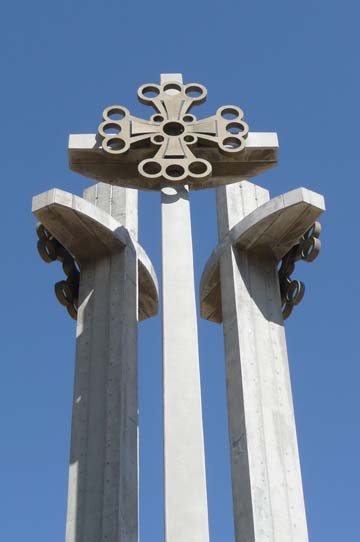
Cross at Church of New Epiphany. PHOTO: Tom Fee


  LONELY PEOPLE ON A CROWDED BEACH


                                                    The ocean breeze teases skin and hair

                                         as the carefree sound of children

                                                                             is carried across the sand.

                                                    The beach is covered with sand, small twigs

                                        and people–

                                                                  people together

                                                                                            yet alone and lonely.

                                                    Couples paired off

                                                                             distant physically from the others

                                        A great deal distant emotionally

                                                                                                      from the others

                                       somewhat distant

                                                                            from each other

                                       and each within himself

                                                                                        a stranger.

 From Love and Other Painful Joys  (1970)  by Tom McFee (aka Tom Fee)


“Echoes” of the Big Bang Misinterpreted?


This is an artist's concept of the Universe's expansion, where space (including hypothetical nonobservable portions of the Universe) is represented at each time by the circular sections. Note on the left the dramatic expansion (not to scale) occurring in the inflationary epoch, and at the center the expansion acceleration. The scheme is decorated with WMAP images on the left and with the representation of stars at the appropriate level of development. PHOTO: NASA/WMAP Science Team

In an analysis by Ray Villard, posted at discovery.com on June 15, 2012, the basis of the “Big Bang” theory is questioned by the findings of a veteran radio astronomer who suggests that the astronomers who posited the theory analyzed their data and stopped when they found what they were looking for!

Consociate Ron Theriault has this to say about the article: “It has been said that although most people like eating hot dogs, few would want to see how they are made. Science is a lot like that. The cosmic microwave background radiation is a relatively recent discovery, and instruments that precisely map it are more recent still. The article gives a glimpse inside the scientific ‘hot dog factory’ to see a bit of the process by which these new data are bring incorporated into the body of received knowledge.”

Read the article online at discovery.com.


Link submitted by Frieda Nelson


The Divine Child of Virgil, Part 3

A bust of Virgil from his tomb at Naples, Italy. PHOTO A. Hunter Wright

3

As fate had it, the promising peace of Brundisium proved to be illusory and the promising boy-child which Virgil expected did not appear: if that child were to have been the child of Octavian, that child was born Julia, a girl; if one of the boys fathered by Pollios himself, one died at birth and the other was starved to death by order of Tiberius; if the promising young nephew of Octavian, Marcellus, he died unexpectedly before reaching manhood, a death that is pathetically alluded to in book six of the Aeneid.

The void in Virgil’s prophecy remained to be fulfilled in a future century. In 339 C.E. Emperor Constantine’s bishop of Caesarea, Eusebius, perhaps believing himself to be in time near the mid-point of the expected one-thousand-year Golden Age, identified the Divine Child with Christ Jesus (Oration in Praise of Constantine, chapters 19–20). Many Christians since Eusebius have made the same identification and thus made Virgil into the gentile prophet of Christ. By the Middle Ages, the poetic works of Virgil were considered to be an oraclular engine of unlimited signification by the Christian populace: Christian consultants opened Virgil’s text at random and interpreted the first verse they chanced upon in relation to their present situation in a process of divination called by them sortes Vergilianae. Modern commentators have tended to approach Virgil in less haphazard fashion, but the variety of their interpretations continue to attest to the poet’s oracular appeal.

In 1907, after centuries of speculation, three British scholars published their excellent thoughts on what they had found behind the prophetic image embedded in Virgil’s Fourth Eclogue (SEE Virgil’s Messianic Eclogue: Its Meaning, Occasion & Sources). A century of historical and literary clarifications followed. To the discoveries of these three, I now add a discovery of my own: The Divine Child who would fulfill the original intention of the Jewish oracle was born, not around 40 B.C.E., as Virgil had hoped, nor around the turn of the first millennium, as medieval Christians believed, but in the year 1959 of our own age (SEE Jamil: Child of Light).

Robert Petrovich
March 2011

REFERENCES

Apocrypha and Pseudepigrapha of the Old testament, Volume Two: Pseudepigrapha, R.H. Charles, ed. (Clarendon Press, Oxford, UK, 1913)
Link to Apocryphile Press facsimile edition, 2004 (SEE pp. 369-406) HERE.

Jamil: Child of Light, Gene Savoy (1973)
For ebook, click HERE.
For printed text, click HERE.

“The Life of Virgil,” Suetonius Tranquillus (second century B.C.E.)
To link to this article online, click HERE.

Virgil’s Messianic Eclogue: Its Meaning, Occasion & Sources; Three Studies by Joseph B. Mayor, W. Warde Fowler, and R.S. Conway; with the Text of the Eclogue, and a Verse Translation, R.S. Conway (London: John Murray, 1907)
To link to this book online, click HERE.


INSIGHT POEM: “Transition”

Cross at the Church of New Epiphany. PHOTO: Tom Fee

TRANSITION

My soul feels free

slowly drifting upward

becoming  one  with Spirit

as I leave my body behind

rising toward the Light

and Eternal Peace

as the vibrations  of my soul

become one

with the Rhythm of the Universe

as I again return

to the flowing Life Force

of His Divine and Holy Love.

Written 9-9-71 / Revised 11- 25-10

Submitted by Tom Fee (aka Tom McFee)


Project “X” Tours Japan Day by Day: DAY 13


21 MAY


Japan-U.S. air route on the screen in the aircraft on the way to Los Angeles. PHOTO: Ron Theriault


Breakfast at hotel. Transfer to airport today for your afternoon flight back to the U.S. via Seoul, Korea. One group returns to U.S.A. immediately. Another group remains in Seoul for extended tour.


GOOD-BYE TO JAPAN

Final breakfast in Japan PHOTO Jim Elliott


“After breakfast at the hotel, we say good-bye to all of our dear Japanese friends and head out for the airport. Some of them, Yuki, Koshu, Miyuki, and Shinobu, accompany us on the train and to the airport. It is a sad departure, as they so much enjoyed having us with them for two weeks in Japan. Now, we are on our way back to the U.S. via the same way we came, i.e., Korea and a long flight back to LAX/Reno.”

—Journal entry by Gary Buchanan


<DAY 12>


**THIS ENDS YOUR JAPAN TOUR WITH PROJECT X**