Mar Iazed-buzid, the Great Donor: Part 3A


PART 3: THE JADE TENT

When the Secretariat Director,
Duke Kuo Tsu-i, Prince of the Fen-yang Commandery,
first commanded troops in the Northern Regions,
Su-tsung ordered him
[I-ssu] to accompany the expedition.
Though treated with friendship in the Prince’s sleeping-tent,

he made no distinction between himself and others on the march.
He was nails and teeth for the Duke,
and was ears and eyes to the army. . . .


Portrait of Tang Dynasty Uighur Khagan


At Ling-wu, tens of thousands swelled the imperial forces of the new Emperor as the units led by generals Li Kuang-pi and Kuo Tzu-i arrived from the eastern front. (See Supplement 1) Immediately Kuo Tzu-i put his armies to work fortifying the city that was to be the root of the restoration. His armies walled in three cities beyond the Great Wall to form protecting wings for Ling-wu, which stood backed up against the Great Wall. Now the Tibetan Turfans came to the aid of Su-tsung, and the Uighurs (hui ho) at their camp in Hua-men became imperial allies. Mounting horses in the distant desert, four thousand hui ho crossed the long province of Lin Tao to vow their devotion to the Emperor and to hold back the rebel hordes. Led by their endearing qaghan, they took an oath to “turn the Emperor’s red shame white” and, as an earnest of good faith, gashed their faces until the blood ran. One by one, minor officials from the confines of Chang-an strengthened Su-tsung’s court by simple addition (See Supplement 2): at times hiding from the rebels to avoid being taken into service at the rebel court in Lo-yang, at times moving freely through the city, they, like I-ssu, had finally escaped and made their way to the exiled court for appointment by their Emperor. Although weak and in exile, Su-tsung’s Throne found the absence of the normal horde of bureaucrats an advantage. The army met its need for food and horses out of local requisitions, and a straightforward field command structure established itself.

Here I-ssu received his imperial commission. From the Jade Tent of Kuo-Tzu-i at the Ling-wu base in the Northwest, I-ssu commenced his command as Joint Military Vice Commissioner of the Northern Region. For at least the next three years, his generosity and fiery influence on the battlefields balanced him between the hui ho and the throne in loyal personal service to the martial governor Kuo Tzu-i. (See Supplement 3)

Beyond these few facts, it is not possible to portray I-ssu’s personal experience during these years but only the collective experience of war.


< READ PART 3B: THE JADE TENT >


SUPPLEMENTS

Supplement 1:
The Northwest Command

Duke Kuo Tzu-i receiving homage of Uighurs. Detail from Song Dynasty painting.

Early in 756 Hsuan-tsung had placed the Northwest Command, the large armies immediately north of Chang-an and the only force of experienced fighting men in the Empire, under the supreme command of Kuo Tzu-i. Kuo had been chief lieutenant in that army under An Lu-shan’s cousin, An Ssu-shun, who was removed for obvious political reasons. Another of An Ssu-shun’s commanders, the Khitan Li Kuang-pi, had been made acting military governor of Ho-tung. The Emperor had sent Kuo Tzu-i’s armies to aid Li Kuang-pi in the northeastern province of Ho-pei in the second moon of 756. Now they had returned.


Supplement 2:
The Official Life of the Poet Tu Fu

The poet Tu Fu. Anonymous artist's conception.

Among the minor officials who escaped was the poet Tu Fu. Months later, in May 757, before the reconquest of Chang-an, Tu made his way to the exiled court at Feng-hsiang. When he arrived there, he was appointed Reminder. According to tradition, the duty of Reminder was to advise the Emperor and to point out any errors or oversights he might make. In Tu’s time, however, Reminders were expected to do little more than take part in the imperial pageantry. The new Emperor, Su-tsung, who was becoming suspicious and unreasonable, soon demoted one of his highest officials, Fang Kuan. Tu, taking his traditional advisory duties quite seriously, pointed out the Emperor’s shortsightedness. The demoted official was Tu’s patron and friend. Su-tsung immediately had Tu arrested, and only after the intervention of several other ministers was he released.

Tu had by now been separated from his family for a year, and he had no idea what might have befallen them. The war had reportedly reached the city of Fu-chou, where he had left them, so he suspected that his family had been killed or driven away. Finally, in September, he received a letter from his wife. With news of them, he was now anxious to return to his family, and the Emperor was hardly reluctant to allow the pesky man a leave of absence from the court. After a difficult journey, he arrived home at the beginning of October.

A month later, loyal forces drove the rebels from the capital and soon recovered Lo-yang as well, driving the rebels into the east. Tu Fu, overjoyed, returned to Feng-hsiang and joined in the Emperor’s jubilant return to the capital. In January 758, his family joined him in Chang-an, where he was happily attending court and accompanying the Emperor in victory celebrations. By spring, however, the poorly advised Emperor began to banish worthy officials, notably Fang Kuan and his associates, many of whom were Tu Fu’s close friends. That summer, because of his association with the Fang Kuan group, Tu Fu himself suffered a mild form of banishment. He was sent to a town between Chang-an and Lo-yang, where he served as Commissioner of Education.

The following January, apparently on official business, Tu went to Lo-yang. He used this opportunity to advise the commanders who had been sent to subdue the remaining rebels. His advice was ignored, though it was, as it turned out, quite astute, including specific warnings against the very dangers that led to the unforeseen and disastrous defeat for the loyal forces. A surprise attack staged by the most powerful rebel commander threatened Lo-yang, and its people fled. Tu Fu also fled, returning to his small-town home.

Because his bureaucratic routine was unbearably tedious and his position in government a source of danger, Tu soon began to consider leaving official life and devoting himself to writing. In late August, famine and the intensifying rebel threat compounded his frustrations; he resigned his post and moved his family three hundred miles to the west.

The sequence of collected poems in Chang-an II and Chin-Chou/Tung-Ku are Tu Fu’s lyric reports, still vivid and direct; they read like correspondence from those times and those places.


Supplement 3:
Associate Lieutenant General I-ssu

Uighur cavalry. Detail from Song Dynasty painting.

To lead thousands of hui ho mercenaries together with their chief, acting as associate lieutenant general, I-ssu must have been a master of the Uighur language, as was KuoTzu-i. Monks of the Luminous Religion had long served as interpreters in KuoTzu-i’s armies, and others before them had evangelized among the hui ho for decades and gifted their tribe with an alphabet and script.


INSIGHT INTERVIEW: Mason Dwinell, Part 4

Mason at party. PHOTO: Mason Dwinell

CC: All right. Let’s get back to your book then.

There are a couple of anecdotes you mention in your book that I found rather intriguing. I would like you to take a little time to talk about them in more detail than you did in your book, if you would. The first (on p. 74) deals with prisoners of war who were forced to stare at the sun for hours with amazing results. I have never heard of these accounts. Could you let us know more details? Who wrote them and where can we find the accounts?

MD: Hearsay. I also looked for concrete documentation, but along with so many other bits and pieces of sungazing there seems to be a dearth of solid information to support this unique practice.

CC: That is unfortunate. I was hoping you had found something “concrete,” as you say. But it has been my experience too that it is often very difficult to find concrete historical documentation for these things.

The other anecdote that caught my attention is a one-line mention you make about parents who were working with the sun during the conception of their child. You say of them (on p. 77): “The parents’ sungazing practice was one of a spiritual nature therefore they still ate food.” (Emphasis is my own.) This makes sense to me. But it may not make sense to some other people who practice looking at the sun. How do you reconcile “spiritual” sungazing with eating physical food and “physical” sungazing, if I may use that term, with not eating physical food? How do you explain this to people?

MD: Hmmm—that gets confusing and begins to become a word association game. similar words can have very different meanings to people. For me it goes back to the intention, the driver, the emotion pushing a choice. Regardless of whether one uses the word spiritual or physical, there is a force that inspires action. The feeling which creates action or reaction, that is fascinating to me.

CC: What about action for a purpose? What about directed action? A “calling”? Or a response to a “calling out” or a “calling together”? Has anything like this been part of your experience with the sun? Do you find such things to be of interest?

MD: Nope. Such mirages are an illusion, or perhaps a delusion, driven by foreign energy (entities), running their programs in people’s energy field for their own agenda. We must be careful and diligent to keep such energy at bay as to not compromise our own systems.

CC: I take it that that is why you are so distrustful of organized religion and spiritual institutions in general, because of the possibility that Dark energies, or as you say, foreign energy entities, may be what is directing such organizations. Is that the case?

Have you ever considered that there may be such a thing as a School that provides instruction and guidance on how to avoid the influence of such foreign entities? And that there have been such Schools in the past?

MD: I’m not distrustful of organized religion and such; more so simply not drawn to them.

Oh yes, Robert, I have considered many such things.

CC: I ask you this because I know you have received training and are licensed in particular healing arts and sciences, but I wonder why you consider that you are better off experimenting with the sun on your own than you would be if you received training in the spiritual arts and sciences related to the sun and the benefits of others’ experience. After all, you did once (about ten years ago) apply to our Academy.

MD: I never assumed I would be better off one way or another. My sungazing experience happened rather organically, all while I was enrolled in The American College for Traditional Chinese Medicine.

CC: Thank you, Mason, for granting us this interview. It was interesting for me to read your book after seeing the film Eat the Sun. The book gave me another perspective on what you were going through during the time the movie was being made and gave me a sense of the depth of your search that I think did not quite come through in the film. I am happy to hear that you are continuing the work that you set off to do when we met some ten years ago.

Do you have any parting lines you would like to leave us with? Perhaps something touching on a topic that we didn’t touch during our interview?

MD: Thanks for the cathartic expedition into passages long since written, educational and insightful. I appreciate your efforts and look forward to checking out your final presentation.


“An Ungodly Predicament”

PHOTO: newsreview.com/reno

In the September 2012 issue of Reno Tahoe Tonight (RTT) magazine, Sean Savoy uses his monthly editorial column to mildly take to task the author of a pro-atheist opinion piece that appeared as the feature article in the popular free weekly magazine Reno News & Review (RN&R).

That critical and judgmental piece, titled “Are You There, God? It’s Me, Jake,” by longtime University of Nevada-Reno professor of journalism Jake Highton, addresses the pretenses and hypocrisy of modern-day religion and at the same time wags a finger at the moral foibles of famous professed believers whose behaviors, he believes, prove to him their moral hypocrisy. Professor Highton’s article begins with the childhood trauma that convinced him that God did not exist, then hops from eighteenth-century deistic points to ancient and modern atheistic points to contemporary scientific points, and ends with the arguments that all religion and all concepts of God defy reason, that modern empirical science alone is reasonable, and that the most morally decent nations are the most secular.

Bishop Savoy, in his article, recognizes the correctness of Professor Highton’s stance when the professor makes solid arguments and promotes an intelligent and more reasonable spiritual perspective when the professor does not.

Read Professor Jake Highton’s original article in RN&R.

Read Bishop Sean Savoy’s response in RTT.


INSIGHT INTERVIEW: Mason Dwinell, Part 3

Mason as he be at Burning Man 2012. PHOTO: Mason Dwinell

CC: How would you approach sungazing differently now that you have had the experiences you have had as a more mature individual? Have you found any guidance through ancient texts, for example, the “secret” of the eighth-century Chinese text The Secret of the Golden Flower, or the old Hermetic admonition to “get to know the Light”?

MD: Sunrise only. Incorporate the moon a little. Be very empty prior to gazing. Go slowly. Have a goal of being without a goal. Gaze without a camera crew. Let it all go!!!

CC: “Gaze without a camera crew.” I understand that completely. I know how that can change the energy of the event.

Now I would like to take a little time to discuss what I guess we could call technical matters.

To begin, you seem to recommend staring directly into the sun, a conscious focusing, rather than the method of looking around the sun and relaxing the mind and the eyes with the eyelids half closed in the way Buddha, say, is depicted. Why is this? And where did you get the idea to do so?

MD: Hmmmm—yes, looking right into the sun. But very much so relaxed, neutral; allowing for the ability to relax deeper, further, to let it go. But still conscious and focused. Must still be present and alert—feeling all that is coming up from within, as opposed to being checked out. Far too many guru-yogin types have all the right answers, but in reality are totally checked out.

Be careful. Regarding bliss, there is a colossal difference between being vacant and being present.

CC: Yes, there certainly is a big difference between being present and being in a trance. That is not really what I was asking about, but I get from your response that you are working from a relaxed state. I only ask because in the movie Eat the Sun you looked tense at times, as if you were fighting to keep your eyes open. But I see now that that is not actually what you must have been doing.

In your book you write (p. 81) “Sunlight actually cleanses and rebuilds the whole of your being, bringing a new vibration to your mind, thoughts, feelings, and physical body: total rejuvenation.” And later in the book you write (p. 122) “. . . enlightenment, realizing and expressing one’s being is absolutely not dependent upon an ultra-clean body. In fact, ultimately, it has nothing to do with a body.” With you, I would say that both of these statements are more or less true, except that I would clarify that enlightenment has nothing especially to do with a physical body. And I am bringing this up to lead into my next question for you.

Now, I am aware that many raw foodists have come upon sungazing as a natural progression of their quest for seeking “pure” food, recognizing that the energy that prepared their uncooked food and provided the nutrients of that food came through the sun, and that sunlight itself was an even more pure source of “food” or nutriment than uncooked or raw food. What do you generally say to raw foodists who speak to you about the cleansing quality of sunlight and the relation of sunlight to enlightenment? Anything more than what you have said in these two sentences from your book?

MD: Interestingly enough, I speak about this stuff to very few people.

What you ask about is certainly two different worlds. Yes, playing with the vibration of one’s body can be fun, challenging, and quite an adventure, as well as help to isolate different blocks if one wishes to evolve an aspect of their energy. However, unless, and until, said person is willing to actually look into why the choice of drinking beet juice occurs in the first place, they are still falling short of our human experience. Oftentimes the motivation behind a certain diet, practice, or lifestyle is a defense mechanism, enabling the person to hide even deeper from their real issues. The same can be said for the participation of sungazing. What is the intention, the drive, that subtle emotion that puts action into motion. Indeed, using imagination and motivation to alter diet, appearance, and the like is fascinating, and I love it, but to become aware of how the different aspects of your energy expresses itself is paramount if we truly wish to participate in this earth life. So whether one is eating cheetos or the sun, without the awareness of you, there is nothing [gained].

CC: It is no surprise that you speak about these things to few people. Few people care to look deep into life for an extended period of time. And fewer still care to look deep into their own psyche and spirit. Fewer still are able to personalize impersonal forces or energies to strengthen themselves, psychically and spiritually, rather than simply trying to get along with these forces by doing what they think is the right thing.

In the final part of your book, which deals with health concerns, you say (on p. 113): “As your awareness increases, the magnitude and wonder of your earthly experience will become more magnificent.” And during your talk here in Reno, you said something like you “back anything that increases awareness.”

In our System of practice, we recognize two distinct forms of higher awareness or higher consciousness, one of a psychic nature, wisdom of the kind that is acquired and grows through experience, and another of a spiritual nature, wisdom of the kind that just “knows” and is “revealed from heaven” we might say.

When you speak of awareness and the true “you,” the true self, are you making a similar distinction? Could you talk a little bit about the concepts of awareness and the true self as you understand them?

MD: Sort of. However, there is more. Yes, anything that encourages people to look inside is a good thing. Listen. What do you feel? What do you hear? Can you differentiate the expressive energy between your personality, your DNA, your different organ systems, your mind, foreign energy, old patterns, ancient past-life patterns, your atoms, your soul, your true self??

Another cool aspect about listening is: generally it inspires even more listening—possibly, better listening. Awareness breeds awareness. There is so much for us to experience, to become aware of, and at the end of the day the common denominator of everyone i know, or have read about, who has heard, felt, and known is that they sit still. They meditate. They learn to quiet the mind, and they listen. To me meditation is simply a tool to learn how to be present. To feel what is occurring now. With practice, we all could be present all the time. But at the end of the day it starts with you. Heal thyself. Do you meditate??

CC: I tried a few meditation techniques back about thirty-five to forty years ago of the quieting, calming, centering, slowing down, relaxing kind. Now the solar techniques I have been practicing for the past thirty-plus years serve as my meditation and contemplation ritual—meditating with eyes open not closed, “speeding up” not slowing down, and still centered, calm, and relaxed. And it has been my experience that, as you say, spiritual awareness breeds spiritual awareness, and awareness heightens Consciousness by accumulation, bit by bit.

It has been my experience, and I think the experience of everyone who continues to practice our spiritual System, that working with the sun over an extended period of time actually opens your deep being “to the light,” so to speak, and parades in front of you one by one all sorts of personal issues, and these issues must be dealt with if you are to remain in or regain your psychical and spiritual health. In a very essential way, therefore, I see sustained work with the sun for spiritual purposes to be by its nature a healing process of grand, even ultradimensional, proportions.

Is this the kind of thing you hope to pursue in the future with your sungazing?

MD: Yes—utilizing an emotional process to evolve how we act and react is paramount to my daily life. Although one can tap into all of that by sitting on a cushion in the dark. The sun’s mojo makes the process infinitely easier, but certainly able to do without.

That said, the piece that continues to tickle the back of my brain rests in the arena of human potential. Can we fly? Can we dematerialize and rematerialize? Can we travel interdimensionally with our bodies? Can we dance with the light of immortality?

While I have heard all is possible, until I actually do it, it is simply a myth.

CC: I was actually referring to more of a cosmic Process, not an emotional process centered in our human nature but a Process that links our inner nature to its ultimate ultradimensional origin and regenerates our immortal spiritual Light body, that uses the sun of our solar system as a gateway to higher realms. To me, that does not seem to be the kind of thing you can tap into by sitting on a cushion in the dark. Have you ever considered the importance and value of seeking contact with your immortal nature as a human potential in itself rather than seeking to extend the potentials of human physical action—like flying, dematerialization, physical interdimensional travel? Or do these things seem to you to be automatically and intimately interrelated?

MD: Yes, related. And I assure you, one can tap into everything and anything by sitting on a cushion in the dark.

However, I fear we are getting a touch off base here as your agenda, projections, and such are beginning to express themselves.

<PART 4>


Mar Iazed-buzid, the Great Donor: Part 2D


Tessellated bird's-eye view of Chang-an during Tang Dynasty. Designed by Mazlin Ghazali.

(B)

If I-ssu had not soon followed on the emperor’s southern path, now, with An Lu-shan’s jackals in the blood-drenched city of Chang-an, he hid in the monasteries for days or weeks, like other officials and prominent men, to avoid conscription into the ranks of the confederate dynasty. On one of those undivulged nights, after rumor had transformed Prince Chung into a Dragon who marshaled his forces in the wilds at Ling-wu, the dark pathway of the sky grew lofty and transcendent, and, while other men of the capital turned their faces to the north in grief, waiting for the army’s fires to appear on the hills, I-ssu secreted himself out.

Over a course of nights, while screech owls moaned in yellowing mulberry trees and field mice scurried to prepare their own holes, the refugee I-ssu fled four hundred miles in search of the new emperor’s palace. At first guided across the plains by stars, and nights later, by following the lines of deep-cut ravines that stretched like sunken paths into the Northwest, I-ssu reached the Traveling Palace, risen anew, with its back against the Great Wall. On a spring day months later at the South Gate of Ling-wu, Prince Chung, still a Dragon Without Horns, addressed the people of one hundred surnames to announce that he would accept the Great Seal in the seventh moon, on the day of Chia Tzu, when a new cycle would begin. Immediately, the prince began to organize the fighting men of the surrounding loyal province. He summoned the aid of loyal tribesmen – the Pei Ti of the North, the Uighurs at Hua-men, Tibetans and the Hsi Jung from the West – and of client kingdoms in the Tarim as far west as the Central Asian city of Farghana. On the day of Chia Tzu, with no more than thirty officials to aid him, and the eastern and western capitals in the hands of rebels, Prince Chung – known to history by his posthumous temple name, Su-tsung – changed the fifteenth year of his father’s second reign to the first year of his own, and he styled his reign Chih Te, “Virtue Drops as a Bird to Earth.” Just as the sunflower and the clover lean toward the light, and the ants are jealous of their own holes, so every living thing has its essence which cannot be snatched away. Now two emperors, at two separate Traveling Palaces, ten thousand li apart, performed the formalities of predicating a court in exile. One in Cheng-tu, where the old emperor, and a diminished entourage of thirteen hundred persons, had stopped on the road to Szechuan. (See Supplement 7) The other, at the headquarters of the northern command. Here the new emperor, Su-tsung, and his council prepared the portico and front hall of the empire; but officials and soldiers, the beam and the wall, were lacking.

*

By one of the two possible routes of time and events described above, I-ssu reached the imperial headquarters in the north at Ling-wu. After the period style had been changed, and while promotions were being made in the official ranks, I-ssu, like all the others, approached the new emperor in his tent and, kneeling before the Imperial Couch, placed his head on the Green Rush Mat to tender himself, as if he were in Palace Audience Hall.

<PART 3A: THE JADE TENT>


SUPPLEMENTS

Supplement 7:
The Last Days of Hsuan-tsung

Hsuan-tsung's flight. Song Dynasty; artist unknown.

Hsuan-tsung was still on the road to Szechuan at the time. Unaware that he had been created Above Emperor by his son’s act, Hsuan-tsung arrived in Cheng-tu on the twenty-eighth day of the seventh moon and went through the formalities of establishing a court in exile. It was not until the twelfth day of the eighth moon that envoys from Su-tsung reached Cheng-tu to announce his usurpation of the throne. The old emperor, exhausted and racked with remorse for the death of his imperial consort, gave his consent without protest and on the eighteenth day, dispatched his own trusted ministers to Su-tsung’s headquarters, bearing the Instruments of Abdication and the State Signet, and a great deal of jade.

Hsuan-tsung remained in Cheng-tu until the tenth moon of 757, when, after Kuo Tzu-i had recovered the two capitals from the rebels, Su-tsung summoned his father back to Chang-an, where he was received with honor and allowed to reside at first in his favorite Hsing-ching palace. Later, in the seventh moon of 760, he was moved to quarters in the imperial palace, probably because he still retained the loyalty of many of the court and posed a potential threat to his successor as a possible focus of factional intrigue. He died in the fourth moon of 761 at the age of seventy-seven.


INSIGHT INTERVIEW: Mason Dwinell, Part 2

Mason at Burning Man 2012. PHOTO: Mason Dwinell

CC: At one point in the commentary portion of your book (p. 73), you say: “I have been told that 44 minutes of time is required for the whole amount of blood in the human body to pass through the retina. The retina is the only place in the human body where sunlight touches the blood (directly or indirectly).” Later in your commentary (p. 95), you say: “Sunlight increases the oxygen-carrying capacity of the blood. This extra oxygen helps to cleanse the bloodstream and tissues as well as encourages the body’s immune system to work more efficiently.” I take it that this is what you mean when you say that a kind of photosynthesis occurs when sunlight hits our blood through our eyes. Do you think that the time of 44 minutes was devised by HRM for his sungazing protocol for this reason, because that is how long it takes all the blood in an individual’s circulatory system to be “solarized” at one time? And if you think it is, can you explain why the protocol does not require an individual to continue this practice?

MD: I am not convinced HRM devised anything—he was simply a spokesperson utilizing information passed down from generations of the Jain religion.

Every body runs a bit differently, but yes, I believe once the physiology of the eyes can handle the intensity and duration, coupled with clean body and blood vibrating at a high frequency, photosynthesis (or some similar clean energetic process) occurs.

CC: And do you have any idea why the protocol would advise that a person reach the point of 44 minutes of viewing, the time period that allows all of a person’s blood to be exposed to the sun through the retina once only, and then cease looking at the sun completely after that? It would seem that such a process may be beneficial to repeat at certain intervals.

MD: I do not know. And I agree, something seems amiss. Perhaps the mind gets to a point of evolution it can create whatever energy it needs through imagination. Without a doubt, there are some pieces and parts missing from of theory, instruction, or direction.

CC: Thanks for being so honest. And to continue in the same vein for a moment: You have no doubt heard it said that all the cells in the human body are replaced about every seven years. What do you think could be the result if an individual were to continue sungazing regularly for seven years, and thereby “solarize” every cell in his or her body? What are your thoughts on this concept, if any?

MD: Maybe—although I have heard many things said. I have learned not to hold much credence in media or Western medical limits. I exist more along the lines of: live, taste, attempt, feel, digest, and, possibly, evolve. When you are truly present and have an experience, that moment in time becomes yours, your experience. No one can tell you differently. Perhaps cells replenish at set rates, perhaps not. I’ll wager there are enough different people hosting different cells that many unique possibilities could come to be.

Yes, it may be helpful to use printed material and lore to lend parameters, but nothing is set in stone—life is constantly ebbing, flowing, and changing. Indeed, we can look to the past for guidance, but we must be careful not to become attached to such standards. Apathy coupled with limitations can create stagnation, and frankly, such patterns are boring.

You, any and all of you reading this, are pioneers. It is your job to be curious about human potential, to push the limits, to imagine a future, and then be present and focused to manifest the impossible as possible. To help create a new way of being, seeing, thinking, feeling, and existing. Oh, and have fun! Giggling, laughing, and dancing along the journey.

We received this photo from Mason at this point in our conversation.

CC: At one point in your journal, you bring up the concept of the “true self” and mention that sungazing led you to knowledge of your true self. Why do you think that it was the act of sungazing that led you to this knowledge, and not something else?

MD: Something else certainly could have aided in this revelation. Yes, meditation can access many of the same realizations; however, the sun helped amplify sensations and awarenesses. When i was able to fully relax and let go, it was as if layers of an onion were falling away. Limitations and foreign programming sliding off, and the true me was birthing itself into the world. People resonated differently, not only with their actions, but also with comments about how I felt and appeared: richer, deeper, peaceful—more.

CC: That is a beautiful description. Elsewhere in your book (p. 81), you mention that man is a photobiotic being and that “our aura” is our “true self.” I assume that you are speaking here of the combination of color bodies related to what are sometimes called chakras or energy centers or force centers, the whole of which is sometimes called the psychic body. Is that correct? And have you ever considered the possibility or found evidence of an even higher type of body, a Light body?

MD: Hmmm—I didn’t see mention of that on page 81. Nonetheless, no. Our aura is our aura. Our true self, our true self. Our soul, our soul—all different, all unique, all energetic. Our chakras are different from our meridians; yet, all of it a swirling mass of an individual. Yes, there are many different aspects of the energetics and light bodies that incorporate the human being. We are truly awesome, complex, and incomprehensibly powerful. All aspects of our energy is around us all the time having an experience. Only with awareness can we begin to feel, listen, and alter our status quo. As we quiet the mind, slow down our lives, learn to breathe, and live more in the present—only then are you able to begin the objective journey into all of the varieties of your energetic makeup that makes you, you.

CC: You’re right. It was pp. 91–92. At one point in your book (p. 78) you mention that you have been told that “the sky is the limit” with sungazing, and you mention that it is up to each individual to decide where this path will take them. You, of course, have written this book about your experience, your path, and where it took you. Could you take a moment to explain why you did not “decide” on another path, a different path; for example, continuing your work with the sun specifically for spiritual purposes?

MD: Hmmmm—while many doors opened during my brief dance with sungazing, I feel my experiences from a decade ago were simply a teaser. Perhaps the main event has yet to occur.

CC: Well, that is not the answer I expected. After reading your book, I got the impression that you had simply put your experiences with the sun aside and gone on to something else. But there is a comment you made to close the section of your book that contains anecdotes about sungazing that should have alerted me to your continued interest in the information that sunlight carries. This is the line (p. 99): “There is plenty that is unknown about the practice of sungazing.” What are the unknown areas that continue to interest or intrigue you?

MD: RE: pages 49–50: One of the experiences that scared me, and intrigued me, was when I had the sensation of voltage traveling up my arms. It was beyond anything I could have imagined. I feel as though now I’m standing on more stable ground, and would very much like to tap into that energy once again. I can only imagine where it would lead. This and having better awareness of all the systems within could make for quite an odyssey.

I also know we have yet to really express our potential. We are capable of so much more.

I am curious.

CC: I remember how awed you were by that sensation. You describe the experience quite clearly in your book. In our Academy we take a more moderate approach to the sun and its energies, and the kind of sensation you are describing is treated late in the first year of practice in our program. There it is described as more of a deep and harmonious tingling and a loving energy rather than an unexpected jolt. I think the difference may lie in the more gradual nature of the approach we take over a more extended period of time. And it now seems to me that you might approach sungazing differently if you were to take it up again. Do you think you would be more interested in such an approach to the sun, a milder and more continuous approach, now that you are more mature and experienced than you were when you were “younger,” or do you see pitfalls in such an approach?

MD: Either gentle or jolting could probably be beneficial depending where in life the practitioner is at the time. For me, I had never even heard of such an experience. So it was a tad on the wowzers side of things.

Yes, now I’m in a different place—almost welcoming such sensations.

<PART 3>


Mar Iazed-buzid, the Great Donor: Part 2C


An Lu-shan's forces advancing to the capital. Modern artist's rendering.

(A)

If I-ssu did flee along the same path as the emperor, the next days made him a witness to the events that removed Hsuan-tsung from the throne and set up his son, the heir apparent. At a midday stop along the road, the distinguished fugitives discovered that, in their haste, they had left without provisioning themselves or the soldiers who escorted them. The next day they rested again, at the post station of Ma-wei, forty miles west of Chang-an. Here the solders – hungry, discontented, mutinous – broke out in open rebellion and, within earshot of emperor Hsuan-tsung’s camp, murdered the chief minister, Kuo-chung, whom they charged with the cause of their present disaster. The emperor, now completely at the mercy of his subjects, was given a choice: his own life or the life of his imperial consort, the chief minister’s corrupt and ostentatious cousin. In agony, the emperor gave his order. In a nearby Buddhist temple, his beautiful consort was strangled. When her body was displayed, the soldiers, satisfied, at once returned to their duty and allegiance. The imperial records tell us that the emperor was so overcome by the spectacle of his lover’s death that he no longer desired to be emperor and resigned the Dragon Throne. The same record tells us that his son, Prince Chung, reluctant to take the honor which belonged to his father, yet responsive to the will of his counselors and the people, finally accepted it, with suitable misgivings. In another version of the incident, the son usurped the throne a month later. In a fourth, it is said that the heir simply intended to assemble and equip an army to launch the recapture of the capital in preparation for his father’s triumphal return and did not receive the imperial insignia until summer; in this version, Prince Chung, the Dragon Without Horns, carries out an act of filial piety that cannot be greater, which the chorus of advisors who appear in this version of the story are quick to point out. Whichever version of the story historians prove to be correct, at Ma-wei, or some days later at Kuan-chung, two thousand men enrolled themselves for the defense of the empire, while the retired emperor continued his journey southward to Szechuan.

I-ssu, if he had followed the populace to Mai-wei, now joined the imperial heir on his forced march to the north. At the Wei River crossing, Prince Chung called on the riverside people to arrange for transport of his army of loyal volunteers. Three thousand responded. Moving further north, the army entered into a desolation of incomparable size and age, an accumulation of dust hundreds or thousands of feet thick that the wind had compressed and formed into crumbling hills and plains. The traveling army crossed this uneven, irregular land, descending into ravines, then ascending again onto cliffs and high ridges torn open by the angry wind. The great gashes in the land, making their steps tediously varied, repeated themselves in dull lines before them. Of the two thousand men who accompanied the prince through this surly and monochromatic land, less than five hundred remained by the time they reached Peng Yuan. The army that continued on to Ping Liang still called for men. Only a few hundred responded. Once, at the head of the Yellow River south off Feng Ming, the prince stopped to consider that the stream that runs there in a net of waters might provide him protection; then he turned again, further into the dark northern regions. The prince arrived with his small army at Ling-wu on the ninth day of the seventh moon. With him was I-ssu.

Reports came from the capital. A few days after the incident at Mai-wei, riders had appeared across the river from Chang-an. Then, suddenly, ten hundred hu brigands descended on the city. The rebels decimated the palace and destroyed the Spirit Tablets of the Imperial House. The Ancestral Temple, guarded only by stone unicorns, they consumed with fire. The Jade Dragon Throne they overturned. At yellow dusk, iron-mounted horsemen came in, line on line, and filled the ancient capital with their dust. By dawn of the next day, treasure-laden asses were scattered along the streets. The ancient capital was filled, in time, to overflowing, with humped camels trailed in from the East. By mid-August, when An Lu-shan arrived, the wind wafted the rank smell of blood. The self-proclaimed emperor of Yen called for public executions on the street in Chung-jen Ward. At his command, An Lu-shan’s men tore out the hearts of his choice of Palace Ladies, who had been left behind by Hsuan-tsung, and offered them as compensation to the ghost of An Lu-shan’s son, whom the emperor had put to death six months before in reprisal for An Lu-shan’s rebellion. Then, to repay the partisans of his arch-enemy Kuo-chung and others obnoxious to him, An Lu-shan ordered his men to pry off the tops of their heads with iron claws. After the street ran with their blood, An Lu-shan turned to hunting down the imperial clan, the Dragon-Seed. (See Supplement 6)

<PART 2D: THE RED COURT>


SUPPLEMENTS

Supplement 6:
Detection of the Dragon-Seed

Emperor Hsuan-tsung. Tang Dynasty; source unknown.

The Dragon-Seed, or clan of Tang, was naturally considered different from other men. The famous aquiline, or “dragon,” nose, which we describe as “Roman,” was looked upon as a feature peculiar to members of the royal house and made easy the detection of clansmen left behind by Hsuan-tsung when he fled. An Lu-shan’s intended execution of the members of the royal clan was a simple continuation of the ageless Chinese custom that had been followed by all pretenders to China’s throne – annihilation of the royal branch that one wished to supplant.


INSIGHT INTERVIEW: Mason Dwinell, Part1

The Earth Was Flat, Mason Dwinell (Xlibris, 2005)

Mason Dwinell PHOTO: from the back cover of his book

For our first Insight Interview, we speak with Mason Dwinell about his 2005 book on sungazing: The Earth Was Flat. Mason was the subject of the 2011 documentary film Eat the Sun, which followed his exploits as a young man searching for information on the ancient practice of looking at the sun, or sungazing. We met him for the first time during the filming, when he came to Northern Nevada to speak to Bishop Gene Savoy Sr. and other members of the Community about their experiences working with the sun and to attend a Sunrise Divine Service with us at Red Rock Consecrated Sanctuary.

Mason wrote The Earth Was Flat a few years after the footage for the film was shot and while the filmmaker, Peter Sorcher, was still editing the film. (You can read more on the film and acquire the DVD at the film’s splash page. You can read more about the book and purchase a copy at Mason’s web site.)

We ran into Mason again this summer during one of his speaking engagements here in Reno. At that time we arranged to carry on an extended email interview with him about his book, which we did from May 15 to September 15, 2012. What you read here, with minor editing, is the result:

CC: Hello, Mason.

It was nice seeing you last weekend at the Psychic Fair in Reno, and I’m glad we could make arrangements to interview you about your book.

MD: Yes, Bob—[I’m] alive and well.

CC: This weekend I was able to read Part 1 of your book and took a bunch of notes, enough to begin our email interview if you are ready to do so. I plan to finish the text in the next day or two.

If you have time to go back and forth with emails every day or two for awhile, let’s get started.

MD: Now is as good a time as any.

CC: Okay. Let’s begin then. There are a number of questions in my notes, so it may take a good number of back-and-forth messages, maybe twenty or so. There is no rush, and I would appreciate full responses when you can give them.

On the acknowledgment page of your book, you thank your friends and family for giving their unconditional support to you so that you were free to “chase the sun.” What kind of support did you receive? And do you think that a community of sungazers could have provided a similar kind of support, or do you think that the kind of support you received specifically from your friends and family was irreplaceable?

MD: By unconditional support, I meant they were there for me if I ever needed them. But more importantly they were not going to hinder [me]. One of my pet peeves is when people actually hinder someone’s quest. Quests are challenging enough as it is, and to have people so entrenched in their issues that they stand in the way is silly and unproductive.

CC: Early in your book, you quote Omraam Mikhael Aivanhov, who was the head of the Great White Brotherhood and a teacher of solar viewing. Since you knew of that organization and the organization continues to exist, how is it that you did not connect with the Great White Brotherhood and their system for sungazing instead of ending up following Hiram Ratan Manek (HRM) and his protocol?

MD: HRM was my introduction into the world of sungazing. I had reached about fifteen minutes of gazing prior to beginning research into other techniques or gazers. The experiences I was having were rich enough (which is an understatement), that I figured I might as well let HRM’s protocol run its course before I dipped my toes in other waters.

CC: It took you about four months looking at the sun every day for you to reach fifteen minutes of gazing. That is a pretty long time. Did you begin getting direct personal coaching from HRM during those first four months, or did you go it completely on your own without much concept of what you were doing or what you were in for?

MD: Yeah—it was mostly the blind leading the blind. Four of my friends and I headed into the void on our own. All we had to draw from was our own and each other’s experiences. At about twelve minutes, when things really started to change, i reached out to HRM for some guidance, but even then, I was very much on my own. Eerie, wonderful, terrifying, and totally awesome.

CC: Since you had that experience of “the blind leading the blind,” why do you recommend [pp. 20, 74] that each person approach sungazing in his/her own way rather than under the guidance of experienced practitioners?

MD: Every body is different and every soul is different. An experience, based on a technique or approach, will not relate equally to each person. At the end of the day, the individual experience is all that matters—all that is. Awareness, focus, relaxation, letting go and allowing the time and space in one’s life for change may be the greatest assets one could host for this practice as well as the practice of living life.

CC: If you understand individual sensory and perceptual experience to be what matters most, I can see then why you might say that there is “no wrong way” to approach the sun and that “every person may carve out their own form of sungazing.” However, even if you do not recognize that the sun affects all humans in a similar way or that there is a proper way for all humans to approach the sun that is “The Way,” your journal seems to suggest that you have recognized a process that is common to all who look at the sun, a sequence of experiences that you recognized: An overwhelming sensation of blissful and calming reverence for the sun, the feeling of being immersed in love, the practice of sungazing growing into a form of deep meditation, an incredible sense of peace, conflict with yourself, recognition of the potentials of sungazing on a global level, the intense tingling sensation in your hands and arms as if plugged into a power grid, increase in your overall energy, speeding up of your mind that culminates in a total and complete peace, intense emotional disturbances that you could sense as an intense body odor, supersensitivity in your gastrointestinal system, a wonderful feeling of liberation, sensations in your energy centers (chakras), evidence of solar information factors, etc.

What significance does this sequence of experiences have for you? Do you think that this sequence is peculiar to you individually, or do you think this sequence represents a series of new feelings that is typical to anyone who is getting into the sun? And did HRM or anyone else make you aware of what kind of experiences you would have before you began looking at the sun?

MD: The main reason my friends and I embarked upon the sungazing journey was to save the world—to save humanity. I concluded that if people could understand, or at the very least come to peace with their hungers (the energetic subtleties that drive our choices), then real change would occur. Tranquility, wonder and blissful expression would ensue; no more war due to insecurities, want for power, riches, lust—more more more.

One of the most powerful aspects of the practice was that it is free to every human on earth. Tomorrow the sun will rise.

Yes, any meditation will create a spell of space and quiet within and around one who is still for any length of time. However, I significantly underestimated the power held within the sun’s light. The clarity and peace that I experienced went well beyond anything I had read, seen, or felt prior. Change was afoot. With a balanced and neutral approach, I feel what I experienced can be mirrored by anyone.

While HRM should be credited for sharing information about the practice, short of [his being] a cheer leader, there was no insight instilled. But perhaps that is one of the keys, simply allowing folks to go out and experience life for themselves; not sold, pushed, or bullied by other’s ideals.

CC: How were you made aware that not all transformations that come with ingesting solar energy are necessarily pleasant or beneficial? I remember you mentioning a particular event when you were able to “smell” your bad mood. What kinds of transformational experiences have you had or witnessed that were not beneficial or were especially unpleasant? And what did they tell you about the nature of the energies of the sun?

MD: First off, I wish to reiterate that before embarking upon a journey with the sun (or life for that matter), one must without a shred of doubt, be willing to take 100{1fa2ef75e2e78439128d99df03acfe1d8ee3047374abe3d4676fe3470ff8b909} responsibility for everything that has happened, is happening, and will happen in the their life. 100{1fa2ef75e2e78439128d99df03acfe1d8ee3047374abe3d4676fe3470ff8b909}.

Yes, many of the transformative aspects of my evolution were a tad bumpy. Awareness may be one of the greatest assets we can cultivate; however, awareness does breed awareness. Becoming aware of blocks and limitations that have been slumbering within our systems all along can be uncomfortable and unsettling. Also challenging was having patience with ancient (occasionally past-life) issues bubbling up through my skin in the form of rashes and such. I learned a couple things—fasting can be a powerful and helpful way to help access some deep-rooted issues.

And, utilizing the full vibration of the sun’s light spectrum, if people allow the time and space in their lives for change, and if one is willing to focus, relax through, and let go of emotional history, then evolution will follow. Yes, this process can certainly occur without the sun; however, for better or worse the sun helps isolate and magnify different blocks.

Now, that is all simply the energetic side of things. Regarding the physiological component, I believe that when direct sunlight hits our blood through our eyes, photosynthesis occurs—free, clean, energy!

Mason as he appeared sometime before we contacted him for this interview. PHOTO: Mason Dwinell


Mar Iazed-buzid, the Great Donor: Part 2B


Emperor Hsuan-tsung (685-762) fleeing to Sechuan during the An Shi Rebellion. China, Tang dynasty, 8th century.

We have the winter scene of Hsuan-tsung’s final days as emperor on the good authority of Tu Fu, the poet of whom the Chinese say “to read his poems is to read Chinese history.” In the central hall of the palace, the poet tells us, the smoke of incense lilted from jade-white bodies of dancing goddesses, and grieving flutes harmonized with clear pure strings. While guests in warm sable coats savored camel’s hoof soup, fragrant whipped kumquats, and frosted coolie oranges, in the kitchen, blue-blooded families divvied up the imperial gold tableware. With music swelling, regal ministers stayed up late taking their pleasure, bathed by their choice women, whom they pampered with silks that came slowly from the hands of shivering farm wives, whose husbands were horsewhipped by tax collectors demanding tribute for the palace and whose farms were beyond hope. The people’s wise monarch, wishing them well, sent them baskets and bushels full of sincere gifts. Outside the imperial-red gates lay the frozen dead and the twisted paths along which noble men were driven. Simple-hearted people, frantic, ran themselves ragged. The one hundred grasses were in tatters, and banners trailed out into the stars. War-bound men, each wearing quiver and bow, were herded about like chickens and dogs to the borderlands, where meals, like day and night, passed indistinct, and blood swelled up like seawater. Lament seized every district. The elusive engines of grief loomed like a mountain, ready to heave and swing loose. . . . Tu Fu was a palimpsest, and his work a reflection, of those times. It is inevitable that I-ssu, perhaps at the time already an attendant at the palace, received similar impressions.

In the last month of the final year of Hsuan-tsung’s reign (AD 755), the pretender to the throne, General An Lu-shan, lifted his childlike mask. With his armies coiled in the northeast, he raised the standard of rebellion. At first An intended to wait until the death of the emperor, but now, fearing that insinuations made by the new chief minister could lead to his destruction, he struck, and paralyzed, the eastern capital of Loyang. In that city An found himself in an imperial dream: at the head of 150,000 men, proclaiming himself emperor, and proposing the new dynasty of Yen. The bravest generals of the day, Kuo Tzu-i and Li Kwang-pi, were dispatched at once into Honan against him. The counterfeit general took the road south, announcing his desire to kill the emperor’s new chief minister, Yang Kuo-chung. Several battles were fought. On the seventh day of the sixth moon in 756, at a place called Ling-pau, Ko Shu-han, one of Kuo Tzu-i’s generals, was defeated and captured. (See Supplement 5) On that day, Ko Shu-han unwittingly made a place for I-ssu to become his military successor. By the ninth day, fugitives from the battle arrived continually at the capital and filled the minds of everyone with fear when they told the story of the terrible combat and the treason of Ko Shu-han. (It was said, “Ko Shu-han’s eyes turned on a new emperor.” Whether Ko Shu-han actually joined An Lu-shan or was secretly put to death by him is uncertain.)

The bright emperor Hsuan-tsung watched anxiously from the top of the Flower and Calyx Belvedere for the “fires of peace.” Lighted each night on little watchtowers built a few li apart, this shining chain of torches signaled security between Chang-an and the Pass. But on the twelfth night of the sixth moon, there was no chain of light. In the icy dawn of the thirteenth day, a small and pale retinue accompanied the Son of Heaven through the western gates of the city with a quota of armed men. As day broke, Hsuan-tsung passed through the Gate of Lingering Autumn in his chariot. Golden whips were broken in haste. In a downpour of rain, the emperor fled among the shadows that towered over the imperial highway, leaving members of his own clan to fend for themselves. For I-ssu, circumstances now left only two possible courses of action. We do not know which he took: Either (A) he now joined with the hordes of populace who were passing before and behind the imperial retinue, polishing smooth the way southward to Szechuan where the emperor’s soldiers and adherents were numerous, or (B) he remained in the city multitude and witnessed the arrival of the barbarians and their acts of slaughter.

<PART 2C: THE RED COURT>


SUPPLEMENTS

Supplement 5:
The Capture of Ko Shu-han

General An Lu-shan

After Loyang sunk under waves of invasion, the horses of 300,000 hu barbarians dashed against Lofty Barrier Pass, the single crossing between Honan and Shensi. The pass was held by Ko Shu-han and 200,000 men. The new chief minister, Yang Kuo-chung, impatient and consumed with anxiety for his own life, persisted in urging the emperor to order Ko Shu-han to leave his safe position and advance through the pass until the imperial army prevailed. Ultimately, orders from the palace, inspired by Yang Kuo-chung, forced the fiery Khitan general, a seasoned military governor of the northwest since AD 747, to abandon his safe position, to meet and be engulfed by the oncoming waves of An Lu-shan’s barbarians.

Ko Shu-han led his men through the towering walls. At Dividing River, several hundred groups of hu barbarians suddenly appeared on horseback. The general urged his horse, and the imperial army moved onto the heights. By sunset, the fume of his marching men pervaded the forest on the winding mountain summits. Like clouds and mists, the imperial troops and their horses massed themselves, clinging to cold rocks on precipitous paths. At one moment, the glint from the surface of the mountain waters was pierced by shining arrowheads; at the next, the imperial forces were defeated and Ko Shu-han captured.


Historian Says Piece of Papyrus Refers to Jesus’s Wife

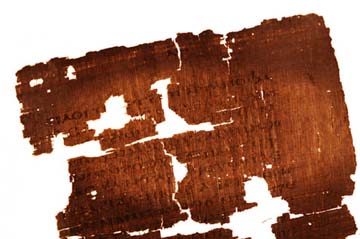
Papyrus scrap referring to the wife of Jesus. PHOTO: nytimes.com

A historian of early Christianity at Harvard Divinity School has identified a scrap of papyrus that she says was written in Coptic in the fourth century and contains a phrase never seen in any piece of Scripture: “Jesus said to them, ‘My wife …’ ”

Read the translated legible text and the entire article online in the New York Times.

Note from Bob Anderson: Be sure to read people’s comments following the article—some insights and several laughs!

Link submitted by Michael McIntyre