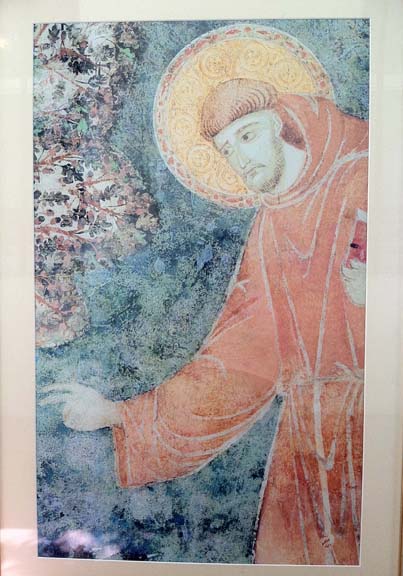
Detail of Francis from the fresco “St. Francis Preaches to the Birds” painted on the west side of the nave of the lower basilica in the Basilica of St. Francis in Assisi.
News of disturbances among the friars in Italy reached Francis in the East and compelled him to return: The two vicars-general whom Francis had left in charge of the Order had convened a chapter in his absence to impose innovations more severe than the rule required, and the papal protector, Cardinal Ugolino, had conferred on the Poor Ladies a written rule practically identical to that of the Benedictine nuns, which the friar charged with their interests had accepted. To make matters worse, one of the first companions of Francis was attempting to form a new brotherhood of lepers, and rumors were circulating that Francis was dead. Five thousand friars and five hundred novices were present at this famous Chapter of Mats held at the Portiuncola during the season of Pentecost 1220–1221. The simple and unceremonious ways that had characterized the movement disappeared. Cardinal Ugolino had undertaken the task of “reconciling inspirations so unstudied and so free with an order of things they had outgrown.”* It was on this occasion that Francis resigned direction of the Order.
In the last years of his life, while his fraternity was passing through its transition under papal influence, Francis grew increasingly ill. In the summer of 1224 he retired with some brothers to the rugged mountain retreat of La Verna (Alvernia), not far from Assisi, where it is said he beheld a marvelous “seraphic” vision. (After the death of Francis, Brother Elias announced to the Order by circular letter that as a sequel to the vision Francis had received the five wounds of the stigmata, and after the canonization of Francis, Brother Leo, the saint’s confessor and intimate companion, left a written testimony of the event.) Francis lived two years longer. At times his eyesight failed him and, during an excess of anguish, Francis paid a visit to Clare at St. Damian’s. There, in a little hut of reeds made for him in the garden, he composed the “Canticle of the Sun.” Not long afterwards, the pope ordered that Francis undergo an operation on his eyes which entailed cauterizing his face with a hot iron. Although the operation was unsuccessful, at the urging of others, Francis underwent further medical treatment until 1226, when alarming dropsical symptoms developed. He grew increasingly ill and was carried to his beloved Portiuncola, where he passed his last days near the chapel in a tiny hut that served as an infirmary. On his last day, Francis removed his shabby clothing and lay down on the bare ground in the form of a cross and, facing the sun, made his transition, asking that his soul be released from its prison.
On July 16, 1228, Francis was canonized by the newly elected pope, Gregory IX (the former Cardinal Ugolino, the papal protector of the Friars Minor) at St. George’s in Assisi. From that moment and for the next two hundred years, the influence of Francis and his name was the greatest power at work in the growing civilization of Europe. The Franciscan movement advanced with astonishing rapidity and, in the course of a few years, established over all of central Italy a network of religious houses in his name. The new pope saw in the mendicant Order a means for counteracting the love of luxury, a weapon for suppressing heresy, an army of soldiers ready to preach the gospel at the risk of their lives; and in the Third Order, unlike anything attempted before, he saw a way to draw laypersons from the entire continent into a magic circle supposed to secure the hereditary inheritance of Franciscan principles. Sporadic attempts to revive the authentic concepts of Francis, such as that of the spiritual Franciscans, met powerful resistance, and by the end of the fourteenth century, the movement had more or less spent its strength.
On the day following the canonization of Francis, Gregory IX laid the first stone of the church in Assisi erected to honor the new saint. That church grew into the Basilica of St. Francis, which became the birthplace of a new age in painting and European art. Frescoes were begun in the lower basilica around 1250. Within a few decades, the walls of the upper and lower basilica were covered with religious scenes illustrating the stories of the Bible and the lives of the saints. The life of Francis became a passionate tradition painted everywhere, full of color and dramatic possibilities, inspiring more iconographic cycles and more allegorical scenes than any other saint. And as the life of Francis brought about the birth of Italian art, his love of song called forth the beginning of Italian vernacular poetry: “The Canticle of the Sun” is one of the earliest poems written in Italian. Italian poets of the 13th- and 14th-century dolce stil nuovo (“sweet new style”), which reached its greatest brilliance in the lyric poems of Dante, have as their precursors Francis and the troubadours of Provence.
_______________________
* It is not difficult to recognize Cardinal Ugolino’s hand in the important changes made in the organization of the Order. And it is clear that the rule of the Brothers and Sisters of Penance, in the form it has come down to us, and confirmed by Pope Nicholas IV in 1289, does not represent the original rule. The customary date to assign for the foundation of this new Order—which was later used by the Roman Church to re-Christianize medieval society and whose members came to include Dante, Petrarch, Tasso, Giotto, Michelangelo, Christopher Columbus, and Galileo—is 1221.
—Robert Petrovich, 2003
* * *
REFERENCES
Historical sources on Francis are his own writings, as they are preserved, early papal bulls, and a few diplomatic documents. The Franciscan friar Thomas of Celano wrote his hagiographic “First Life” of Francis by order of Gregory IX soon after the canonization of Francis; a “Second Life,” which reflected the new official perspective in France, between 1244 and 1247 by commission of Crescentius, the then minister general of the Order; and a treatise on the miracles of Francis about ten years later at the bidding of John of Parma, the successor of Crescentius as minister general of the Franciscan Order. In addition to these Lives are a joint narrative compiled by his intimate companions Leo, Rufinus, and Angelus about 1246, a legend of Francis by Bonaventure about 1263, a more polemic legend attributed to Brother Leo, several 13th-century chronicles of the Order and a few later chronicles. Upon these works are based all later biographies of Francis. In recent years, a large controversial literature has grown up around them. In addition, energetic research work has recovered several important early texts and resulted in the careful reediting and translating of Francis’s own writings and of the contemporary manuscript authorities bearing on his life.
What still remains is to review the life and works of Francis in light of the Second Advent.