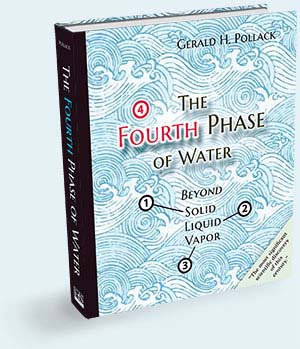
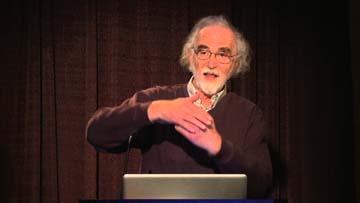
Gerald Pollack: “The Fourth Phase of Water” Part 4
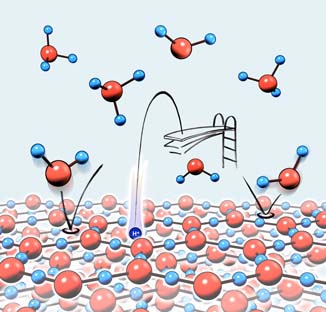
PHOTO: Ebner & Sons
What Cosolargists have to say on the 4th phase of water (aka vicinal water and EZ water):
The following is an email discussion between the Reverend Dr. Gary Buchanan, author of Sona and Sonatherapy, and physicist Dr. Stephan Fuelling on the 4th phase of water (aka vicinal water and EZ water):

PHOTO: Scribd.com
Reverend Dr. Gary Buchanan:
Pollack has done wonderful research on 4th-phase (EZ) water, and it is important, for sure. I have discussed a lot of this in my books, and in conversations with Dr. Pollack, of course.
The main point I perceive is that EZ water in the body, and on the surface of standing water, is that it is a negative ionic field that is impervious to solutes. That is, particles, bacteria, viruses, et al. have a difficult time penetrating that/those layer(s), if [they even can] at all. In other words, the natural state of the body’s interior is coatings of this kind of protective water.
What Pollack has proven is that LIGHT shining on EZ water increases the ion layers . . . up to a millionfold. This is to say, sunbathing and solar techniques almost certainly strengthen the 4th-phase water viscosity, thus providing additional protection from outside influences—disease, etc. Perhaps help better lubricate, etc.
The thing I have discussed with him personally is the application of sound waves/frequency combinations at different amplitudes: how may those affect the layers of the water, how does EZ water transport the phonons, different kinds of bosons, solitons, oscillons, etc.?
Unfortunately, he has not really followed up in that area, which would be tremendously helpful information in the vibrational healing field, obviously. He did put a speaker by some of the water, ionic layers observed under a microscope, and noted that the ionic field moved away from the sound/speaker. But, he was using a high-powered (big) speaker, with a huge electromagnetic coil, and employing extremely high and loud sound in the kilohertz range!
I suggested perhaps the reason the fields moved “away” was because of the huge coil next to the water—not [because of] the sound, per se. So, I suggested using a smaller speaker, at least six inches away from the water (to eliminate EM influences), and use normal sounds, e.g., within the human audible range, at low amplitude.
In recent correspondence he said he might look into that, if he has time!
Oh well, one tries.
Stephan, you might like to do a little experiment along these lines, as you have access to a lab and equipment. EZ water is easily available online from several places. The effects of light and sound on this vital water within the body may prove quite revealing and important to our understandings of health and healing, as well as solar techniques. “Baptism” may also be relevant; the global emphasis upon the healing and purifying qualities of water among religious orders, for example.
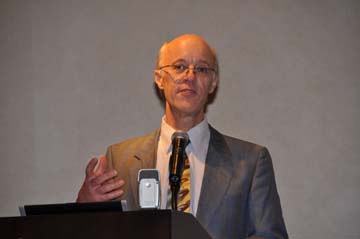
Dr. Stephan Fuelling PHOTO: Stephan Fuelling
Dr. Stephan Fuelling:
Infrared [IR] & sound must work even better! But the sound level can’t be too high, or it has to go from high to low over a treatment period. What I envision is that sound will shake the ‘frozen’ water layer and it may allow temporarily the mobilization of toxins that would otherwise be frozen inside the cell and enable them to get out. Then IR lamps are turned and the IR is absorbed and then the sound level is slowly diminished, which will promote the structured water to be built up again and that pushes the toxins out [of the cells and] into the lymphatic system, which also needs agitation, and the sound will do that, too.
I remember that infrared sauna is so good for detoxification, even of mercury. Could it be that the IR promotes the structured water and it pushes the mercury out of the cells??
If one would include rebounding on a little trampoline, maybe after the IR/Sona therapy, then this will activate the lymphatic system on a larger scale, meaning that the fluid is transported out of the lymph and into the bloodstream, where the liver and kidneys can remove it.
I read the fascinating story about Dr. T.C. McDaniel with his cardiovascular problems that he had when he was 57. He must be 99 years old now, and he retired just a few years ago! He sells an anionic surfactant that helps stabilize the Zeta potential in the blood. This is the other extreme: the blood must be in a highly liquid state, and NOT structured like the water in the cells! Here the water is used to transport nutrients and oxygen and to get toxins removed from the cells.
The two systems go hand in hand but with quite opposite states of water. The water in the cell – highly structured – and the water in the blood – highly liquid state – two opposite extremes but both extremely important for good health.
PHOTO: Scribd.com
Reverend Dr. Gary Buchanan:
Yes, Stephan. Pollack talks about using IR on the water.
Of course, the problem I have researched is that IR has an immediate, beneficial effect, certainly. However, prolonged usage can begin tearing down the cells! Red stimulates dramatically, so cell stimulation is a given. However, once set into motion that speeding-up can often lead to rapid “dying-off.” (Niels Bohr stuff). Once turned on, those cellular energies are difficult to manage. This is why in therapies I normally use orange, orange-lime, etc. Stimulation, but moderate.
And, sure, the blood is a different type of water structure from that of the vicinal waters, which is why it would be so nice to do microscopic analyses with sound and light on the different kinds of bodily fluids, cells, etc.
It would also be quite interesting to see what [founder of Cymatic Therapy, Dr. Peter] Manners’ “detox” commutations [healing frequencies] do in that regard!