“Tools are Tools”

2013-REP-Harold_Boulette_Solar_Wind


Fasts and vigils, the study of Scripture, renouncing possessions and everything worldly are not in themselves perfection, as we have said; they are its tools. For perfection is not to be found in them; it is acquired through them. It is useless, therefore,to boast of our fasting, vigils, poverty and reading of Scripture when we have not achieved the love of God and our fellow man. Whoever has achieved love has God within himself and his intellect is always with God.” ~The Philokalia

“Just as some people will treat a national flag as a thing of worship, some people who consider themselves spiritual or religious think they are being holy when they act as if the tools used for spiritual growth are themselves divine. We especially see this in many Christians who treat the Bible as if it is actually God rather than simply a book about God and his prophets. Many Muslims act the same with the Koran, even threatening death to those who deface or destroy a copy of it, a book, as if it were indeed God and therefore of more value that a human life.”


< Read the entire article online at Solar Wind. >


< Visit and bookmark Harold Boulette’s blog Solar Wind at: http://blog.spiritsun.net/ >


contributed by Harold Boulette


ADVOCATES FOR HUMAN SPIRITUAL RIGHTS: Nestorius, Part 2


In such wise as the corruptible body is one thing and further the immortal soul is another thing, yet one man is constituted of them both, so from the mortal and the immortal, from the corruptible and from the incorruptible, and from what is subject to beginning and from the nature which has no beginning, that is, of God the Word, I confess one prosôpon of the Son.
– from a homily of Nestorius called “Concerning the Faith”

First Acts

Bust of Emperor Theodosius II

Bust of Emperor Theodosius II

The fate of Nestorius is sealed long before the Council of Ephesus opens. Emperor Theodosius II nominates Nestorius, the pupil of Theodore of Mopsuestia, a teacher for whom the emperor’s grandfather had the greatest respect, for the position of Bishop of Constantinople. The nomination is part of a deliberate plan to weaken the political influence of his older sister, Pulcheria, who had gained effective control over imperial affairs and all the powerful parties of Constantinople while acting as his guardian for years until he came of age. The debut of Nestorius – an unknown outsider whose temperament does not permit him to undertake things gradually – is a storm of zeal to inaugurate a new age of reform and doctrinal purity within Byzantium. From the outset, his naivete and lack of political experience set him at odds with the populace and with some of the most prominent and influential individuals in Constantinople.

Immediately he takes steps to suppress the assemblies of Arians, Novatianists, and Quartodecimans, and the followers of Macedonius. Of the groups considered heretical in the West, he will favor only the Pelagians; several Pelagian bishops receive refuge with him at the capital as they had received refuge at Mopsuestia with his mentor Theodore years before. Nestorius next takes action against the immorality of Constantinople’s theatrical entertainers; this irritates the nobility, as does his attempt to disconnect monks in the empire’s archiepiscopal see from the day-to-day affairs of the capital and from close relationships to members of the nobility. The new regulations of Nestorius humiliate the monks of Constantinople, outrage the aristocracy, and belittle the emperor’s sister, who is the monks’ strongest supporter. Within a few months, all these powerful groups become his adversaries.

Next, as the spiritual father and pastor of the most influential city in the world, Nestorius devotes his strength and resources to articulate and vindicate those points of doctrine that he considers to be most in danger of misunderstanding. One of these is the notion, commonplace in fifth-century Constantinople, that Mary gave birth to God when she gave birth to her son Jesus, a notion that Nestorius fears may engender a false doctrine of the relationship between the human and the divine. In November 428, six months into his term as Bishop of Constantinople, a presbyter whom Nestorius has brought with him from Antioch preaches against the popular use of the epithet Theotokos (Èåïôüêïò, “God-bearer”) with reference to Mary, the mother of Jesus. A crisis develops. Nestorius silences the protesters by force, and on Christmas Day he begins a course of sermons in the chaplain’s defense. Faithfully following Theodore of Mopsuestia’s christology to a logical conclusion, Nestorius declares that the Divine Nature cannot be born any more than it can die, that the human nature of Jesus was born of Mary while the Divine Nature was not. Further, he risks explaining the mystery of the Incarnation as a prosopic union in terminology easily misunderstood. Then to appease and at the same time correct his vast congregation, Nestorius gives them permission to call Mary Christokos, “Christ-bearer,” saying that while it is theologically correct to say “Christ was born of a woman” it is not orthodox to say “God was born of a woman.” The faithful of the city, who often call Mary Theotokos in songs and prayers, are surprised that the newly appointed bishop of their city should stand up in the cathedral and order them to stop it. Alexandrian spies, no doubt, are both shocked and delighted.

That Spring on the Feast of the Annunciation—the celebration of the incarnation of Jesus in the womb of Mary—Proclus, the unsuccessful rival of Nestorius for the position of Bishop of Constantinople a year before, preaches in the cathedral at Constantinople before the patriarch Nestorius at the latter’s invitation. Proclus so firmly asserts the propriety of the epithet Theotokos in his sermon that Nestorius is constrained to rise from his patriarchal throne during the service and reply. A few weeks later, during Eastertide, Nestorius addresses Proclus in three sermons and then writes his arguments into a circular Easter letter, which makes it official: The Patriarch of Constantinople considers reference to Mary as Theotokos to be a heresy. Alexandrian agents in the capital begin to set up anonymous placards near the churches throughout the city juxtaposing phrases from Nestorius with sayings of the old Antiochene heretic Paul of Samosata. The placards draw attention, and people in Constantinople begin to gossip about Nestorius’s flawed orthodoxy.

Cyril of Alexandria, painted by Rousanu

Cyril of Alexandria, painted by Rousanu

Matters are ripe for foreign intervention, and the antagonism and jealousy of the Alexandrian school toward the Antiochene school find determined and unscrupulous expression in Cyril, the new Bishop of Alexandria, who is as eager to get rid of Nestorius as his predecessor had been to get rid of the Antiochene patriarch and reformer John Chrysostom, who in 403 was deposed and led to die in exile, as Nestorius will be.

In June, after Pentecost, Cyril sets into motion the series of events that will lead to the downfall of Nestorius: He stirs up his own clergy, encourages dissidents at Constantinople, begins a vigorous correspondence with bishops around the Roman Empire and, by beggaring the clergy of his own diocese to bribe the officials of the imperial court, manages to address himself to both the sister and the wife of the Emperor Theodosius. The emperor’s sister and the rest of the aristocracy, the monks, and the populace of the capital are collectively driven by abhorrence of their bishop and personalize it in the zeal of Cyril to challenge Nestorius.

Celestine I, Bishop of Rome

Celestine I, Bishop of Rome

The next year, around Easter, Cyril sends a letter to Celestine, the Bishop of Rome, and encloses a careful selection of the writings of Nestorius. Cyril appeals to Celestine to hold in his city a council to settle the controversy. Celestine, who appreciates being asked to take precedence over the Bishop of Constantinople, is delighted. At about this same time Nestorius is approached by the Pelagian exiles, who have been designated as heretics in Rome but whom he has received favorably; Nestorius takes the occasion to write to the Bishop of Rome concerning them and to give his own account of the dispute. Celestine naturally resents any questioning of his Roman decision concerning the Pelagians; that summer at a church council in Rome, Celestine makes the determination that correct Christology requires the use of the term Theotokos. Celestine condemns Nestorius and instructs Cyril to carry out the sentence. With Celestine’s letter in hand, Cyril pressures the emperor, who reluctantly agrees to convoke a council on the assumption that Nestorius and the Antiochene tradition will be vindicated thereat. The council is to be convened at Ephesus on Pentecost.

Cyril sends out a synodical letter, his third against Nestorius, with twelve anathemas, or denunciations, attached. In December, Nestorius receives Cyril’s letter and Celestine’s sentence of excommunication (which cannot immediately be put into force owing to the imperial letter calling the council). Nestorius preaches two new sermons and sends them with counter-anathemas to Cyril; then, with the aid of Cyril’s list of anathemas, he wins over John, the Bishop of Antioch, who enlists the Bishops of Samosata and Cyprus on the side of Nestorius.


“Catch late summer and fall sun rays to experience significant health benefits”


PHOTO: Naturalnews.com

PHOTO: Naturalnews.com

“The power of the sun for health and healing are far reaching. Optimal times to store up on the sun’s health benefits are between 10am and 3pm. Overwhelming research shows that sunlight improves mood, athletic performance, blood pressure, immunity and bone health while helping to prevent cancers, heart disease and autoimmune disorders. Humans cannot survive without the sun. They have evolved to absorb the sunrays needed according to their proximity to the sun.”

< Read the entire article by Michelle Goldstein posted online September 14, 2013 at naturalnews.com. >


link submitted by Frieda Nelson


“The Soul Owner’s Manual”


2013-REP-Harold_Boulette_Solar_Wind

  1. Awakening
    When you arrive on the physical plane of existence, your soul is in a state that is described as inactive, comatose, egg-like, etc. It needs to be awakened before it can truly function, grow, and guide your life. Sadly, the vast majority of people never bother to do this, either because they don’t believe they have a soul, or they believe that it will awaken on its own without any effort on their part. This simply does not happen. You do have to make an effort to awaken the soul, although you cannot do it on your own. The only one who can truly awaken the soul is God, but he will not do so unless you do your part to prepare for that awakening. If you do follow the practices that only a good spiritual teachers can recommend, then God will send a special energy into the soul to awaken it and make it conscious. This is what is really meant by being reborn.
  2. Nourishing
    Once awakened, the soul and spirit need to be nourished and cared for just as the physical body and mind do. The method is different, however, because the nature of the spirit and soul is different than the nature of the material body and the brain-mind. We feed the physical body and brain by consuming animals and/or plants. We feed the spirit and soul with spiritual Light. The feeding of the physical body is not a process that just happens on its own. We need to seek nourishment for it. The same is true of the spirit and soul. We need to seek out the spiritual frequencies of Light that nourish them. Those frequencies are found primarily in the spiritual sun, but they will simply flow through us if we do not attune to them. And this needs to be regularly, not just once or twice a year.
  3. Cleansing
    Just as the physical body and mind need to be cleaned periodically, both internally and externally, the soul and spirit need the same. This cleansing of the spirit and soul is done partly on a mental level by visualizing and imagining that negativity and all forms of evil are being cleaned out of us. Sometimes we need to stimulate this process on the physical level by fasting and other forms of self-sacrifice. And when you bathe or shower, tell yourself you are cleansing your mind and spirit as well.
  4.   Educating
    You know that your brain/mind needs to be educated, but your body also needs to learn. When you are a baby, your movements are awkward and uncoordinated but after a while they get better as your brain gets better at controlling our movements. Your soul needs to be educated as well, but fortunately if you follow the recommendations for nourishing, you will be educating your soul at the same time because spiritual Light contains embedded information that we call Information Factors. While reading spiritual books is helpful, the most important thing is to take in that spiritual Light with its Information Factors which are never lies and never just opinions, but always truth.
  5.  Sharing
    Once you have achieved a certain degree of enlightenment and filled your spirit with the spiritual Light, you must share that Light with others who have not yet learned to get it directly. You are also obligated to teach others so they can grow spiritually as well. If you fail to do this, you will stop growing spiritually.


< Read the article posted online September 14, 2013 at Solar Wind. >


< Visit and bookmark Harold Boulette’s blog Solar Wind at: http://blog.spiritsun.net/ >


contributed by Harold Boulette


ADVOCATES FOR HUMAN SPIRITUAL RIGHTS: Nestorius, Part 1


Nestorius, Patriarch of Constantinople

Nestorius, Patriarch of Constantinople

 Nestorius (born circa AD 386, perhaps of Persian parents, in Germanicia, a small town in the patriarchate of Antioch on the fertile plain at the foot of Mount Tauras in the Euphrates district of Syria, now known as Kahramanmaras, South Turkey – died circa 451 at Panopolis, now Akhmim, in the desert of the Egyptian Thebaid) was consecrated Patriarch of Constantinople on April 10, 428 and served until June 22, 431, when he was deposed and later sent into exile. Little is known of the details of Nestorius’s life outside of the records kept in the months leading up to and during the council at which he was deposed. He received his education near Antioch, at the neighboring monastery of Saint Euprepius, probably as a pupil of Theodore, Bishop of Mopsuestia, the early companion and friend of the then late patriarch John Chrysostom. As a monk, Nestorius gained a reputation for asceticism and eloquence. Elevated to the coveted position of Bishop of Constantinople and Patriarch of the East, Nestorius was one of the last high official representatives of the catholic and orthodox Imperial Church to hold uncompromisingly to doctrines regarding the nature of Christ that are necessary tenets for one to recognize and acknowledge the manifestation of God as Christ in the Second Advent Age. In his capacity as bishop and defender of the faith, he upheld the doctrines of his teacher Theodore, who distinguished between the “man whom God put on” in the Incarnation and the Logos who put on the man, and who spoke of the divinity of Christ as an “indwelling” of the Logos in the man. For Nestorius, the Incarnation occurred for the purpose of revelation, and union in Christ was the perfect revelation of God. The opponents of Nestorius made of his position a heresy and used his name to anathematize those churches of the East that they could not reconcile to themselves by naming those churches for him. After Nestorius, catholic and orthodox doctrine promoted one or another conception of Jesus as man-God.


There is nothing harder to the souls of men than the sickness of ignorance.
– the opening of a homily by Nestorius

Council of Constantinople 381, fresco from Stavropoleos Church, Bucharest, Romania

Council of Constantinople 381, fresco from Stavropoleos Church, Bucharest, Romania

 The Imperial Stage
There are two dramatic elements at work in the theater of the christological controversy: imperious church councils and longstanding rivalries. Both play out across centuries and shape the tragic fate of our protagonist, Nestorius. General church councils mark the opening, the climax, and the denouement of the drama. The drama opens with the Council of Constantinople (381) requiring all those who would call themselves orthodox Christians to believe that Jesus Christ was and is God incarnate, and to confess that God is a single divine being eternally existing as three distinct persons or subsistencies. The climax of the drama takes place at the Council of Ephesus (431), which ends with all Christians of the Imperial Church bound to a dogmatic formula taken almost word for word from the letters written to Nestorius by his main antagonist, Cyril of Alexandria: “One and the same is the eternal Son of the Father and the Son of the Virgin Mary, born in time after the flesh; therefore, she may rightly be called Mother of God.” The denouement begins at the Council of Chalcedon (451), with the acceptance of the “Rule of Faith” expounded at Ephesus by Cyril and the adoption of a reconciliatory Definition of Christ, it continues to unfold over the next 1,543 years.

The second major element of the tragedy is the deadly rivalry between the Christian leaders of Antioch and Alexandria. The city of Alexandria, which at times rivaled Rome as cultural headquarters of the empire and to which theological focus shifted during the second and third centuries, envies the new upstart capital, Constantinople. Antioch, with less influence than Alexandria in the imperial scheme of things but with an old and venerable heritage as the first city where Christians were so called, looks to the new imperial city as a place to regain influence and power. Constantinople, with no great heritage itself, is the stage of action, a “power vacuum” to be filled: Whoever is Bishop of Constantinople is Patriarch of the Eastern Church.

At the council that opens the drama in 381, the christology of Apollinarius, the theological hero of Alexandria, is condemned. Antiochenes consider this a great victory; Alexandrians, a defeat. By the time Nestorius is appointed patriarch, Alexandrians are not only resentful about Apollinarius but fearful that their greatest hero, Athanasius, may too be criticized if not condemned. The appointment of Nestorius comes as a blow to the Alexandrian dream of domination but also as an opportunity to regain it, and Alexandrian spies lurk around the capital watching and waiting to catch Nestorius or some other Antiochene repeating some old Antiochene heresy.


JAPAN REPORT: Letter from Japan, April 2013

Syotaro Hagihara, Yukinori Matsushita, and Syotaro's mother Kuniko Hagihara PHOTO: Miyuki Okayama

Syotaro Hagihara, Yukinori Matsushita, and Syotaro’s mother Kuniko Hagihara PHOTO: Miyuki Okayama


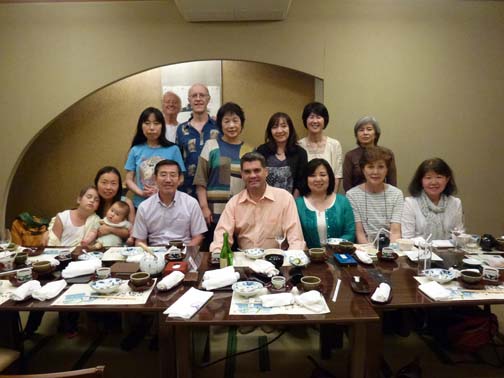
On April 6, 2013 we all celebrated the completion of the fifth class of Cosolargy students in Japan to complete the two-year course. The two members of this class were Kuniko Hagihara and her son Syotaro Hagihara.

Following the celebration, we held a social gathering in the seminar room.

Miyuki Okayama, Syotaro Hagihara, Yukinori Matsushita, and Kuniko Hagihara before the celebration PHOTO: Miyuki Okayama

Miyuki Okayama, Syotaro Hagihara, Yukinori Matsushita, and Kuniko Hagihara before the celebration PHOTO: Miyuki Okayama


Sincerely,

Miyuki Okayama


Moab Sunrise


Consociate Paul Schmittendorf taking in the sunrise at North Window in Arches National Park, Moab Utah PHTO: Paul Schmittendorf

Consociate Paul Schmittendorf taking in the sunrise at North Window in Arches National Park, Moab Utah PHTO: Paul Schmittendorf


Academy Consociate Paul Schmittendorf sent us this photo from his trip on the way to Reno to attend the 2013 Convocation. The photo was taken on the morning of Saturday, September 28, 2013 at the North Window in Arches National Park, Moab Utah. Paul told us “needless to say, it was a pretty magical place to see the sun rise.”

For those of you who don’t recognize Paul as the minute human being in the picture above, we are including the close up below to help you recognize him.

Paul Schmittendorf taking in sunrise at Moab (Detail)

Paul Schmittendorf taking in sunrise at Moab (Detail)


“Self-Control for Spiritual Growth”


2013-REP-Harold_Boulette_Solar_Wind


A clear rule for self-control handed down by the Fathers in this: stop eating while still hungry and do not continue until you are satisfied. When the Apostle said ‘Make no provision to fulfill the desires of the flesh’, he was not forbidding us to provide for the needs of life, he was warning us against self-indulgence. … If we avoid avarice not only by having no money, but also by not wanting to have any, this leads us toward purity of soul. Freedom from anger, from dejection, self-esteem and pride also contributes to purity of soul in general.” ~The Philokalia 
 
 
“Self-control isn’t about denying the needs of the body and mind, but rather denying the whims and desires. We all practice self-control to some degree, but if we are pursuing a spiritual path, it is important that we control our desires and whims even more.”


< Read the entire article online at Solar Wind. >

< Visit and bookmark Harold Boulette’s blog Solar Wind at: http://blog.spiritsun.net/ >


contributed by Harold Boulette


“It Takes Practice”


2013-REP-Harold_Boulette_Solar_Wind


 We have already agreed that, if we wish to grasp the real character of spiritual life, we must avoid the temptation to look at it as merely a historic subject. If it is what it claims to be, it is a form of eternal life, as constant, as accessible to us here and now, as in any so-called age of faith: therefore of actual and present importance, or else not at all. This is why I think that the approach to it through philosophy and psychology is so much to be preferred to the approach through pure history.” ~Evelyn Underhill

Of course it is useful to the spiritual student to study the history of spirituality and religion, but that alone is not enough to cause spiritual growth or lead to true enlightenment. If your goal is to become wealthy, just studying the history of wealth or reading the biographies of wealthy people will not make you wealthy. You need to do certain things to become wealthy, not just read about it. You need to practice a great deal to become an Olympic athlete, not just read about the history of the Olympics.

This is even truer with spiritual studies than with other disciplines for the simple reason that only the basic spiritual studies and techniques are ever written into books. The more advanced teachings are not written down, or are hidden in cryptic language that requires knowledge of the interpretation key to understand much like an encrypted file on a modern computer cannot be read unless you have the decryption key that will unscramble it. So much of the advance spiritual training must come verbally from a spiritual teacher who has that knowledge.


 < Read the entire article online at Solar Wind. >


< Visit and bookmark Harold Boulette’s blog Solar Wind at: http://blog.spiritsun.net/ >


contributed by Harold Boulette


Open House, Health Fair & Expo: October 6, 1-5 PM

STOCK-REP-Steamboat.1930s


Give yourself the tools to be healthy!

Are you looking for a fun afternoon? Come join us OCTOBER 6 from 1 to 5 PM for expert advice , therapy demonstrations, vendors, food, music, prizes and much more. Take some time and enjoy learning what Steamboat Hot Springs Healing Center is all about.

CO-SPONSORS
+ Electric Blue Elephant Vegetarian & Vegan Restaurant
+ Steve Starr Entertainment
+ Swill Coffee & Wine


PROGRAM OF EVENTS from 1 to 5 PM
+ Facility tours ongoing every 20 minutes
+ Therapy demonstrations every 15 minutes:
– Sound Table/Spectrum therapy demos
– Reflexology Massage demos in Tahoe Room
– Chair Massage demos in Manzanita Room
– Aromatherapy Massage demos in Aspen Room
– Energy Work demos in Truckee Room

+ Expert Speaker Presentations:
– 1:15-1:45 PM- Pearl Laperla – “What You Need to Know About Your Immune System to Survive in the Future”
– 2-2:30 PM – Michelle Smith & Sue Bello – “How to Kick Your Cravings and Get Back Into Your Life”
– 2:45-3:15 PM – Rebecca Willis – “History of Steamboat Springs”
– 3:30-4 PM – Tina Mokuau – “Enhancing Your Beauty with Simple Makeup”
– 4:15-4:45 PM – Gary Robert Buchanan – “Using Sound, Light, Color, Geothermal Water and Subtle Energy for Healing”

+ Vendors:
– Bella Bucha Kombucha
– Juice Plus
– The Makeup Artist (Tina Mokuau)
– Oceans of Youth
– Om Home
– Purium
– Reno Hypnosis Center
– Roxxy Star Cosemtics
– Yoga for Kidz

 PLUS. . . ongoing RAFFLE PRIZES given out throughout the event.

Call (775) 853-6600 for more information.