“Issues with Self-esteem”

2013-REP-Harold_Boulette_Solar_Wind


 Our seventh struggle is against the demon of self-esteem, a multiform and subtle passion which is not readily perceived even by the person whom it tempts…. The vice of self-esteem, however, is difficult to fight against, because it has many forms and appears in all our activities – in our way of speaking, in what we say and in our silences, at work, in vigils and fasts, in prayer and reading, in stillness and long suffering. … When it cannot seduce a man with extravagant clothes, it tries to tempt him by means of shabby ones. … When it cannot puff him up with the thought of his luxurious table, it lures him into fasting for the sake of praise. …
The person who wants to engage fully in spiritual combat and to win the crown or righteousness must try by every means to overcome this beast that assumes such varied forms.” ~The Philokalia

“This seems like an odd complaint to many of us today because our modern society has pushed the idea of self-esteem as a virtue. Our public schools in particular have pushed the idea that self-esteem is such a wonderful thing that we all need lots of it and every student in their schools is given piles of it for virtually nothing.”


< Read the entire article online at Solar Wind. >


< Visit and bookmark Harold Boulette’s blog Solar Wind at: http://blog.spiritsun.net/ >


contributed by Harold Boulette


PATH TO LIGHT: Emanuel Ratliff


Akhenaton and Nefertiti

Akhenaton and Nefertiti


This magical story begins in the deep south of Louisiana; particularly, the 9th ward of New Orleans. A little boy named Ernesto and his siblings were playing among themselves in the hot summer Sun. While playing marbles with his siblings, Ernesto suddenly stood up and decided to look at the Sun. The moment Ernesto glanced at the brilliant and scintillating light of the Sun, his life was immediately changed forever. To the boy’s surprise, the Sun actually answered him! The Sun told Ernesto that his uncle had just passed away and that he should tell his mother the sad news.

Ernesto quickly ran inside the house to deliver the sad news to his family. Ernesto’s family questioned him as to why he was not playing with the rest of his siblings. Ernesto exclaimed that he had important news to deliver to his mother. All ears were on the boy waiting to hear the important news. Ernesto stated with a sure and calm voice, “Uncle just passed away today.”

Ernesto’s mother was deeply saddened by the news because she believed her brother was still alive in the hospital. She asked Ernesto who told him this news. Ernesto explained that the Sun in the sky told him the news. Suddenly, the neighborlady across the street called Ernesto’s mother to her house because she had had a phone call from the hospital where Ernesto’s mother’s brother had been admitted (during those times, not everyone had a phone in their house). The doctors told Ernesto’s mother that her brother had just passed away about an hour or so ago. The voices in the room fell silent as they could not believe what they have just heard. From that moment on, Ernesto’s life changed dramatically because he had the “gift.”

In New Orleans, it is assumed that when a baby is born with a veil (caul) over his\her face, he\she will have supernatural powers. Mostly in African American culture, it is an omen that the boy will be able to speak to invisible entities. Ernesto happened to be born with a veil over his face but didn’t show signs of psychic prowess until the age of three. Ernesto was able to communicate with the so-called dead and could foretell events before they occurred. Ernesto became an exceptional, gifted child and excelled in any activity he put his hand to. Throughout his life, paranormal activities never ceased to happen to him and actually became stronger as he matured.

Ernesto became very confused about his life and why he was given this “gift.” Christianity couldn’t answer any of his pending questions. He therefore went to find his own path. He studied different cultures who used the Sun and discovered that the Christian Bible did in fact contain truth about a solar culture. Ernesto studied vigorously throughout the night, attempting to break this code for the purpose of inner truth. His bones ached terribly, and his feet began to swell from sitting in the same position for a long time. Ernesto persisted, and he did finally find the answer he was looking for.

Unfortunately, no one would believe the wonderful news he discovered buried in the texts of the New and Old Testaments. Ernesto was viewed by his fellow men and women as a lunatic and false prophet. He was disdained by the same society he grew up in. Although he received resistance from his community, he still persisted, unnerved by their comments. Ernesto believed that the true “Sun God” would reveal himself again as he had when Ernesto was three. Sure enough, the Sun would appear to him in the form of a spirit.

While sleeping next to his wife, Ernesto was approached by a spirit concerning the birth of his third son. The spirit informed Ernesto that the child would be born out of the “word.” The baby’s birth will be mythical since he will be born on the same day as his mother. Ernesto quickly awakened his wife to alert her to the news. Ernesto’s wife, Joanie, could not believe that the dream was really a prophecy. Joanie rubbed her stomach and said, “I believe our next child will be a girl, because I’ve been waiting on this one. I can feel it!” Despite Joanie’s beliefs, she did have a son on the 24th of June, which is her birthday. The child’s birth was normal like any other child’s. His pigmentation was lighter than most African Americans, but that was a common occurrence in Ernesto’s family.

As soon as the new baby was brought home, Ernesto dedicated his new child to the Sun of Righteousness. From that day forward, the child’s life would be directed by the will of “spirit.” Although the names have been slightly altered, the story is true. This is my story and this is how I found the Jamilian University of the Ordained. I was called to this school by unexplainable circumstances that are too difficult to explain because of the limitations of human speech. I am not concerned with how I came into being but more or less how I can further my knowledge about the universe around me. I would rather live in the now than obsess over a divine birth. As most people have come to know, even Jesus (Yeshua) had to learn a thing or two in the so-called “mystery schools” before he could perform miracles. From living on this Earth for such a short time, I have come to find out that we are made up of this divine cosmic stuff. God, for lack of a better word, is in us all. It shines light on all of us, rich or poor, black or white. Of course this is obvious and well-known information. Nothing is new under the Sun, as the saying goes. I look forward to my journey and accept any challenges that await me. With every defeat, there is victory and understanding that emerges from the tears of failing.

I would like to thank the editor of the Community Communiqué for allowing me to publish my thoughts. I would also like to thank all of the readers who took the time to hear the words from my heart. God bless you all.

With the deepest love,

Emanuel Ratliff
(Community member since September 2013)


ADVOCATES FOR HUMAN SPIRITUAL RIGHTS: Nestorius, Part 5


*

When therefore I had seen that these things were brought to pass by God, would you have wished that I should be silent and hide such a dispensation of God as all this? . . . The prophets of God, who had been cursed as lying prophets by lying prophets . . . would not have been distinguished, unless they had consented to be cursed by lying prophets for the sake of God.
– from The Bazaar of Heracleides

Mar Dinkha IV (2008)

Mar Dinkha IV (2008)


John Paul II (1993)

John Paul II (1993)

The entire dramatic action of the Nestorian controversy played out over fifteen centuries on several continents and reached an inglorious conclusion as a footnote of 1994. In that year, the modern representative of the Syriac Church, Mar Dinkha IV, Patriarch of the Church of the East, signs the “Common Christological Declaration” with Pope John Paul II of the Roman Church. The declaration does not mention Nestorius by name but does vindicate the term Christotokos by both churches. In addition, the Holy Synod of the Church of the East unilaterally decides to remove from its liturgical books and official publications all negative references to Cyril, who had been canonized a saint by the Western Church.

* * *


Nestorius, Patriarch of Constantinople

Nestorius, Patriarch of Constantinople

The writings of Nestorius, originally very numerous, were condemned to be burned by imperial edict in 435. The few works of Nestorius that are extant are the product of or derived from his engagement in the ecclesiastical polemics of 428–431: fragments of letters preserved among the works of those to whom they were written, some sermons collected in Latin translation by an African merchant doing business in Constantinople during the time of the dispute, a liturgy attributed to him that is still used in the Church of the East for five days of the year, and a pseudonymous and autobiographical account of the whole difficulty supposed to have been written by him (The Bazaar of Heracleides) and which was preserved in a single mutilated manuscript of styleless Syriac translation for several hundred years in a monastery in the Euphrates valley. In the fourteenth century, in addition to these, a collection of letters and a collection of homilies were still extant. They have since been destroyed in wars and natural catastrophes. The writings of the teacher of Nestorius have suffered a similar fate. Theodore of Mopsuestia, hailed as a great orthodox biblical scholar and theologian during his lifetime, was condemned as a heretic more than one hundred years after his death (at the fifth general council under the influence of Emperor Justinian in 553) because he was perceived to be a precursor of the heresy of Nestorius. From that time, even his name disappears in the West; and of the Syriac translations of his work, which once filled forty-one tomes, today only one remains.

Robert Petrovich
October 2005


“The Need to Share Our Light”


2013-REP-Harold_Boulette_Solar_Wind


 “And the third feature we notice about these men and women is that this new power by which they lived was, as Ruysbroeck call it, ‘a spreading light.’ It poured out of them, invading and illuminating other men so that, through them, whole groups or societies were re-born, if only for a time, on to fresh levels of reality, goodness and power. There own intense personal experience was valid not only for themselves. They belonged to that class of natural leaders who are capable of infecting the herd with their own ideals, leading it to new feeding grounds, improving the common level. It is indeed the main social function of the man or women of the Spirit to be such a crowd-compeller in the highest sense; and, as the artist reveals new beauty to his fellow men, to stimulate in their neighbors the latent human capacity for God.” ~Evelyn Underhill

“It is indeed important when we become full of spiritual light, that we share that light with others around us. It is likewise important that we share the divine knowledge that we call information factors found in that light. In short, the path of enlightenment is always the path of a teacher.”


< Read the entire article online at Solar Wind.


< Visit and bookmark Harold Boulette’s blog Solar Wind at: http://blog.spiritsun.net/ >


contributed by Harold Boulette


ADVOCATES FOR HUMAN SPIRITUAL RIGHTS: Nestorius, Part 4


But I have endured the torment of my life and all my fate in this world as the torment of one day and lo! I have now already got to me the time of my dissolution, . . . [and mine] eyes have seen the salvation of God.
– from The Bazaar of Heracleides

Exile

Schenoute I

Schenoute I

 In August 435 an imperial edict proscribes the writings of Nestorius and any meetings of his followers; Nestorius himself is dragged from retirement and banished to Petra in Arabia; a second decree sends him to the Great Oasis in the Libyan desert, known now as the Oasis of Kharijah. How Nestorius spends the remainder of his days is somewhat uncertain, but we know that at some point he is carried off in a raid by either Nubians or the Blemmyes and set free again circa 450 in the Egyptian Thebaid, with his hand and one rib broken. Nestorius gives himself up to the governor at Panopolis in order not to be accused of having fled, and then, there in the desert inhabited by thousands of orthodox monks and nuns in a city of monasteries, his persecution continues at the hand of Schenute (Shenoudi), the hero of the Egyptian monks, appointed by Cyril in 431 to act as archimandrite at the council that condemned Nestorius. In Panopolis Nestorius dies, still defending his doctrinal position. It is there in Egypt, probably during the final year of his life, that Nestorius writes The Book of Heracleides of Damascus (mistakenly translated into Syriac as The Bazaar of Heracleides), a pseudonymous defense of his teaching and a history of his public life.

Council of Chalcedon (October 8–25, 451)
After the death of Nestorius’s principal antagonist, Cyril, in 444, the ecclesiastical balance of the Imperial Church suffers another turn of events. At the so-called Robber Council of Ephesus (449), Cyril’s successor in Alexandria deposes the Bishop of Tyre, who was once a friend of Nestorius, and the Bishop of Edessa, who is known in his city as a great teacher, together with the Bishop of Cyprus and the new Bishop of Antioch, the nephew of John. Two years later, the new empress, the older sister of Theodosius II, succeeds her brother after his early death in a horse-riding accident and summons a council to meet at Nicaea. When the Hunnic invasion of Rome that year prevents the imperial representative from reaching Nicaea for fear of the Huns in Illyricum, he orders the bishops to move the council to Chalcedon. This council endorses a letter written by Leo, the new Bishop of Rome, in which he uses the term “Mother of the Lord”— somewhat as Nestorius had originally wished. At this council, the Bishops of Edessa and Cyprus both take the view that Leo’s Roman perspective helps rehabilitate Antiochene theology, and both bishops are restored to their sees. If we may believe the final pages of The Bazaar of Heracleides, Nestorius too rejoices at this reversal of Roman policy from the perspective of his exile during the last days of his life.

Missions East

Theodore of Mopsuestia

Theodore of Mopsuestia

 In the Syriac-speaking world of the fifth century, Theodore of Mopsuestia was held in high esteem, and the condemnation of his pupil was not well received. After the deposition of Nestorius, whose doctrines had been theirs since the first century, a Great Syriac Church built up, and the Sassanid Persian kings, then at war with Byzantium, used the opportunity to assure the loyalty of their Syrian Christian subjects by supporting the division between the churches of the East and West: They granted protection to the adherents of Nestorius (462); they executed the pro-Byzantine Catholicos and replaced him with the bishop of the Persian city of Nisibis, Bar Sauma (484); and when the Byzantine emperor closed the school of Edessa for its heretical tendencies (489), they allowed the transfer of the school to Nisibis. After 489, the Church in Persia, which then called itself Chaldean, practiced an autonomy like that of the old eastern patriarchates. They did not accept the Councils of Ephesus and Chalcedon, and the great doctor of their school was Theodore of Mopsuestia. From the monastery of Beth ‘Âbh in Mesopotamia under the Sassanids, many missionaries traveled east into Asia from the sixth through the eighth centuries, even reaching China in 635.

Monastery Beth 'Abhe

Monastery Beth ‘Abhe


JAPAN REPORT: Letter from Japan, May 2013


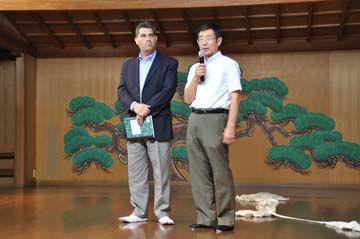
The 2013 Japan Seminar Tour was held May 25-26.

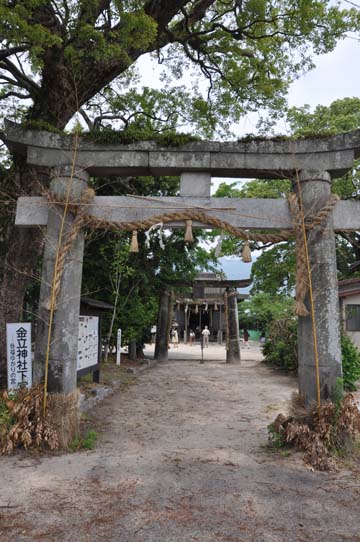
On May 25, we visited the Kinryu shrine.


Gene Savoy Jr. and daughter Sabrina entering Kinryu Shrine PHOTO: Miyuki Okayama

Gene Savoy Jr. and daughter Sabrina entering Kinryu Shrine PHOTO: Miyuki Okayama


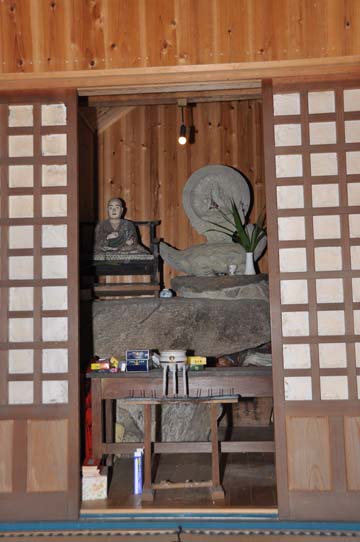
Shrine interior showing Kobo Daishi (Kukai) and Benzaiten, the goddess of eloquence, music, and wisdom PHOTO: Miyuki Okayama

Shrine interior showing Kobo Daishi (Kukai) and Benzaiten, the goddess of eloquence, music, and wisdom PHOTO: Miyuki Okayama


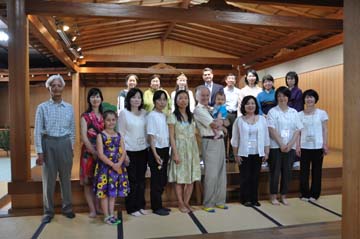
Members of 2013 Japan tour group gather outside the shrine  PHOTO: Miyuki Okayama

Members of 2013 Japan tour group gather outside the shrine PHOTO: Miyuki Okayama


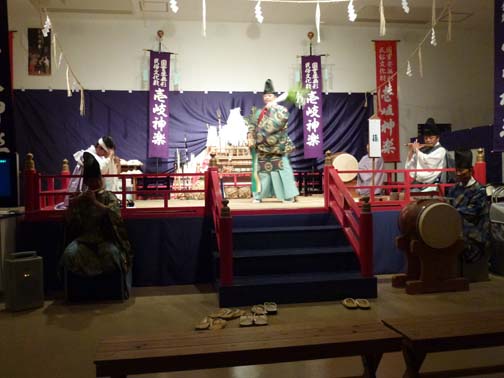
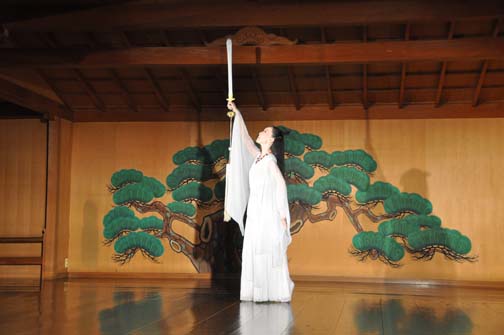
After that, we admired dedication dancing by Mizuho Asano. 

Performance stage for traditional dancer Mizuho Asano PHOTO: Miyuki Okayama

Performance stage for traditional dancer Mizuho Asano PHOTO: Miyuki Okayama


Members of 2013 Japan tour with dancer Mizuho Asano (second row center) PHOTO: Miyuki Okayama

Members of 2013 Japan tour with dancer Mizuho Asano (second row center) PHOTO: Miyuki Okayama

 Then Bishop Gene Savoy Jr. announced the publication of the Japanese version of the book Project “X”: The Search for the Secrets of Immortality, titled in Japanese Project Sun.


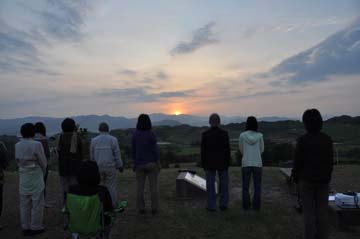
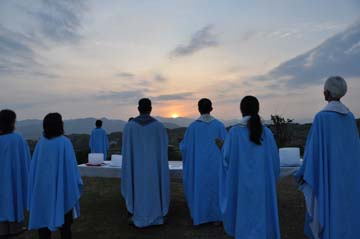
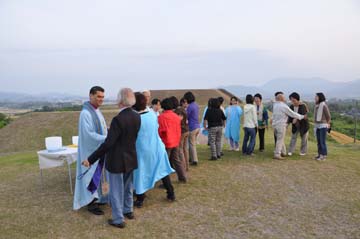
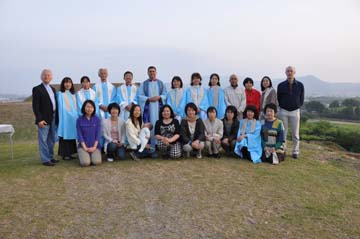
On May 26, we performed the ceremony of the Sunrise Service at the ancient solar site of Yaki-no-Touge.

Sunrise view at ancient solar site of Yaki-no-Touge PHOTO: Miyuki Okayama

Sunrise view at ancient solar site of Yaki-no-Touge PHOTO: Miyuki Okayama


Officiants at sunrise service May 26, 2013 at  Yaki-no-Touge PHOTO: Miyuki Okayama

Officiants at sunrise service May 26, 2013 at Yaki-no-Touge PHOTO: Miyuki Okayama


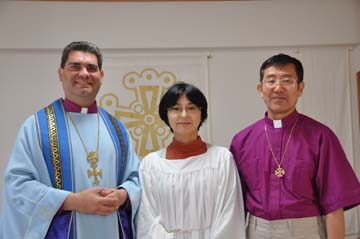
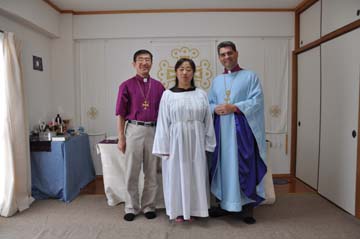
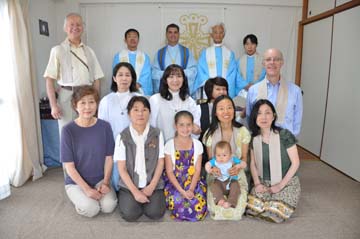
Later an Ordination service was performed at the headquarters of Cosolargy Institute in Japan for Akiko Takahashi and Junko Kodama.

Akiko Takahashi between Bishop Gene Savoy Jr and Bishop Yukimori Matsushita PHOTO: Miyuki Okayama

Akiko Takahashi between Bishop Gene Savoy Jr and Bishop Yukimori Matsushita PHOTO: Miyuki Okayama


Junko Kodama between Bishop Yukinori Matsushita and Bisho Gene Savoy Jr PHOTO: Miyuki Okayama

Junko Kodama between Bishop Yukinori Matsushita and Bisho Gene Savoy Jr PHOTO: Miyuki Okayama


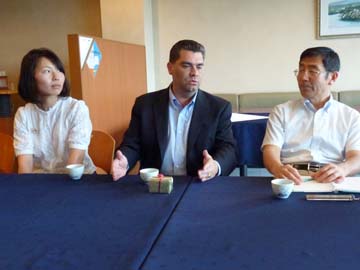
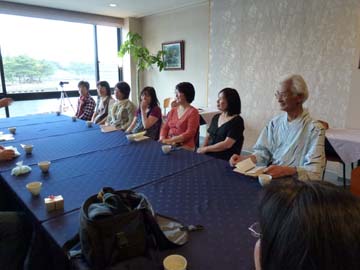
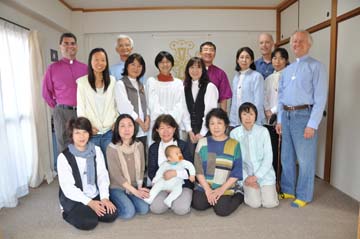
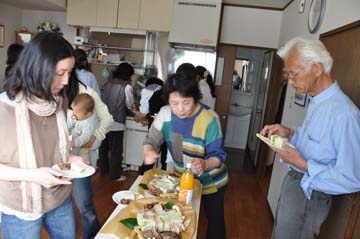
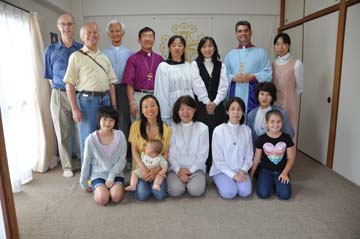
The service was followed by a social gathering at the headquarters.

Sincerely,

Miyuki Okayama


“The Importance of Symbols and Understanding Them”


2013-REP-Harold_Boulette_Solar_Wind


In a sense one has to pass beyond the ‘symbols’ used in religion to the reality that it represents. The symbols contain and convey something of the reality that they signify. The symbols are therefore to be integrated into one’s spirituality as one moves toward greater realization of the truth, since they are not a ‘false’ reality, merely and attempt t representing the true reality. The symbols of a religion are not to be regarded as the religion itself, but to be transcended in order to discover why the religion exists.” ~Dion A Forster

“Symbols are important in religion and spiritual schools because anyone can understand them. No matter what language people speak, no matter if they are illiterate, they can understand symbols.”


 < Read the entire article online at Solar Wind. >


< Visit and bookmark Harold Boulette’s blog Solar Wind at: http://blog.spiritsun.net/ >


contributed by Harold Boulette


2014 Peru Tour & Pilgrimage Announced

STOCK-REP-AEF-flags

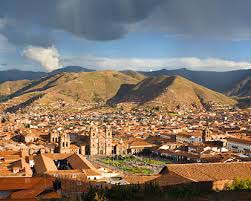
Sean Savoy, President and Chief Explorer of the Andean Explorers, revealed plans for a historic tour to ancient sites of Peru during the 2013 Convocation. The announcement was made on October 3rd as part of the “Solar Cultures of North America & the Sierra Seminar” at Camp Galilee, Lake Tahoe.

All Community members are invited to accompany the Peru Tour & Pilgrimage, which will take place in July 2014.

The Pre-Registration form provides an itinerary of the fascinating areas to be visited. Further details on the trip will be provided as arrangements develop.

< Click here to view or print a copy of the pre-registration form. >


ADVOCATES FOR HUMAN SPIRITUAL RIGHTS: Nestorius, Part 3


Every one, of whatsoever city it may be, who has suffered therein on my account, would not be giving light, even as the sun, if I had looked towards my accusers and not towards God and if also I had not been deemed worthy to be given a share in those things . . . brought to pass by God; for this affair is not mine but Christ’s who made me mighty.
– from The Bazaar of Heracleides

Representation of the Counceil of Ephesus 431, at the center Cyril of Alexandria shows the image of the infant and Mary, proclaiming her divine maternity. Image from the Church Notre-Dame de Fourvieres, Lyon, France

Representation of the Counceil of Ephesus 431, at the center Cyril of Alexandria shows the image of the infant and Mary, proclaiming her divine maternity. Image from the Church Notre-Dame de Fourvieres, Lyon, France

The Council of Ephesus (A.D. 431)
Soon after Pentecost, the bishops and imperial officials assemble at Ephesus. Only the famous Augustine of Hippo and the other bishops of North Africa are indisposed to attend, owing to the Vandal invasions of their territories. John of Antioch, held back by circumstances surrounding a drought in his territories, sends the message that he hopes to arrive in several days and not to wait for him to convene the council. Cyril and his followers, with the support of the Bishop of Ephesus and the populace of Ephesus, assemble in the Church of the Theotokos. Nestorius is summoned but refuses to attend until all the bishops are assembled. With the Gospels placed on the throne to represent the presence of Christ, Cyril proceeds to open the first session without delay. Creeds and letters are read at the first session. Cyril’s letters are received with acclamation, those of Nestorius with anathemas. The council deposes and excommunicates Nestorius. When John of Antioch and the bishops of the East arrive four days later, they immediately hold council to depose Cyril and excommunicate all those who will not repudiate Cyril’s twelve anathemas. Three days later, an imperial rescript arrives that rebukes Cyril for his haste and commands all the bishops to await the arrival of an imperial commissioner. Cyril continues the council anyway. Rome’s legates arrive and give their support to Cyril at a second session. During the fourth session, John sends the message that he refuses to have anything more to do with Cyril and his supporters.

In August, the imperial commissioner arrives. He deposes and arrests Nestorius, Cyril, and the Bishop of Ephesus; he also tries to persuade the Cyrillians to confer with the bishops of the East, who have drawn up a formulary of reunion, but the Cyrillians refuse and continue to stir up the clergy of Constantinople with their appeals. On September 11, the emperor receives seven delegates from each side at Chalcedon, but no agreement is reached. The emperor dissolves the council, sends Nestorius back to his former monastery at Antioch, per his request, and orders the consecration of a new Bishop of Constantinople, who proceeds to depose those bishops who continue to adhere to Nestorius. After the rival parties go home, Cyril is released from prison and, in October, arrives at Alexandria in triumph.

Rome, in exchange for the vote to depose Nestorius, gets Pelagius condemned by an ecumenical council and wins greater prestige in the East because Cyril, going over the head of the emperor, had appealed to the Bishop of Rome; in exchange for the vote to condemn Pelagius, the Alexandrians get Nestorius deposed, as well as Cyril’s explanation of the incarnation canonized over the doctrine of Nestorius.

The Reconciled and the Irreconcilable
In spring 432, the emperor suggests as a basis of reconciliation that the East give up Nestorius and that Cyril give up his twelve anathemas. By autumn, John of Antioch and a few others go ahead with the reconciliation; some waver; and others, like the Bishop of Hierapolis in Syria, stand out. Those for reconciliation send to Alexandria an envoy who brings the Formulary of Reunion and other propositions; when the envoy arrives, John is pressed to accept the deposition of Nestorius, whereupon he is received into communion at Alexandria and admitted to preach there on Christmas Day as an orthodox bishop. In 433 John and Cyril sign the Formula of Reunion, and it is ratified by the emperor. After this action is taken, whoever wishes to be part of the catholic and orthodox Imperial Church must, in their thought and speech, avoid denying the humanity of the rational soul of Christ and at the same time avoid dividing his two natures into two persons. Some bishops of the East acknowledge the orthodoxy of Cyril but refuse to accept the deposition of Nestorius; others denounce both. The following year, Proclus, the old adversary of Nestorius, is consecrated Bishop of Constantinople, and the emperor orders all bishops of the East to abandon their resistance to John and Cyril. Many obey, but eighteen are deposed; they are banished to the mines of the Egyptian Thebaid, as persecuted Christians in the Roman Empire had been since Diocletian.


“Alfredo Moser: Bottle light inventor proud to be poor”


PHOTO: BBC News Magazine

PHOTO: BBC News Magazine

“Alfredo Moser’s invention is lighting up the world. In 2002, the Brazilian mechanic had a light-bulb moment and came up with a way of illuminating his house during the day without electricity – using nothing more than plastic bottles filled with water and a tiny bit of bleach.

I”n the last two years his innovation has spread throughout the world. It is expected to be in one million homes by early next year. ”

< Read the entire article posted 12 August 2013 by Gibby Zobel BBC World Service, Uberaba, Brazil at the online BBC NEWS magazine. >


link submitted by Tom Fee