The Ark
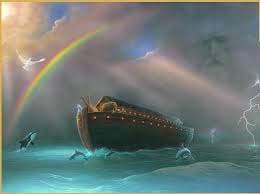
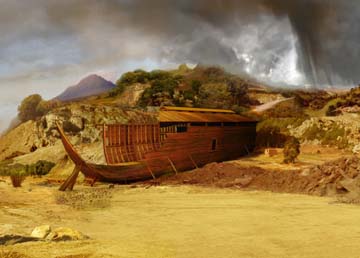
In Noah’s story (Genesis 6–8) we will begin with word ark. In Hebrew the word is tebeh, which frequently occurs in Noah’s story but appears only twice in the rest of the Old Testament (OT); both in Moses’s stream-drifting episode as an infant. So Tebeh is exclusive to Noah and Moses; all other accounts in the OT use the equivalent words boat, ship, or vessel.
Tebeh (Ark) has an explicit meaning, made up of the letters Tav, Bayt, and Hay:
Bayt—the archetypal container
Tav— the utmost resistance to influence or destruction
Hay— the essence/principle of primordial life
In other words: “The Ark is the most destruction-resistant archetypal container to support the essence of life.”
Noah in Hebrew letters is Noun and Hhayt:
Noun—individual existence
Hhayt— sphere for undifferentiated energy
In other words: “Noah is the embryo, the potential of every individual existence.”
Traditionally, each Hebrew letter also represents a number. Aleph was 1, bayt was 2, etc., with the second row of letters signifying a series of tens: yod was 10, kaf was 20 and so on. The third row designated numbers by hundreds. To differentiate a letter from a number in any text, a line was simply drawn under the letter. With this in mind we can look at the cubit dimensions of the Ark: 300 (Sheen) x 50 (Noun) x 30 (lammed):
Noun—individual existence
Lammed—controls/connects primordial movement
Sheen—Breath of God
“The Ark dimensions are the atmosphere for the individual to be moved by the Breath of God: a sacred place.”
When we put the Man Noah (the potential of individual existence) in the Ark (the most destruction-resistant archetypal container to support life) and add the ark dimensions (the atmosphere connected to the Breath of God), we can see the Ark is designed for a voyage that will exalt human potential. This is the blueprint for the entire episode of the Ark on the Flood Waters.
In constructing the ark, Noah is instructed to use “gopher” wood. The Hebrew word gopher (not to be confused with the English word for a certain rodent) appears nowhere else in the Hebrew Scriptures. A word that appears only once in a given document is called a hapax legomenon, a Greek term meaning “something that happens only once,” and is often abbreviated as hapax. Four hundred words in the Old Testament are true hapaxes, and twenty-nine of these have no meaning. Gopher falls in this latter category. The word is composed of three letters:
Ghimel—archetypal organic movement
Phay—essences; building blocks of individual life
Raysh—universal container
In other words: “Gopher is the building blocks of individual existence that can be organized into any form and any container.”
Genesis 6:14: “Make thee an ark of gopher wood, rooms shalt thou make in the ark, and shalt pitch it within and without with pitch.” The word pitch is translated from kopher in Hebrew, made up of the letters Kaf-Phay-Raysh. In the 106 other uses in the OT, kopher is translated to mean “atonement” or a synonym thereof. Genesis 6:16 is the only instance of the word’s being translated “pitch.” The key to understanding gopher is found in its relationship to kopher. The gopher wood is sealed with pitch on both sides; thus we have pitch-gopher-pitch. The matrix below reveals the true content of verse 14 and sweeps away all obscurity around the term gopher:
Pitch Kaf Phay Raysh
Gopher Ghimel Phay Raysh
Pitch Kaf Phay Raysh
Immediately we can see the bonding of triple Phay and triple Raysh: an incredibly resilient structure. Kaf is the archetypal container for individual life and in Hebrew means “the hollow of the hand.” It is ready to receive all that comes. If you can imagine (Ghimel) the essence of organic movement expressing (Kaf) both hands stretching out to embrace all that may come, rooted upon an unshakable foundation . . . then you, the reader, are about to embark on the Ark.
The Ark story is not a single historical event, but a continuous one. It is the realization for the unbound capacity to explore the extent of the cosmos—be it inner or outer worlds—so the individual may flourish to become a ‘being’ beyond one’s personal gravity of prediction. The story has nothing to do with catastrophe, destruction, or divine revenge. The storyline, originally passed on as an oral tradition, is simply a vehicle for the inner message. The Rabbim would figuratively put this story on and wear it like a vest or breastplate; carry the inner message in their chest. When I first heard this it seemed like utter nonsense, when actually it is quite a pleasant experience. Most of us in the Western world conceive of thought as being located in our heads, but this is not true of all cultures. To give you a sense of this, read the following sentence, a memo that might show up on your desktop:
“The meeting for next Wednesday has been moved forward two days.”
Now answer this question: What day will the meeting occur? There are two correct answers. About half of people answer “Monday” and the other half will say “Friday.”
People that answer “Friday” perceive time as static and only they themselves move through the corridor and so they move themselves to a site in the future. People that answer “Monday” perceive themselves as static and see time moving or passing by them: since time moves past them it can only move to an earlier event: Monday. This cognitive preference is due to how we orient ourselves to objects. It also defines our ability to locate thought outside ourselves and place it between objects. If you look around the room you are in right now you might notice a table, chair, lamp, and other items. In and of themselves those items have little if any connection; it is our attention that bridges these items and brings continuity to the scene. In effect, our thoughts glue these articles together, and essentially our thoughts reside between the objects.
When an American is shown a picture containing a conspicuous object with other visuals as background, they will report more details about the conspicuous object than would a Chinese or Japanese person. By the same token the Japanese and Chinese can give more details of the background visuals than can an American. Americans are comparatively more object oriented than Japanese or Chinese, who are comparatively more environmentally oriented. There are several neurological studies—hard data, specific brain areas being active—that support these cognitive preferences within these cultures. It is not just a psychological phenomenon; the brain is actively different. We have the capacity to place our attention, our mental projections, and not confine them to areas strictly inside our heads.
When we gesture within the context of a conversation, motor neurons are responding to the visual, emotional, and or sensual content of our thoughts. Essentially our mental projections inhabit different parts of our body for brief moments and this is no less real than the neural activity prompting the movement or gesture. Going a step further we can allow those thoughts to inhabit and hold themselves in those gestural repositories in the same manner we would perceive thought to reside in our skulls. To have a feeling in our belly, chest, hands, or about the shoulders is no less peculiar than carrying or experiencing a “thought” in those same locales.
The key to posting thoughts in areas other than the head is in converting word content into images or concepts. It is simpler to mentally inscribe the figure of a triangle on one’s chest, say, rather than the letters t-r-i-a-n-g-l-e. It is more economical to use an image. By the same token, if one embodies the Noah story and firmly images the concepts, the story can be posted within the chest; the concepts can be absorbed into and expressed from the chest for extended periods with a minimal amount of personal administration. In this way the message contained in the storyline becomes a living artifact, rather than fractured moments of recollected memories coming to the surface of our attention. This is the purpose of autoit expression and at the heart of this qabalistic art as the biblical authors had originally intended.
In Genesis 6:16 Noah is instructed to place a window, one window, in the ark. Tsohar, tsaddle-hay-raysh, is the Hebrew word translated as “window” in the context of this verse. Tsohar appears 23 other times in the OT, and in every one of these instances it is translated as “noon,” “midday,” or “noonday”; Tsohar means light in its highest azimuth. The translation “window” can only be a deliberate allegory by the author; challown (pronounced khal-LONE) is most commonly used to indicate the word window in the OT. At this point, the reader should be able to assign his or her own interpretation of tsohar.
In the construction of the ark described in three verses—14 through 16—at the core of every element—ark, gopher wood, pitch, window, and the dimensions—there is a dense occurrence of words having exclusive meanings, singularities, and anomalies, which goes beyond any rich coincidence. All of this suggests that the English interpretation has been excessively suited to the view of the translators to such an extent that the story no longer reflects the original narrative. The story continues with the ark’s having three levels, for which the reader would have an array of interpretation for this allegory.
Genesis 6:17: “And behold, I, even I, do bring flood of waters upon the earth, to destroy all flesh, wherein is the breath of life, from under heaven: and every thing that is in the earth shall die.” To understand the interaction of the components in Genesis 6:17, we have to visit the first chapter of Genesis where after the creation of light, Elohim (God) separates the “waters” with a firmament. The firmament is renamed “heavens” and we then have this construction: waters<heavens>waters” or mayim<shamayim>mayim in Hebrew, and the schema is:
mem-yod-mem (Mayim or Waters)
Sheen-mem-yod-mem (Shamayim or Heavens)
mem-yod-mem (Mayim or Waters)
Sheen, traditionally, is equivalent to the “breath of God.” This is the second cosmogony (after Elohim creates a “double light”) in order to establish the potential for a physical realm. The archetypal or ethereal waters are infused with the breath of God that bonds and creates a material representation of the ethereal waters.
When God says “I, even I, ” will flood the earth with water, the “I, even I,” is critical and establishes that once again, as in the beginning, God will reestablish the heavenly waters upon the earth. The flood is not a threat but a restoration of Sheen “wherein is the breath of life, from under heaven,”. And the Ark containing Noah (the archetypal embryo) will be bathed in these waters that the human spirit can once again achieve its highest potential and return to a state that was originally in accord with God and the heavens. The waters only destroy that which is not aligned with Sheen; that is, no flesh can endure terrestrial waters but spirit can propagate and thrive upon the ethereal waters, and the Ark is the key for a safe voyage.
The Ark allows a terrestrial trek wherein one is not separated from the creator, and all of the human family—Noah’s wife, sons, and their wives—are afforded this opportunity. Noah is instructed that the Ark is to have all of life two by two and by this is meant nothing more than: Man is also a material being and as such must engage in the material world, but this is engagement need not be excessive. All the animals on the Ark are therefore not excessive, but only paired as a reminder that there is terrestrial food and there is also food of the spirit. To be truly human one must also feed the spirit.
We could continue through the end of Genesis 7, but at this juncture further exposure of Noah’s flight would become laborious for most readers. All the explanations, to this point, should give one a pretty good glimpse of how the ancients enabled the Torah in a much different fashion than readers of the modern times.
The segment that follows in the book turns to the other Ark—The Ark of the Covenant—discloses the true identity and location of this elusive artifact, and once and for all puts to rest any speculation on the matter that has ever existed. It is a much different exposé than Noah’s Ark, which turns out to be so obvious that originally the author was struck with disbelief. We look forward to presenting this next section of the book to Communique readers when it becomes avalable.
by Michael McIntyre, 2014