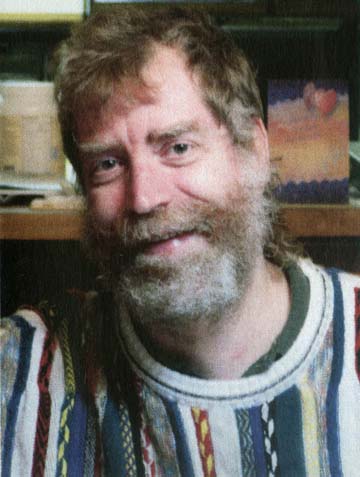
Russell Ault Jr in 2007
Consociate Russell Stewart Ault Jr. (January 7, 1954–June 18, 2015) passed away unexpectedly on Thursday, June 18, at Pardee Hospital in Henderson, North Carolina. A self-employed accountant by profession, he also worked part-time in the Distance Learning Center at Blue Ridge Community College. Russell first applied to the Academy Program in 1985 and remained an active member of the Academy until 1989, when his financial and personal situation forced him to discontinue his affiliation with the Community until 2007. In that year Russell again enrolled in the Academy to complete the program and remained a Community member until his passing in 2015. The following account of Russell’s “PATH TO LIGHT” is drawn from his own words shared with us in 2007:
From the late 1970s through the 1980s, I pursued spiritual studies through the Rosicrucian Order (AMORC), Astara, and ultimately Cosolargy International. I discontinued my studies when I married, because my wife (now ex-wife) did not support my seeking and meditation practices once finances became tight. But I still meditated 20–30 minutes each day, attended weekly dharma sessions at the local Buddhist hermitage, and studied the Holy Bible frequently.
Of all the religions known to me, mystic Christianity and Buddhism appealed to me most throughout my life. I was brought up Southern Baptist and had no problem following the beliefs of that church until I entered college. In college I started asking questions of the Baptist preachers and Sunday school teachers. Their responses typically quoted various Bible verses that did not answer my questions. I had read the entire Bible carefully by that point. And to my mind, the Bible gave examples of how each person could behave to become a more fully realized human being; however, I found that most Protestant Sunday sermons seemed to imply that emulating Jesus’s behavior was an unreachable goal. The conclusion of the Protestants was to worship Jesus so he would be an intermediary between one and God instead of using one’s entire heart, soul, and mind to discipline oneself to become like Jesus with the goal of beholding God “face to face.” That was my path of worship.
For me, the most helpful teachings of Buddhism were from the hermitage in my local community. The two Buddhist abbots held discussions on “Western” Buddhism. Their lessons were true to the teachings of the Buddha, but their practices did not include the long chanting and formal observance that are prevalent in Eastern Buddhist temples. The two abbots were ordained in both the Theravada and Mahayana traditions, but they discussed the truth given by all the great masters and welcomed seekers from all spiritual traditions. The discussions they led and the meditative practices they taught were intended to assist individuals to watch their behavior and improve their reactions bit by bit over time. The wisdom they gave was intended to be practical and for the purpose of helping individuals free themselves from destructive emotions so that they could walk in peace in day-to-day life.
I also became interested in learning more about the Seventh-Day Adventist Church and Islam. Some of the seminars offered by the Seventh-Day Adventists that I attended revealed the incredible research they have conducted into the Christian scriptures, especially those that relate to prophecy. Where the prophecy given in one place in the Bible was unclear, the Adventists found verses in other parts of the Bible that quite plausibly explained the metaphorical language of the unclear prophecy.
I knew little about Islam—only that Muslims believe that Muhammad did not start a new religion but attempted to restore the proper teachings that were given first to the Jews and then to Christians. Both of these groups had distorted the true interpretations of their scriptures. With the large number of terrorists justifying their violent actions on the Koran, I was interested in learning more about Islam if for no other reason than to be informed about the second-largest religion in the world. And I knew that most Muslims found Islam a religion that teaches peace and unity, not war.
The beginnings of my search for higher truths began when I was a senior in high school during the 1970s. I had picked up a copy of Test Your ESP by Martin Ebon, even though I had no idea what ESP (extrasensory perception) was. Once I found out, I wanted to learn more about using the higher faculties of my mind.
The second mystically oriented book I acquired was written by one of Edgar Cayce’s sons. The book discussed the psychic experiences of many people. The author found that many intuitive people were confined to mental institutions, perhaps because they were unable to cope with their gifts. Of course, back then there were many fewer individuals with knowledge of psychic matters so those who were overwhelmed by their psychic senses often did not receive the help and understanding they needed. The book also briefly mentioned how one could meditate and get in touch with these higher realities by using safe techniques.
The following year I went off to college. In addition to studying for my college courses, I was determined to learn more about the potential that one’s mind could actualize. I reread the Bible, now looking more closely at the numerous examples of seekers reaching transient states of higher consciousness and then being inspired to write about their experiences of Divine Love and sometimes to write prophecy on what one should do or avoid doing.
The search was not easy. The ministers I spoke to about these topics were at best not sure how to respond to my questions and at worst would warn me that any investigations in these areas amounted to devil worship. This latter response hardly seemed true to me since the major prophets in the Bible had the mystical experiences about which I wished to learn more, and they were definitely worshiping God. I finally decided to expand my search to groups outside the Southern Baptist tradition.
Fortunately, many spiritual groups had formed in the town where I attended college. When I joined some of them, I noticed how applying their techniques helped me as well as how other members of the organizations grew (or not) through their practices.
In 1982 I made a trip to India to meet the leader of the social service and meditation group Ananda Marga. At that time, the leader, Prabhat Ranjan Sarkar, wanted his followers around the world to come to Calcutta to meet him. While there, a number of these travelers, myself included, visited Nepal with the special intention of going to the Monkey Temple in Kathmandu.
In 1985 I made a trip to Egypt with Astara to meditate in the King’s Chamber of the Great Pyramid and to visit various energy centers in that country.
In 1988 I traveled to China with a t’ai chi instructor and a number of his students to visit Wuhan Mountain, where t’ai chi had originated, as well as other locations relevant to the origin and practice of t’ai chi.
My quest came to a sudden end in 1992 when I married a woman who claimed spirituality and meditation were extremely important to her; however, within a year of the marriage, she had changed her actions and spent most of her time in front of the television set instead of continuing her artistic crafts and direct contact with nature. Her constant complaints about finances led me to spend more time working and to eventually drop out of the spiritual groups I had joined.
A few years later she left me, but the divorce and property settlement were not finalized until 2000. During that time I joined no mystical groups but continued to meditate on—my own at first, but after 2006, with the Buddhists who had moved into the area. I also attended a few seminars sponsored by the Seventh-Day Adventists.
Initially I felt that these organizations were enough to remind me of the ancient wisdom that had been given thousands of years ago and to help me grow spiritually. However, by that time things were not as they had been before. Ever since I had first encountered Cosolargy in the 1980s and heard how important our Sun was to not only our physical lives but also to our spiritual lives, I had been monitoring the unusual events taking place on the Sun.
Solar Cycle 23 was supposed to have attain its maximum in mid-2000, but the maximum continued for a few years longer. The intensity of the solar flares had also been at unusually high levels. From my findings, there seemed to have been more X-class flares (the most powerful class of flare) during the first few years of this millennium than during any period in the past. The general consensus was that global warming was due primarily to increased greenhouse gases around the Earth created by human technology; however, this belief did not explain why the Martian polar ice cap was melting at the same time as those on Earth. Nor did this belief explain the increased energy of the atmospheric storms on Jupiter and Saturn. What if global warming were due to the increased energetic output of the Sun? The next Cycle, the 24th, was predicted to be 30–50 percent stronger than its predecessor. And the peak of the Cycle was predicted to be in the auspicious year 2012.
Another major event that would happen in the year 2012, according to several reports, was the crossing of our solar system over the galactic plane, an event that happens twice every 62 million years. This period is about equal to that of the alautun cycle, the longest cycle of the Mayan calendar. Some authors stated that the Mayans believed 2012 to be the year that time was to end and then restart again (although I had found one author who reported that the current cycle would not end until October 12, 4772). I considered that crossing over the galactic plane could be a time when the Earth would encounter more meteor strikes since there could be more debris floating in the region of the galactic plane than is usually found in our solar system; this could pose a new risk that Earth had not faced in recorded history.
I also considered that as the Earth was crossing the galactic plane and heading toward the northern side of the galaxy, its inhabitants might encounter ever increasing amounts of light—electromagnetic radiation—in the form of cosmic rays coming from a large group of galaxies in the direction of the constellation Virgo. The DNA of all living creatures might be damaged or transformed. In fact, a study of 500 million years of fossil data, which was published in Nature in 2005, indicated that the greatest risk of extinction occurred every 62 million years.
All of this might be relevant to the dawn of the new cosmic age spoken of in the Teachings of Cosolargy, I thought. If nothing else, this information provided fuel for my quest for truth, using both my brain, when researching data from the physical sciences, and my intuition, when contemplating information from mystical sources.
Even though I had developed my brain to process immense amounts of information and had attempted to develop my intuition as well, I still felt the need to really awaken my consciousness.
What I had not found was a system of spiritual transformation that incorporated information of the great changes in the energy coming to all people on the Earth as well as practices to use these ultradimensional forces to activate the higher centers in sincere seekers. And that is why I wished to again enroll in the Academy of Cosolargy to learn the spiritual disciplines and to be of assistance to others in these changing times.
Russell Ault Jr, 2007