Peru Expeditions Promoted in Taiwan
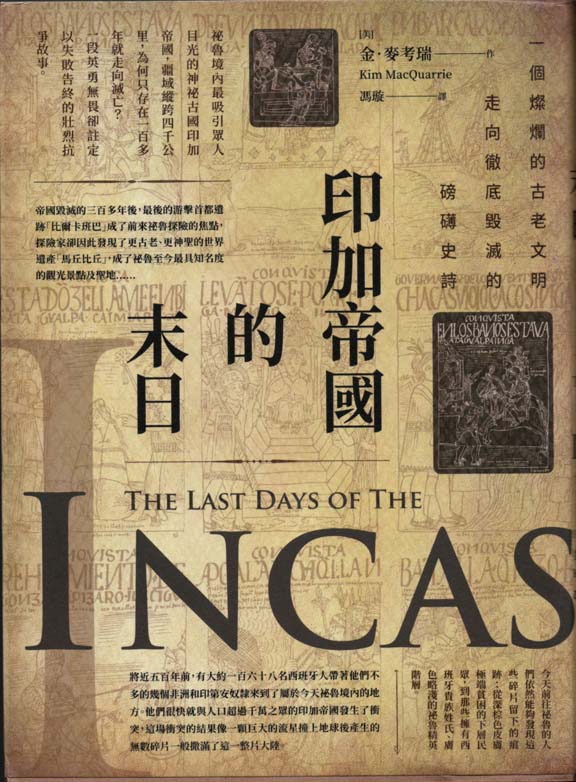
Freedom Hill Creatives publishing house in Taiwan is publishing a Chinese language edition of Kim MacQuarrie’s book The Last Days of the Incas, in which Gene Savoy’s discovery of Gran Pajaten is featured.
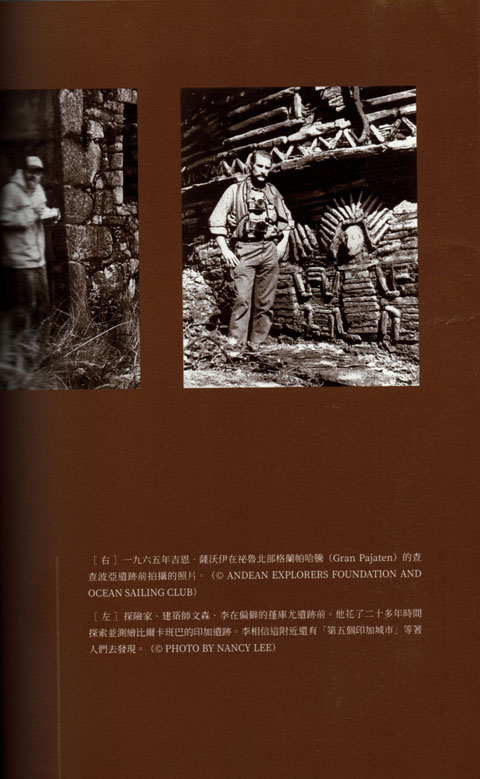
Freedom Hill Creatives publishing house in Taiwan is publishing a Chinese language edition of Kim MacQuarrie’s book The Last Days of the Incas, in which Gene Savoy’s discovery of Gran Pajaten is featured.
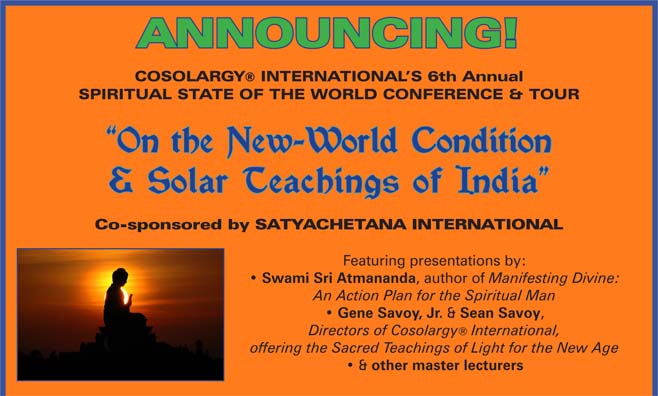
If you have the dream to make a meaningful visit to mystical India, an amazing opportunity is available. But it is still in the very early planning stages. In fact, the trip cannot be scheduled until there is enough interest from people to participate.
So if you are interested, send an email to info@cosolargy.org right away. The decision to finalize the India journey must be made by August 31.
Costs and itinerary will be developed once interest is shown. But typically, expenses in India are minimal compared to many other countries. Even flights to India are reasonable.
10 to 20 people need to join the tour group for the journey to be guaranteed to take place. Tour members do not need to be members of The Community, so feel free to send a copy of the flyer to your personal mailing list.
The tour is of spiritual interest as you will see by the flyer attached. Help make this a reality for February 2016!
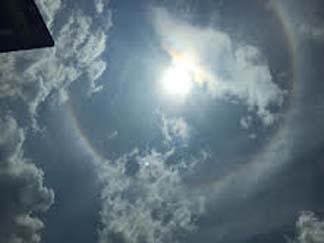
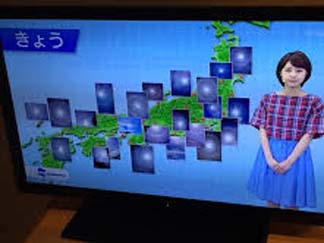 On Friday, May 22, 2015 the country of Japan was umbrellaed with a sunbow display that lasted virtually the entire day. Hundreds of people across the country submitted pictures of the phenomenon to local Japanese newscasts.
On that same day, another little known and unusual event took place prior to the appearance of the sunbow. At 4:30 am, shortly before sunrise, about 30 people from Australia, Canada, Ireland, Japan, and the U.S. gathered at Lake Biwa for a Sunrise Celebration. Lake Biwa is the largest fresh water lake in Japan, located 51km NE of Kyoto.
The sunrise gathering was embellished with music and chants from three different cultures and an early morning Japanese dance in traditional dress. During all the music and chants, the friendly appearance of two large hawks (4ft wingspan) circled above the celebratory gathering for a little more than 10 minutes.
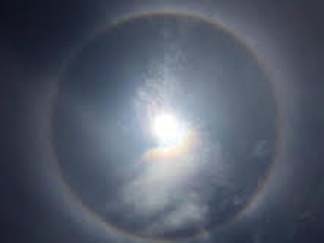 Shortly after sunrise, a sunbow began to take shape and within a half hour a double bow fully encircled the sun. Everyone at Lake Biwa saw this spectacular display unfold. Soon after, countless people across the entire country began to notice, photograph, and share this wondrous event. Photophones clicked, and clicked, and shared, and clicked. Thousands of people tipped their gaze to look skyward. This continued through the entire day. Everyone was noticing. It was as if the sun was casting a rainbow of kisses over the land. But before the sun would set for the day, one more and probably the most interesting thing took place: On that day across Japan many people saw and many people reported that Lake Biwa appeared within the face of the solar orb. And it was not just the outline or the shape of the lake, but Lake Biwa was superimposed on the sun.
“The hawks were spectacular. They were amazing. They took more than ten minutes from their morning to circle and prance above us all as we celebrated and greeted the morning sun.
“A bit later, these flying creatures began doing this really incredible thing. They would scout the shoreline and select a particular type of discarded tree branch. These special branches were noted by little pieces of bark hanging loosely from the wood. So the hawks would gather these branch pieces, fly over the lake, and drop them onto the water, where the branch would float, with the dangling bark below the surface. Not long after, fish would surface to nibble on the bark phalanges. These hawks would then skillfully swoop down and lift the unsuspecting fish from the water; all as a result of their cleverly devised ‘lures’. “— Amanda Buchanan
report by Michael McIntyre
Announcing Cosolargy® International’s 6th Annual
SPIRITUAL STATE OF THE WORLD CONFERENCE & TOUR
“On the New-World Condition & Solar Teachings of India”
Download full-color event flyer to share with friends
Co-sponsored by SATYACHETANA INTERNATIONAL
Featuring presentations by:
• Swami Sri Atmananda, author of Manifesting Divine: An Action Plan for the Spiritual Man
• Gene Savoy, Jr. & Sean Savoy,
Directors of Cosolargy® International, offering the Sacred Teachings of Light for the New Age
• & other master lecturers
February 12 – February 20, 2016
Bhubaneswar, the “Temple City of India”
Orissa, India
Learn about ancient solar cultures & teachings of India and how they relate to current teachings under a new-world solar condition
Practice solar techniques taught by experienced adepts in the field
Participate in solar meditation rites at sacred sites
Visit the Sun Temple of Konark, Puri Temple, the Taj Mahal, Agra, New Dehli, the Ganges, & the Himalayas
Experience India with a group of like-minded individuals
Enjoy safety & satisfaction in an affordable tour guided by experts
Please indicate your interest in participating at your very earliest opportunity. The timeliness and number of early requests will help organizers confirm tour plans with Indian agencies.
Download full-color event flyer to share with friends
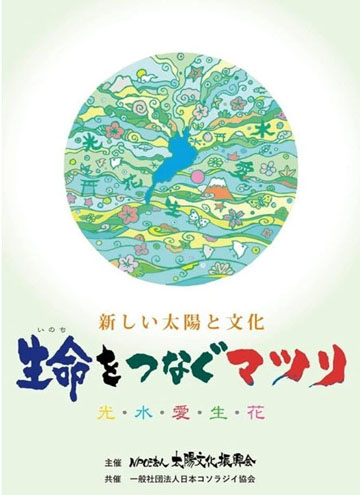
You are invited to the 2015 “Spiritual State of the World” Conference in Otsu City, Japan from May 22-23, 2015.
There will be one day of talks (May 22nd) and one day of workshops (May 23rd) at the Piazza Omi Hotel, 3rd-floor conference rooms.
Over two hundred people are expected to attend the two-day conference and workshop.
Where is the conference being held?
Piazza Omi
Conference: Main conference room, 3 floor
Workshop: conference room, 3 floor
Adress: 1-1-20 Nionohama, Otsu, Shiga 520-0801
What is the cost?
Conference ticket: $125 (15,000 yen). There is a special discount price of $100 (12,000 yen) for registration before 4/30.
2-day Workshop (5/23&24): $200 (24,000 yen). There is a special discount price of $175.00 (21,000 yen) for registration before 4/30.
How can I register?
If you read Japanese, go to the NPO Solar Culture Organization’s Web site: www.npo-taiyo.com
For registration information in English,
contact Miyuki Okayama in Japan by email (mihime21c.anjel2@gmail.com)
or Robert & Noriko Roy in the United States by phone (775-324-4889).
< Watch the promotional video clip for the Conference & Workshop on YouTube. >
Conference topics:
Echan Deravy: “Pilgrimage to the stars: A Journey Through the Solar System”
Gene Savoy Jr.: “The New Sun”
Sean Savoy: TBA
Dr. Gary Robert Buchanan: “Ancient Solar Cutures of Japan”
Jupiter Joji: TBA
Yukinori Matsushita: TBA
Workshop titles:
Workshops on May 23rd
Echan Deravy: “Pilgrimage to the Stars”
Gene Savoy Jr.: “The New Sun”
Sean Savoy: TBA
Dr. Gary Robert Buchanan: “SONATHERAPY: New Directions & Technologies in Wave Front Bioresonance”
Jupiter Joji: TBA
Yasuko Nishimura: “The Secret of Sex and Life”
Workshops on May 24th
Flower arranging session: “ Meet Life” by Mieko Sibata.
Mieko learned Japanese flower arranging under Toshiba Kawase and communicates with the flowers while she is arranging them. She appreciates Nature and loves to give a second life to flowers and plants in her artwork.
PHOTO Sean Savoy
The 2015 Cosolargy Conference and Tour, which will be held in Kyoto, Japan from May 22 – 28 is taking shape.
In addition to the conference and associated workshops, there will be a tour of Kyoto – Japan’s ancient capital and one of its most beautiful cities. Kyoto is known for its beautiful Zen gardens, its wonderful cuisine, and is home to one of the most impressive Zen Buddhist temples, the Golden Pavilion.
There will also be a visit Mount Koya, the seat of Kobo-Daishi’s esoteric school of Shingon (True Word) Buddhism where a replica of the so-called Nestorian Monument stands. There, the tour group will lodge overnight in a Buddhist monastery, which promises to be a very interesting and unique experience.
Please call our offices if you have any interest in attending this special event in the Land of the Rising Sun.
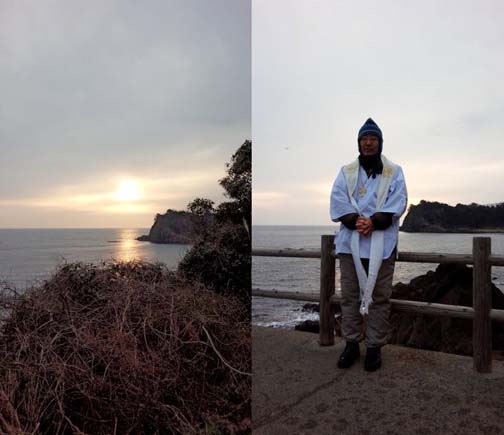
On left, coastline of Sado island off the main island of Honshu; on right, Yukinori Matsushita vested after Sunrise Service. PHOTO: Keiko Inoue
Yukinori Matsushita, Eriko Ueno, Keiko Inoue, Miyuki Okayama, Shoko Oba and Yaeno Sanada went to Sado Island in Niigata province for a Sunrise Service there on Epiphany Day.
Niigata is located on the island of Honshu on the coast of the Sea of Japan.
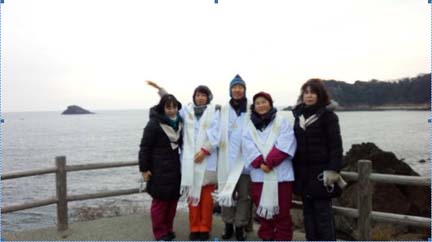
From left to right, Miyuki Okayama, Eriko Ueno, Yukinori Matsushita, Yaeno Sanada, Shoko Ohba. PHOTO: Keiko Inoue
The Community in Japan attends Sunrise Service in Kurume every Sunday and visited Hokkaido and had private Sunrise Service there as well. When we look at Kurume and Hokkaido as points, and then add Sado Island, there are 3 points that together make a large triangle for Light to prevail over a larger space. That is why Yukinori picked Sado island.
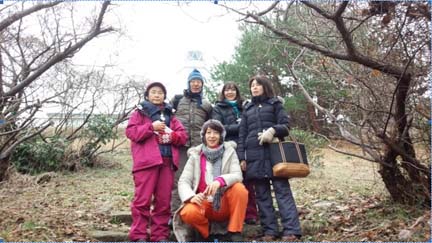
Standing from left to right, Yaeno Sanada, Yukinori Matsushita, Miyuki Okayama, Shoko Ohba. Crouching in front is Eriko Ueno. PHOTO: Keiko Inoue
The place was already ready for a Sunrise Service. The weather was as warm as it is at beginning of March and birds also attended the Service. That morning was overcast but the sun came out by the end of the Service. We were expecting the Sun from the East during the Service. That is the direction that points towards San Francisco and on to Reno.
Everyone felt relief that everything was going well. In this year, we will hold our big conference in Japan. We are looking forward to a big success for both Communities!
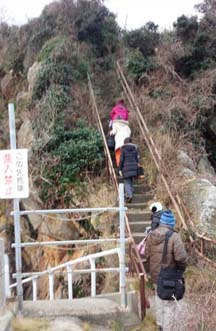
PHOTO: Keiko Inoue
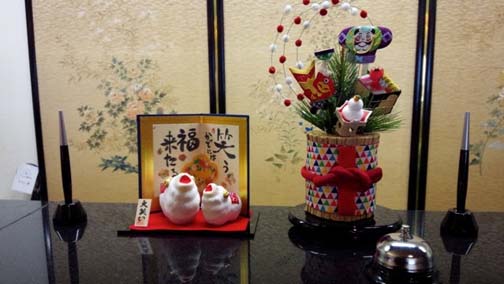
Japanese New Year decorations at hotel. On the left are two sheep made of pottery. Behind is a Japanese folding screen with a well-known proverb is written on it: “Good fortune and happiness will come to the home of those who smile” or “Fortune comes in by a merry gate.” PHOTO: Keiko Inoue
submitted by Keiko Inoue
(translated by Noriko Roy)
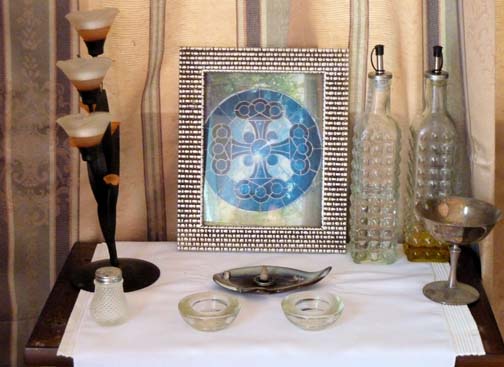
Harold Boulette’s home shrine PHOTO: Harold Boulette
Longtime Community member Harold Boulette shared with us a photo of his home shrine, designed after the instructions given in the Community’s Christology, along with these comments:
“Several years ago, we had a lecture and demonstration on how to set up and use a home shrine. Following the instructions, I set up this one. The shrine itself is a small table, about fifteen by eighteen inches. At the back of it is a large photo of the Community Cross (actually a photo of a stained glass copy of that cross) in a picture frame. On the right side (in the photo) are two bottles, one containing water and the other with scented oil—olive oil with essential oils added. In front is a small chalice. Instead of three individual candle sticks, I have a candelabra on the left that holds three small candles. In front of that is a small salt shaker. In the center there is an incense burner with two small glass bowls in front of it for the water and oil. Not visible in the photo are several books of scripture and a copy of the Rules of the Order, which sit on a shelf below. Also, there are no flowers on the shrine. Instead, I have a potted plant, a peace lily, next to the shrine.”
contributed by Harold Boulette
Harold’s Blog: Solar Wind
5/29 Wednesday
Yukinori Matsushita and Gene Savoy Jr. enjoyed a discussion after breakfast. Later in the day, we had a final dinner with Japanese members at the restaurant SHUN.
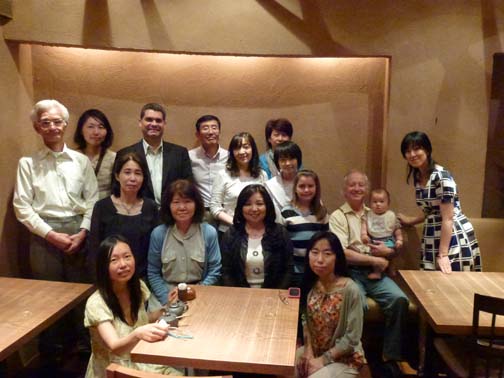
After the dinner (front row, left to right) Noriko Roy, Shinobu Uwataki; (middle row, left to right) Shoko Oba, Keiko Inoue, Yoko Nishimura, Sabrina Savoy, Robert and Joseph Roy, Kahori Sano; (back row, left to right) Koshu Kawahara, Hiroko Soejima, Gene Savoy, Yukinori Matsushita, Miyuki Okayama, Eriko and Hiroe Ueno PHOTO: Stephan Fuelling
References Cited:
Vandaman, James M. Japanese Religion. Japan: IBC Publishing co, 2011.
Travel notes by Noriko Roy
< DAY 6 >
5/28 Tuesday
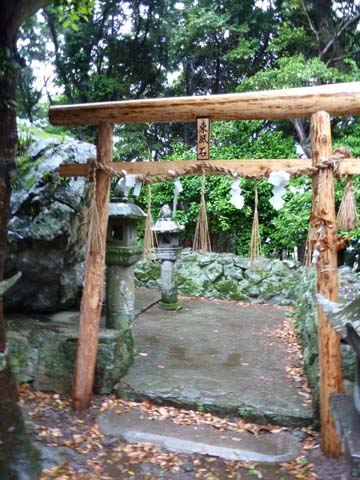
Niji Shrine PHOTO: Stephan Fuelling
After breakfast, we visited the following sites by chartered bus:
*Niji Shrine
Amanotenagao Shrine
Tsukiyomi Shrine
Ondake Shrine
Mendake Shrine
* Emperor Saga founded Niji Shrine in 811. The Kochi Stone is on the grounds of the shrine. According to shrine records, when Emperor Jingu sent troops to Korea, the troops were forced to stop at Iki island because there was no tailwind. They enshrined the divine wind to the big stone “Kochi Stone” and prayed for the wind. The Kochi stone broke into two pieces and the wind blew. They were able to travel to Korea and won their battle because of the grace of the wind.
The Kochi stone measures about 3.4 meters wide, about 4 meters high, and 11.5 meters around. It is known as the stone that makes the needle of a compass not work because it has strong magnetic energy.
—excerpt from Japanese Religion by James M. Vardaman and Sawada Gumi
How did Shinto develop?
While Shinto is usually treated as a religion, it is different from most so-called world religions. It does not have a founder. It does not have real scriptures. And it does not have a system of doctrines.
Basically it evolved out of the ancient worship of unique natural phenomena ancestors and various kind of *kami. This worship did not need to have a name until it was confronted by Buddhism, which was imported from China. Eventually it came to be called Shinto, “the way of the deities,” to distinguish it from the newly introduced Buddhism.
Shinto existed side by side with Buddhism. Sometimes its kami were said to be manifestations of buddhas. Sometimes the two religions became involved in political conflicts. But as a general rule, Shinto continued to be an integral part of everyday life, especially in farming communities.
—excerpt from Japanese Religion by James M. Vardaman and Sawada Gumi
What is a kami?
Defining kami is not easy. It is best to think of a kami as something that produceS the emotions of awe or fear. A kami can be positive or negative, but it always possesses a miraculous, mysterious power. A kami is either the power itself or something that possesses such power. Rather than translating kami as “god/gods,” it is safer to translate it as “deity/deities.”
Japanese tradition refers to yao-yorozu-no-kami, which means “myriads of deities.” But there are two main categories of kami. One kind is the heavenly or earthly kami mentioned in Japanese mythology. The other includes those connected with natural phenomena, those connected with historical people and those who are connected with prosperity, commerce and occupations. Farmers, fishermen, and hunters each have their own deities.
Natural phenomena that are considered kami are Mt.Fuji, other impressive mountains, waterfalls, peculiar rocks, unique or ancient trees, thunder and lightning. In the animal world, deer, snakes and foxes are considered kami. Among humans, over a period of time, the 9th-century court scholar Sufawara no Michizane became deified as Temman Tenjin, patron saint of scholarship. The first Tokugawa shogun, Tokugawa Ieyasu, was deified as Daigongen at the Toshogu shrine at Nikko.
—excerpt from Japanese Religion by James M. Vardaman and Sawada Gumi
After lunch, we visited Iki City Ikikoku Museum, Haranotsuji Restoration Park, Hakusahachiman Shrine.
Iki City Ikikoku Museum
The Ikishima are the ruins of the 482 well-known places of the Jomon era. From these ruins, and others in Iki, many relics on behalf of Japanese heritage have been excavated.
The museum provides not only a complete history of Iki. By using the overview of the history of Iki from an East Asian perspective, it is possible to know about the historical background and social situation of East Asia at the time. By focusing on the history of trade exchanges by sea during each era, the museum presents the history of Iki from a new perspective.
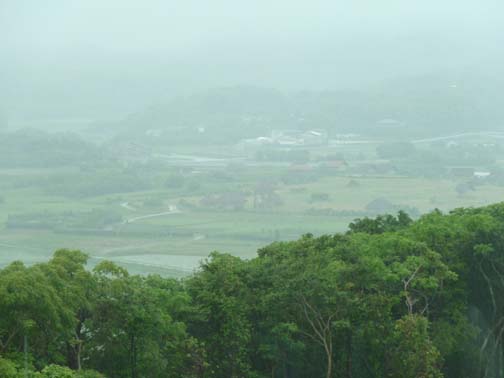
View of Haranotsuji Restoration Park PHOTO: Stephan Fuelling
Haranotsuji Restoration Park
Haranotsuji Ruins is a moat village of the Yayoi period, and the remains have been identified as the king capital of “Ikikoku”, which was recorded in the “Gishi” Wajin Den (a Chinese history book written about Japan in the 3rd century). It has been designated a special national historic site. There are only two other sites that are specified as special historic sites of Yayoi period: the Toro Ruins (ShizuokaPrefecture) and the Yoshinogari ruins (Saga).
The excavations so far include the remains of the oldest pier in Japan, and the dwellings that indicate that “Ikikoku” was flourishing with trade. Various pottery pieces from different areas were brought by trading. Chinese coins, a stone-mask, a whistle made with coconut, and more have been found at the site.
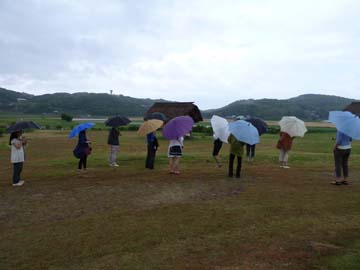
At Haranotsuji Restoration Park PHOTO: Stephan Fuelling
We departed Iki island at 5:00pm and arrived at the port of Hakata at 6:10pm.
Travel notes by Noriko Roy
< DAY 5 >
< DAY 7 >