INSIGHT POEM: “Lonely People on a Crowded Beach”


Cross at Church of New Epiphany. PHOTO: Tom Fee


  LONELY PEOPLE ON A CROWDED BEACH


                                                    The ocean breeze teases skin and hair

                                         as the carefree sound of children

                                                                             is carried across the sand.

                                                    The beach is covered with sand, small twigs

                                        and people–

                                                                  people together

                                                                                            yet alone and lonely.

                                                    Couples paired off

                                                                             distant physically from the others

                                        A great deal distant emotionally

                                                                                                      from the others

                                       somewhat distant

                                                                            from each other

                                       and each within himself

                                                                                        a stranger.

 From Love and Other Painful Joys  (1970)  by Tom McFee (aka Tom Fee)


INSIGHT POEM: “Transition”

Cross at the Church of New Epiphany. PHOTO: Tom Fee

TRANSITION

My soul feels free

slowly drifting upward

becoming  one  with Spirit

as I leave my body behind

rising toward the Light

and Eternal Peace

as the vibrations  of my soul

become one

with the Rhythm of the Universe

as I again return

to the flowing Life Force

of His Divine and Holy Love.

Written 9-9-71 / Revised 11- 25-10

Submitted by Tom Fee (aka Tom McFee)


INSIGHT BOOK REVIEW: Three Books on Near Death and Pre Death Experiences

Into the Light by John Lerma MD (2007)
Messages from the Light by Christophor Coppes (2011)
Saved by the Light by Dannion Brinkley (1994)

PHOTO: HowStuffWorks.com


Late last year (2011) the story of a high school student from my town appeared several times on the local news. The student was Ben Breedlove, who had been born with a heart condition that caused doctors to predict that he would not live beyond his teen years. In December of that year he created a YouTube video called “This Is My Story,” which “went viral.” In it he described (using only note cards) the near-death experiences that occurred to him during traumatic episodes resulting from his heart condition and concluded the video with the simple question and answer: “Do you believe in Angels or God? I do.”

This powerful and unusual story prompted my curiousity about other reports of near-death experiences, so I went to an online book seller and chose three books from among the many available: Messages from the Light by Christophor Coppes (2011), Into the Light by John Lerma, MD (2007), and Saved by the Light by Dannion Brinkley (1994).

In Messages from the Light, Christophor Coppes attempts to sum up and organize the entire body of known near-death experiences (NDEs). His approach appears to be to regard NDEs as evidence of a nonphysical parallel universe that can be known by examining the fragmented descriptions of those who have glimpsed it, almost as I imagine Renaissance Europeans might have tried to understand the New World by analyzing tales from returning explorers.

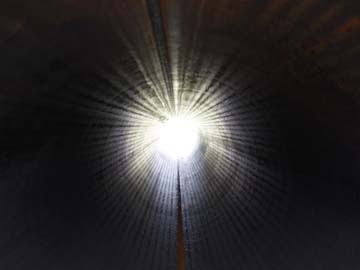
He describes the typical elements that appear in such experiences, some of which have become almost cultural clichés; for instance, the dark tunnel with a beckoning light at the end. Of course, not all NDEs begin this way, nor do they all contain all of the commonly reported elements. Nevertheless they all display a remarkable consistency. For instance, the “life review,” whereby a loving being of light meets the person and reviews all the events of the individual’s life, is almost universal. This is not done in a judgmental way but in a way that all the consequences of the person’s decisions and actions are experienced firsthand. Another common feature is the insistence by the NDE experiencer that the experience is “more real” than this life.

Coppes picks out messages from NDEs that seem to be of universal interest (as opposed to those that are of interest only to the person involved) and draws his own conclusions from them about how to live a better life in this physical world. He also investigates NDEs that are negative or frightening in character (which do make up a small fraction of reported experiences) and NDEs of those who attempted suicide. He considers an obvious question: If the life on the other side is happier and more real, then why not end one’s own life? Here he notes that whenever this thought comes up during an NDE, the answer comes back that suicide is a mistake: Everyone has a specific purpose in this life that is short-circuited by exiting prematurely.

Dr. John Lerma, author of Into the Light is a palliative-care physician who practices at a large and well-regarded hospice in the Houston area. He is responsible for prescribing pain medication that allows patients to be as comfortable as possible without being comatose and arranging for other care as might be required by the patients or requested by their relatives. His book contains sixteen fairly detailed accounts of individual patients and their near-death experiences, ranging from a nine-year-old boy who had three Angelic buddies and swam with dolphins during his NDE, to a retired Catholic priest who joyfully refused all pain medication because he was convinced that his experience of pain was beneficial to humankind.

Dr. Lerma, by the very nature of his practice, spends a great deal of time at the bedsides of terminally ill people, and so many patients begin to open up and honestly describe their experiences to him. NDEs, at least during the period of time covered in the book, were routinely dismissed as hallucinations or delirium by other MDs, and in the face of such treatment, most patients learned to keep quiet. By maintaining an open mind, Dr. Lerma slowly gained the confidence of these sixteen patients and, by his account, personally much more.

All the near-death experiencers in this book also insist that their experiences are more compelling and real than the life they are about to exit. They report Angelic beings of various forms and statures who appear to them when awake, as well as compelling experiences during sleep. These patients sometimes were also able and willing to let Dr. Lerma ask a question or two himself to a visiting Angelic being.

The figure of Jesus also appeared to two or three patients, each time at the foot of the bed, unlike the Angelic beings, who appeared in corners or other places in the room. Dr. Lerma asked about this, and the answer was that it was symbolic of the washing of the feet as a sign of respect and that those in the spiritual world hold us in the physical world in high regard. He also once asked another patient, “Why Jesus, and not Buddha or some other great religious figure?” and the answer was, “Dr. Lerma, is that really important?”

Despite there being only sixteen experiences in this book, as opposed to the hundreds that were surveyed in Coppes’s book, they make up for that by their depth, the contexts of the persons who experienced them, and the conversational quality of many of them. The phrase “negotiating with Angels” appears more than once in this book. Negotiating not about whether to stay in this world or not but about arrangements to either forgive or provide for their family members before they leave permanently. I get the feeling that there is much wisdom embodied in the experiences documented here—what is said in the context of a person’s life, what is said for the benefit of everyone else (presumably including the readers of the book), and what is left unsaid. I plan to visit this book again.

Saved by the Light was ghost-written by Mr. Paul Perry, who in his foreword to the book describes wanting to write a book about the best and most revealing near-death experience. Putting this question to Dr. Raymond Moody, the “father of near-death studies,” in 1992, Perry found out about Dannion Brinkley. Perry subsequently spent an extensive amount of time with Brinkley, interviewing him, and even living for a period of time in Brinkley’s home, sleeping on Brinkley’s couch.

Brinkley was by his own admission not the nicest of people. Most of his early life was spent as a contractor for the U.S. Armed Forces, in what seems like a special operations role. In 1975, at the age of twenty-five, Brinkley was struck by lightning while talking on a landline telephone in his home state of South Carolina. The resulting injuries were severe enough that doctors did not expect him to live, even after he recovered from being clinically dead. It was during this latter event that he had his long and detailed NDE.

The description of his NDE life review consists mostly of the recounting of things that he regrets, such as the numerous fights and other trouble he got into while growing up. After the life review he was ushered into a wondrous lecture hall in a crystal cathedral, where thirteen beings of light behind a podium communicated information to him. The first twelve each presented images of future events such as images of hollow people, who symbolized the Spiritual emptiness of America after the Vietnam War, nuclear and other ecological disasters, and wars in the Middle East and elsewhere. The book jacket states that 117 revelations were given, 100 of which have been realized. Nowhere near 117 are described in the book, and while many of the revelations have come to pass, the dates ascribed to many others in the crystal cathedral have passed without the associated events transpiring.

The thirteenth light being did not have predictions but instead stated that the preceding visions of future events were not necessarily cast in stone—that humans are powerful Spiritual beings. He said that those who go to earth are heroes and heroines who have the courage to go to earth to expand their beings and become cocreators with God. In furtherance of this the thirteenth being went on to direct Brinkley to establish healing centers. There were seven types of rooms to be used in these centers, each being specially designed to perform a specific function.

After this, the NDE ended, and most of the rest of the book is taken up with Brinkley’s recovery from the debilitating physical effects of the lightning strike. Like others who have experienced near-death, Brinkley found his experience so compelling that he was moved to try to communicate it and the importance of establishing the healing centers, even though his ability to talk was shattered. His friends and family described him as constantly babbling like a madman the first few weeks and months after the strike. His ability to walk and speak eventually returned after much effort. This story is of interest in itself; however, I wish that more of the book had been oriented toward describing the healing centers and his progress toward making them a reality.

These three books provide a good enough introduction to NDEs, but there are now available extensive writings on the subject. Coppes’s book contains a bibliography and is well documented. Both Dr. Lerma and Dannion Brinkley have published additional books, and there exists a Journal of Near-Death Studies, as well as at least two websites that are dedicated to this topic. (Near Death Experience Research Foundation and International Association for Near Death Studies).

Cosolargists will not be surprised by the appearance of the word “light” in the titles of these three books as well as many others. There can be little doubt that Spiritual life is composed of light or some form of energy that is closely related to light. Also of note is the report of a vibratory level in some NDEs with higher, brighter beings and regions having a more rapid rate of vibration than lower and darker regions.

Finally, one of the most fascinating aspects of these experiences is the insistence that they represent a form of existence that is more real than physical life. For me this is strong evidence that this physical plane of existence was either created by mistake or for a purpose which has not yet been generally revealed.

Submitted by Ron Theriault


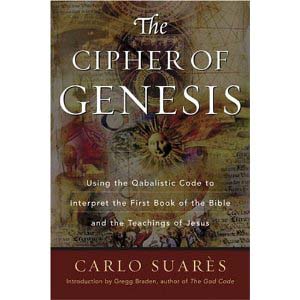
INSIGHT BOOK REVIEW: The Cipher of Genesis

Carlos Suares (1892–1976). The Cipher Of Genesis: Using The Qabalistic Code to Interpret the First Book of the Bible and the Teachings of Jesus (2005)

A book by Carlos Suares of a little more than 200 pages, translated into English in 1970. This book presents us with a translation of the book of Genesis using a code to decipher the traditional meaning of the Hebrew words in the text. Originally each of the twenty-two letters of the Hebrew alphabet represented archetypes emerging as cosmic forces whose interplay not only creates this Earth, but all Worlds and every dimension of Being. Suares reveals this lost Ha-Qabala, held by ancient Rabbans that unlocks the true understanding hidden in the first book of the Torah. Relentlessly, the contents in Cipher of Genesis teeter on the brink of understanding, but always unfathomable, and not quite fully grasped.

Genesis in its original content is not lore from the distant past, but expresses states of consciousness, living forces present now, intended to project into our very being. Each letter in the text has a designation, interacting with other letters within the word to form a concept. This concept is then put in syntax with other word-concepts within the indigenous verse, revealing something quite unlike any conventional reading. By no means would one word convey the entire meaning of the line, but let’s take one word from Gen 1:3 “And God said, Let there be . . .

AWR. The Hebrew word for light.
Pronounced ‘Or’, it is composed of the three letters: Aleph, Waw, and Raysh. Each letter corresponds to the following:

Aleph— the unthinkable abstract principle of all that is and all that is not. It is the creative immanence but was never created, the imperishable pulsation penetrating all existence, timeless and elusive, emanating from beyond all realms.

Waw (or Vav)—expresses a copulative or connecting mediator, a fertilizing agent.

Raysh—Each germ of life has an envelope. Raysh is the ultimate expression of this. It is the cosmic container and is conceivable in the same manner one might ponder the finiteness of the physical universe.

The schema Awr (translated as “light”) can be cognized as the unconditional movement of the discontinuous and unthinkable Aleph imprinting itself on Raysh, the exalted multiple and infinitely expanding container. The true context of AWR is an ever-occurring primordial event: the wedding of Two Infinites. It is around all everywhere. In all everywhere. Beyond all everywhere . . . it is alive. Although this is only a single word from Gen 1:3, one might get the sense that the verse is not confined to a ‘Once upon a time’ episode, but a continual process outside of “moment by moment.”

Such is an example that Suares admits he cannot offer the truth of Genesis, but only images of that truth, because to understand it in its original intent is not to synthesize a language but to experience “a would-be transmission from the unknown.” This book is not a leisurely read. Although the subject matter is laced with commentaries of psychology, sociology, politics, and physics that lend the reader breathing space, it is still a very dense publication.

The author conveniently offers a formatted Code of the Hebrew letter-numbers, and while the initial letter code is brief, oftentimes a letter’s explanation is expanded throughout the course of the book. Because the quintessence of the letters is by nature conceptual, it is risky to confine them in any brittle terms of our languages. The interaction of these primal archetypes do not occur linearly but more in a simultaneous sense. Even so, The Code can be viewed as an ordered emanation of existence, one primordial essence sequentially leading to the next. An explanation of the first five letters, in their order, illustrates such an idea:

Aleph, no.1 the unthinkable life-death, abstract principle of all that is and all that is not. Aleph does not possess the qualities of existence in duration. It is beyond that.

Bayt (or Vayt), no.2 is the archetype of all dwellings, of all containers. Bayt conveys the whole duality of existence, it allows energy to reflect so energy can discern that which is not itself.

Ghimel, no.3 is the movement of every container animated by Bayt. Ghimel is motion expressed as uncontrolled function, action that is not predisposed.

Dallet, no.4 is the resistance to destruction. Dallet is the archetype of resistance, allowing energies to order.

Hay, no.5 is the archetype of universal life. The previous four emanations bring about the emergence of Hay, which does not exclaim individual existence, but is rather its potential.

Following the explanations of the letter-numbers six through nine, we come to Yod, the 10th letter, which culminates as a projection of Aleph into temporal continuity, creating duration, which by its very nature creates its own demise.

Yod is existence. Intent on itself. In contrast, Aleph, open to all possibilities, is timeless— yet deeply hidden, almost absent, buried by Yod’s pronounced disposition to mimic it. As Yod struggles to re-invent Aleph in an effort to perpetuate itself, it must eventually yield to Aleph or otherwise be consumed by its own duration. In order to prolong itself, Yod is constantly balancing resistance and flexibility: resistance to maintain its identity and flexibility so that it can be transient.

These letter-numbers are aspects, issuants, of one cosmic energy just as every color of a rainbow is of, and in, the light. They begin to express their complete meaning only through interaction with other letter-numbers, and their play is not restricted by phonetical positioning as are secular characters. Shemesh (Sheen-Mem-Sheen) is the Hebrew word for “sun.” Sheen the “Breath of God”. Mem the maternal waters. Sheen: the “breath of God”. Fusion! And then again something else . . . left entirely to the reader. That is the nature of Autoit Qabala. Open. Breathing. Aborting the meticulous.

Adam, Eve, Cain, Abel, The Garden of Eden, Elohim, Jehovah, and many other archetypes are addressed, decoded, and placed in context to the Genesis story events, opening an entirely new vista, never imagined by most. These biblical figures seen in the light of the Qabala become what Suares calls “abstract formulas of cosmic energy focused in the human psyche.” As the book progresses, Suares leaves it more for the reader to make in-depth inquiries into the specific translations.

It is worthy of mention that Suares received a degree in architecture in Paris. Later he went on to be a painter for fifteen years, researching the composition of light and color, which resulted in his book L’Hyperbole chromatique.

Forty years of effort culminated in Suares’ Cipher of Genesis, which some consider his pinnacle publication. Such a unique unveiling as this comes along only every 50 years or so. Anyone involved in language, psychology, religion, sociology, anthropology, architecture, or fine arts would find the disclosures of this book to be a welcome resource in their tool belt.

Reviewed by Michael McIntyre


Check out the book online at Amazon.com.


Is There a Theory of Everything?

Popular science programs often revolve around the question of whether physicists will find a “theory of everything.” What that usually means is a single theory that explains the four known fundamental forces of nature: the two nuclear forces, strong and weak; the electromagnetic force; and the gravitational force. Physicists, however, usually refer to such a theory as a “unified field” theory.

Currently, a single theory or model that includes all four forces is a tough and long-standing problem. The current theory that explains the nongravitational forces is called the Standard Model, and is an outgrowth of particle physics and quantum theory. It is quantum in nature, which is to say that it explains the forces in terms of quanta, or indivisible quantities of mass or energy. The best gravitational theory (the General Theory of Relativity) is primarily geometric in nature and contains no feature that would allow for the quantization of gravitational energy. This is particularly frustrating for those who study black holes, as all four forces interact there as nowhere else. More significantly, the General Theory breaks down at the center of a black hole.

If a unified field theory is found, it is doubtful that it would be a “theory of everything” that explains all that there is to know about the physical universe, but the question itself is worth pondering. Could there be a point where everything is known about the physical world? A self-consistent set of theories that completely explains the physical universe would imply that the physical universe is a closed system; i.e., that there is nothing beyond, for if there were something beyond, it too must be explained by the theory or else be completely isolated from the physical. Perhaps the close relationship between physics and mathematics can provide a few clues.

The ability of mathematics to explain the world we live in has been noted several times by scientists and philosophers. Nobel laureate physicist Eugene Wigner referred to the “unreasonable effectiveness of mathematics” in explaining physical phenomena, and Albert Einstein is quoted as saying, “How is it possible that mathematics, a product of human thought that is independent of experience, fits so excellently the objects of physical reality?”

Time and again, mathematical concepts and structures developed in isolation have turned out to apply to the physical world, and mathematical models developed to describe some observed phenomenon have predicted previously unobserved phenomena. For instance, when the physicist Paul Dirac developed a key equation that describes the behavior of moving electrons in the late 1920s, he noticed that there was another solution where the charge of the electron was positive instead of negative. In 1932 just such a particle was discovered: the anti-electron.

Mathematics is of course based on axioms, or simple statements that are accepted as factual and are not required to be proven, with everything else being derived logically from the axioms. The axioms themselves seem to be observations of the world we live in. If there are two pencils on a table, and I add two more, it is a directly observable fact that there are now four pencils on the table. Whatever axioms result in the conclusion that 2+2=4 can comfortably be said to be directly observable facts of the world we live in.

But what of the logical processes by which deductions from axioms are made? As some have put it: Is mathematics only a product of the human mind, or does it have an existence independent of human thought, as Plato and his followers thought? Without attempting to answer such a deep question, it is still possible to accept this close relationship for what it is, with the aim of gaining an insight into the physical world, by examining the mathematical one.

In light of the above, it may be helpful to look more closely at the concept of a closed system by considering a simple closed mathematical system consisting of the set of integers (all whole numbers, the negative whole numbers, and zero) and the operations of addition and subtraction. Any two integers when added together will always produce another integer. Likewise, any two integers when subtracted from each other result in another integer. This system is closed, i.e. every possible operation within it results in an object which is a member of the system. This system is in fact a special kind of closed mathematical system called a “group.”

Now add the operation of multiplication to the system. Here again, the system is still closed, as any two integers when multiplied together always produce another integer. If the operation of division is added to the system, however, one sees immediately that it is no longer closed: 2/5 and all other such fractions are not integers, and the concept of number must expand beyond integers in order to accommodate division of integers.

Of course fractions (the rational numbers) have been part of mathematical knowledge for at least three thousand years, but this is hardly the only time in which the concept of number had to be expanded to accommodate expanding knowledge. Another example is the conundrum faced by the ancient Greeks when it was proved by the Pythagoreans that the square root of two could never be exactly represented by a ratio of two integers. The Greeks were quite familiar with representing lengths numerically: the impetus for calculating the square root of two was in fact to determine the length of the diagonal of a unit square. Since they only knew about rational numbers, imagine their surprise when they determined that numbers as they knew them, could not represent the diagonal length! This proof was in fact kept secret under penalty of death, for fear of unsettling consequences.

If a theory that unifies gravity and the other three forces in a single framework is ever developed, there is a real possibility that it may require a re-envisioning of some fundamental physical concepts, such as time, space, matter, and energy, in much the same way that the computation of the diagonal of a square required an expansion of the concept of number. Even so, it would still not be a “theory of everything,” as it would not prove that physics, and by extension, the physical universe is a closed system. So is mathematics itself a closed system, the extent of which simply hasn’t been found yet?

There is an account in Euclid’s Elements of an argument that addresses the aforementioned Pythagorean problem, but the issues raised by this problem were not really settled for over two millennia and required that numbers be represented by an infinite string of digits. In the nineteenth century Georg Cantor and his students explored this new concept of number, which today comprises irrational numbers. As any grade school student today knows, using decimal notation, rational numbers are represented as a string of digits that eventually becomes an infinitely repeating sequence of digits, whereas irrational numbers never repeat and therefore cannot be exactly represented by a finite set of quantity symbols. (The radical sign, which is used to represent roots, symbolizes an operation on its argument and not a quantity per se.)

Many mathematicians of Cantor’s time objected to the inclusion of infinite processes in mathematics; nevertheless, irrational numbers are an accepted concept today. Even Cantor’s description of infinite (or transfinite) quantities by means of set theory is now commonly accepted. The notion of number has expanded several times since the days when shepherds needed to know whether a sheep was missing at the end of the day!

So mathematics now includes, and reasons about, infinite quantities (an “infinity of infinities”), but can it be said to be either open or closed? After all, calculus, which is centuries old, deals with infinite and infinitesimal quantities. For instance, an integral is nothing more than the sum of an infinite number of infinitesimally small quantities that , when done correctly, results in a finite quantity.

The question of the closure of mathematics was raised more directly in the early twentieth century by the eminent mathematician David Hilbert, who is most remembered for his list of twenty-three important unsolved problems, which was published in 1900. Hilbert and many of his contemporaries espoused a “formalist” view of mathematics whereby all of mathematics could be based on a few well-chosen axioms and that all derivations from these axioms would be complete and self-consistent.

To elaborate a bit on formalism, computer-programming languages are all formal languages, as opposed to the natural languages that are spoken by people. Each word and each element of syntax has, and must have, one and only one meaning or function. If there is ambiguity in any element, it can result in ambiguity of any statement expressed in the language. Imagine how the English sentence “My car needs to be washed badly” would be interpreted by a formal language system where the word “badly” can have only one meaning!

Curiously, this formalist impulse parallels the thinking of physicists of about the same era. In the late 1800s it was generally thought that only a few more details in physics needed to be worked out, such as why things glow when they are heated up, and determining what the medium was in which light waves traveled. In fact these two small and troublesome details turned out to be just the tips of larger icebergs of knowledge. Unraveling the former led to quantum theory, and investigating the latter led to the theory of Special Relativity.

The expectations of the formalist school of mathematics were not to be realized, however. In 1931 Kurt Gödel published his Incompleteness theorems, which proved the impossibility of mathematics’ ever being completely self-consistent, which has forced the formalists to retrench and set more limited goals. In essence, Gödel demonstrated that no logical system that is complex enough to include arithmetic, can prove or disprove all possible propositions that are expressible by it.

A simple example of an undecidable proposition is: “This statement is false.” The self-referential nature of the statement is understandable, but the statement taken by itself is neither true nor false. Such a statement is useful in the more inclusive sphere of human reasoning: it has just been used as an analogy of a mathematically undecidable proposition. Of course the human mind is not a formal logical system, but Gödel showed that any more-encompassing system of formal logic in which this statement is decidable in some way, would itself contain undecidable propositions.

So where does all of the above leave the issue? Is there a “theory of everything”? Assuming that the close parallel between physics and mathematics continues to hold, physicists will never know everything about the physical universe due to Gödel’s remarkable theorem. There arise inevitable gaps in what mathematics can prove, and it would be surprising if the physical sciences did not share the same characteristic.

Moreover, the trends in both physics and mathematics would argue against a theory of everything. Seemingly small, unsolved problems in physics often turn out to be the tips of much larger issues, and concepts about numbers and operations on them have constantly expanded to become more inclusive. Neither mathematics nor physics seems to be closed, which leads the reasonable observer to conclude that the physical universe itself is not a closed system.

If the universe is not closed, is it infinite? Since the histories of both mathematics and physics demonstrate that complete understanding of a subject usually requires inclusion of elements of a more encompassing body of knowledge, it is plausible that there is no end to this process and that existence in general is infinite.

Ron Theriault 2011.12.31


For further investigation:

Burger, Edward. “Zero to Infinity: A History of Numbers.” DVD Lectures. Chantilly, VA: Teaching Company, 2007.

Kramer, Edna. The Nature and Growth of Modern Mathematics. Princeton, NJ: Princeton Univ. Press, 1981.

Livio, Mario. Is God a Mathematician? New York: Simon & Schuster, 2009.

Pollock, Steven. “Particle Physics for Nonphysicists.” DVD Lectures. Chantilly, VA: Teaching Company, 2003.


THE AUTHOR: Ron Theriault earned a B.S. degree in physics from the University of Michigan, and has been working as a software engineer since then. He holds a ministerial title in the International Community of Cosolargy, and is an active supporter of the church.

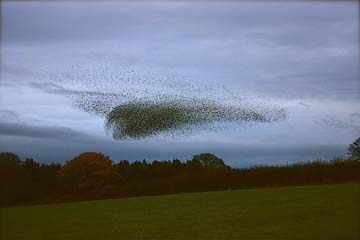
A murder of crows, a gaggle of geese, . . . a murmuration of starlings


Starling murmuration. PHOTO: ad551/Flickr


Sample one of the intelligences on our planet through the video link below.

Murmuration. No one knows why they do it. Yet each fall, thousands of starlings dance in the twilight above England and Scotland. The birds gather in shape-shifting flocks called murmurations, having migrated in the millions from Russia and Scandinavia to escape winter’s frigid bite. Scientists aren’t sure how they do it, either. The starlings’ murmurations are manifestations of swarm intelligence, which in different contexts is practiced by schools of fish, swarms of bees, and colonies of ants. As far as I am aware, even complex algorithmic models haven’t yet explained the starlings’ aerobatics, which rely on the tiny birds’ quicksilver reaction time of under 100 milliseconds to avoid aerial collisions—and predators—in the giant flock. After a tour de force in the dusky sky, the birds roost in Britain’s rural pastures, settling down to sleep (and chatter) after their evening ballet.

Two young ladies who were out for a late afternoon canoe ride caught the wonderful murmuration display on video. The URL for the short video is below. Watch the variation of color and intensity of the patterns that the birds make in proximity to one another. And take a look at the reaction of the girl in the bow of the canoe watching the aerial display. Enjoy.

Watch the amazing 2-minute video of a massive flock of starlings “dancing” in the sky of England.


Video link and accompanying text submitted by Robert Anderson.


The Healing Sun: Sunlight and Health in the 21st Century


REVIEW: The Healing Sun: Sunlight and Health in the 21st Century by Richard Hobday, PhD

Two contrasting paradigms of our health relationship to the sun are presented in this book: advice from the modern medical community to avoid the sun, and the record of healing work done using the sun during the first half of the 20th century. Dr. Hobday also explores the health importance of natural light in buildings and the orientation of buildings that produces the best natural light. This well-researched book is full of good, practical information on how to derive health benefits from the sun.

Read the review of this book by Rebecca Willis on Cosolargy.org.


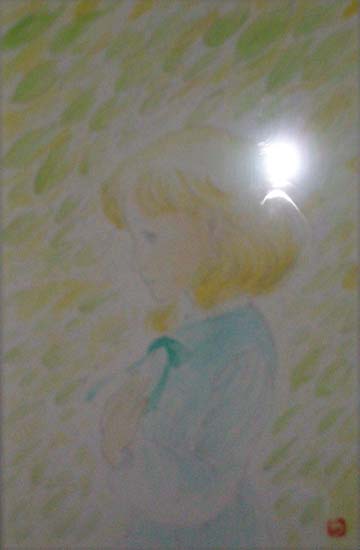
Shinobu Exhibits Artwork at Fujiyama Gallery


PHOTO: Shinobu Uwataki

Shinobu Uwataki, a longtime member of the Community from Japan exhibited a selection of her artwork at Fujiyama Gallery in Fukuoka, Japan, October 27–30, 2011. This, her third individual show, displayed 45 of her pencil drawings and water colors. Her images include Angels, The Child, and plant life.

Born in Kumamoto, Japan, Shinobu studied Japanese traditional art at Saga University and later moved to Takeo when she married. At present she executes paintings for the Buddhist Temple. She says, “I hope that people feel light, affection, and hope from my works over the pain and sorrows of life.”

A sampling of her works is included with this article. (Please note that some of the photos Shinobu provided us show the flash of her camera.)

PHOTO: Shinobu Uwataki


PHOTO: Shinobu Uwataki


PHOTO: Shinobu Uwataki


PHOTO: Shinobu Uwataki


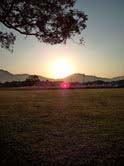
Sunrise Service held in Japan

One of our new Consociates in Japan, Kaori Sujaku, sent us a few small photos from the sunrise service on October 20, 2011, held near the putative ancestral home of an ancient queen of the Yayoi era (300 BCE–300 CE) who was identified with the sun goddess. The Reverend Yaeno Sanada officiated the sunrise service that morning.


PHOTO: Yukako Kawai


PHOTO: Yukako Kawai


PHOTO: Yukako Kawai


James Oschman, PhD: “Conversing with the sun”

Dr. James Oschman, the keynote speaker at the 2011 Conference on the Spiritual State of the World presented by Cosolargy International, has written a short piece about, as he puts it, “conversing with the sun.”

The article was inspired by the people he met in the Community during his visit to Reno, where he participated in Sunrise Divine Service and Chapel Services, the Steamboat Health Center open house, as well as the conference itself.

Follow this link to read the entire article on www.Cosolargy.net.