Heart Filled
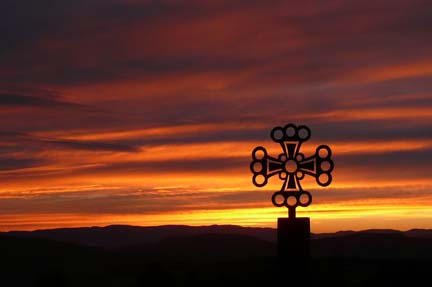
- PHOTO: Tom Fee
One whose heart
is filled with sorrows
of the past
will have less room
for the joys of the present.
Tom McFee 1960
One whose heart
is filled with sorrows
of the past
will have less room
for the joys of the present.
Tom McFee 1960
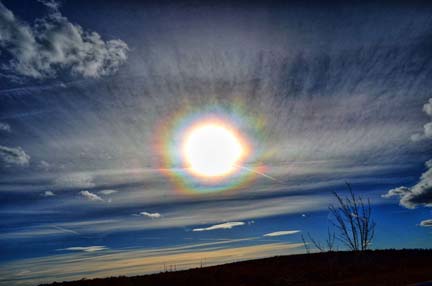
PHOTO: Jim Elliott
A rainbow appeared around the sun on November 20, 2012, at 11:00 a.m., a few days before Thanksgiving.
My wife Karen spotted the ring through the kitchen window about 9:00 a.m. GMT. I took a look, too. Thinking it might be picture-worthy, I got out the Nikon D7000, took a shot, and did a little “photoshopping” to boost the colors in the ring. Then I posted it to Facebook where Roger Weld saw it and sent me this link to NASA:
< http://www.nasa.gov/mission_pages/sunearth/news/News112012-cme.html” >
The text relating to the NASA image indicated: “NASA’s Solar Terrestrial Relations Observatory (STEREO) captured this image of a coronal mass ejection on Nov. 20, 2012 at 8:54 a.m. EST, about two hours after it left the sun. Credit: NASA/STEREO.”
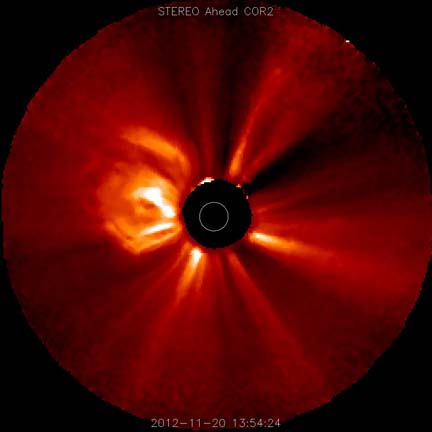
NASA's Solar Terrestrial Relations Observatory (STEREO) captured this image of a coronal mass ejection on Nov. 20, 2012, at 8:54 a.m. EST, about two hours after it left the sun. PHOTO: NASA/STEREO.
Dismissing the differences between GMT & EST time zones because the sun was shining in both at the same (sun) time, the NASA picture and the picture I took were taken almost at the same time. Each is a different visual reflection of the same event.
submitted by Jim Elliott
Whence cometh the Source
Of all that is . . . the Driving Force,
The impetus for life here on Earth
Eternal or a time ’til the Self knows its worth?
Sift through the years . . . millenniums of time.
Search and seek and you shall find
The Light that shines . . . the path . . . the way
To Enlightenment . . . and so we pray
For the strength and fortitude . . . eyes open wide.
Look to the Light that emits from inside.
Know the Truth, for it shall bring
The promise of Eternity . . . the coming of Spring.
So open your heart . . . open it wide.
Release all the love secreted inside.
Answer the Call.
Share it with All.
diana carragher
9/12

PHOTO: Earth Changes Media
I have been a subscriber to Mitch Battros’s Earth Changes Media (earthchangesmedia.com) for two years or more and have always been impressed by his capable research and thoroughness. Consolidation of ancient wisdom and current scientific findings are keys to his study of the effects of the sun on the earth and most interesting in light of our Community’s Prophecies.
Mitch Battros presents fascinating, and sometimes shocking, research from the world’s top scientists. After years of dialogue with these experts, Mitch has been accepted into the guarded halls of NASA (National Aeronautics and Space Administration) , NOAA (National Oceanic and Atmospheric Administration), ESA (European Space Agency), the Royal Observatory, the US Naval Observatory, and other highly esteemed scientific bodies.
In addition to the latest research on the Sun’s influence on our “weather,” Mitch also presents groundbreaking evidence of how the Sun and other celestial orbs produce “charged particles” and their impact on humanity.
Here are some important articles to read for more details:
(Part 1) Something is Happening with the Earth’s Core
(Part 2) Magnetic Pole Reversals and Possible Crustal Displacement
(Part 3) What Are the Effects to Animals and Humans?
(Part 4) We Are Witnessing a Pole Reversal “Right Now”
Anyone can keep up with things by going about once a week to the Earth Changes Media site yourself, but a membership gets you a notification whenever Mitch has something new and also gives you access to the archives. I am presenting his links in order for you to see where he is going with current thought. Part IV in this group of articles discusses the earth trending in the direction of a magnetic pole shift involving earthquakes, volcanoes, and extreme weather—all of which have been part of our Prophecies. It seems to me that he brings our Prophecies up-to-date and fills out the picture we already have.
Article and links submitted by Frieda Nelson
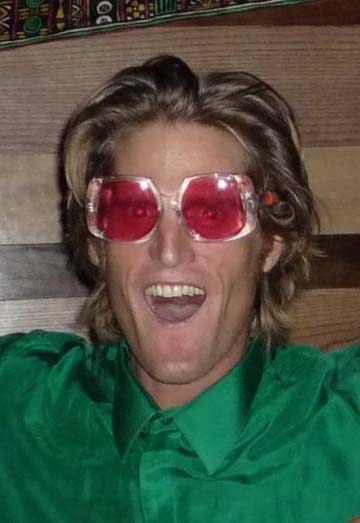
Mason at party. PHOTO: Mason Dwinell
CC: All right. Let’s get back to your book then.
There are a couple of anecdotes you mention in your book that I found rather intriguing. I would like you to take a little time to talk about them in more detail than you did in your book, if you would. The first (on p. 74) deals with prisoners of war who were forced to stare at the sun for hours with amazing results. I have never heard of these accounts. Could you let us know more details? Who wrote them and where can we find the accounts?
MD: Hearsay. I also looked for concrete documentation, but along with so many other bits and pieces of sungazing there seems to be a dearth of solid information to support this unique practice.
CC: That is unfortunate. I was hoping you had found something “concrete,” as you say. But it has been my experience too that it is often very difficult to find concrete historical documentation for these things.
The other anecdote that caught my attention is a one-line mention you make about parents who were working with the sun during the conception of their child. You say of them (on p. 77): “The parents’ sungazing practice was one of a spiritual nature therefore they still ate food.” (Emphasis is my own.) This makes sense to me. But it may not make sense to some other people who practice looking at the sun. How do you reconcile “spiritual” sungazing with eating physical food and “physical” sungazing, if I may use that term, with not eating physical food? How do you explain this to people?
MD: Hmmm—that gets confusing and begins to become a word association game. similar words can have very different meanings to people. For me it goes back to the intention, the driver, the emotion pushing a choice. Regardless of whether one uses the word spiritual or physical, there is a force that inspires action. The feeling which creates action or reaction, that is fascinating to me.
CC: What about action for a purpose? What about directed action? A “calling”? Or a response to a “calling out” or a “calling together”? Has anything like this been part of your experience with the sun? Do you find such things to be of interest?
MD: Nope. Such mirages are an illusion, or perhaps a delusion, driven by foreign energy (entities), running their programs in people’s energy field for their own agenda. We must be careful and diligent to keep such energy at bay as to not compromise our own systems.
CC: I take it that that is why you are so distrustful of organized religion and spiritual institutions in general, because of the possibility that Dark energies, or as you say, foreign energy entities, may be what is directing such organizations. Is that the case?
Have you ever considered that there may be such a thing as a School that provides instruction and guidance on how to avoid the influence of such foreign entities? And that there have been such Schools in the past?
MD: I’m not distrustful of organized religion and such; more so simply not drawn to them.
Oh yes, Robert, I have considered many such things.
CC: I ask you this because I know you have received training and are licensed in particular healing arts and sciences, but I wonder why you consider that you are better off experimenting with the sun on your own than you would be if you received training in the spiritual arts and sciences related to the sun and the benefits of others’ experience. After all, you did once (about ten years ago) apply to our Academy.
MD: I never assumed I would be better off one way or another. My sungazing experience happened rather organically, all while I was enrolled in The American College for Traditional Chinese Medicine.
CC: Thank you, Mason, for granting us this interview. It was interesting for me to read your book after seeing the film Eat the Sun. The book gave me another perspective on what you were going through during the time the movie was being made and gave me a sense of the depth of your search that I think did not quite come through in the film. I am happy to hear that you are continuing the work that you set off to do when we met some ten years ago.
Do you have any parting lines you would like to leave us with? Perhaps something touching on a topic that we didn’t touch during our interview?
MD: Thanks for the cathartic expedition into passages long since written, educational and insightful. I appreciate your efforts and look forward to checking out your final presentation.
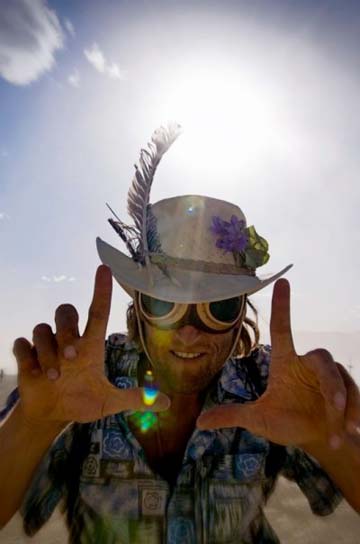
Mason as he be at Burning Man 2012. PHOTO: Mason Dwinell
CC: How would you approach sungazing differently now that you have had the experiences you have had as a more mature individual? Have you found any guidance through ancient texts, for example, the “secret” of the eighth-century Chinese text The Secret of the Golden Flower, or the old Hermetic admonition to “get to know the Light”?
MD: Sunrise only. Incorporate the moon a little. Be very empty prior to gazing. Go slowly. Have a goal of being without a goal. Gaze without a camera crew. Let it all go!!!
CC: “Gaze without a camera crew.” I understand that completely. I know how that can change the energy of the event.
Now I would like to take a little time to discuss what I guess we could call technical matters.
To begin, you seem to recommend staring directly into the sun, a conscious focusing, rather than the method of looking around the sun and relaxing the mind and the eyes with the eyelids half closed in the way Buddha, say, is depicted. Why is this? And where did you get the idea to do so?
MD: Hmmmm—yes, looking right into the sun. But very much so relaxed, neutral; allowing for the ability to relax deeper, further, to let it go. But still conscious and focused. Must still be present and alert—feeling all that is coming up from within, as opposed to being checked out. Far too many guru-yogin types have all the right answers, but in reality are totally checked out.
Be careful. Regarding bliss, there is a colossal difference between being vacant and being present.
CC: Yes, there certainly is a big difference between being present and being in a trance. That is not really what I was asking about, but I get from your response that you are working from a relaxed state. I only ask because in the movie Eat the Sun you looked tense at times, as if you were fighting to keep your eyes open. But I see now that that is not actually what you must have been doing.
In your book you write (p. 81) “Sunlight actually cleanses and rebuilds the whole of your being, bringing a new vibration to your mind, thoughts, feelings, and physical body: total rejuvenation.” And later in the book you write (p. 122) “. . . enlightenment, realizing and expressing one’s being is absolutely not dependent upon an ultra-clean body. In fact, ultimately, it has nothing to do with a body.” With you, I would say that both of these statements are more or less true, except that I would clarify that enlightenment has nothing especially to do with a physical body. And I am bringing this up to lead into my next question for you.
Now, I am aware that many raw foodists have come upon sungazing as a natural progression of their quest for seeking “pure” food, recognizing that the energy that prepared their uncooked food and provided the nutrients of that food came through the sun, and that sunlight itself was an even more pure source of “food” or nutriment than uncooked or raw food. What do you generally say to raw foodists who speak to you about the cleansing quality of sunlight and the relation of sunlight to enlightenment? Anything more than what you have said in these two sentences from your book?
MD: Interestingly enough, I speak about this stuff to very few people.
What you ask about is certainly two different worlds. Yes, playing with the vibration of one’s body can be fun, challenging, and quite an adventure, as well as help to isolate different blocks if one wishes to evolve an aspect of their energy. However, unless, and until, said person is willing to actually look into why the choice of drinking beet juice occurs in the first place, they are still falling short of our human experience. Oftentimes the motivation behind a certain diet, practice, or lifestyle is a defense mechanism, enabling the person to hide even deeper from their real issues. The same can be said for the participation of sungazing. What is the intention, the drive, that subtle emotion that puts action into motion. Indeed, using imagination and motivation to alter diet, appearance, and the like is fascinating, and I love it, but to become aware of how the different aspects of your energy expresses itself is paramount if we truly wish to participate in this earth life. So whether one is eating cheetos or the sun, without the awareness of you, there is nothing [gained].
CC: It is no surprise that you speak about these things to few people. Few people care to look deep into life for an extended period of time. And fewer still care to look deep into their own psyche and spirit. Fewer still are able to personalize impersonal forces or energies to strengthen themselves, psychically and spiritually, rather than simply trying to get along with these forces by doing what they think is the right thing.
In the final part of your book, which deals with health concerns, you say (on p. 113): “As your awareness increases, the magnitude and wonder of your earthly experience will become more magnificent.” And during your talk here in Reno, you said something like you “back anything that increases awareness.”
In our System of practice, we recognize two distinct forms of higher awareness or higher consciousness, one of a psychic nature, wisdom of the kind that is acquired and grows through experience, and another of a spiritual nature, wisdom of the kind that just “knows” and is “revealed from heaven” we might say.
When you speak of awareness and the true “you,” the true self, are you making a similar distinction? Could you talk a little bit about the concepts of awareness and the true self as you understand them?
MD: Sort of. However, there is more. Yes, anything that encourages people to look inside is a good thing. Listen. What do you feel? What do you hear? Can you differentiate the expressive energy between your personality, your DNA, your different organ systems, your mind, foreign energy, old patterns, ancient past-life patterns, your atoms, your soul, your true self??
Another cool aspect about listening is: generally it inspires even more listening—possibly, better listening. Awareness breeds awareness. There is so much for us to experience, to become aware of, and at the end of the day the common denominator of everyone i know, or have read about, who has heard, felt, and known is that they sit still. They meditate. They learn to quiet the mind, and they listen. To me meditation is simply a tool to learn how to be present. To feel what is occurring now. With practice, we all could be present all the time. But at the end of the day it starts with you. Heal thyself. Do you meditate??
CC: I tried a few meditation techniques back about thirty-five to forty years ago of the quieting, calming, centering, slowing down, relaxing kind. Now the solar techniques I have been practicing for the past thirty-plus years serve as my meditation and contemplation ritual—meditating with eyes open not closed, “speeding up” not slowing down, and still centered, calm, and relaxed. And it has been my experience that, as you say, spiritual awareness breeds spiritual awareness, and awareness heightens Consciousness by accumulation, bit by bit.
It has been my experience, and I think the experience of everyone who continues to practice our spiritual System, that working with the sun over an extended period of time actually opens your deep being “to the light,” so to speak, and parades in front of you one by one all sorts of personal issues, and these issues must be dealt with if you are to remain in or regain your psychical and spiritual health. In a very essential way, therefore, I see sustained work with the sun for spiritual purposes to be by its nature a healing process of grand, even ultradimensional, proportions.
Is this the kind of thing you hope to pursue in the future with your sungazing?
MD: Yes—utilizing an emotional process to evolve how we act and react is paramount to my daily life. Although one can tap into all of that by sitting on a cushion in the dark. The sun’s mojo makes the process infinitely easier, but certainly able to do without.
That said, the piece that continues to tickle the back of my brain rests in the arena of human potential. Can we fly? Can we dematerialize and rematerialize? Can we travel interdimensionally with our bodies? Can we dance with the light of immortality?
While I have heard all is possible, until I actually do it, it is simply a myth.
CC: I was actually referring to more of a cosmic Process, not an emotional process centered in our human nature but a Process that links our inner nature to its ultimate ultradimensional origin and regenerates our immortal spiritual Light body, that uses the sun of our solar system as a gateway to higher realms. To me, that does not seem to be the kind of thing you can tap into by sitting on a cushion in the dark. Have you ever considered the importance and value of seeking contact with your immortal nature as a human potential in itself rather than seeking to extend the potentials of human physical action—like flying, dematerialization, physical interdimensional travel? Or do these things seem to you to be automatically and intimately interrelated?
MD: Yes, related. And I assure you, one can tap into everything and anything by sitting on a cushion in the dark.
However, I fear we are getting a touch off base here as your agenda, projections, and such are beginning to express themselves.
<PART 4>
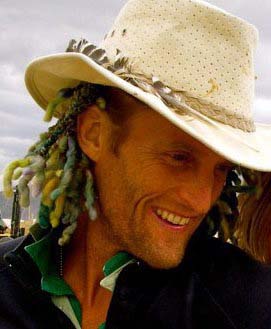
Mason at Burning Man 2012. PHOTO: Mason Dwinell
CC: At one point in the commentary portion of your book (p. 73), you say: “I have been told that 44 minutes of time is required for the whole amount of blood in the human body to pass through the retina. The retina is the only place in the human body where sunlight touches the blood (directly or indirectly).” Later in your commentary (p. 95), you say: “Sunlight increases the oxygen-carrying capacity of the blood. This extra oxygen helps to cleanse the bloodstream and tissues as well as encourages the body’s immune system to work more efficiently.” I take it that this is what you mean when you say that a kind of photosynthesis occurs when sunlight hits our blood through our eyes. Do you think that the time of 44 minutes was devised by HRM for his sungazing protocol for this reason, because that is how long it takes all the blood in an individual’s circulatory system to be “solarized” at one time? And if you think it is, can you explain why the protocol does not require an individual to continue this practice?
MD: I am not convinced HRM devised anything—he was simply a spokesperson utilizing information passed down from generations of the Jain religion.
Every body runs a bit differently, but yes, I believe once the physiology of the eyes can handle the intensity and duration, coupled with clean body and blood vibrating at a high frequency, photosynthesis (or some similar clean energetic process) occurs.
CC: And do you have any idea why the protocol would advise that a person reach the point of 44 minutes of viewing, the time period that allows all of a person’s blood to be exposed to the sun through the retina once only, and then cease looking at the sun completely after that? It would seem that such a process may be beneficial to repeat at certain intervals.
MD: I do not know. And I agree, something seems amiss. Perhaps the mind gets to a point of evolution it can create whatever energy it needs through imagination. Without a doubt, there are some pieces and parts missing from of theory, instruction, or direction.
CC: Thanks for being so honest. And to continue in the same vein for a moment: You have no doubt heard it said that all the cells in the human body are replaced about every seven years. What do you think could be the result if an individual were to continue sungazing regularly for seven years, and thereby “solarize” every cell in his or her body? What are your thoughts on this concept, if any?
MD: Maybe—although I have heard many things said. I have learned not to hold much credence in media or Western medical limits. I exist more along the lines of: live, taste, attempt, feel, digest, and, possibly, evolve. When you are truly present and have an experience, that moment in time becomes yours, your experience. No one can tell you differently. Perhaps cells replenish at set rates, perhaps not. I’ll wager there are enough different people hosting different cells that many unique possibilities could come to be.
Yes, it may be helpful to use printed material and lore to lend parameters, but nothing is set in stone—life is constantly ebbing, flowing, and changing. Indeed, we can look to the past for guidance, but we must be careful not to become attached to such standards. Apathy coupled with limitations can create stagnation, and frankly, such patterns are boring.
You, any and all of you reading this, are pioneers. It is your job to be curious about human potential, to push the limits, to imagine a future, and then be present and focused to manifest the impossible as possible. To help create a new way of being, seeing, thinking, feeling, and existing. Oh, and have fun! Giggling, laughing, and dancing along the journey.
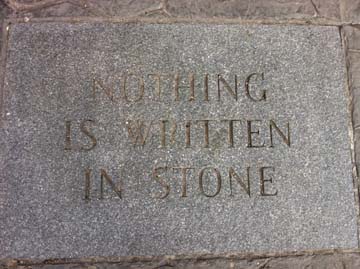
We received this photo from Mason at this point in our conversation.
CC: At one point in your journal, you bring up the concept of the “true self” and mention that sungazing led you to knowledge of your true self. Why do you think that it was the act of sungazing that led you to this knowledge, and not something else?
MD: Something else certainly could have aided in this revelation. Yes, meditation can access many of the same realizations; however, the sun helped amplify sensations and awarenesses. When i was able to fully relax and let go, it was as if layers of an onion were falling away. Limitations and foreign programming sliding off, and the true me was birthing itself into the world. People resonated differently, not only with their actions, but also with comments about how I felt and appeared: richer, deeper, peaceful—more.
CC: That is a beautiful description. Elsewhere in your book (p. 81), you mention that man is a photobiotic being and that “our aura” is our “true self.” I assume that you are speaking here of the combination of color bodies related to what are sometimes called chakras or energy centers or force centers, the whole of which is sometimes called the psychic body. Is that correct? And have you ever considered the possibility or found evidence of an even higher type of body, a Light body?
MD: Hmmm—I didn’t see mention of that on page 81. Nonetheless, no. Our aura is our aura. Our true self, our true self. Our soul, our soul—all different, all unique, all energetic. Our chakras are different from our meridians; yet, all of it a swirling mass of an individual. Yes, there are many different aspects of the energetics and light bodies that incorporate the human being. We are truly awesome, complex, and incomprehensibly powerful. All aspects of our energy is around us all the time having an experience. Only with awareness can we begin to feel, listen, and alter our status quo. As we quiet the mind, slow down our lives, learn to breathe, and live more in the present—only then are you able to begin the objective journey into all of the varieties of your energetic makeup that makes you, you.
CC: You’re right. It was pp. 91–92. At one point in your book (p. 78) you mention that you have been told that “the sky is the limit” with sungazing, and you mention that it is up to each individual to decide where this path will take them. You, of course, have written this book about your experience, your path, and where it took you. Could you take a moment to explain why you did not “decide” on another path, a different path; for example, continuing your work with the sun specifically for spiritual purposes?
MD: Hmmmm—while many doors opened during my brief dance with sungazing, I feel my experiences from a decade ago were simply a teaser. Perhaps the main event has yet to occur.
CC: Well, that is not the answer I expected. After reading your book, I got the impression that you had simply put your experiences with the sun aside and gone on to something else. But there is a comment you made to close the section of your book that contains anecdotes about sungazing that should have alerted me to your continued interest in the information that sunlight carries. This is the line (p. 99): “There is plenty that is unknown about the practice of sungazing.” What are the unknown areas that continue to interest or intrigue you?
MD: RE: pages 49–50: One of the experiences that scared me, and intrigued me, was when I had the sensation of voltage traveling up my arms. It was beyond anything I could have imagined. I feel as though now I’m standing on more stable ground, and would very much like to tap into that energy once again. I can only imagine where it would lead. This and having better awareness of all the systems within could make for quite an odyssey.
I also know we have yet to really express our potential. We are capable of so much more.
I am curious.
CC: I remember how awed you were by that sensation. You describe the experience quite clearly in your book. In our Academy we take a more moderate approach to the sun and its energies, and the kind of sensation you are describing is treated late in the first year of practice in our program. There it is described as more of a deep and harmonious tingling and a loving energy rather than an unexpected jolt. I think the difference may lie in the more gradual nature of the approach we take over a more extended period of time. And it now seems to me that you might approach sungazing differently if you were to take it up again. Do you think you would be more interested in such an approach to the sun, a milder and more continuous approach, now that you are more mature and experienced than you were when you were “younger,” or do you see pitfalls in such an approach?
MD: Either gentle or jolting could probably be beneficial depending where in life the practitioner is at the time. For me, I had never even heard of such an experience. So it was a tad on the wowzers side of things.
Yes, now I’m in a different place—almost welcoming such sensations.
<PART 3>
The Earth Was Flat, Mason Dwinell (Xlibris, 2005)
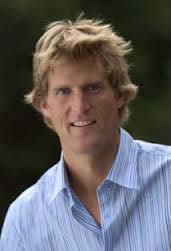
Mason Dwinell PHOTO: from the back cover of his book
For our first Insight Interview, we speak with Mason Dwinell about his 2005 book on sungazing: The Earth Was Flat. Mason was the subject of the 2011 documentary film Eat the Sun, which followed his exploits as a young man searching for information on the ancient practice of looking at the sun, or sungazing. We met him for the first time during the filming, when he came to Northern Nevada to speak to Bishop Gene Savoy Sr. and other members of the Community about their experiences working with the sun and to attend a Sunrise Divine Service with us at Red Rock Consecrated Sanctuary.
Mason wrote The Earth Was Flat a few years after the footage for the film was shot and while the filmmaker, Peter Sorcher, was still editing the film. (You can read more on the film and acquire the DVD at the film’s splash page. You can read more about the book and purchase a copy at Mason’s web site.)
We ran into Mason again this summer during one of his speaking engagements here in Reno. At that time we arranged to carry on an extended email interview with him about his book, which we did from May 15 to September 15, 2012. What you read here, with minor editing, is the result:
CC: Hello, Mason.
It was nice seeing you last weekend at the Psychic Fair in Reno, and I’m glad we could make arrangements to interview you about your book.
MD: Yes, Bob—[I’m] alive and well.
CC: This weekend I was able to read Part 1 of your book and took a bunch of notes, enough to begin our email interview if you are ready to do so. I plan to finish the text in the next day or two.
If you have time to go back and forth with emails every day or two for awhile, let’s get started.
MD: Now is as good a time as any.
CC: Okay. Let’s begin then. There are a number of questions in my notes, so it may take a good number of back-and-forth messages, maybe twenty or so. There is no rush, and I would appreciate full responses when you can give them.
On the acknowledgment page of your book, you thank your friends and family for giving their unconditional support to you so that you were free to “chase the sun.” What kind of support did you receive? And do you think that a community of sungazers could have provided a similar kind of support, or do you think that the kind of support you received specifically from your friends and family was irreplaceable?
MD: By unconditional support, I meant they were there for me if I ever needed them. But more importantly they were not going to hinder [me]. One of my pet peeves is when people actually hinder someone’s quest. Quests are challenging enough as it is, and to have people so entrenched in their issues that they stand in the way is silly and unproductive.
CC: Early in your book, you quote Omraam Mikhael Aivanhov, who was the head of the Great White Brotherhood and a teacher of solar viewing. Since you knew of that organization and the organization continues to exist, how is it that you did not connect with the Great White Brotherhood and their system for sungazing instead of ending up following Hiram Ratan Manek (HRM) and his protocol?
MD: HRM was my introduction into the world of sungazing. I had reached about fifteen minutes of gazing prior to beginning research into other techniques or gazers. The experiences I was having were rich enough (which is an understatement), that I figured I might as well let HRM’s protocol run its course before I dipped my toes in other waters.
CC: It took you about four months looking at the sun every day for you to reach fifteen minutes of gazing. That is a pretty long time. Did you begin getting direct personal coaching from HRM during those first four months, or did you go it completely on your own without much concept of what you were doing or what you were in for?
MD: Yeah—it was mostly the blind leading the blind. Four of my friends and I headed into the void on our own. All we had to draw from was our own and each other’s experiences. At about twelve minutes, when things really started to change, i reached out to HRM for some guidance, but even then, I was very much on my own. Eerie, wonderful, terrifying, and totally awesome.
CC: Since you had that experience of “the blind leading the blind,” why do you recommend [pp. 20, 74] that each person approach sungazing in his/her own way rather than under the guidance of experienced practitioners?
MD: Every body is different and every soul is different. An experience, based on a technique or approach, will not relate equally to each person. At the end of the day, the individual experience is all that matters—all that is. Awareness, focus, relaxation, letting go and allowing the time and space in one’s life for change may be the greatest assets one could host for this practice as well as the practice of living life.
CC: If you understand individual sensory and perceptual experience to be what matters most, I can see then why you might say that there is “no wrong way” to approach the sun and that “every person may carve out their own form of sungazing.” However, even if you do not recognize that the sun affects all humans in a similar way or that there is a proper way for all humans to approach the sun that is “The Way,” your journal seems to suggest that you have recognized a process that is common to all who look at the sun, a sequence of experiences that you recognized: An overwhelming sensation of blissful and calming reverence for the sun, the feeling of being immersed in love, the practice of sungazing growing into a form of deep meditation, an incredible sense of peace, conflict with yourself, recognition of the potentials of sungazing on a global level, the intense tingling sensation in your hands and arms as if plugged into a power grid, increase in your overall energy, speeding up of your mind that culminates in a total and complete peace, intense emotional disturbances that you could sense as an intense body odor, supersensitivity in your gastrointestinal system, a wonderful feeling of liberation, sensations in your energy centers (chakras), evidence of solar information factors, etc.
What significance does this sequence of experiences have for you? Do you think that this sequence is peculiar to you individually, or do you think this sequence represents a series of new feelings that is typical to anyone who is getting into the sun? And did HRM or anyone else make you aware of what kind of experiences you would have before you began looking at the sun?
MD: The main reason my friends and I embarked upon the sungazing journey was to save the world—to save humanity. I concluded that if people could understand, or at the very least come to peace with their hungers (the energetic subtleties that drive our choices), then real change would occur. Tranquility, wonder and blissful expression would ensue; no more war due to insecurities, want for power, riches, lust—more more more.
One of the most powerful aspects of the practice was that it is free to every human on earth. Tomorrow the sun will rise.
Yes, any meditation will create a spell of space and quiet within and around one who is still for any length of time. However, I significantly underestimated the power held within the sun’s light. The clarity and peace that I experienced went well beyond anything I had read, seen, or felt prior. Change was afoot. With a balanced and neutral approach, I feel what I experienced can be mirrored by anyone.
While HRM should be credited for sharing information about the practice, short of [his being] a cheer leader, there was no insight instilled. But perhaps that is one of the keys, simply allowing folks to go out and experience life for themselves; not sold, pushed, or bullied by other’s ideals.
CC: How were you made aware that not all transformations that come with ingesting solar energy are necessarily pleasant or beneficial? I remember you mentioning a particular event when you were able to “smell” your bad mood. What kinds of transformational experiences have you had or witnessed that were not beneficial or were especially unpleasant? And what did they tell you about the nature of the energies of the sun?
MD: First off, I wish to reiterate that before embarking upon a journey with the sun (or life for that matter), one must without a shred of doubt, be willing to take 100{1fa2ef75e2e78439128d99df03acfe1d8ee3047374abe3d4676fe3470ff8b909} responsibility for everything that has happened, is happening, and will happen in the their life. 100{1fa2ef75e2e78439128d99df03acfe1d8ee3047374abe3d4676fe3470ff8b909}.
Yes, many of the transformative aspects of my evolution were a tad bumpy. Awareness may be one of the greatest assets we can cultivate; however, awareness does breed awareness. Becoming aware of blocks and limitations that have been slumbering within our systems all along can be uncomfortable and unsettling. Also challenging was having patience with ancient (occasionally past-life) issues bubbling up through my skin in the form of rashes and such. I learned a couple things—fasting can be a powerful and helpful way to help access some deep-rooted issues.
And, utilizing the full vibration of the sun’s light spectrum, if people allow the time and space in their lives for change, and if one is willing to focus, relax through, and let go of emotional history, then evolution will follow. Yes, this process can certainly occur without the sun; however, for better or worse the sun helps isolate and magnify different blocks.
Now, that is all simply the energetic side of things. Regarding the physiological component, I believe that when direct sunlight hits our blood through our eyes, photosynthesis occurs—free, clean, energy!
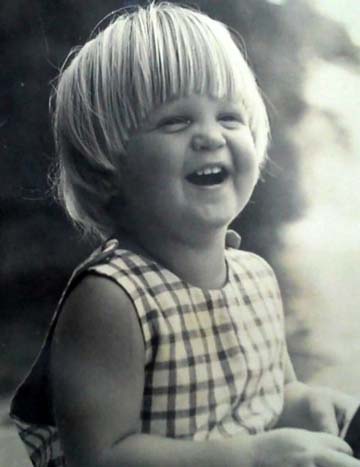
Mason as he appeared sometime before we contacted him for this interview. PHOTO: Mason Dwinell
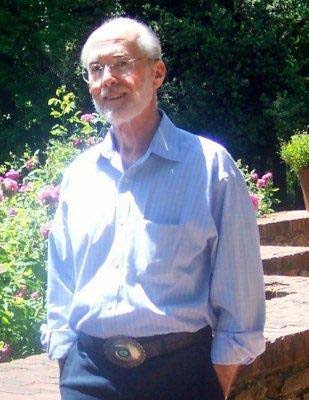
Tom Fee (aka Tom McFee)
The pain and sorrow
of losing someone
can be very deep
yet
seems to be
in proportion to
the joy and happiness experienced
with that special someone
with the sharing of deep thoughts
and meaningful moments.
In parting
the tears of sadness
are but a hint
of the joys that will be missed
and the pleasures known
within.
From Love and Other Painful Joys (1970) by Tom McFee