Orch-OR: Quantum Consciousness: Tour of Consciousness, Week 10


Week 10

2015-REP-con week 10In week 10 we hear from Stuart Hameroff, who along with his partner, has developed a testable model for measuring consciousness as “qubits,” which when collapsed by a quantum gravity event can trigger tiny proteins within a neuron. They call the model Orch OR. These proteins have a digital processing characteristic that imprint thousands of engrams within the neuron; collectively, millions of these engram events have the potential to translate the “quantum wave of consciousness” into a collective neural episode, which becomes the physiological representation of “a thought.” This week’s videos present some of the work of Hameroff and Nobel-Prize candidate Richard Penrose, who together developed the Orch OR model.  Hameroff is an anesthesiologist. Penrose is a British mathematician. The following are some excerpts from an article posted on Science 2.0  on February 2, 2014, concerning the Hameroff/ Penrose Orch-OR model:

“The origin of consciousness reflects our place in the universe, the nature of our existence. Did consciousness evolve from complex computations among brain neurons, as most scientists assert? Or has consciousness, in some sense, been here all along, as spiritual approaches maintain?” ask Hameroff and Penrose in the current review. “This opens a potential Pandora’s Box, but our theory accommodates both these views, suggesting consciousness derives from quantum vibrations in microtubules, protein polymers inside brain neurons, which both govern neuronal and synaptic function, and connect brain processes to self-organizing processes in the fine scale, ‘proto-conscious’ quantum structure of reality.”

“The evidence now clearly supports Orch OR,” they claim. “Our new paper updates the evidence, clarifies Orch OR quantum bits, or “qubits,” as helical pathways in microtubule lattices, rebuts critics, and reviews 20 testable predictions of Orch OR published in 1998—of these, six are confirmed and none refuted.”


Stuart Hameroff, “Fractal Consciousness and Orch OR,” University of Arizona Consciousness, February 17, 2013: 62 minutes.

http://www.youtube.com/watch?v=yp20eWejD6Q


Stuart Hameroff, “How Does the Brain Produce Consciousness?” Psychiatry Grand Rounds, January 8, 2003; posted on June 4, 2011: 58 minutes.

http://www.youtube.com/watch?v=Fb-5Pb9qmPE


by Michael McIntyre


< WEEK 11 >



The Blinders of Materialism


cavallo


“With spherical-holographic perception, measuring attention isn’t important. You’re more interested in being responsive to the Flow … You don’t need to focus a long time since full awareness occurs in each moment. Therefore, you don’t need to use intention. … With spherical-holographic attention, you notice an idea you want to understand or materialize without having to attach special force to it. Instead of the hard focus of intent, you simply “be with” the idea softly. … When an idea is on your wavelength, it remains alive in your field without you having to grip it to keep it in place. … With a softer, more expansive focus, you notice that your personal field itself is paying attention, that your soul is continually paying attention to creating your reality in the best possible way.” ~Penney Peirce


“You often see horses and donkeys wearing blinders, especially in urban areas. This is intended to keep the animal focused on the path in front of him and not get distracted or frightened by things off to the side. This may be a useful thing to do with these animals under the conditions found in a crowded city as long as there is someone controlling them who is not wearing blinders. Otherwise, the horse may be heading forward blissfully unaware that a runaway car is approaching from the side and about to hit him!

“The same is true of people who wear blinders. Of course, the blinders we wear are not so literal and not so obvious, but they are just as effective and just as dangerous.”

< Read the entire blog online at spiritsun.net. >

by Harold Boulette


The Labyrinth of Matter


2015-REP-labyrinth


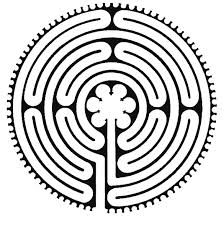
Much of the information concerning the rituals of the higher degrees of the Egyptian Mysteries have been gleaned from an examination of the chambers and passageways in which the initiations were given. … Labyrinths were also a striking feature in connection with the Rites of Serapis, and E. A. Wallis Budge, in his Gods of the Egyptians, depicts Serapis (Minotaur-like) with the body of a man and the head of a bull. Labyrinths were symbolic of the involvements and illusions of the lower world through which wanders the soul of man in it’s search for truth. In the labyrinth dwells the lower animal man with the head of the bull, who seeks to destroy the soul entangled in the maze of worldly ignorance. In this relation Serapis becomes the Tryer or Adversary who tests the souls of those seeking union with the immortals.

The Gnostic Mysteries were acquainted with the arcane meaning of Serapis, and through the medium of Gnosticism, this god became inextricably associated with early Christianity. ~Manly P. Hall


“Most of us are familiar with walking a labyrinth as a religious of spiritual ceremony intended to help one awaken spiritual faculties, or to understand the spirit world better, but I have never heard an explanation of this that made much sense to me until I read this one.”


< Read the entire blog online at spiritsun.net. >

by Harold Boulette


Neuroscience of Consciousness: Tour of Consciousness, Week 9


Week 9

2015-REP-con week 9


This week includes two talks by Baroness Susan Greenfield, a professor of synaptic pharmacology (chemistry of brain neurons) who has also been awarded 28 honorary degrees. She has an extraordinary talent for translating ideas into vivid language. Using examples of everyday experiences she brings us into the world of neuroscience and consciousness. In the last minutes of the second lecture she suggests the possibility of consciousness as being a quantum event that somehow becomes measurable neural activity. Could such a thing be feasible?

Two lectures by Greenfield are included because her topic is somewhat dense and warrants a second viewing. Both talks are similar in content, but the second talk is more detailed.


Baroness Susan Greenfield, “The Neuroscience of Consciousness,” November  28,  2012: 86 minutes. http://www.youtube.com/watch?v=k_ZTNmkIiBc


Baroness Susan Greenfield, “How Does the Brain Generate Consciousness,” September 19, 2010: 64 minutes.

https://www.youtube.com/watch?v=WN5Fs6_O2mY


by Michael McIntyre


< WEEK 10 >


Gatekeepers: Perception, Attention, and Memory: Tour of Consciousness, Week 8


Week 8

2015-REP-con week 8


Brain Study: If you can read this, you have a strong mind (so it is said, anyway):

7H15 M3554G3 53RV35 7O PR0V3 H0W 0UR M1ND5 C4N D0 4M4Z1N6 7H1NG5! 1MPR3551V3 7H1NG5! 1N 7H3 B3G1NN1N6 17 WA5 H4RD, BU7 N0W 0N 7H15 LIN3 Y0UR M1ND 1S R34D1NG 17 4U70M471C4LLY W17H 0U7 3V3N 7H1NK1N6 4B0U7 17, B3 PROUD! 0NLY C3R741N P30PL3 C4N R34D 7H15.

In week 8 we look at a variety of topics, including perception, attention, and memory. The first eight weeks in this series are an introduction to the many fields of research that address “consciousness”; these have been constructed so you may better appreciate and understand the presentations in weeks 9 through 12 that investigate “consciousness” in a more sophisticated manner.


The Ellen Show, “Hosts of ‘Brain Games’ Trick Our Staff,” January 2, 2011: 5 minutes(These examples were actually clinical studies before becoming popular staged performances).

https://www.youtube.com/watch?v=SAmhLLtN8qw


V. S. Ramachandran, “Three Clues to Understanding Your Brain,” TED Talks, March 2011: 24 minutes.

http://www.ted.com/talks/vilayanur_ramachandran_on_your_mind


R. Beau Lotto, “Optical Illusions Show Us How We See,” TED Talks, July 2009: 14 minutes.

http://www.ted.com/talks/beau_lotto_optical_illusions_show_how_we_see?language=e


Neil deGrasse Tyson,”How Does the Brain Work?” NOVA, April 19, 2012: 53 minutes.

https://www.youtube.com/watch?v=iWg0cWFQiiY


National Geographic, “Tap into Your Brain’s Stored Power: A Three Minute Experiment,” February 17, 2014: 3 minutes.

https://www.youtube.com/watch?v=QelK8rDrbpM


Daniel Kahneman, “Two Systems of the Mind,” March 19, 2012: 30 minutes.

https://www.youtube.com/watch?v=k4hqvMYBB1c


Nobelprize.org, The Mystery of Memory, documentary, October 26, 2011: 30 minutes.

https://www.youtube.com/watch?v=4sWnkBf5V7s


Travis, “5 Synesthesia Videos: Sensory Interplay Relay,” April 2014: 20 minutes.

http://www.synesthesiatest.org/


ASAPScience, “Brain Tricks: This Is How Your Brain Works,” January 31, 2013: 5 minutes.

https://www.youtube.com/watch?v=JiTz2i4VHFw


by Michael McIntyre


< WEEK 9 >


Mystics, Mysticism and Reality


2015-REP-MysticismPyramid


Mysticism is the art of union with Reality. The mystic is a person who has attained that union in a greater or lesser degree; or who aims at and believes in such attainment.

It is not expected that the inquirer will find great comfort in this sentence when first it meets his eye. The ultimate question, ‘What is reality?’—a question, perhaps, which never occurred to him before—is always forming in his mind; and he knows that it will cause him infinite-distress. Only a mystic can answer it: and he, in terms which other mystics alone will understand. Therefore, for the time being, the practical man may put it on one side. All that he is asked to consider now is this: that the word ‘union’ represents not so much a rare and unimaginable operation, as something which he is doing, in a vague, imperfect fashion, at every moment of his conscious life; … ~Evelyn Underhill


“I think that very short definition of mysticism is such a great one, as is the definition of a mystic that follows it. We can find rather complicated definitions elsewhere that are open to interpretation. It is often defined as “union with the Deity” but what Deity? Different people have different ideas of God, different beliefs of how God behaves, and different ideas of how to become one with this Deity.”


< Read the entire blog online at spiritsun.net. >


by Harold Boulette


“Cognitive Anthropology, Part 1”: Tour of Consciousness, Week 7B


Week 7B

2015-REP-con week 7 Two thousand years ago Jews would stone a person for working on the Sabbath.  By comparison, in the 21st century, people are being criminally charged for the abuse and killing of domestic animals.  A seven-year-old child in Western culture today can do math problems using zeros; a concept unfathomable 1,500 years ago and that child would have been celebrated as being beyond genius.  Many expressions of music, art, and architecture from the past century would be virtually indigestible for anyone living 700 years ago.

A new science lies on the horizon that suggests that humans are evolving in a fashion not apparent by any biological display.  Cognitive anthropology is the study of cognition to identify conscious peculiarities between cultures, past or present, and peripherally includes inter-species investigations of humans, primates, dolphins, birds, canines, rodents, even lizards, ants, and bees. 

Carl Jung made a good case for cognitive anthropology, although a bit wishful, long before the science was born, stating, “The differing degrees of self-knowledge within [humankind’s] own species are of little significance compared with the possibilities which would be opened out by an encounter with a creature of similar structure but different origin. . . . The possibility of comparison and hence self-knowledge would arise only if [humankind] could establish relations with quasi-human mammals inhabiting other stars.” (The Undiscovered Self, rev. trans. by RFC Hull, 1958, paragraphs 526 and 525.

Like all previous weeks in this tour, this is just a brief introduction, and the citations are only a whisper compared to all volumes on the subject.


PART B

Wade Davis,”The Wayfinders: Why Ancient Wisdom Matters in the Modern World,” Garrison Institute, June 20, 2013: 40 minutes.

https://www.youtube.com/watch?v=XuJsbjKKh3E


Marcus du  Sautoy, “History and Wonders of Ancient Indian Mathematics,” BBC,  The Story of Maths, posted January 28, 2014: 19 minutes.

https://www.youtube.com/watch?v=1FcH33Cuj8w


G. W. Domhoff, “A New Neurocognitive Theory of Dreams,”  Dreaming, vol. 11, (2001), pp. 13–33. In the fourth paragraph of this article, which summarizes the study, Domhoff makes this statement: “Dreaming is a cognitive achievement that develops gradually over the first 8 or 9 years of life.” This statement set off a spark in the dream research community to address the possibility that dream awareness or attentiveness may be a cognitive evolutionary skill; that is, one that evolves. Available online at

http://www2.ucsc.edu/dreams/Library/domhoff_2001a.html


Tim Post, “Lucid Dreaming,”TEDx at TwenteU,November 5, 2013: 14 minutes.

https://www.youtube.com/watch?v=OK3SfNxbK3Y


Susan Blackmore, “Meme Machine,” published by Karol Jalochowski, September 17, 2013: 8 minutes.

https://www.youtube.com/watch?v=3O5dBgu3Iz4


by Michael McIntyre


< WEEK 8 >


“Venerate Truth and Knowledge”


2014-REP-LawGods

Only within his own soul can a man find the means to unseal the lips of an initiate. He must develop within himself certain facilities to a definite degree, and then the highest treasures of the spirit can become his own.

He must begin with a certain fundamental attitude of soul. In spiritual science this fundamental attitude is called the path of veneration, of devotion to truth and knowledge. Without this attitude no one can become a student. . . . There are children who look up with religious awe to those whom they venerate. . . . From the ranks of such children are recruited many students of higher knowledge. . . . It is a blessing for every human being in process of development to have such feelings upon which to build. Only it must not be thought that this disposition leads to submissiveness and slavery. What was once a childlike veneration for persons becomes, later, a veneration for truth and knowledge. ~Rudolf Steiner

“It is unfortunate that many people think spirituality, as with some religious cults and churches, is all about worshiping individuals. Mr. Steiner explains that, while this may be true of children (and childish or lazy adults), It is not true of the real seeker, the person seeking a higher life, a higher world. To that person, it is not about worship, but about gaining knowledge, wisdom, and truth. And true knowledge (Gnosis), wisdom and truth can come only from awakening your spiritual faculties and using them regularly until you reach a high state of enlightenment, a state where you don’t have to look up things in books, or debate them with intellectuals, he simply knows what is right and what is wrong, what is true and what is lies, distortions, or half-truths.”


< Read the entire article online on Harold’s blog at spiritsun.net. >


contributed by Harold Boulette


“Cognitive Anthropology, Part 1”: Tour of Consciousness, Week 7A


Week 7A

2015-REP-con week 7 Two thousand years ago Jews would stone a person for working on the Sabbath.  By comparison, in the 21st century, people are being criminally charged for the abuse and killing of domestic animals.  A seven-year-old child in Western culture today can do math problems using zeros; a concept unfathomable 1,500 years ago and that child would have been celebrated as being beyond genius.  Many expressions of music, art, and architecture from the past century would be virtually indigestible for anyone living 700 years ago.

A new science lies on the horizon that suggests that humans are evolving in a fashion not apparent by any biological display.  Cognitive anthropology is the study of cognition to identify conscious peculiarities between cultures, past or present, and peripherally includes inter-species investigations of humans, primates, dolphins, birds, canines, rodents, even lizards, ants, and bees. 

Carl Jung made a good case for cognitive anthropology, although a bit wishful, long before the science was born, stating, “The differing degrees of self-knowledge within [humankind’s] own species are of little significance compared with the possibilities which would be opened out by an encounter with a creature of similar structure but different origin. . . . The possibility of comparison and hence self-knowledge would arise only if [humankind] could establish relations with quasi-human mammals inhabiting other stars.” (The Undiscovered Self, rev. trans. by RFC Hull, 1958, paragraphs 526 and 525.

Like all previous weeks in this tour, this is just a brief introduction, and the citations are only a whisper compared to all volumes on the subject.


PART A

Daniel Everett, No title (Everett talks about the Pidaha (pronounced pih-ra-ha), a people who have no words for colors or numbers nor consider any distant past or future), September 9, 2013: 46 minutes.

https://www.youtube.com/watch?v=ad6V9AKt24U&list=PLvUXF94GJw3PJURjalMdE57CNjjAmfCi4


Klaus Zuberbuhler and Con Slobodchikoff, “Wild Talk,”Radiolab,October 18, 2010: 21 minutes. http://www.radiolab.org/story/98611-wild-talk/


Ed Green et al., “End of Neanderthal Man,” September 23, 2008: 5 minutes.

https://www.youtube.com/watch?v=MIQNzbd4-RY


Robert Sapolsky,”The Uniqueness of Humans,“TED Talks, Stanford University, 2009, posted January 2010: 38 minutes.

https://www.ted.com/talks/robert_sapolsky_the_uniqueness_of_humans


by Michael McIntyre


< WEEK 7B >


Free Will in a Spiritual School


2015-REP-SpiritTeach


No teacher of the spiritual life wishes to establish a mastery over other persons … He would not tamper with anyone’s independence. Indeed, none respect and cherish human independence mote than the spiritually experienced. … Whenever the initiate leaves his enclosed spiritual sphere and steps forth before the world, he must immediately take a third law into account. It is this: Adapt each one of your actions, and frame each one of your words in such a way that you infringe upon no one’s free-will.

The recognition that all true teachers of the spiritual life are permeated through and through with this principle will convince all who follow the practical rules proffered to them that they need sacrifice none of their independence. … Originally all rules and teachings of spiritual science were expressed in a symbolic sign-language, some understanding of which must be acquired before its whole meaning and scope can be realized. This understanding is dependent on the first steps toward higher knowledge, and these steps result from the exact observation of such rules as they are given. ~Rudolf Steiner


“This is one way you can tell the true spiritual teacher from the phony, the cult leader. The true spiritual teacher tells you what you need to know to grow spiritually (note that it is not necessarily the same for each individual), but makes no effort to force you to follow that path. She may recommend that you eat certain foods and avoid others, but will not criticize or ostracize you for eating something you were advised to avoid. A real spiritual teacher may recommend that you dress in certain colors, for example, if you are a very materialistic type, he may advise that you avoid wearing red or orange and instead wear green, blue and purple. He will not, however, kick you out of the school because you show up in an orange jacket.

“On the other hand, the cult leader who tells you what to wear, where to live, who to marry, etc. and enforces it with a strong hand is not at all a spiritual leader. The preacher who insists that you cannot possibly be saved if you do not join his church and follow his rules to the letter is also not a real spiritual teacher. And the preacher, church or religious group that tries to get laws passed to force everyone into their church, or at least to follow it’s teachings,  is also a fraud. A real church or spiritual school would, of course, love it if everyone followed their teachings, but they would never try to force anyone by legal means, by violence, or by any other form or coercion.”


< Read the entire blog online at spiritsun.net. >

by Harold Boulette