“10 billion-year-old supernova sheds new light on cosmic expansion and dark energy”


A distant stellar explosion has offered astronomers a rare natural experiment, one that turns gravity into a powerful optical tool. The object, known as SN 2025wny, appears not once but four times in the sky, its light split and magnified by a massive foreground galaxy. The result resembles a cosmic hall of mirrors and provides a new way to study how the universe expands.

Click here to read the article


“New images reveal an early-stage stellar eruption (nova) in stunning detail”


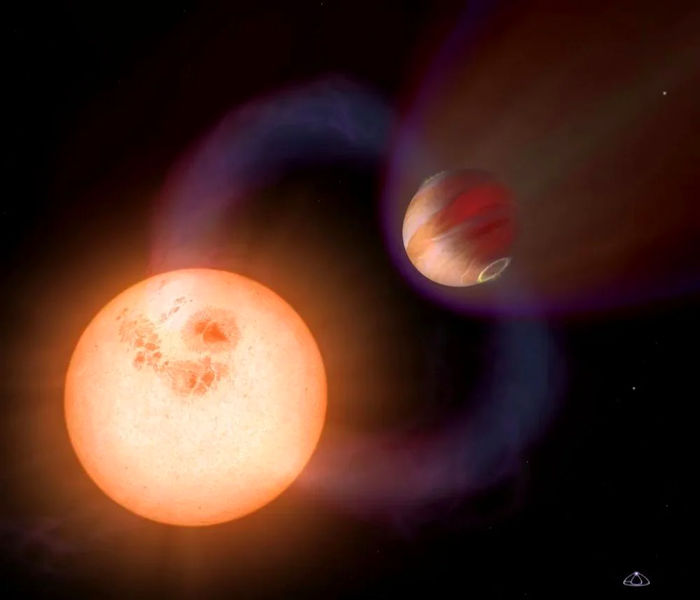
A classical nova may look simple at first. A faint star brightens, sometimes enough for you to spot without a telescope, then slowly dims over weeks or months. Behind that short burst of light sits a white dwarf in a tight orbit with a partner star. The white dwarf pulls in hydrogen from its neighbor until a runaway nuclear reaction ignites. The outer layer swells, and the system releases a wave of energy that should blow gas into space.

Click here to read the article


“Parker Solar Probe spots solar wind ‘U-turn'”


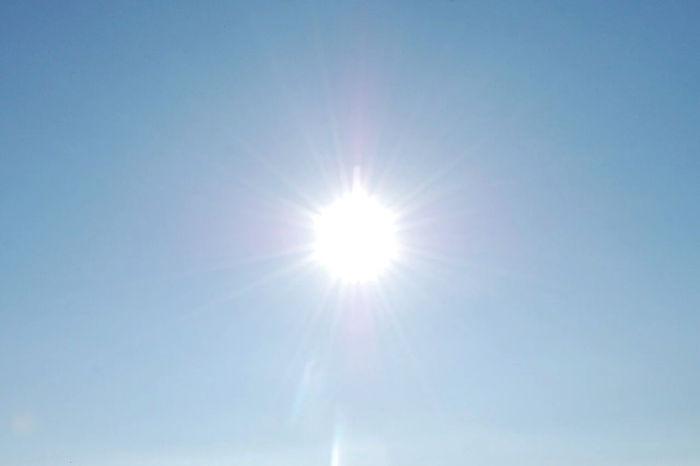
A year ago tomorrow, NASA’s Parker Solar Probe made its record-breaking closest approach to the sun. And the images it captured have now revealed new details about how magnetic fields responsible for space weather escape from the sun … and how sometimes they don’t.

Click here to read the article


“At 50 million-light-years long, scientists discover one of the universe’s largest structures”


Look up on a dark night and the stars seem scattered at random. Step back in scale, though, and the Universe looks nothing like a loose dusting. On its largest stretches, matter forms a vast web. Thick clusters rise where threads meet. Long filaments bind them together. Immense voids lie between, empty as oceans without water.

Click here to read the article


“The Milky Way’s stars reveal a hidden history of two galaxies in one”


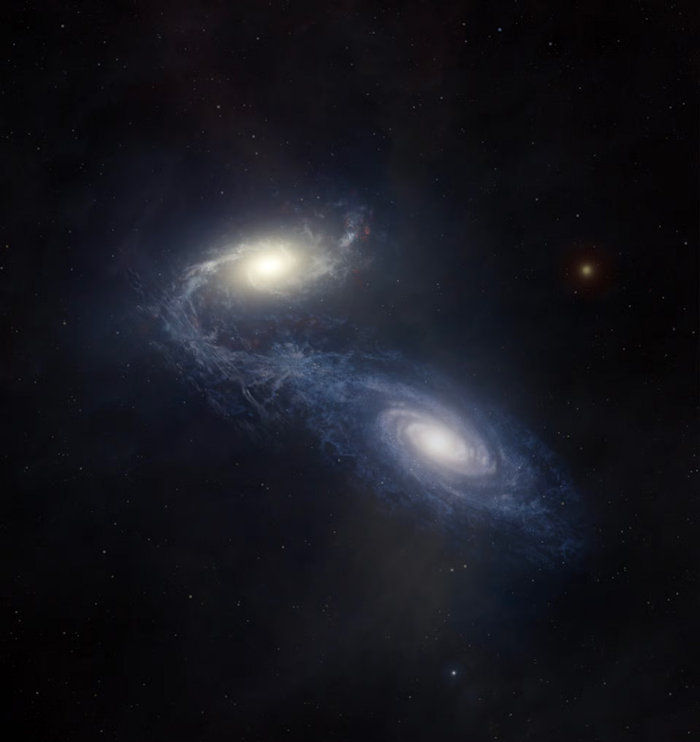
From your place inside the Milky Way, you are living within a galaxy that keeps a detailed chemical diary. Every star holds clues about when it formed and what the galaxy was like at the time. Over the past decade, data from the Gaia space telescope and massive sky surveys have given astronomers an unusually sharp view of those records. With millions of stars tracked for motion, age and composition, a strange pattern has stood out: the stars in the Milky Way’s disc do not follow one smooth chemical trend.

Click here to read the article


“The Christmas Tree cluster”


We’d be remiss to have the holiday season pass by without showcasing the lovely Christmas Tree cluster. The area of sky in this photo goes by a number of names, including the Christmas Tree cluster, the Cone nebula and NGC 2264. The image above shows a region of space about 30 light-years across. Astronomers at ESO’s La Silla Observatory, in the Atacama Desert of Chile, captured this image.

Click here to read the article


“Long-lasting gamma-ray burst is a unique puzzle”


  • Astronomers spotted a gamma-ray burst – named GRB 250702B – on July 2, 2025. It’s the longest gamma-ray burst ever recorded, lasting at least seven hours, nearly double the previous record.
  • The rare, long-duration burst may reveal new ways to create gamma-ray bursts. And it suggests there may be previously unseen types of cosmic explosions.
  • One explanation is that a black hole about three times the sun’s mass – with an event horizon just 11 miles (18 kilometers) across – merged with a companion star.

Click here to read the article


“New evidence for monster stars from the cosmic dawn”


For 2 decades, astronomers have puzzled over how supermassive black holes already existed less than a billion years after the Big Bang. If these black holes formed from collapsed stars, the stars would have needed to be dramatically more massive than any we’ve ever observed.

And now, astronomers say they’ve found the 1st strong evidence that such colossal stars did exist.

Click here to read the article


“Astronomers create 1st map of the sun’s outer boundary”


Astronomers have produced the first continuous, 2-dimensional maps of the outer edge of the sun’s atmosphere, a shifting, frothy boundary that marks where solar wind escapes the sun’s magnetic grasp. By combining the maps and close-up measurements, scientists from the Harvard Smithsonian Center for Astrophysics (CfA) showed that the boundary grows larger, rougher and spikier as the sun becomes more active.

Click here to read the article


“Superstorm squeezed Earth’s plasmasphere to record low – disrupting tech around the world”


A powerful solar storm arrived last May and pushed Earth’s protective systems harder than anything seen in more than twenty years. When waves of charged material erupted from the Sun and slammed into the planet on May 10 and 11, 2024, the impact set off a chain of rapid changes in the space around you. What scientists uncovered from this event offers the clearest picture yet of how an extreme solar storm can squeeze Earth’s plasma layers, distort the upper atmosphere, and disrupt the technology people rely on every day.

Click here to read the article