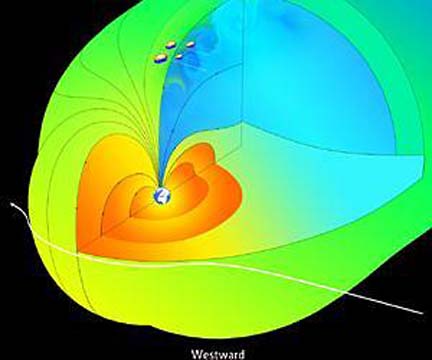
When the interplanetary magnetic field (IMF) is oriented westward (dawnward) or eastward (duskward), magnetopause boundary layers at higher latitude become most subject to Kelvin-Helmholtz instabilities – shown here in an artist’s representation as giant swirls. PHOTO: AOES Medialab.
“A new study based on data from European Space Agency’s Cluster mission shows that it is easier for the solar wind to penetrate Earth’s magnetic environment, the magnetosphere, than had previously been thought.”
< Read the full article by Karen C. Fox for Goddard Space Flight Center online at spacedaily.com. >
This article may be a bit too abstruse for nonscientists, says Consociate Stephan Fuelling, a research physicist at the Desert Research Center in Nevada, but the topic is fascinating. “I am familiar with Kelvin-Helmholtz waves. These are studied at our Physics Department at the Nevada Terawatt Facility. This is an interesting subject in plasma physics.”
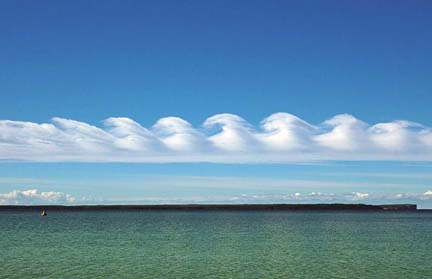
Kelvin-Helmholtz waves occur at a shear boundary. PHOTO: toptenz.net
“Kelvin-Helmholtz waves occur at a shear boundary in the picture above, where the lower air layer may be at rest, while the upper layer moves from the right to the left. The waves are made visible due to cloud formation in this shear layer.”
< Click here to see the picture of this cloud formation online at topttenz.net. >
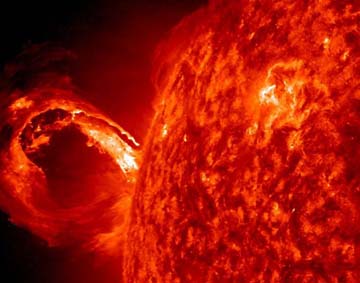
“In an analog way, the solar wind creates this shear when it encounters Earth’s magnetic field. These waves tear up the magnetic field lines and reconnect, allowing the plasma of the solar wind to enter Earth’s magnetic field.
“Magnetic reconnection is another hot topic in plasma physics, how tangling magnetic field lines that may twist and turn around each other come close enough to finally ‘reconnect’. This also happens during a solar mass ejection: a plasma bubble forms that slowly rises, and at its back the magnetic field lines are stretched and twisted. When they reconnect, the plasma bubble is ejected with high velocity.”
As Dr. Fuelling said: “Although this is a fascinating topic, it may be too difficult to follow for most readers.”