“Why We Love Beautiful Things”

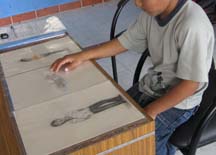
Detail of a drawing by Baptiste Alchourroun

An article by Lance Hosey published February 15, 2013, in the New York Times opinion page caught the eye of one of our Community members, who is a painter. It must have been the discussion of the effect of colors and the concept of our genome-determined sense of beauty that attracted her.

Consociate Robert Anderson had this to say about the article: “It demonstrates what Cosolargists know about the generation of wavefronts and their effects and color and its effects, and it demonstrates that science and art, like science and religion, can reveal the same truths. Our preexistent nature recognizes these higher forms. A materialistic perspective has to resort to a physical cause and the ultimate physical cause for humans (in this perspective) is the gene, but I would say it’s our higher consciousness that finds these attractive because they ARE higher (dimensionally speaking) and thus closer to God and our true Selves.”

Read the entire article online at nytimes.com and tell us what you think about it.

link submitted by Frieda Nelson


“This column will change your life: pseudoscience”

ILLUSTRATION: Kenneth Andersson for the Guardian

“When does science become pseudoscience? And when is it something else entirely?

“It’s a given that the world of pop psychology contains spadefuls of pseudoscience, but as soon as you start reading Michael Gordin’s compelling new book, you realise you don’t quite know what that word means,” says Guardian writer Oliver Burkeman, author of the article.

“The article does not really present anything new,” says Consociate Robert Anderson, “just the standard dogmatic rejection of fringe thinking and experience, the ‘nothing that happens outside the lab is real science’ mentality. Its point that some things are just not science could be answered with: not science that we have yet figured out, though some people (especially healers) don’t worry about lab replication as much as results—even just one client.”

Read the article online and tell us what you think: < Follow this link to “This column will change your life: pseudoscience” at guardian.co.uk. >


link submitted by Frieda Nelson


“Galactic Geysers Fueled by Star Stuff”

Illustration of Fermi gamma ray structure of the Milky Way. PHOTO: spacedaily.com

“Enormous outflows of charged particles from the centre of our Galaxy, stretching more than halfway across the sky and moving at supersonic speeds, have been detected and mapped with CSIRO’s 64-m Parkes radio telescope.”

Read the entire article online and let us know what you think: Follow this link to the article “Galactic Geysers Fuelled by Star Stuff”at spacedaily.com.

link submitted by Frieda Nelson


“New study: are we all living in the future now?”

PHOTO: nomorefakenews.com

A posting with the intriguing title “New study: are we all living in the future now?” was posted by Jon Rappoport on his blog site on February 14, 2013.

Consociate Robert Anderson sent us the link to the posting with this message: “They’re starting to corroborate religion—ours.”

Read the article online and let us know what you think:  Follow this link to “New study: are we all living in the future now?”


New Pyramid Sites Discovered in Egypt and Sudan

The infrared image on the right reveals the ancient city streets of Tanis near modern-day San El Hagar. PHOTO: BBC

Over the past few days, reports have been posted on new findings of ancient pyramid sites, one in Sudan and one in Egypt.

Read the reports and leave us your comments:

Stephan Fuelling sent us this link posted on BBC World News:  “Egyptian pyramids found by infra-red satellite images.” Seventeen lost pyramids are among the buildings identified in a new satellite survey of Egypt. More than 1,000 tombs and 3,000 ancient settlements were also revealed by looking at infra-red images which show underground buildings.

Roger Weld linked us to this online article at the UK Daily Mail:  “Mini-pyramids of the kingdom of Kush: Archaeologists discover 35 burial chambers in Sudan desert with fascinating links to Ancient Egypt”


Science Captures Images of What Happens on the Sun’s Surface

On July 19, 2012, SDO captured images of a solar flare in numerous wavelengths. PHOTO: NASA/Goddard Space Flight Center.

Spacedaily.com has posted some new information on what is actually happening on the surface of the physical sun, all possible because of new atmospheric imaging technology.

Read the posts and let us know what you think:

“Solar Dynamics Observatory Provides First Sightings of How a Coronal Mass Ejection Forms” by Karen C. Fox for Goddard Space Flight Center
“On July 19, 2012, SDO captured images of a solar flare in numerous wavelengths. . . .”


“Why Sun’s Corona Is Much Hotter Than Its Surface”
“Scientists at Northumbria University have for the first time begun to unlock the mystery of why the outer edge of the Sun is much hotter than its surface. . . .”

links submitted by Frieda Nelson


“Yet more evidence emerges that our universe is a grand simulation created by an intelligent designer”

“There’s a lot of buzz in the news about a new scientific study that statistically supports the idea that our known universe is actually a grand computer simulation. This is mainstream science, and the idea isn’t as wacky as you might first suppose. . . . This news, by the way, also supports the idea of a Creator who brought this universe—and everything in it—into existence by design.

“A new scientific paper published in arXiv and coauthored by Silas Beane from the University of Bonn reveals strong statistical evidence that our reality is, indeed, a grand computer simulation. The title of the paper is ‘Constraints on the Universe as a Numerical Simulation.’”

Read the entire article by Mike Adams online at naturalnews.com, then share with us your thoughts and comments. If this becomes the standard world view, how would you address it?


link submitted by Robert Anderson


“Science Set Free”

Rupert Sheldrake. PHOTO: sheldrake.org

Rupert Sheldrake spoke at the 2013 Electric Universe Conference on the theme of his latest book, which was published in January 2012 in the United Kingdom under the title The Science Delusion, and in the U.S. in September 2012 as Science Set Free: 10 Paths to New Discovery. The book summarizes much of his previous work and encapsulates it into a broader critique of modern materialism.

The British title of Sheldrake’s book apparently mimics the title The God Delusion, written by one of Sheldrake’s critics, the avowedly atheist biologist Richard Dawkins; but Sheldrake, in an April 2012 interview, insisted the title was his publishers’ idea. In the interview with Fortean Times, Sheldrake commented, “Dawkins is a passionate believer in materialist dogma, but the book is not a response to him—although I do object to his dumbed-down representation of science.”

In his book, Sheldrake proposes a big question as the theme of each chapter, each of which seeks to elaborate on his central premise that science is predicated on the belief that the nature of reality is fully understood with only minor details needing to be filled in. This “delusion” is what Sheldrake argues has turned science into a series of dogmas, rather than a genuinely open-minded approach to investigating phenomena.

Watch the two-part presentation of Ruper Sheldrake’s talk at the Electric Universe 2013 conference on YouTube:

Click here to watch PART 1 (30 minutes)

Click here to watch PART 2 (28 minutes)

To find out more about Dr. Sheldrake, visit his web site: http://www.sheldrake.org

links submitted by Robert Petrovich


Background Controversy on the Gospel of Judas Translation


PHOTO: Kenneth Garrett/NGS

In 2006 The National Geographic Society released the first English translation of the Gospel of Judas, a second-century text discovered in Egypt in the 1970s. The translation caused a sensation because it seemed to overturn the popular image of Judas the betrayer and instead presented a benevolent Judas who was a friend of Jesus.

In The Thirteenth Apostle, April DeConick offers a new translation of the Gospel of Judas that seriously challenges The National Geographic interpretation. Inspired by The National Geographic Society’s efforts to piece together this ancient manuscript, DeConick sought out the original Coptic text and began her own translation. She said: “I didn’t find the sublime Judas, at least not in Coptic. What I found were a series of English translation choices made by the National Geographic team, choices that permitted a different Judas to emerge in the English translation than in the Coptic original. Judas was not only not sublime, he was far more demonic than any Judas I know in any other piece of early Christian literature, Gnostic or otherwise.”

Read what April D. DeConick has to say about the original translation of the Gospel of Judas in  the New York Times Op-Ed page on December 1, 2007: “Gospel Truth”

Read what the translators of the Gospel of Judas have to say about the comments on their work made by April D. DeConick in the New York Times Op-Ed page on December 7, 2007: “The Gospel of Judas: A Word from the Translators.

Read what was written about the debate in  National Geographic News at nationalgeographic.com by Stefan Lovgren : “Judas was a Demon After All, New Gospel Reading Claims.”

Follow this link to the book The Thirteenth Gospel: What the Gospel of Judas Really Says by April D. DeConick  at Amazon.com and there *Look Inside* to read the “Preface to the Revised Edition.” You will get a good piece of the story of how the stressful translation schedule of the scholars hired by National Geographic led to important translation errors and a sensational and misguided view of what the original manuscript said.

Click here to see a PDF of the 2006 translation of the Gospel of Judas at nationalgeographic.com.

Click here to link to The Gospel of Judas, Critical Edition at Amazon.com.


links provided by Robert Petrovich


“UPDATE: The Reaction to Karen King’s Gospel Discovery”


The "Mary" in the controversial text, King says, may be Mary Magdalene, who was present at the Crucifixion. (Sandro Botticelli, The Mourning of Christ, c. 1490. Alte Pinakothek, Bayerische Staatsgemaeldesammlugen, Munich/ BPK, Berlin/Art Resouce, NY)

“When the divinity scholar unveiled the papyrus fragment that she says refers to Jesus’ ‘wife,’ our reporter was there in Rome amidst the firestorm of criticism.”

Read the entire article at smithsonianmag.com by Ariel Sabar, the only reporter on the scene in Rome when the divinity scholar Karen King made the announcement.

This story is an update of < the news broken by Smithsonian magazine on September 18, 2012 >.

Read the original Communique article on the discovery.

Links provided by Robert Petrovich