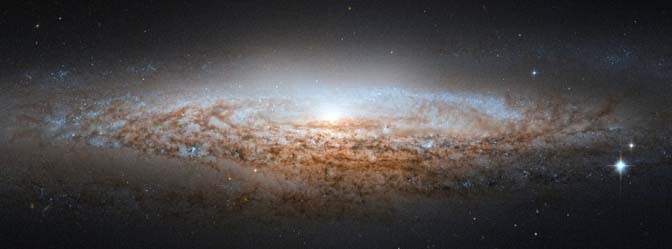
This composite image of the Crab Nebula was assembled with arbitrary color scaling by combining data from five telescopes spanning nearly the entire electromagnetic spectrum: the radio emission representing the wind of charged particles from the central neutron star in red (from the Karl G. Jansky Very Large Array), the infrared including the glow of dust particles absorbing ultraviolet and visible light in yellow (from the Spitzer Space Telescope), the visible-light image featuring the hot filamentary structures in green (from the Hubble Space Telescope), the ultraviolet image in blue and the X-ray image in purple showing the effect of an energetic cloud of electrons (from the XMM-Newton Observatory and the Chandra X-ray Observatory).
Credit: NASA / ESA / NRAO / AUI / NSF and G. Dubner (University of Buenos Aires)
The origin of cosmic rays, high-energy particles from outer space constantly impacting on Earth, is among the most challenging open questions in astrophysics. Now new research published in the journal Monthly Notices of the Royal Astronomical Society sheds new light on the origin of those energetic particles.
“Discovered more than 100 years ago and considered a potential health risk to airplane crews and astronauts, cosmic rays are believed to be produced by shock waves — for example, those resulting from supernova explosions. The most energetic cosmic rays streaking across the universe carry 10 to 100 million times the energy generated by particle colliders such as the Large Hadron Collider at CERN.
“The Crab Nebula, the remnant of a supernova explosion that was observed almost 1,000 years ago in A.D. 1054, is one of the best-studied objects in the history of astronomy and a known source of cosmic rays. It emits radiation across the entire electromagnetic spectrum, from gamma rays, ultraviolet and visible light, to infrared and radio waves. Most of what we see comes from very energetic particles (electrons), and astrophysicists can construct detailed models to try to reproduce the radiation that these particles emit.
“The new study, by Federico Fraschetti at the University of Arizona, USA, and Martin Pohl at the University of Potsdam, Germany, reveals that the electromagnetic radiation streaming from the Crab Nebula may originate in a different way than scientists have traditionally thought: The entire zoo of radiation can potentially be unified and arise from a single population of electrons, a hypothesis previously deemed impossible.”
Read the entire article posted September 4, 2017 at sciencedaily.com
link submitted by Frieda Nelson