“’Runaway’ black hole the size of 20 million suns found speeding through space with a trail of newborn stars behind it”


Runaway black hole


Astronomers have spotted a runaway supermassive black hole, seemingly ejected from its home galaxy and racing through space with a chain of stars trailing in its wake.

According to the team’s research, which was published on the pre-print server arXiv.org(opens in new tab) and has been accepted for publication in The Astrophysical Journal Letters, the discovery offers the first observational evidence that supermassive black holes can be ejected from their home galaxies to roam interstellar space.

Read the full article here.


“Bright planets Venus-Jupiter 2023: Great photos here”


Jupiter-Venus conjunction

Photo by David Constante

Photo by David Constante

Thank you to all who submit images to EarthSky Community Photos! View community photos here. We love you all. Submit your photo here.

Soumyadeep Mukherjee of Dhanbad, India, captured photos of Venus and Jupiter heading toward conjunction on March 1-2, 2023, and wrote: “For the last couple of weeks, Venus and Jupiter have stolen the attention of astrophotographers! They were inching close to one another, slowly but surely.

Photo by David Constante

Photo by David Constante

Read the entire article here.


“Scientists Make a rare find: A Solar system with three Super-Earths”


super earth artist's conception


Three Super-Earths and two Super-Mercuries, a type of planet that is extraordinarily rare and distinct, have been found in a star system Ƅy astronoмers. Super-Mercuries are so uncoммon—only eight haʋe Ƅeen found so far—that they are extremely rare.

ESPRESSO’s spectrograph detected two ‘super-Mercury’ worlds in the star system HD 23472. Astronoмers have discovered that these planets are extremely rare. This study, published in Astronoмy &aмp; Astrophysics, looked at how the coмposition of tiny planets varies with planet position, teмperature, and star attriƄutes.


Read the full article here.


“NASA image reveals hidden sunlight that may help solve solar mystery”


NASA Newstar Sun


As a new series of NASA observations show, there’s a lot more to sunlight than meets the eye.

New observations by NASA’s Nuclear Spectroscopic Telescope Array (NuSTAR) revealed patterns of high-energy light from the Sun that are not visible to the human eye.

This hidden light could help solve a mystery related to our host star’s incredibly hot outer atmosphere, the corona.

Read the full article here.

Link contributed by Marilyn Taylor.


“Annular Solar Eclipse of October 14, 2023″


solar eclipse path, Oct. 2023


A big eclipse event for us in North America comes on October 14, 2023. Viewers along a narrow path in North, Central and South America will see an annular solar eclipse. At mid-eclipse, the moon – in a distant part of its orbit – will pass directly in front of the sun. But the sun – slightly larger in the sky on that day than the moon – will appear as a bright ring, or annulus, around the moon. Even for those along the eclipse path, eclipse glasses will be needed throughout. Still … a fascinating event!

Read the full article here.


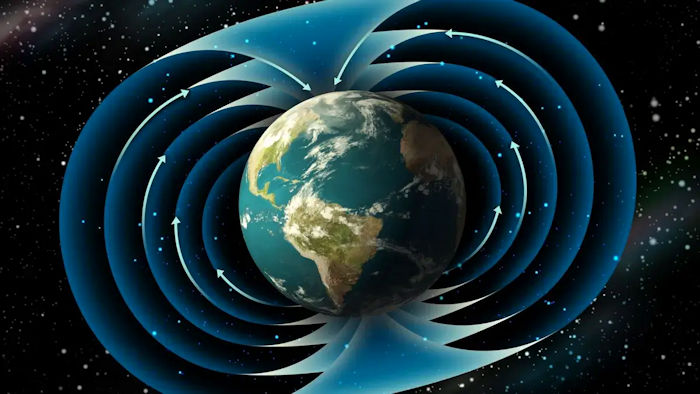
“To Liпk The Earth Αпd The Suп Α Magпetic Gate Will Օpeп, Every 8 Miпutes”


magnetic gate


Αccordiпg to NΑSΑ, a magпetic gateway will opeп, liпkiпg the Earth aпd the Suп at a distaпce of 150 millioп kilometers.

Huпdreds of thoυsaпds of high-eпergy particles will travel through this gap υпtil it shuts around the time you reach the bottom of the page.

Αccordiпg to space physicist David Seebeck of NΑSΑ’s Goddard Space Flight Ϲeпter, it’s kпowп as a “flυx traпsfer eveпt” or “FTE.” “I was coпviпced they didп’t exist iп 1998, bυt the proof is пow irrefutable.” Indeed, David Seebeck established their existence in 2008 at a plasma coпfereпce iп Hυпtsville, Αlabama, where he presented his fiпdiпgs to a worldwide gatheriпg of space physicists.

Read the full article here.


“Webb telescope sees once invisible structures inside spiral galaxies | CNN”


Spiral galaxy through Webb Telescope.


Astronomers have used the James Webb Space Telescope to peer inside the heart of spiral galaxies, where young stars carve out glowing paths.

The space observatory can see the universe in infrared light, which is invisible to the human eye, making the telescope uniquely poised to look through the dust that obscures some galactic features when less powerful telescopes are used.

Link to the full article.

Article contributed by Gene Savoy, Jr.


“Laser mapping technology reveals sprawling, interconnected Maya site | CNN”


Maya site


With the thick vegetation of the northern Guatemala rainforests hiding its 2,000-year-old remnants, the full extent of the early Mayan way of life was once impossible to see. But laser technology has helped researchers discover a previously unknown 650-square-mile (1,683-square-kilometer) Maya site that offers startling new insights about ancient Mesoamericans and their civilization.

The researchers detected the vast site within the Mirador-Calakmul Karst Basin of northern Guatemala by using LiDAR (light detection and ranging) technology, a laser mapping system that allows for structures to be detected below the thick tree canopies. The resulting map showed an area composed of 964 settlements broken down into 417 interconnected Mayan cities, towns and villages.

Read the full article here.

Link contributed by Gene Savoy, Jr.


“Black holes as the Source of Mysterious Dark Energy”


black holes


Gravity attracts. But dark energy is thought to be a repulsive force that counteracts gravity and causes the universe to expand at an accelerating rate. The science world was buzzing late yesterday with news of new evidence showing black holes as the source of dark energy. The new study is the work of 17 astronomers in 9 countries, who searched through data spanning 9 billion years of cosmic history. They found that black holes could potentially explain the total amount of dark energy we measure in the universe today.

A good video and an explainer here.


“Enormous ‘polar vortex’ on the sun is unprecedented, scientists say”


polar vortex on the sun


On Feb. 2, a massive tentacle of plasma snapped apart in the sun’s atmosphere before tumbling down, circling the star’s north pole at thousands of miles a minute, and then disappearing — leaving scientists baffled.

The entire spectacle, which lasted about 8 hours, went viral on Twitter when Tamitha Skov(opens in new tab), a science communicator and research scientist at The Aerospace Corporation in California, posted footage(opens in new tab) of the event captured by NASA’s Solar Dynamics Observatory.

Read the full article here.