“Exploding Primordial Black Holes Might Have Reshaped the Early Universe – And Created All Matter As We Know It”


The early universe is absolutely so far outside our understanding of how the world works it’s hard to describe in words. Back then, the cosmos wasn’t filled with stars and galaxies but with a boiling soup of quarks and gluons, with a few microscopic black holes thrown in, occasionally detonating like depth charges. That’s the early universe theorized by a new paper, available in pre-print from arXiv, from researchers at Vrije Universiteit Brussel and MIT anyway.


“Scouring TESS Data With AI Reveals A Hundred New Exoplanets”


Artificial Intelligence (AI) and Machine Learning (ML) are making a growing contribution to astronomy. As powerful telescopes and large automated surveys become more commonplace, the vast quantities of data they generate demand equally powerful diagnostic tools. The Vera Rubin Observatory and its enormous data-generating capacity drive the point home. The observatory’s Legacy Survey of Time and Space generates up to 20 terabytes of data each night, and that data is processed at a dedicated facility.


“Astronomers Find a Third Galaxy Missing Its Dark Matter, Validating a Violent Cosmic Collision Theory”


Dark matter makes up most of the mass in the Universe, but it’s not evenly distributed. Astronomers are finding examples where galaxies contain less dark matter than average, or more, and now they’re finding examples of galaxies that contain only dark matter, galaxies with the size and mass of the Milky Way but with 1/500th the number of stars, so you could see right through them to the galaxies behind. And now researchers have found their third example of this strange situation: a galaxy that’s almost entirely dark matter.


“The Sun That Never Flips”


The Sun doesn’t spin at the same rate. Its equator takes 25 days to complete one rotation while its poles take 35 days. This differential rotation was thought to settle down as stars age and maybe even reverse, with the poles going faster than the equator. A new supercomputer simulation shows that it won’t be the case. Even as it slows its rotation over billions of years, the equator will continue to rotate more quickly than the poles.


“The Early Universe was Hot, Dense, and Soupy”


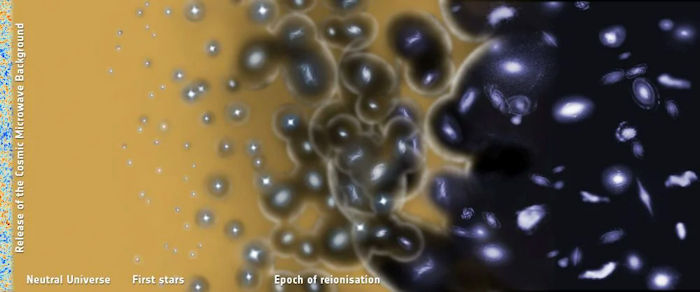
Shortly after the Big Bang, the Universe was hot and dense, a plasma of quarks and gluons that led to the formation of the first hydrogen atoms. It’s called the primordial soup, and it turns out, that name is apt. New research shows that quarks moving through that early time behave like objects moving through a liquid. This can help researchers understand how this early time in the Universe evolved to the more modern structures we see today.


“‘Space archaeologists’ use oxygen map to reconstruct a galaxy’s 12-billion-year past”


The oxygen in a galaxy does not sit still. It spreads, thins out, piles up, and leaves behind a record of where stars formed, where gas moved, and when smaller galaxies crashed in. In the nearby spiral galaxy NGC 1365, astronomers have now read that record in unusual detail, using oxygen as a kind of fossil trail.

Click here to read the article


“The Answer is Written in the Stars”


Here’s a question that sounds simple but has kept cosmologists arguing for decades – how old is the universe? You’d think we’d have nailed this down by now. We’ve sent spacecraft to the edges of the Solar System, photographed galaxies billions of light years away, and detected ripples in the very fabric of spacetime itself. And yet, depending on which method you use to measure the universe’s age, you get a different answer and those answers seem to contradict each other.

Click here to read the article


“Astronomers Produce the Largest Image Ever Taken of the Heart of the Milky Way”


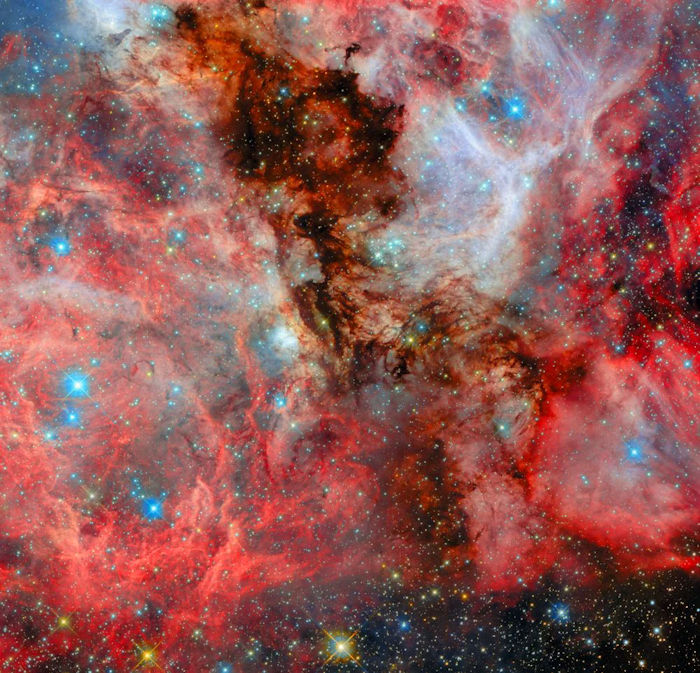
Astronomers have used a collection of telescopes to peer through the gas and dust obscuring the center of the Milky Way to reveal the enigmatic Central Molecular Zone. This is a region 650 light-years in diameter filled with a complex network of filaments made of dense clouds of gas. A new image shows how cold molecular gas flows along these filaments to feed into clumps where new stars are born in the Milky Way’s most extreme environment.

Click here to read the article


“Expanding catalog of black hole collisions is rewriting the history of the universe”


Between May 2023 and January 2024, a global network of gravitational-wave detectors picked up 128 new cosmic signals, more than doubling the entire catalog built across the previous decade. The universe, it turns out, is not quiet. It is constantly shaking.

Click here to read the article


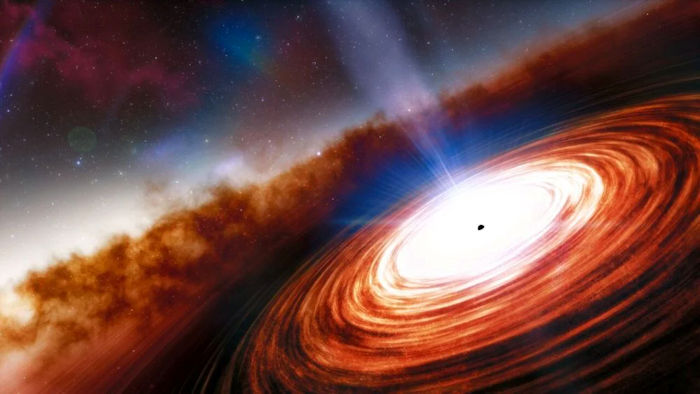
“Black hole-powered blazars may explain the highest-energy neutrino ever detected”


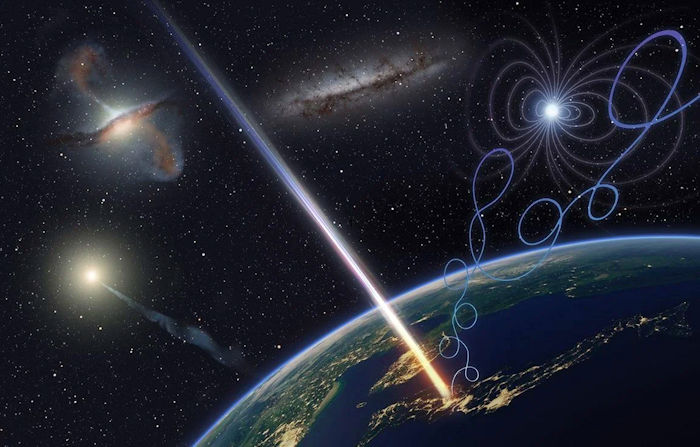
A single particle cut through the Mediterranean in February 2023 carrying an almost absurd amount of energy. Detected deep off the coast of Sicily by the KM3NeT/ARCA neutrino telescope, the neutrino clocked in at about 220 petaelectronvolts, making it the most energetic neutrino ever recorded.

Click here to read the article