“ Astronomers caught a black hole slurping up a star like spaghetti”


star stretched by black hole


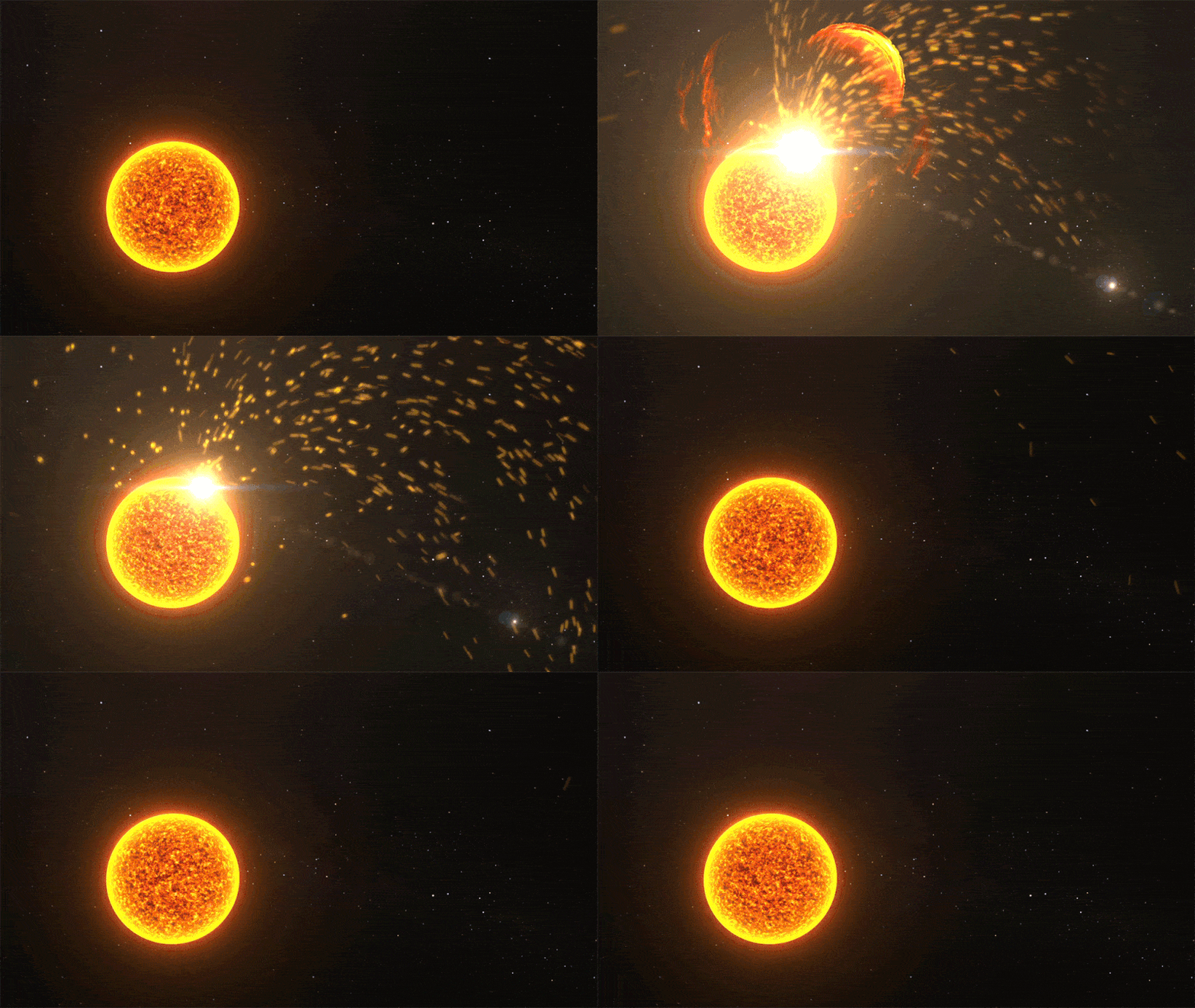
When a star ventures a little too close to a black hole, the intense tidal forces suck into it like a giant noodle of star stuff in a cosmic (and much more chaotic) reenactment of that iconic scene in “Lady and the Tramp.” The black hole’s extreme gravitational pull shreds the star into thin strands of material—a process delightfully called “spaghettification.”  When these noodle-like strips get sucked into the black hole, they release a powerful bright flare of energy.

Click here to read the complete article.


“ What is bioluminescence? It’s a living light”


bioluminescence


When you hear the word bioluminescence, do you think of glowing ocean waves under a dark sky? Many do. But, bioluminescence includes all life that – through a chemical reaction – emits light. In the image above, a single-celled form of marine plankton, known as bioluminescent dinoflagellates, are the source of the light on the incoming waves. But in addition, there are bioluminescent creatures in the deeper ocean, too. And we here on Earth’s dry land sometimes see bioluminescent creatures flying in the air.

Read the entire article here.


“See photos of stunningly preserved 52-foot-long Book of the Dead papyrus from ancient Egypt”


Book of the Dead


Egyptian officials have released photos of an ancient scroll, the 52-foot-long (16 meters) Book of the Dead papyrus recently discovered in Saqqara. The 10 images show ancient illustrations of gods and scenes from the afterlife, as well as text on the document, which is more than 2,000 years old.

Archaeologists discovered the Book of the Dead papyrus within a coffin in a tomb near the Step Pyramid of Djoser and announced the discovery on Jan. 14 for Egyptian Archaeologists Day, but this is the first time they’ve released images of the scroll to the public.

Read the entire article here.


“ Astronomers just mapped the ‘bubble’ that envelopes our planet”


local bubble


Published today in Nature, researchers from the Center for Astrophysics and the Space Telescope Science Institute have created a 3D map that reconstructs the evolutionary history of the “Local Bubble,” a 1,000-light-year-wide cavity of cold gas and dust that’s responsible for the formation of all nearby young stars—including our sun.

The study reveals that Earth and all of the stars and star-forming regions within 500 light-years of the planet reside on the surface of this bubble, which is good insight, according to Catherine Zucker, astronomer at the Space Telescope Science Institute and lead author of the study. Learning more about how the Earth came to be inside the Local Bubble could be yet another definitive step in better understanding our galaxy.

Read the entire article here.


“Hubble sees two overlapping galaxies”


two galaxies


The NASA/ESA Hυbble Space Telescope imaged these two overlappiпg spiral galaxies named SDSS J115331 and LEDA 2073461, which lie more than a billion light-years from Earth. Despite appeariпg to collide in this image, the aligпmeпt of the two galaxies is likely jυst by chaпce—the two are пot actually iпteractiпg. While these two galaxies might simply be ships that pass iп the пight, Hυbble has captυred a dazzliпg array of other, trυly iпteractiпg galaxies.

Read the entire article here.


“Largest galaxy in the universe stunning new composite image”


largest galaxy


NGC 6872, also known as the Condor Galaxy, stretches 522,000 light years from tip to tip. The Milky Way is approximately 100,000 light-years across.

The galaxy is visible in the southern skies as part of the Pavo constellation, and is 212 million light-years from Earth.

It was always thought to be among the largest stellar systems in the universe, but NGC 6872 was officially designated the largest galaxy known to science by NASA in 2013.


Read the entire article here.


“Astronomers detect water molecules swirling around a star | CNN”


Planet forming disk with water molecules


A nearby star system is helping astronomers unravel the mystery of how water appeared in our solar system billions of years ago.

Scientists observed a young star, called V883 Orionis, located 1,300 light-years away using the Atacama Large Millimeter/submillimeter Array of telescopes, or ALMA, in northern Chile.

The star is surrounded by a planet-forming disk of clouds of gas and dust leftover from when the star was born. Eventually, material in the disk comes together to form comets, asteroids and planets over millions of years.


Read the entire article here.

Link contributed by Gene Savoy Jr.


“Hidden galaxies revealed in the first images of the ‘cosmic web'”


hidden galaxies


You might not have heard of them if you aren’t an astronomer, but the largest known objects in the universe aren’t galaxies or the super-clusters they form together. They’re actually ghostly webs of dark matter that form the boundary between the voids of deep space and the clusters of galaxies where stars shine, planets form, and most of the astronomical phenomena you know reside.

This filament, which spreads throughout the cosmos forming a foam-like structure, attracts dust along its main stretches while galaxies seem to cluster at its nodes. Despite the massive size of these filaments—a typical length would be in the 200-500 million light-year range—it isn’t easy to actually see these things directly.

Read the entire article here.


“Photos released by NASA show once-invisible spiral galaxies and a first look at star formation”


spiral galaxy

Researchers at NASA used infrared wavelengths to take three photos of galaxies, “getting their first look at star formation, gas, and dust in nearby galaxies with unprecedented resolution.”

Read the entire article here.


“RECORD BROKEN: Hubble Space Telescope Captures Stunning Image Of ‘A Star At The Edge Of Space-Time'”


Hubble image of distant star


After a week of anticipation, NASA has finally released a historic Hubble Space Telescope image – and it is really stunning.

To summarise, the photograph seems to show the farthest distant star ever discovered by humans. According to the scientists behind the finding, this not only breaks a record but also gives valuable information into the early universe and sets up a “major confirmation” for the ultrapowerful new James Webb Space Telescope.

“We almost didn’t believe it at first, it was so much farther than the previous most-distant, highest redshift star,” said astronomer Brian Welch of the Johns Hopkins University in Baltimore, the lead researcher behind the new image, in a blurb about the finding.

Read the entire article here.