“Object mistaken as a galaxy is actually a black hole pointed directly at Earth”


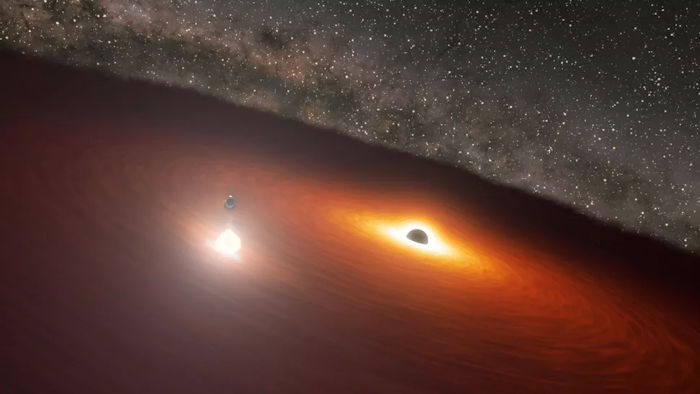
blazar black hole

In a distant galaxy, a supermassive black hole spewing radiation at near light speed has shifted its angle by a whopping 90 degrees to point directly toward Earth — a sharp turn that’s puzzling physicists.

Active galactic nuclei (AGN) are the hungry black holes at the cores of many other galaxies, and they accrete matter and spew powerful jets of high-energy particles known as relativistic jets. AGN are classified according to what part of the AGN is pointed toward Earth.

Click here to read the full article.


“Scientists Finally Manipulate Quantum Light, Fulfilling Einstein’s 107-Year-Old Dream”


quantum light


Scientists stand ready to manipulate quantum light, just as Albert Einstein envisioned in 1916.

Researchers from the University of Sydney and the University of Basel successfully managed to manipulate and identify small numbers of interacting photons—packets of light energy. According to the team, this work represents an unprecedented landmark development for quantum technologies.

Click here to read the full article.


“Caroline Piaulet, Ph.D. Student just discovered 2 alien water worlds with oceans 500 times deeper than Earth’s”


water world artist concept


We met Caroline Piaulet, Ph.D. Student at Institut Trottier de recherche sur les exoplanètes (iREx) from Université de Montréal (Canada). Team led by Caroline Piaulet, did a detailed study of the planetary system Kepler-138. More precisely, it discovered two “water worlds“: two exoplanets full of water that orbit around the Red Dwarf Star, about 218 light-years away from Earth. A light-year is equivalent to about 9.46 trillion kilometers (5.88 trillion miles).

Click here to read the full article.


“NASA’s Juno Spacecraft Beams Back The Sharpest Images Of Jupiter—Ever”


Jupitor


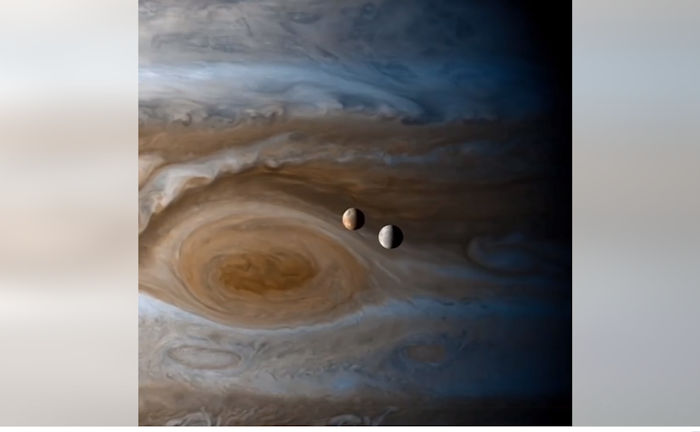
On July 5, 2022, NASA’s Juno probe did its 43rd close flyby of Jupiter. It studied the colors and shapes of the clouds on the giant planet.

Bjorn Jónsson, a citizen scientist, used raw data from the JunoCam instrument on the spacecraft to make these two photos. When the raw photo was taken, Juno was about 3,300 miles (5,300 km) away from Jupiter’s cloud tops and about 50 degrees north of the planet. The north is on the rise. At the time, the spacecraft was moving away from the earth at about 209,000 km per hour (130,000 mph).

Click here to read the full article.


“Bizarre star bridge links galaxy to runaway black hole”


Black hole with star bridge


HubbleSite said on April 6, 2023, that scientists have identified a 200,000-light-years-long bridge of hot, young, blue stars. It spans twice the diameter of our Milky Way galaxy. This star bridge – located halfway across the universe – appears to stretch between a runaway supermassive black hole and the galaxy the black hole is escaping. Astronomers think the black hole is causing gas to compress along its wake.

Click here to read the full article.


“Possibly the First White Hole Ever Discovered by Astronomers”


Artist's concept of a white hole.


The existence of black holes was predicted more than a century ago, using only mathematical equations to do so. Now that we’ve taken the first shot of one, we may go on to the next. Black holes, on the other hand, continue to retain a wealth of mysteries. Similar to their even more enigmatic mirror twins: the white holes!

White holes are hypothetical cosmic areas that operate oppositely to black holes in their function. Nothing can escape from a black hole, and nothing can enter a white hole in the same way.

Click here to read the full article.

Link contributed by Terrance Hutchinson


“Light from behind supermassive black hole detected for first time”


light behind black hole


Black holes are regions of space-time where gravity is so strong, nothing can escape the pull — not even light. So it’s remarkable that scientists have now directly observed light from behind a supermassive black hole — but it wouldn’t have surprised Albert Einstein.

The hole story: We don’t actually know what’s inside a supermassive black hole, but we do know that a spinning plane of gas and dust, called the accretion disc, rotates around it.

Click here to read the full article.


“The Brightest Gamma-Ray Burst of All Time”


Gamma-ray burst


On October 9, 2022, the brightest gamma-ray burst (GRB) ever detected lit up monitors across Earth. Nicknamed BOAT for brightest of all time, the blast is thought to have been from a star becoming a black hole. It was so powerful that it disturbed Earth’s ionosphere from 2.4 billion light-years away. And its x-ray radiation illuminated dust in our Milky Way galaxy, creating the apparent concentric rings seen in the image above (the increase in size is really a perspective effect, with the largest ring the closest to us).

Read the entire article here.

link submitted by Gene Savoy Jr.


“Hubble Telescope Accidentally Discovers a MIND-BLOWING New Galaxy”


Hubble galaxy


Humankind is getting very good at looking deep into space: We have already seen two neutron stars colliding, we have encountered mysterious radio blasts and we are about to see, for the first time, the event horizon of a black hole.

But there are still some surprises out there, right here in our own corner of the Universe.

Upon retaking the observations of a nearby globular cluster, the Hubble Space Telescope accidentally captured an unpublished galaxy. The newly discovered galaxy was named Bedin I – and is almost as old as the Universe.

Click here to read the full article.


“Astronomers discover ultramassive black hole using new technique | CNN”


massive black hole


An ultramassive black hole, understood to be one of the largest ever detected, has been discovered by astronomers using a new technique.

The findings, published by the Royal Astronomical Society, show that the black hole is more than 30 billion times the mass of the sun – a scale rarely seen by astronomers.

The researchers described it as an “extremely exciting” discovery that opens up “tantalizing” possibilities for detecting further black holes.

Read the entire article here.

link submitted by Robert Petrovich