“Stephen Hawking’s famous black hole paradox may finally have a solution”


Hawking's paradox black hole


One of physicist Stephen Hawking’s most famous paradoxes may finally be solved: Black holes may in fact hang onto information about the massive stars that created them, new research indicates.

This information may lurk in the radiation around black holes – colloquially known as “quantum hair” – and could, in theory, be retrieved to retell the origins of those black holes, the research suggests.

Read the complete story here.


“Hubble Telescope eyes aftermath of supernova in distant galaxy (video)”


galaxy with supernova


The Hubble Space Telescope has snapped a stunning image of a distant galaxy while on a quick break from its usual observations.

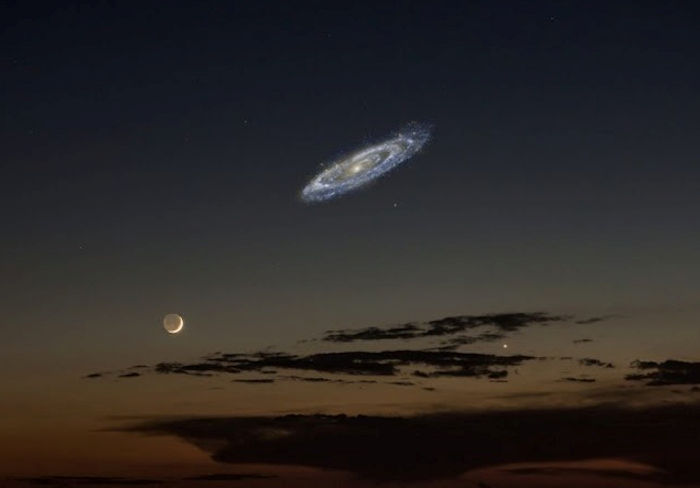
The latest Hubble photo captured a side view of the “amorphous” UGC 2890 galaxy, which lies 30 million light-years from Earth in the constellation Camelopardalis (The Giraffe). Like our own Milky Way, UGC 2890 is a spiral galaxy with a central bulge and a rotating star-studded disk.

Read the full article (with video) here.


“Einstein rings might help solve dark matter puzzle”


Einstein rings

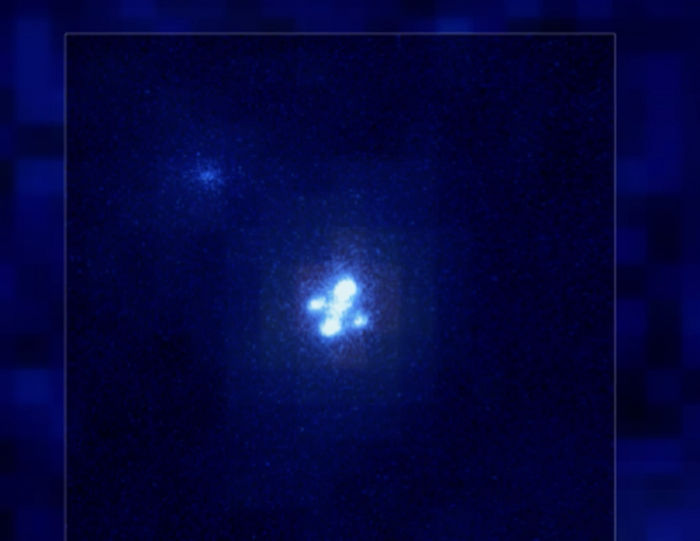
Physicists believe most of the matter in the universe is made up of an invisible substance that we only know about by its indirect effects on the stars and galaxies we can see. We’re not crazy! Without this dark matter, the universe as we see it would make no sense.

Click here to read the full article.


“Supermassive black holes share a surprising link with subatomic gluon ‘color glass walls'”


massive black hole

Scientists have discovered a surprising connection between the supermassive black holes that dwell at the hearts of most galaxies and dense walls of subatomic particles called gluons.

In terms of size, they couldn’t be more different: Supermassive black holes can be billions of miles across, and the dense walls of gluons, known as color glass condensates (CGCs), are less than a billionth of a mile in diameter.

Click here to read the full article.


“Ingredients for life discovered in Perseus molecular cloud in space 1,000 light-years from Earth”


molecular precursors of life

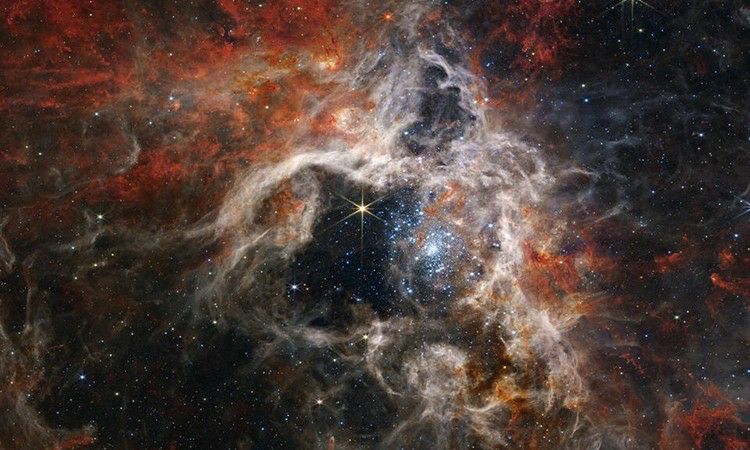
A “soup” of molecules in a distant star-forming cloud contains compounds that are considered the essential building blocks for life, astronomers have found.

These molecules can contribute to the construction of amino-acids, which themselves form the basis of genetic material and are believed to have been essential in the development of the first microorganisms on Earth.

Click here to read the full article.


“A Flip of Earth’s Magnetic Poles 42,000 Years Ago May Have Led to Mass Extinctions”


pole reversal

A new study is revealing that a reversal in the Earth’s magnetic poles 42,000 to 41,000 years ago may have led to environmental crises that resulted in mass extinctions. The period is called the Laschamps excursion and the research used precise carbon dating obtained from ancient tree fossils to study its effects.

Read the complete article here.


“Astronomers found a massive cloud of water floating in deep space”


water in space

Astronomers studying the formation of a distant star have discovered a cloud of water in space. The water, which is both regular water as we know it from Earth, as well as heavy water – water where one of the hydrogen atoms has been replaced by deuterium – could offer new insights into the origins of water in our solar system.

Click here to read the full article.


“Astronomers find the thinnest ever explosion in space – a cow 180 million light-years away”


ring galaxy

Stars are basically spherical, and when they explode, the explosions are spherical too. Most of the time.

But an international team of astronomers has observed a disc-shaped explosion – the thinnest yet known to science.

The explosion is called a Fast Blue Optical Transient (FBOT): a rare event that astronomers have only known about for the past five years. They’re also called ‘cows’.

Click here to read the full article.


“Astronomers Just Found a Radio Galaxy That Turned Into a Blazar”


blazar galaxy

Astronomers have observed a rare case of a galaxy shapeshifting.

A few decades ago, an object located some 630 million light-years away named PBC J2333.9-2343 was classified as a giant radio galaxy. It projected large, radio-emitting structures perpendicular to our line of sight, formed by colossal jets that once erupted from the galactic center.

Click here to read the full article.



“Scientists find dark matter “bridges” that may reveal future of our galaxy”


dark matter bridge

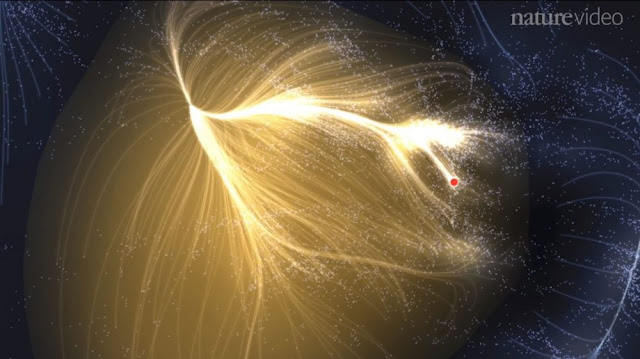
A new map derived with the help of artificial intelligence reveals previously unknown “bridges” linking galaxies in the local universe. The bridges are in the form of filamentary structures. The scientists hope their map, published along with their paper in the Astrophysical Journal, can provide fresh insights into dark matter and the history of our universe.

While dark matter is an accepted notion, thought to make up 80 percent of all the matter in the universe, it has been hard to find. Scientists have, however, inferred much about the existence and behavior of dark matter by observing its gravitational influence on other space objects.

Click here to read the full article.