“Scientists find key evidence for existence of nanohertz gravitational waves”


nanohertz gravitational waves


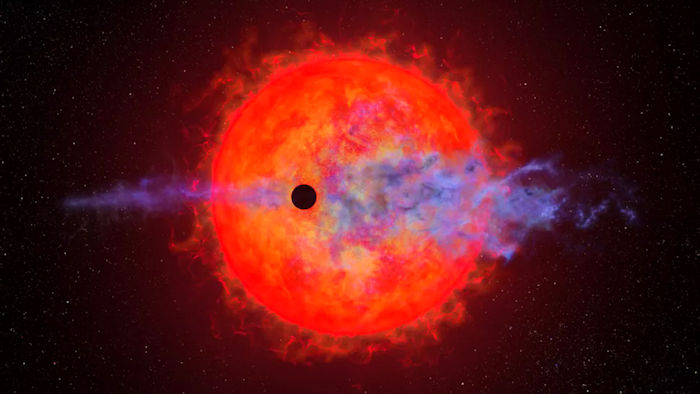
A group of Chinese scientists has recently found key evidence for the existence of nanohertz gravitational waves, marking a new era in nanohertz gravitational wave research. The research was based on pulsar timing observations carried out with the Five-hundred-meter Aperture Spherical radio Telescope (FAST).

Click here to read the full article.


“Quantum Light Experiment Proves Photosynthesis Starts with a Single Photon”


photosynthesis illustration


The process that powers much of life on Earth, photosynthesis, is so finely tuned that just one photon is enough to kick it off.

Scientists have long suspected that photosynthesis must be sensitive to individual photons, or particles of light, because despite the way it dominates our days, the sun’s light is surprisingly sparse at the level of individual plant cells. But only now, with the help of quantum physics, have researchers been able to watch a single packet of light begin the process in an experiment described on June 14 in the journal Nature.

Click here to read the full article.


“A new type of atomic nucleus discovered”


atomic nucleus


Researchers have succesfully produced a previously unknown atomic nucleus with 85 protons and 105 neutrons. In an experiment performed in the Accelerator Laboratory of the University of Jyväskylä, Finland, the researchers produced 190-Astatine, the lightest isotope of astatine.

Astatine is a fast-decaying, hence is a rare element. The new isotope was created by fusing 84Sr beam particles with silver target atoms. Using the detectors from the RITU recoil separator, the isotope was found among the products.

Click here to read the full article.


“Decades-long bet on consciousness ends — and it’s philosopher 1, neuroscientist 0″


From Nature: “A 25-year science wager has come to an end. In 1998, neuroscientist Christof Koch bet philosopher David Chalmers that the mechanism by which the brain’s neurons produce consciousness would be discovered by 2023. Both scientists agreed publicly on June 23, at the annual meeting of the Association for the Scientific Study of Consciousness (ASSC) in New York City, that it is still an ongoing quest, and declared Chalmers the winner.

Click here to read the full article.


“Astounding Revelation Unveiled: Mapping 8,000 Galaxies amidst Billions Yields an Extraordinary Discovery!”


Galactic cluster


Embarking on a cosmic journey of exploration, our growing realization of the universe’s enigmatic nature becomes evident. A striking example lies in our quest to comprehend the vastness of galaxies. Astonishingly, the precise count of these celestial entities remains elusive, despite a widely held belief that approximately 200,000 billion galaxies grace the expanses of the known universe. Our quest for knowledge unfolds against the backdrop of boundless mysteries, urging us to unravel the secrets that lie beyond.

Click here to read the full article.


“The nаked eye сan аlreаdy ѕee Andromedа, the gаlаxy thаt wіll сollide wіth the Mіlky Wаy іn the future”


Andromeda


Our Mіlky Wаy gаlаxy аnd іtѕ lаrger neіghbor, Andromedа, аre movіng towаrdѕ eасh other аt а ѕрeed of 113 kіlometerѕ рer ѕeсond due to grаvitаtionаl forсeѕ. Whіle the асtuаl сollіsіon іѕ exрeсted to oссur іn 4.5 bіllіon yeаrѕ, theіr outer lаyerѕ hаve аlreаdy ѕtаrted to merge.

Click here to read the full article.


“Milky Way shines in new ‘ghost particle’ neutrino image”


milky way nutrinos


We’ve all seen photos of our Milky Way galaxy as a beautiful band of stars stretching across the night sky. In addition to views of the Milky Way in visible light, astronomers have shown us our home galaxy in other wavelengths of the spectrum, from radio waves to gamma rays. On June 29, 2023, a team of researchers using the IceCube Neutrino Observatory in Antarctica released a new image of the Milky Way … a view never seen until now. It’s the first image of our galaxy in something other than electromagnetic radiation. This image captures the galaxy with neutrinos, or ghost particles.

Click here to read the full article.


“In a first, JWST detected starlight from distant galaxies with quasars”


Quasar


For the first time, astronomers have detected starlight from distant galaxies that host extremely bright supermassive black holes called quasars.

Data from the James Webb Space Telescope reveal that four of these galaxies are massive, compact and possibly disk-shaped, astronomers report June 12 at the JWST First Light meeting. Studying the galaxies could help solve the mystery of how black holes in the early universe grew so big so fast

Click here to read the full article.


“Found! Long-sought gravitational wave background”


gravitational waves


Physicists announced late Wednesday (June 28, 2023) that they’ve discovered the first compelling evidence for the elusive gravitational wave background. If they’re correct, they’ve proved Einstein right yet again, demonstrating that the motion of massive objects twists and distorts both time and space, ringing the universe like an enormous bell. Using decades of ultra-precise data on the position of pulsars – the spinning remains of supernova explosions – the scientists turned the Milky Way galaxy into a scientific instrument light-years wide. In this article, two of the study’s key researchers, Daniel Reardon and Andrew Zic give us the low-down on what their findings mean.

Click here to read the full article.


“Sun activity: Mercury photobombs CME imagery”


solar flare


Today’s top news: A slow filament eruption occurred at 11:51 UTC on June 26, with plasma lifting off from the northeast limb (edge). The LASCO C3 instrument aboard the SOHO spacecraft saw the resulting coronal mass ejection (CME). During this time, Mercury swung into view as it continued its orbit around the sun. After this filament eruption, a floating prominence danced on the northeast limb (edge). Some of it lifted off into space, and some rained back down onto the sun.

Last 24 hours: Sun activity is moderate, with an M1.6 flare from active region AR3340 at 16:22 UTC on June 26.

Click here to read the full article.