“’Like a mirror’: Astronomers identify most reflective exoplanet”


bright exoplanet


A scorching hot world where metal clouds rain drops of titanium is the most reflective planet ever observed outside of our Solar System, astronomers said on Monday.

This strange world, which is more than 260  from Earth, reflects 80 percent of the light from its , according to new observations from Europe’s exoplanet-probing Cheops space telescope

Click here to read the full article.


“Is the universe controlled by gigantic structures?”


Universal structures


  • New findings in astronomy are making some astronomers doubt our basic model of the universe.
  • Alignments of celestial objects suggest that they may be embedded in large-scale structures.
  • Galaxies too far apart to be influencing each other are moving through space together.

Click here to read the full article.


“Scientists Find “Evidence” of Another Universe Before Our Own”


two universes


According to research, there was a previous cosmos that existed before ours. This is regarded as a form of everlasting cosmic cycle.

It’s possible that a scientist has discovered substantial evidence that there was another universe before this one. In addition, he asserts that our universe is only the latest in an endless string of universes. Professor Sir Roger Penrose thinks that the universe we presently understand is the most recent in a lengthy chain of past universes in order to explain what was “there” before the Big Bang.

Click here to read the full article.


“This logarithmic view of the Universe will blow your mind”


universe


  • From the scale of planet Earth, at a few thousands of kilometers, to the scale of the observable Universe, at nearly 100 billion light-years, there’s a long way from here to the cosmic horizon.
  • But rather than a linear scale, which would take several quintillions of Earths lined end-to-end to reach the limits of the observable Universe, a logarithmic scale holds far more cosmic insights to an onlooker.
  • From here to the limits of what we can see, here’s a breathtaking logarithmic view of the Universe, brought together in one fantastic, artistic finale by artist Pablo Carlos Budassi.

Read the entire article here.


“Scientists Just Took an Actual Picture of a Planet in Another Star System”


Beta Pictorus C


The planet, known as “b Pictoris c,” is located roughly 63 light-years from Earth in the Beta Pictoris system. Using the additional brightness and dynamic mass data obtained from imaging it, they are aiming to narrow down how it arose.
The researchers utilised a technique known as the “radial velocity method,” which has been used for years to discover hundreds of exoplanets but has never been used to directly evaluate exoplanets.

Click here to read the full article.


“Enormous ‘sunspot archipelago’ 15 times wider than Earth could soon bombard us with solar flares”


sunspot cluster


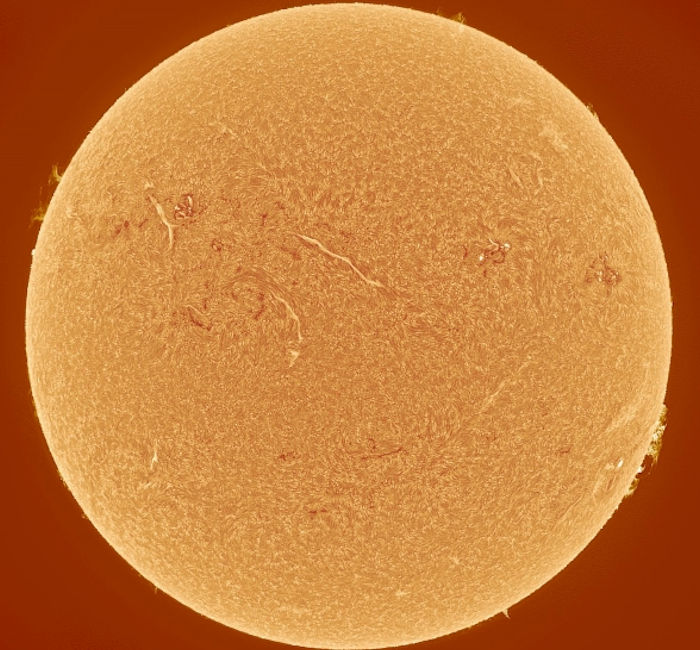
One of the largest and most densely populated sunspot regions seen in more than a decade has appeared on the sun’s nearside to Earth — and has begun to unleash a barrage of solar storms that are shaking up our home star’s surface in a big way. The sunspots’ emergence could make it an interesting few weeks for Earth, which will soon be in the firing line of these eruptive dark patches.

The first sunspot group, named AR3490, rotated onto the sun’s nearside on Nov. 18 over the star’s northeastern shoulder. The dark patch was quickly followed by another sunspot group, AR3491, which trailed in its wake, Spaceweather.com reported.

Read the entire article here.


“There’s a striking link between quantum and astronomic scales. What could it mean?”


quantum world


While working late one night in 2017, Konstantin Batygin, a professor of planetary sciences at the California Institute of Technology, made a mathematical connection that he imagined someone else had surely found before, likely centuries ago. He had realised that the peculiar ‘washed-out wave’ behaviour of matter on the quantum scale – which disappears on the macroscopic scale (the one we can observe with our naked eye) – reemerges at the astronomical scale.

Read the entire article here.


“Have Archaeologists Found Lyobaa, the Zapotec Land of the Dead?”


Beneath monumental stone structures discovered at the archaeological site of Mitla in the southern Mexican state of Oaxaca, it has long been believed that the ancient Zapotec people built a huge and complex labyrinth of chambers and passageways. This network of tunnels was ultimately supposed to lead to the entrance of the Zapotecan underworld or Land of the Dead, which was known as Lyobaa.

In search of the truth about this legend, a team of Mexican archaeologists launched an ambitious exploration project at Mitla in 2022, relying on non-invasive geophysical survey tools to see what really lies underneath the ancient site.

Click here to read the full article.


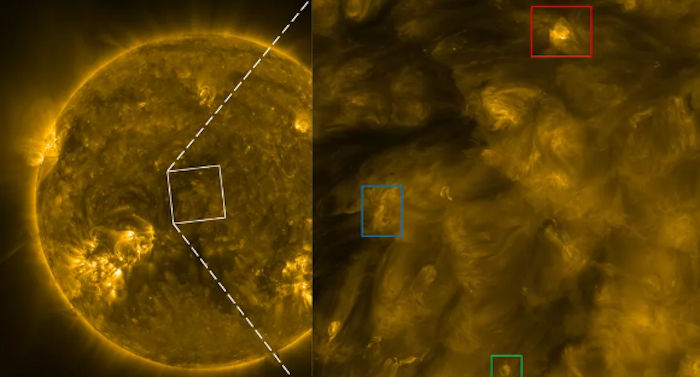
“Solar astronomers discover ‘shooting stars’ on the sun’s corona”


"shooting star" on the sun.


A team of astronomers from several European institutions led by Northumbria University in Newcastle has discovered “shooting stars” on the sun. Observations from the European Space Agency’s Solar Orbiter (SolO) have revealed never-before-seen “falling star”-type phenomena or meteor-like fireballs occurring within the spectacular plasma displays known as coronal rain. The work will be presented this week at the National Astronomy Meeting (NAM 2023) by lead author Patrick Antolin, Assistant Professor at Northumbria University.

Click here to read the full article.


“Quasars reveal the early universe moved slower than it does now | CNN”


Scientists have peered into the early days of the universe, when it was about 1 billion years old, and discovered that things moved in slow motion compared with now.

The finding supports Albert Einstein’s general theory of relativity, which suggests that the distant universe moved much more slowly in the past.

Given the vastness of the universe, studying its earliest days is like looking back in time. Faint light from the oldest galaxies is still traveling across the universe to reach Earth, so the farthest reaches of the universe visible to scientists is light from the past.

Click here to read the full article.

Link contributed by Gene Savoy, Jr.