“Super-close supernova captivates record number of citizen scientists”


close supernova


The closest cosmic explosion to Earth in the last 10 years became a record breaker for the Search for Extraterrestrial Intelligence Institute (SETI).

The supernova, designated (SN) 2023ixf, was first spotted on May 19, 2023, by Japanese amateur astronomer Koichi Itagaki. Just an hour after this manifestation, amateur astronomers taking part in SETI and Unistellar’s Cosmic Cataclysms program were on the case.

Click here to read the full article.


“’Ghost stars’ haunt the center of the Milky Way galaxy. Now we know why”


ghost star illustration


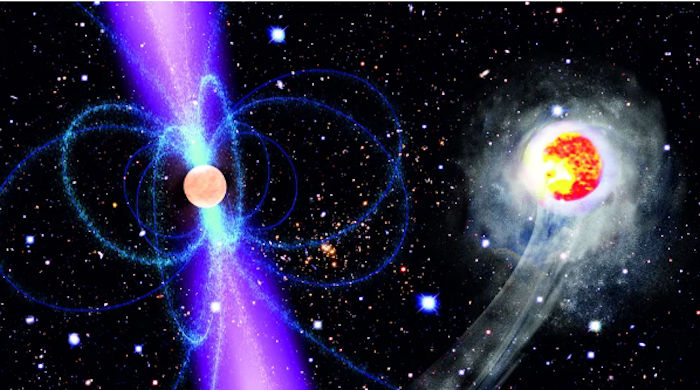
A mysterious alignment of stellar “ghosts” from dead stars haunts the heart of the Milky Way, and scientists may finally know why.

These cosmic specters exist in the form of planetary nebulas, clouds of gas that are expelled by dying stars at the end of their lives. These can resemble butterflies or hourglasses with the smoldering remains of the star at their heart. The sun, when it runs out of fuel for nuclear fusion at its core and after it has swelled out as a red giant and swallowed the inner planets in around 5 billion years, will leave similar gaseous remains around a white dwarf star.

Click here to read the full article.


“We now know the big bang theory is (probably) not how the universe began”


big bang


Where did all this come from? In every direction we care to observe, we find stars, galaxies, clouds of gas and dust, tenuous plasmas, and radiation spanning the gamut of wavelengths: from radio to infrared to visible light to gamma rays. No matter where or how we look at the universe, it’s full of matter and energy absolutely everywhere and at all times. And yet, it’s only natural to assume that it all came from somewhere. If you want to know the answer to the biggest question of all — the question of our cosmic origins — you have to pose the question to the universe itself, and listen to what it tells you.

Click here to read the full article.


“A Researcher Says the Expansion of the Universe Is Just a Mirage. He Might Be Right.”


galaxy


  • For decades, scientists have discerned that the universe is not only expanding, but accelerating.
  • But this evidence doesn’t always square with models, throws flags with things like the cosmological constant, and makes explanations like dark energy necessary
  • A new paper from a researcher at the University of Geneva goes back to the drawing board and proposes a new idea—that our perception of an expanding universe could be a mirage.

Click here to read the full article.


“The James Webb Space Telescope wraps 1st year peering across the universe. What has it discovered so far?”


Webb telescope


It’s been one year since we saw the first official images taken by the groundbreaking James Webb Space Telescope.

Since then, the telescope has been hard at work collecting data on our universe. In just one year, researchers have published over 750 pieces of peer-reviewed scientific literature using or citing data from the James Webb Space Telescope (JWST or Webb), according to the Space Telescope Science Institute. From data on some of the universe’s first galaxies to a greater understanding of our own solar system, JWST has begun to deliver on its promise of observing our universe in more detail than ever before.

Click here to read the full article.


“New research puts age of universe at 26.7 billion years, nearly twice as old as previously believed”


galaxy


“Our newly-devised model stretches the galaxy formation time by a several billion years, making the  26.7 billion years old, and not 13.7 as previously estimated,” says author Rajendra Gupta, adjunct professor of physics in the Faculty of Science at the University of Ottawa.

For years, astronomers and physicists have calculated the age of our universe by measuring the time elapsed since the Big Bang and by studying the  based on the redshift of light coming from distant galaxies. In 2021, thanks to new techniques and advances in technology, the age of our universe was thus estimated at 13.797 billion years using the Lambda-CDM concordance model.

Click here to read the full article.


“Time is “elastic”: Why time passes faster atop a mountain than at sea level”


elastic time


  • Since Einstein posited his theory of general relativity, we’ve understood that gravity has the power to warp space and time.
  • This “time dilation” effect occurs even at small levels.
  • Outside of physics, we experience distortions in how we perceive time — sometimes to a startling extent.

Click here to read the full article.


“We have never seen dark matter and dark energy. Why do we think they exist?”


dark matter artist concept


Scientists think that only about 5% of the stuff that makes up the universe is known to us.

Yes, you are reading that right. Cosmological models show that invisible energy and matter must make up a combined 95% of the universe for it to work according to existing theories.

The invisible part of the universe consists of two components, dark energy and dark matter. The latter is somewhat less mysterious and scientists are fairly certain of its existence: The rules of gravity simply wouldn’t work without it.

Click here to read the full article.


“Science Answers the Big Questions”


quantum foam


Why are we here? Where did it all come from―the laws of nature, the stars, the universe? Humans have been asking these questions forever, but science hasn’t succeeded in providing many answers—until now.

In Observer, scientist Robert Lanza, one of Time Magazine’s “100 Most Influential People,” is joined by Nancy Kress, 8-time Hugo and Nebula award-winning science fiction writer, to shed light on the big picture that has long eluded philosophers and scientists alike. What if life isn’t just a part of the universe… what if it determines the very structure of the universe itself?

Read the entire article here.


“Webb Space Telescope reveals moment of stellar birth, dramatic close-up of 50 baby stars”


star birth


CAPE CANAVERAL, Fla. (AP) — The Webb Space Telescope is marking one year of cosmic photographs with one of its best yet: the dramatic close-up of dozens of stars at the moment of birth.

NASA unveiled the latest snapshot Wednesday, revealing 50 baby stars in a cloud complex 390 light-years away. A light-year is nearly 6 trillion miles (9.7 trillion kilometers).

The region is relatively small and quiet yet full of illuminated gases, jets of hydrogen and even dense cocoons of dust with the delicate beginnings of even more stars.

Click here to read the full article.