“Cosmic simulations reveal how galaxies formed and evolved over billions of years”


Cold gas does not look dramatic at first glance. Neither does dust. Yet those two quiet ingredients sit at the center of a new effort to build a far more realistic picture of how galaxies formed. They help explain how galaxies changed and spread across the universe over billions of years.


“Saturn’s Magnetic Shield Is Not Where Anyone Expected It To Be.”


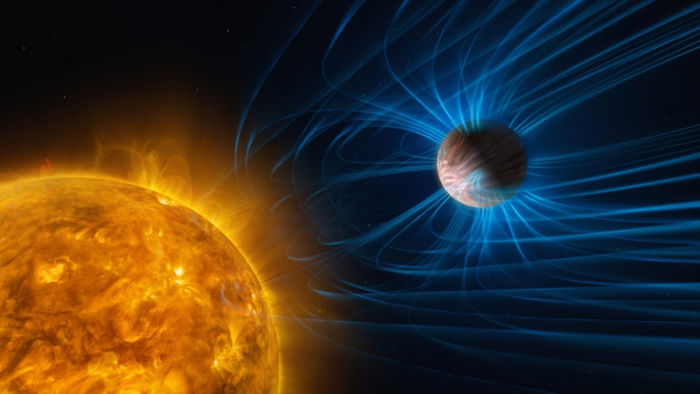
Despite hundreds of years of observations, the beautiful ringed planet Saturn continues to surprise us. Recently, astronomers tracked down the planet’s magnetic field and found that a key feature sits in a completely different place than expected. On Earth, there’s a funnel-shaped opening called a magnetospheric cusp which is on the sunward-facing side, but according to Cassini data, Saturn’s cusp is pointed away from the Sun, probably caused by Saturn’s rapid rotation.


“JWST Sees Smoking Gun for Black Hole Mergers in the Virgo Cluster”


Astronomers have used JWST to observe two galaxies, both of which have “overmassive” black holes near their centers. Normally, the central black hole accounts for less than 1% of the mass of its host galaxy, but these account for much more. Another puzzle: the black hole in one of the galaxies is off-center, as if it wobbled out of place and is slowly moving back to the center of the galaxy. It’s probably the result of a recent merger.


“DESI’s 3D map of the universe is complete!”


  • The Dark Energy Spectroscopic Instrument has created one of the most extensive surveys of the cosmos ever conducted. The five-year survey is now complete.
  • DESI has mapped more than 47 million galaxies and quasars. This is the largest high-resolution 3D map of our universe to date.
  • DESI will continue observations into 2028 and further expand the map. The observations will help astronomers understand how dark energy works in the universe.


“Astronomers discover three distinct groups of merging black holes”


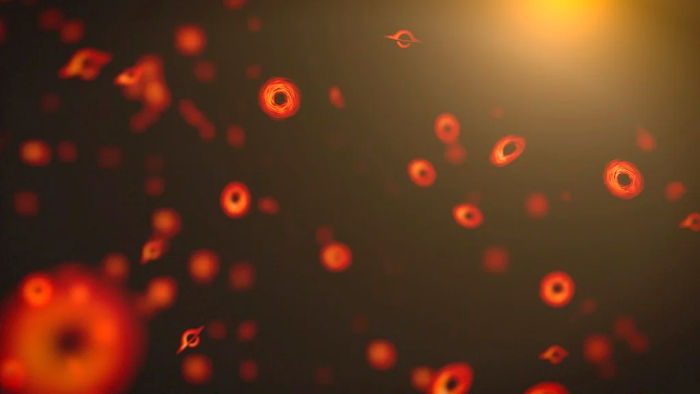
After studying more than 150 mergers detected through gravitational waves, astronomers say the growing catalog points instead to three distinct groups of merging black holes. Each group seems to carry its own signature in mass, spin, and how often the mergers happened across cosmic time. Taken together, the pattern suggests that these violent collisions are being built in more than one kind of environment.


“Webb’s Picture of the Month Features Two Planet-Forming Disks and a Possible Planet”


Gaze in wonder at these two amazing images of protoplanetary disks captured by JWST. They’re designated Tau 042021 and Oph 163131, located 450 and 480 light-years away respectively. The disks are seen roughly edge-on with Webb’s infrared instruments, allowing us to see through the gas and dust that typically surround these young objects. The different colors in the image correspond to different molecules in the disks as well as the sizes of various dust grains.


“See and hear galaxies evolving in new simulations”


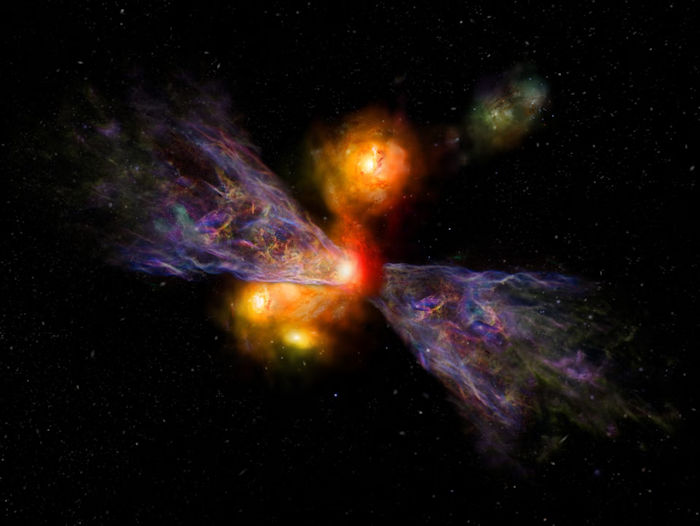
New simulations have provided what the Royal Astronomical Society is calling the “most realistic picture yet” of galaxy formation. Tracing growth from the early universe to today, the simulations allow us to see and hear the evolution of galaxies.

The astronomers aimed to improve on previous simulations by including cold gas and cosmic dust, which are the raw materials for stars.


“Cassini-Huygens mission finds lopsided shift in Saturn’s magnetic bubble”


After combing through years of data from the Cassini spacecraft, researchers found that a key opening in Saturn’s magnetosphere, the region where solar wind particles can slip into the planet’s atmosphere, is pushed well away from the noon position seen at Earth. Instead, it tends to sit in the afternoon sector, usually between 13:00 and 15:00 local time, and sometimes stretches as far as 20:00. That skew, the team says, points to a basic difference in how giant planets work.


“What if dark matter came in two states?”


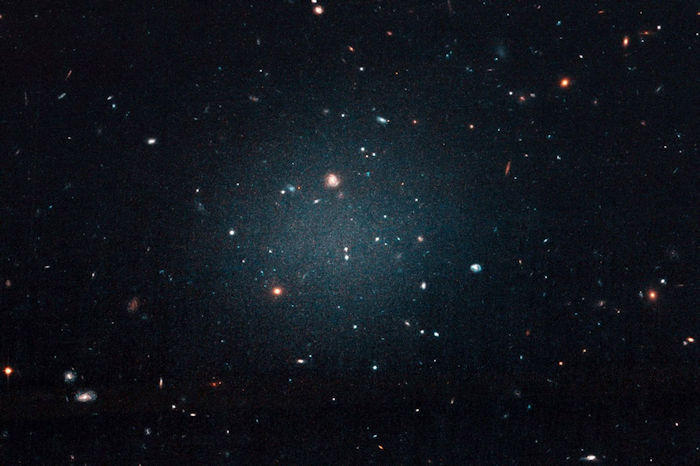
The absence of a signal could itself be a signal. This is the idea behind a new study published in the Journal of Cosmology and Astroparticle Physics (JCAP), which aims to redefine how we search for dark matter, showing that it may not be necessary to find the same “clues” everywhere in order to interpret it.


“Astronomers discovered the most primitive star ever”


A dim red giant just out of reach of the Milky Way is providing astronomers with an incredibly rare glimpse into the earliest days of our universe, at a time when it was not possible for a telescope to observe these objects directly.