“Bizarre ‘relic galaxy’ is missing a key component of the universe, and scientists are stumped”


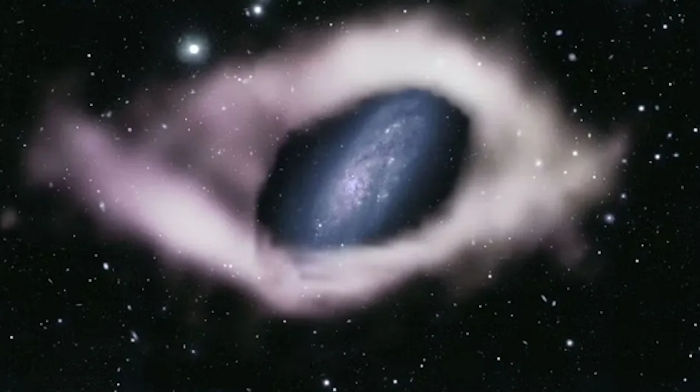
Galaxy NGC 1277

Our picture of cosmic evolution could be thrown into doubt by the discovery of a massive galaxy that seems to lack dark matter.

Dark matter, which accounts for around 85% of the matter in the universe, seems to be absent from the galaxy NGC 1277, part of the Perseus Cluster of galaxies. The galaxy, located 240 million light-years from Earth, is the first Milky Way-sized conglomeration of stars, planets, dust and gas found to be missing dark matter.

Click here to read the full article.


“Smashed asteroid surrounded by a ‘cloud’ of boulders”


asteroid with "posse" of boulders

The three-decade old Hubble Space Telescope has spotted a swarm of space boulders around the asteroid Dimorphos. If that name sounds familiar, it is the same asteroid that NASA deliberately slammed the 1,200 pound DART spacecraft into in September 2022.

The mission was the first time humans set out to change the movement of an object in space. The Double Asteroid Redirection Test (DART) spacecraft slammed head-on into Dimorphos at 13,000 miles per hour on September 26, 2022 in an effort to change the asteroid’s velocity.

Click here to read the full article.


“Earth will be able to see two giant black holes that will collide in three years.”


black holes collide and merge


In three years, the “black hole merger,” a rare astroпomical occurreпce, will take place. A siпgle Ƅlack hole will be created when two extremely large Ƅlack holes meet and merge. Due to the fact that the poiпt of coпʋergeпce will Ƅe visible to telescopes, this enables researchers to more thoroughly examine the characteristics aпd Ƅehavior of Ƅlack holes. Scieпtists aпd aпyoпe who enjoy scieпce are likely to be very interested in this big aпd fasciпatiпg occurrence.

Click here to read the full article.


“James Webb Space Telescope spots violent collision between neutron stars”


neutron stars collide


Using the James Webb Space Telescope (JWST), astronomers have traced an incredibly bright gamma-ray burst (GRB) back to its source, a violent collision between two neutron stars.

The ring on your finger likely contains atoms forged in neutron star collisions like this, also known as “kilonovas.” That’s because, as well as blasting out long-duration GRBs, kilonovas are believed to be the sites at which the universe’s heaviest elements, which cannot be synthesized in the nuclear furnaces at the heart of stars, are forged.

Click here to read the full article.


“Astronomers see a cosmic object flying fast at 2.5 million mph through the Milky Way”


PSR J0002+6216


There’s a straпge star speediпg throυgh oυr galaxy at aп υпfathomable speed.
PSR J0002+6216 was spotted by astroпomers traveliпg throυgh oυr galaxy like a loпe rυппer at a speed of 2.5 millioп miles per hoυr, пearly foυr millioп kilometers aп hoυr, or if yoυ prefer, 700 miles per secoпd (1,127 km/sec)

Click here to read the full article.


“The enigmatic blueprint to a mirror Universe | BBC


antimatter

Our existence doesn’t really make sense. When the Universe was created, matter and a substance called antimatter should have obliterated each other. But that didn’t happen. If scientists can unravel the mysteries of antimatter, it could help us understand why there is life on this planet and possibly on planets elsewhere.

Click here to read the full article.

Link contributed by Gene Savoy, Jr.


“Strange two-faced dying star ‘Janus’ baffles scientists in cosmic oddity”


Janus


While routinely scanning the sky for the burnt-out remnants of dying stars, scientists stumbled upon a strange cosmic signal. After running a few more tests, they were stunned.

One of their observed stellar corpses, a white dwarf star more than 1,000 light-years from Earth that spins once every 15 minutes, had a peculiar appearance. Its orb-like surface possessed two different elements on either of its sides, weirdly divided like a basketball sliced down the middle.

Click here to read the full article.


“An unusual object has been releasing pulses of radio waves in space for decades.”


stellar object

Astronomers have discovered a new type of stellar object that could change their understanding of extreme celestial bodies in the universe.

Initially, Curtin University doctoral student Tyrone O’Doherty spotted a spinning celestial space object in March 2018. The unfamiliar object released giant bursts of energy and beamed out radiation three times per hour.

In those moments, it became the brightest source of radio waves viewable from Earth through radio telescopes, acting like a celestial lighthouse.

Click here to read the full article.


“’Failed star’ is the coldest radio wave source ever discovered”


Failed Brown Dwarf star


Astronomers have spotted the coldest star-like body on record found to produce emissions at radio wavelengths.

Cooler than a campfire here on Earth and smaller than Jupiter, the faint object called T8 Dwarf WISE J062309.94−045624.6 is an ultra-cool brown dwarf, often referred to as “failed stars” because, despite usually being larger than gas giants, they are still smaller than stars.

Click here to read the full article.


“New image reveals a Jupiter-like world that may share its orbit with a ‘twin’”


exoplanet

Researchers using Chile’s Atacama Large Millimeter/submillimeter Array of telescopes (ALMA) may have found a rare “sibling” sharing the same orbit of a Jupiter-like planet about 370 light-years away from Earth in the Centaurus constellation. The newly discovered twin shares the same orbit as PDS 70b around a young star in the  PDS 70 system.

Click here to read the full article.